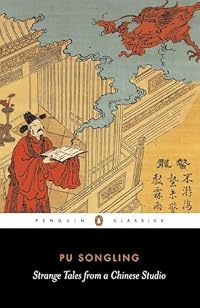
Strange Tales from a Chinese Studio
by Songling Pu
On This Page
Description
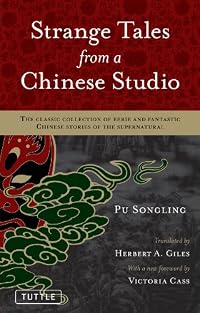
The strange tales of Pu Songling are exquisite minatures regarded as the pinnacle of classical Chinese fiction. With their elegant prose, witty wordplay and subtle charm, the 104 stories in this selection reveal a world in which nothing is as it seems.Tags
Recommendations




Member Reviews
Lots of fun stories. The most notable theme is sex with fox spirits although there's a good variety of stuff too, with varying morals and conclusions even when the set-up is pretty similar. There's nothing here that made me think "woah that's amazing" hence the 4 star but I enjoyed reading every single story here - there's a lot of cool ideas and overall there's an amazing and absorbing atmosphere that really takes you into the world of the Chinese studio.
The Penguin edition I was using has very helpful notes and a good glossary that help you understand the setting for each story as well as pointing out allusions to classic Chinese literature - although I'd note it relies notably on 19th century sources and stuff quite a bit, dunno how show more some of the explanations of concepts stand up to modern scholarship. 1 story adds the commentary which is apparently standard in the full original Chinese editions. show less
The Penguin edition I was using has very helpful notes and a good glossary that help you understand the setting for each story as well as pointing out allusions to classic Chinese literature - although I'd note it relies notably on 19th century sources and stuff quite a bit, dunno how show more some of the explanations of concepts stand up to modern scholarship. 1 story adds the commentary which is apparently standard in the full original Chinese editions. show less
Boy, they weren’t kidding. These are some strange tales! The introduction in my edition was helpful in putting me in a frame of mind so I wasn’t just thinking “what on earth is this?!” It helped flesh out the setting of the lonely garden studio of a Chinese scholar. I appreciated the choices of the translator, as this edition does not contain all the tales, and thought they did a good job varying between one-page stories and longer ones. Some of the stories are similar, but I think that probably reflects the original, and not the editing choices of the translator. The stories illuminate how ghosts and spirits are different between Western and Chinese traditions—they seem more corporeal for the Chinese; you can even marry them show more and have children! The stories are a good introduction of the idea of fox spirits, those creatures like the selkies and water spirits of Northern Europe, who seduce men, for good or evil. The fox spirits of Chinese culture, however, can also be more like poltergeists that need to be eliminated. I also like that at the end of my edition they gave the original author’s preface with a full annotation, line by line, so that the reader can appreciate the complexity of his writing in a way they could not do for every story.
I wish that my edition included all the stories, though maybe that would be asking for an even more repetitive read. show less
I wish that my edition included all the stories, though maybe that would be asking for an even more repetitive read. show less
I've been reading a lot of "difficult" books recently, and a few short books that just weren't very good. Amid that pile, Pu's tales were a glorious reminder of why people enjoy telling stories, why people enjoy reading them, and how many different ways something can be interesting.
Short of listing the best stories here, there's not much to review. THere are supernatural tales (ghosts and 'foxes'); there are little anecdotes; there are morality tales; there are anti-morality tales; and most of all there's a kind of joy I just don't get from a lot of contemporary books. I've been recommending this to all of my meat-space friends since I finished reading it. Now I recommend it to my interwebby friends on goodreads: anyone who likes to show more read will love this book.*
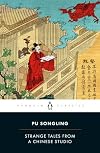
As a special bonus, you'll learn a bit about Imperial era China. As a super-extra-special bonus, the editor/translator includes illustrations from a nineteenth century Chinese edition of the text. They are fabulous.
* caveat: this is a book written by a lonely scholar for other lonely scholars, all of whom are men. There's a lot of lady-love wish-fulfillment. It's unfortunate. show less
Short of listing the best stories here, there's not much to review. THere are supernatural tales (ghosts and 'foxes'); there are little anecdotes; there are morality tales; there are anti-morality tales; and most of all there's a kind of joy I just don't get from a lot of contemporary books. I've been recommending this to all of my meat-space friends since I finished reading it. Now I recommend it to my interwebby friends on goodreads: anyone who likes to show more read will love this book.*
As a special bonus, you'll learn a bit about Imperial era China. As a super-extra-special bonus, the editor/translator includes illustrations from a nineteenth century Chinese edition of the text. They are fabulous.
* caveat: this is a book written by a lonely scholar for other lonely scholars, all of whom are men. There's a lot of lady-love wish-fulfillment. It's unfortunate. show less
This book contains a large variety of stories, mostly pretty short. Some are quite a bit more interesting than others. But overall, it's an enjoyable collection. The volume also contains copious notes, b/w illustrations, and a long list of references & suggestions for further reading. I like that it's a modern translation, so it's pretty colloquial and easy to read. I.e., it doesn't suffer from the "thee/thou/thine" problem endemic to many overwrought archaizing translations of yesteryear.
[sidebar] This book took me a very long time to read. It's quite long at over 500 pages, but the main reason it took me over 8 years to read (3010 days) is that I put the ebook on my [smart] phone, not my usual reading tablet. Therefore, I partook of show more it only when I was in the position of having to wait around for something, such as standing in queue, sitting in a waiting room, etc. Finished the last four tales today while I was waiting for my car to get smog checked. show less
[sidebar] This book took me a very long time to read. It's quite long at over 500 pages, but the main reason it took me over 8 years to read (3010 days) is that I put the ebook on my [smart] phone, not my usual reading tablet. Therefore, I partook of show more it only when I was in the position of having to wait around for something, such as standing in queue, sitting in a waiting room, etc. Finished the last four tales today while I was waiting for my car to get smog checked. show less
This collection of over one hundred stories was a fun and quick read for me, despite the fact that some of the story features get repetitive and few stories stood out from the herd. the introduction explains that the collection consists of two types of tales: one type is actual stories, with beginning, middle, and end as well as a theme and often times a lesson. The other type is just bizarre occurrences that Pu Songling heard about and recorded. The latter kind provides short breaks between the former kind, and both are amusing, but few individual stories of either type grabbed my attention or impressed me. If someone were to ask me about this book in a few years I would remember it as a collection of stories about fox spirits and show more ghosts, most of which only seemed interested in seducing humans, but that will probably be about all. One or two tales might stick with me, like the wonderfully bizarre story of a man cursed with blindness whose pupils decide to leave his eyes, or the humorous story of a dandy who pretends to hang himself in order to make a girl laugh, only to actually choke himself to death, but the vast majority of the tales aren't memorable. Despite this, reading the collection was a lot of fun, and I found it much more accessible than most Chinese literature. Thus I rate this collection four stars. If ghost stories or Chinese folklore is your thing then by all means give this one a read. show less
The book contains a collection of a little over 100 tales from Pu Songling's original 500 , which is rather unfortunate, as I would love to read all of them. I was hooked from the very first tale and took every opportunity to read more. Granted, some tales are mere curiosities that I don't find particularly appealing (for example, an account of a man with a dozen frogs that were trained to croak on cue and in "perfect pitch"), but most were enthralling. The tales have a broad range of subjects, although most were dealing with either fox-spirits or ghost, yet every one was different and unique.The translator's preface was good as well and helped to put things in the proper perspective. The notes and a glossary at the back also are great show more for those, like myself, not familiar with the broader Chinese literature. The only complaint I have -- and even that is more my fault than the editor's -- is that I didn't realize there were notes until I was practically done with the book. It would have been helpful to have footnote-style annotation in the text of the tales to give some indication that this particular line/word is explained in the notes. As things stand, if you run across something that you don't understand, you just have to flip to the back and hope there is a note about it. That said, the notes are thorough and provide a lot of added content. show less
An excellent selection of "weird tales" by the master of Chinese weird fiction. Since being first written, Pu Songling's Strange Tales have been the benchmark for this genre, and also the standard for Classical Chinese fiction. Some tales are short, but perfectly conjure up bizarre creatures and haunted places; others are longer, with well-developed characters and plots. John Minford has translated these tales expertly and provides ample notes and background to both Pu Songling's life and times, and the genre itself.
Members
- Recently Added By
Lists

scav
54 works; 2 members
Author Information

102+ Works 1,407 Members
According to the man who wrote P'u's epitaph, on their first meeting, he was expecting someone as brilliant and charming as his stories, only to find an old man who was very precise in his habits and low in his speech, and who found it rather difficult to say what was on his mind. The writer goes on to say, however, that, after knowing P'u a show more while, he came to appreciate the breadth and depth of his knowledge and the boldness and daring of his ideas. In his own preface to his Strange Tales from Make-do Studio, a work that is now considered one of the great achievements of Chinese fantastic narrative, P'u writes in moving terms what that narrative represents to him, the only vent for his feelings in a world where he feels totally alone and surrounded by poverty and contempt, where he is "a bird terrified by the winter frosts and nestling against the tree which can afford him no warmth." And yet, in his miserable little room with its smoky lamp and table "cold as a sheet of ice," he spins marvelous tales and through them vents his indignation against the arrogance of the rich, the subjugation of women, and the plight of the poor peasants, from whom he was distinguished by education but not by condition. Though P'u writes in a classical and highly artificial style, studded with literary allusions, there is something disconcertingly modern about his view of the world, with all its cruelties and carefully chosen and subtly realistic detail, and yet illuminated by an unspoken set of very untraditional principles that shines through the supernatural story lines. In P'u's imaginary world, the ideal woman is not a captive, but a bold and independent actor who, unfettered by convention, is free to love a man as her equal. And, although corruption spreads beyond earthly bounds all the way to the underworld, the God of War himself punishes an evil office seeker after his death, so that justice eventually does prevail. P'u had a hard life and wrote out of his own experience. As the youngest son, he was left with little when family frictions necessitated the division of property, and, having been unsuccessful in the examinations, he was forced to eke out a living as a tutor to various prominent gentry families who treated him as contemptuously as they did their servants. It was only in later years, after his book of tales was completed, that he finally found a comfortable position in a wealthy family who treated him with respect and friendly intimacy. But by that time he was already well into middle age. It is a great testament to the human imagination that a man in such a setting could weave such unusual tales. Unlike many Chinese writers of fiction P'u did not borrow heavily from tradition, but instead made fairy tales out of real life, where, as Jaroslav Prusek, the great Czech Sinologist has written, "the frontiers between the world of man and the world of other creatures of nature disappeared, . . . and he hinted at something mysterious behind every apparently natural and simple phenomenon, and . . . he flooded the whole of life with an air of inexplicable but unlimited possibilities." (Bowker Author Biography) show less
Some Editions
Series
Belongs to Publisher Series
Common Knowledge
- Canonical title
- Strange Tales from a Chinese Studio
- Original title
- 聊齋誌異
- Alternate titles
- Strange Tales from a Chinese Studio (Penguin Classics) (Penguin Classics)
- Original language
- Chinese
- Disambiguation notice
- This is the Penguin Classics selection; please do NOT combine with other selections.
Classifications
- Genres
- Fiction and Literature, General Fiction, Fantasy, Horror
- DDC/MDS
- 895.134 — Literature & rhetoric Asian Literature Literatures of East and Southeast Asia Chinese Chinese fiction Song, Yuan, Ming, Qing dynasties 960–1912
- LCC
- PL2722 .U2 .A2 — Language and Literature Languages and literatures of Eastern Asia, Africa, Oceania Languages of Eastern Asia, Africa, Oceania Chinese language and literature Chinese literature Individual authors and works
- BISAC
Statistics
- Members
- 545
- Popularity
- 54,281
- Reviews
- 8
- Rating
- (4.11)
- Languages
- Chinese, English
- Media
- Paper, Ebook
- ISBNs
- 4
- ASINs
- 2