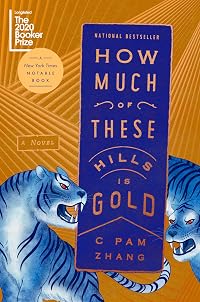
How Much of These Hills is Gold
by C Pam Zhang
On This Page
Description
Newly orphaned children of immigrants, Lucy and Sam are suddenly alone in a land that refutes their existence. Fleeing the threats of their western mining town, they set off to bury their father in the only way that will set them free from their past. Along the way, they encounter giant buffalo bones, tiger paw prints, and the specters of a ravaged landscape as well as family secrets, sibling rivalry, and glimpses of a different kind of future.Tags
Recommendations








Member Recommendations
MM_Jones Fiction and nonfiction descriptions of Chinese in California Gold Rush
Member Reviews
Longlisted for the Booker Prize 2020
A little uneven, but rather impressive and original - I can see this one making the shortlist too. The book follows a Chinese family in California after the goldrush. The story is in four parts.
In the first part we meet Lucy and her sibling Sam as they are forced to leave their house with the body of their dead father (Ba, a gambler and drinker) and a horse. They search for somewhere suitable to bury the man. Sam is also a girl, but dresses as a boy and acts the part (initially because Ba saw this as a way to earn more for her work in the mine).
In the second part we travel back to a time when the mother was still with the family and planning to use found gold to pay for the family's passage back to show more China. Like much else in the book this dream ends badly, and Ba claims to have buried his dead wife.
The third part is more surreal, as Ba's ghost (or haint) tells his story to Lucy. In this version of the story, he was a foundling who was discovered as a small child and brought up by native Americans. As a young man he is employed as a go-between to communicate with Chinese labourers, and has to learn to communicate without knowing their language. He meets the mother and their plot to escape leads to a tragedy.
The final part continues and resolves Lucy and Sam's stories.
There are a number of places where the story takes implausible turns, but I enjoyed this subversive retelling of American history. show less
A little uneven, but rather impressive and original - I can see this one making the shortlist too. The book follows a Chinese family in California after the goldrush. The story is in four parts.
In the first part we meet Lucy and her sibling Sam as they are forced to leave their house with the body of their dead father (Ba, a gambler and drinker) and a horse. They search for somewhere suitable to bury the man. Sam is also a girl, but dresses as a boy and acts the part (initially because Ba saw this as a way to earn more for her work in the mine).
In the second part we travel back to a time when the mother was still with the family and planning to use found gold to pay for the family's passage back to show more China. Like much else in the book this dream ends badly, and Ba claims to have buried his dead wife.
The third part is more surreal, as Ba's ghost (or haint) tells his story to Lucy. In this version of the story, he was a foundling who was discovered as a small child and brought up by native Americans. As a young man he is employed as a go-between to communicate with Chinese labourers, and has to learn to communicate without knowing their language. He meets the mother and their plot to escape leads to a tragedy.
The final part continues and resolves Lucy and Sam's stories.
There are a number of places where the story takes implausible turns, but I enjoyed this subversive retelling of American history. show less
A story whose structure is very reminiscent of Cormac McCarthy's Frontier Trilogy. In an America sick with gold fever and struggling with coal and the first railways, two sisters, orphaned by Chinese immigrants, try to make their way in a world where they are both sought after, as exotic, and rejected. On their journey, as well as the world around them, they learn the truth about themselves and what binds them to the homeland of their birth and the lost homeland of their parents. A beautiful novel, just slightly marred by a few too many slowness.
Lucy and Sam need to bury their Ba, but as poor Chinese orphans living in the American West just after the Gold Rush, no one wants to give them the needed silver dollars, and they must leave town.
At once a sweeping tale with a close focus on family, this debut novel shows a lot of promise. We mostly get the close third person of Lucy's point of view as she navigates her world, but we also get a glimpse of the family's backstory as well in what was my favorite part of the book. Beautiful descriptions, especially about the land, and wanting to know what would ultimately happen to Lucy kept me reading, though the tone is bleak and the plot a little disjointed. Not perfect, but an interesting story, and I'll definitely try another book by show more this author should she write more. show less
At once a sweeping tale with a close focus on family, this debut novel shows a lot of promise. We mostly get the close third person of Lucy's point of view as she navigates her world, but we also get a glimpse of the family's backstory as well in what was my favorite part of the book. Beautiful descriptions, especially about the land, and wanting to know what would ultimately happen to Lucy kept me reading, though the tone is bleak and the plot a little disjointed. Not perfect, but an interesting story, and I'll definitely try another book by show more this author should she write more. show less
C Pam Zhang's debut novel, How Much of These Hills is Gold, is a beautiful, roaming, aching novel about the promise of the American dream and what it means to find a home. Set against the twilight of the American gold rush, two siblings are on the run in an unforgiving landscape—trying not just to survive but to find a home.
These siblings, Lucy and Sam, 12 and 11, children of Chinese laborers, take their father's body on a journey through the California hills in the middle of the Gold Rush. The quest for burial, the family strife, the smell of death, the hot sun, the dust, the storms, all recall Faulkner. Ba (Mandarin for "dad") haunts the narrative as Addie Bundren did, first as voice and then ultimately as a corpse, awful, show more unwieldy, and decomposing.
“How Much of These Hills Is Gold” is an aching book, full of myths of Zhang’s making (including tigers that roam the Western hills) as well as joys, as well as sorrows. It’s violent and surprising and musical. It's a book that doesn't provide easy answers. And it's one that quietly confrontational. Zhang wants you to remember the forgotten Chinese laborers, the very laborers who helped build the transcontinental railroad. More importantly, Zhang wants you to realize that they belong to this land too, even if they quite don't feel that way and even if their own individual ideas of what constitutes a home, a body, etc. may differ.
Zhang characters are flawed. Ba, is one mean-spirited but well meaning individual. And Lucy, tragically in the end, might be looking for a home in all the wrong places. Zhang does interesting things with genre too - subverting the Western to talk about race, gender, sexual identity, poverty and pubescence.
Alongside Sam and Lucy’s family story are the stories of the genocide and persecution of Native Americans, the colonization of the west and the compulsive exploitation of the land by desperate settlers and greedy opportunists. This is not your American history course from high school. This is poetic truth.
How Much of These Hills is Gold, is a beautiful and daring debut novel from a promising novelist. The novel doesn't necessarily have a neat ending. It's up to you to decide if Lucy and Sam ever truly find a home to call their own. show less
These siblings, Lucy and Sam, 12 and 11, children of Chinese laborers, take their father's body on a journey through the California hills in the middle of the Gold Rush. The quest for burial, the family strife, the smell of death, the hot sun, the dust, the storms, all recall Faulkner. Ba (Mandarin for "dad") haunts the narrative as Addie Bundren did, first as voice and then ultimately as a corpse, awful, show more unwieldy, and decomposing.
“How Much of These Hills Is Gold” is an aching book, full of myths of Zhang’s making (including tigers that roam the Western hills) as well as joys, as well as sorrows. It’s violent and surprising and musical. It's a book that doesn't provide easy answers. And it's one that quietly confrontational. Zhang wants you to remember the forgotten Chinese laborers, the very laborers who helped build the transcontinental railroad. More importantly, Zhang wants you to realize that they belong to this land too, even if they quite don't feel that way and even if their own individual ideas of what constitutes a home, a body, etc. may differ.
Zhang characters are flawed. Ba, is one mean-spirited but well meaning individual. And Lucy, tragically in the end, might be looking for a home in all the wrong places. Zhang does interesting things with genre too - subverting the Western to talk about race, gender, sexual identity, poverty and pubescence.
Alongside Sam and Lucy’s family story are the stories of the genocide and persecution of Native Americans, the colonization of the west and the compulsive exploitation of the land by desperate settlers and greedy opportunists. This is not your American history course from high school. This is poetic truth.
How Much of These Hills is Gold, is a beautiful and daring debut novel from a promising novelist. The novel doesn't necessarily have a neat ending. It's up to you to decide if Lucy and Sam ever truly find a home to call their own. show less
C Pam Zhang’s stunning debut novel examines the myth of the American West from the vantage point of marginalized Chinese immigrants whose role in the California Gold Rush has rarely been acknowledged. The story begins in 1862 and focuses on two sisters Lucy,12, and Sam,11 (who identifies as male.) The children’s prospector/ miner father, Ba has died and the children whose mother had died earlier must bury him and survive. The book chronicles their struggle in a world defined by racism and poverty and moves back and forth in time providing the backstory of the children’s lives and the lives of their parents. The writing is lyrical and the characters are finely drawn. I came away with a deeper understanding of the Chinese- American show more experience and a fuller more complex picture of the history of the American West. show less
It's always a relief when a book I've been eagerly looking forward to reading doesn't disappoint.
[Mild spoilers (such as structure and setting changes) throughout, with additional spoilers behind tags.]
We begin with 12-year-old Lucy, newly responsible for 11-year-old Sam, who shows tendencies of being like their impulsive, abusive father...the father who has just died, leaving them orphans, penniless and at the mercy of everyone in their coal mining town who dislikes them for not looking like everyone else. So Lucy and Sam set off into the California wilderness with their father's body, looking for an appropriate place to bury a man whose prospecting dreams carried them all over the west without finding one place to call home.
Zhang show more evocatively paints a beautiful but dying land for their journey--a place where water has been poisoned, majestic buffalo and tigers have been driven to extinction, and mountains are being blasted to make way for railroads. The first section of the book is largely psychological, as Lucy grapples with what, if anything, she owes her dead father and emotionally distant Sam...with what makes a family and what makes a home. She doesn't look to the future, not when Sam's quest for the perfect place to bury their father seems like it might cost them their lives.
Part II takes us back several years, when Lucy and Sam still lived with their mother and father in a miserable hut in the coal-mining town. We meet a Ba whose prospecting dreams of striking it rich have been all but broken; a Sam who still has beautiful long hair but gravitates toward Ba; a Lucy who favors her mother in all but looks and whose intelligence intrigues the local intellectual-turned-schoolteacher; and a magnetic Ma who uses her beauty and strong will to keep the family fed, housed, and--in Lucy's case--educated. Money is next to nonexistent when Ma becomes pregnant...but then Ba reveals that he hasn't been spending evenings gambling away his earnings, and suddenly money becomes a worry in a very new way.
Most authors would have started with this section, but Zhang's choice to unspool Lucy and Sam's quest to bury their father first (instead of just as a prologue) gives Lucy an interesting psychological depth: if we know her mind when she's older, how did she get to be there in the first place? Zhang uses the early focus on Lucy's interior life to set up themes and images that will recur throughout the book--not only the words that serve as chapter headings (blood, water, meat, mud, etc.), but tigers, buffalo, the land, family, home, and (of course) gold--so that we're actively reading for them once we hit the more conventional A-to-B plot structure.
I fully expected to return to Lucy and Sam after showing us how Ma and Ba's hopes for a bright future go the way of most dreams in America, but Zhang surprised me witha step both forward and backward in time, with the ghost of Lucy's father telling her his story on the eve of his body's burial. It turns out that Ba isn't Chinese. He was an orphan raised on Californian soil by the surviving members of local tribes that had been decimated by European settlers. To him, any gold belongs to the people like them who grew up in those hills, and he decides to get some of his own. While working, he agrees to accompany Chinese laborers from seashore to mines--not realizing until they step off the boat that the boss assumes he can speak their language. Fortunately, he and Ma hit it off, learn each others' languages, and plot revenge on the bosses who lied to get cheap labor to agree to board their ship. Unfortunately, their revenge spirals out of control.
We skip ahead again, back to Lucy, several years after burying Ba. She's settled into a more comfortable life in town, working at hotels and acting as a kind of "kept friend" to a wealthy miner's daughter. She knows that comfort will soon be disrupted when her friend marries a man that Lucy knows better than she'd like, but then Sam returns after years of absence and complicates everything. Like Part II, this section would seem more conventional and linear if it weren't for what came before it.
Zhang also managed to surprise me with the ending. I actually put the book down for a couple days because I knew that things were going to turn sour and I didn't want to face them...but, like the nonlinear plot, the ending didn't go the way I expected it to. The result was much better than what I was expecting, at least in terms of storytelling. I'm once again curious to go pick up a copy of this book in the store, to see if the end is still the same as it is in this advanced reader's copy.
This was the rare book that lived up to my expectations, in large part because it was very much not what I expected (in large part because of the cover copy).
If you love character- and place-driven stories, I highly recommend How Much of These Hills Is Gold---and I look forward to seeing what Zhang writes in the future.
[This book deserves a quote roundup but after reading about 60 books this year (!) I'm getting review fatigue. 8-( Sorry. But also not--the language is beautiful, go read this one!] show less
[Mild spoilers (such as structure and setting changes) throughout, with additional spoilers behind tags.]
We begin with 12-year-old Lucy, newly responsible for 11-year-old Sam, who shows tendencies of being like their impulsive, abusive father...the father who has just died, leaving them orphans, penniless and at the mercy of everyone in their coal mining town who dislikes them for not looking like everyone else. So Lucy and Sam set off into the California wilderness with their father's body, looking for an appropriate place to bury a man whose prospecting dreams carried them all over the west without finding one place to call home.
Zhang show more evocatively paints a beautiful but dying land for their journey--a place where water has been poisoned, majestic buffalo and tigers have been driven to extinction, and mountains are being blasted to make way for railroads. The first section of the book is largely psychological, as Lucy grapples with what, if anything, she owes her dead father and emotionally distant Sam...with what makes a family and what makes a home. She doesn't look to the future, not when Sam's quest for the perfect place to bury their father seems like it might cost them their lives.
Part II takes us back several years, when Lucy and Sam still lived with their mother and father in a miserable hut in the coal-mining town. We meet a Ba whose prospecting dreams of striking it rich have been all but broken; a Sam who still has beautiful long hair but gravitates toward Ba; a Lucy who favors her mother in all but looks and whose intelligence intrigues the local intellectual-turned-schoolteacher; and a magnetic Ma who uses her beauty and strong will to keep the family fed, housed, and--in Lucy's case--educated. Money is next to nonexistent when Ma becomes pregnant...but then Ba reveals that he hasn't been spending evenings gambling away his earnings, and suddenly money becomes a worry in a very new way.
Most authors would have started with this section, but Zhang's choice to unspool Lucy and Sam's quest to bury their father first (instead of just as a prologue) gives Lucy an interesting psychological depth: if we know her mind when she's older, how did she get to be there in the first place? Zhang uses the early focus on Lucy's interior life to set up themes and images that will recur throughout the book--not only the words that serve as chapter headings (blood, water, meat, mud, etc.), but tigers, buffalo, the land, family, home, and (of course) gold--so that we're actively reading for them once we hit the more conventional A-to-B plot structure.
I fully expected to return to Lucy and Sam after showing us how Ma and Ba's hopes for a bright future go the way of most dreams in America, but Zhang surprised me with
We skip ahead again, back to Lucy, several years after burying Ba. She's settled into a more comfortable life in town, working at hotels and acting as a kind of "kept friend" to a wealthy miner's daughter. She knows that comfort will soon be disrupted when her friend marries a man that Lucy knows better than she'd like, but then Sam returns after years of absence and complicates everything. Like Part II, this section would seem more conventional and linear if it weren't for what came before it.
Zhang also managed to surprise me with the ending. I actually put the book down for a couple days because I knew that things were going to turn sour and I didn't want to face them...but, like the nonlinear plot, the ending didn't go the way I expected it to. The result was much better than what I was expecting, at least in terms of storytelling. I'm once again curious to go pick up a copy of this book in the store, to see if the end is still the same as it is in this advanced reader's copy.
This was the rare book that lived up to my expectations, in large part because it was very much not what I expected (in large part because of the cover copy).
If you love character- and place-driven stories, I highly recommend How Much of These Hills Is Gold---and I look forward to seeing what Zhang writes in the future.
[This book deserves a quote roundup but after reading about 60 books this year (!) I'm getting review fatigue. 8-( Sorry. But also not--the language is beautiful, go read this one!] show less
4.5 Bleak, dark gritty and thoroughly unforgettable. A well written debut novel to boot. Characters that are multifaceted, and an atmosphere that draws in the reader. Time out if mind, maybe not to s happy place, but to a place that makes one want to learn more.
The Gold Rush, 1840's or so and despite many prospecting efforts, they are now considered miners. Though because if their heritage, they are paid less and barely subsisting. Lucy is the eldest, Sam the youngest and their story is told in different sections. We also learn the stories of their parents, a terrible one under. The story also relates the plight of the Chinese who came over, lured with false promises, to build the railroad. Bleak fates all.
The author leaves many show more questions, conclusions to the reader, making this a good pick for a book discussion. I read this with Angela and Esil, and we found much to discuss. I actually went back and re-read the ending to firm up my thoughts. Think I came to an appropriate conclusion, but others may see it differently. A stellar debut novel, nonetheless.
ARC from Edelweiss. show less
The Gold Rush, 1840's or so and despite many prospecting efforts, they are now considered miners. Though because if their heritage, they are paid less and barely subsisting. Lucy is the eldest, Sam the youngest and their story is told in different sections. We also learn the stories of their parents, a terrible one under. The story also relates the plight of the Chinese who came over, lured with false promises, to build the railroad. Bleak fates all.
The author leaves many show more questions, conclusions to the reader, making this a good pick for a book discussion. I read this with Angela and Esil, and we found much to discuss. I actually went back and re-read the ending to firm up my thoughts. Think I came to an appropriate conclusion, but others may see it differently. A stellar debut novel, nonetheless.
ARC from Edelweiss. show less
Members
- Recently Added By
Published Reviews
ThingScore 100
In this outstanding debut, Zhang does more than just push against the cowboy narrative: She shoves it clear out of the way.....Misdirection abounds here, but the novel’s grave tone seldom wavers. Eleven and 12 years old, respectively, when the novel opens, sisters Sam and Lucy are 3½ years past the loss of their mother when their father, Ba, dies one night...If anything puts the cowboy show more narrative out to pasture in this novel, it’s Sam.... show less
added by vancouverdeb
Sure to be the boldest debut of the year, How Much of These Hills Is Gold by American writer C Pam Zhang grapples with the legend of the wild west and mines brilliant new gems from a well-worn setting..The story is heavy with layers of trauma, starting with the grim humour of the children, Lucy and Sam, dragging around their own father’s rotting corpse... Through Zhang’s deep attention, show more the classic western is given a rich new shading as race, gender, sexual identity, poverty and pubescence come into play. The novel is thick with detail, metaphor and oblique allusion – so much so that the story has to fight through the language. But at its core is a chilling sense of the utter loneliness and isolation felt by Lucy and Sam.
How Much of These Hills Is Gold is an impressive debut. Though sometimes weighed down by the sheer heft of its language and atmospherics, it rewards patient reading. The prose carries an airless, uniquely pungent flavour. By the end, it has built into an epic, powerfully wrought journey, and it is refreshing to discover a new author of such grand scale, singular focus and blistering vision. show less
How Much of These Hills Is Gold is an impressive debut. Though sometimes weighed down by the sheer heft of its language and atmospherics, it rewards patient reading. The prose carries an airless, uniquely pungent flavour. By the end, it has built into an epic, powerfully wrought journey, and it is refreshing to discover a new author of such grand scale, singular focus and blistering vision. show less
added by vancouverdeb
Like William Faulker's As I Lay Dying, C Pam Zhang's debut novel opens with a body in need of burying...Zhang's style can be densely, airlessly lovely. Self-conscious lyricism fills the page like all that California dust, sometimes making it hard to breathe....The novel also depends so heavily on foreshadowing that it feels like we might be in a de Chirico painting. For Zhang's characters, any show more good thing — a baby, a new friend, sudden money — spells disaster, a feature which drains suspense and makes it impossible to sustain any hope for them. To read this novel the way it wants to be read — earnestly, wholeheartedly — would be to be in a perpetual state of longing and disappointment...... With Zhang, we hear the shredders coming from miles away — and it's hard not to resent that emotional manipulation.
But Zhang also unspools sophisticated ideas about land, ownership, rootedness, and history. show less
But Zhang also unspools sophisticated ideas about land, ownership, rootedness, and history. show less
added by vancouverdeb
Lists

Books recommended by Barack Obama
295 works; 28 members

Books Read in 2023
5,617 works; 146 members

Books Read in 2020
4,379 works; 124 members

Overdue Podcast
806 works; 9 members

Obama Reads
181 works; 3 members

Books Read in 2021
5,361 works; 114 members

Barack Obama's Summer Reading List 2020
17 works; 5 members

Books Read in 2025
4,189 works; 98 members
Author Information

2+ Works 1,712 Members
Some Editions
Awards and Honors
Awards
Distinctions
Work Relationships
Common Knowledge
- Canonical title
- How Much of These Hills is Gold
- Original publication date
- 2020-04-07
- Important places
- California, USA
- Important events
- California Gold Rush
- Epigraph
- This land is not your land.
- Dedication
- To my father,
Zhang Hongjian,
loved but slenderly known. - First words
- Ba dies in the night, prompting them to seek two silver dollars.
- Quotations
- What makes a home a home?
This land is not your land. - Last words
- (Click to show. Warning: May contain spoilers.)She opens her mouth. She wants
Classifications
Statistics
- Members
- 1,162
- Popularity
- 21,628
- Reviews
- 45
- Rating
- (3.70)
- Languages
- 8 — Dutch, English, French, German, Italian, Polish, Portuguese, Spanish
- Media
- Paper, Audiobook, Ebook
- ISBNs
- 23
- ASINs
- 9