
The Living
by Annie Dillard
On This Page
Description
Ninety miles north of Seattle on the Washington coast lies Bellingham Bay, where a rough settlement founded in the 1850s would become the town of Whatcom. Here, the Lummi and Nooksack Indian people fish and farm, hermits pay their debts in sockeye salmon, and miners track gold-bearing streams.Here, too, is the intimate, murderous tale of three men. Clare Fishburn believes that greatness lies in store for him. John Ireland Sharp, an educated orphan, abandons hope when he sees socialists show more expel the Chinese workers from the region. Beal Obenchain, who lives in a cedar stump, threatens Clare Fishburn's life.
A killer lashes a Chinese worker to a wharf piling at low tide. Settlers pour in to catch the boom the railroads bring. People give birth, drown, burn, inherit rich legacies, and commit expensive larcenies. All this takes place a hundred years ago, when these vital, ruddy men and women were "the living."
. show less
Tags
Recommendations





















Member Reviews
If you like those "historical village" tourist attractions where they recreate old-timey life in static 3D detail — the milkmaid's stool, the cans of cocoa powder, the underequipped schoolroom — then you might like this book. I found it lifeless, its characters smothered under a blanket of superfluous exposition, their thoughts chaperoned tiresomely by Dillard's control-freaky, omniscient 3rd person. What little dialogue there is seems to be more a showcase for the author's lovingly-gathered period vernacular than an engine of character or plot. No character is permitted to appear without a fulsome description of their looks and apparel; no article without an explanation of its provenance, manufacture, etc. We're treated to show more interminable descriptions of carpentry, dressmaking, agriculture, trees living and dead, and all the other minutiae of life in 19th century Puget Sound, but we never really feel at home there. It's the commonest pitfall of the historical novel — the research overpowering the story — and with "The Living", Dillard hitches up her bloomers, or whatever ladies wore back then (I suppose I should know this after ~500 pages) and leaps enthusiastically in. show less
“The Living” by Annie Dillard portrays the numerous hardships and the strengths and weaknesses of character of the original white settlers and their immediate descendents in the northwest corner of Washington State during the last half of the Nineteenth Century. Her novel begins in the fall of 1855 with the arrival of a fictitious pioneer family, the Fishburns, and ends in July 1897 with a celebratory gathering of second and third generation friends that include a Fishburn son and granddaughter. It is a historical novel that informs us, that engages us with its interesting characters, and that tests our patience.
The novel’s authenticity is one of its strengths. It is evident throughout that Annie Dillard knows her subject matter. show more One example is how early settlers felled huge Douglas fir. The fastest way was to use fire. They would augur one foot long holes downward into the massive tree trunks. They would then bore holes laterally to connect with the downward-angled holes. Next, they would insert burning sticks into the downward holes, the lateral holes to serve as a draft for smoke to escape. The next day “deep inside, the fired trees were burning. Weak yellow flames curled low from their trunks.” The following day “the trees started to fall, one after the other, and shook the earth so the house jumped. … The house rose, and everything in it rose, too … Shreds of cast green lichens, like bits of beard, blew into the house, with twigs, bark, sawdust, and plain dust. … The charred stumps kept burning. … The fir roots were so pitchy that a man could burn them right in the ground.” Not once did I doubt the novel’s setting or historical accuracy.
We who have lived life into our senior years know well what human existence is about. We are brought into this world without our consent, as children we are taught (or not taught) how to survive, if fortunate we live to adulthood, we procreate, and we survive until we don’t. The quality of our existence is more often determined by factors beyond our control -- governmental decisions, economic forces, groups of people, individuals, chance -- than by our force of will. We, nobody else, determine our lives’ value. This appears to be the central theme of the novel. I appreciated how Dillard’s characters grappled with difficult burdens, endured unexpected tragedy, and strived to ascribe meaning to their lives. “The Living” is a dark story that offers little optimism that man will ever ascend beyond his baser elements. Strive as we may to make better the lives of our family members, friends, and neighbors, stronger forces ultimately restrict if not defeat our brave efforts and force us eventually to live safe lives of avoidance of that which may be harmful. I prized this aspect of the novel.
The main characters were well developed and, at times, intriguing.
Ada Fishburn loses her three-year-old son Charley on the wagon trail west. Standing by the front passenger barrier of his parents’ wagon, he topples over. “… their own wheels ran him over, one big wheel after the other, and he burst inwardly and died.” She and her husband Rooney carve out a plot of land amidst the enormous, ever-present firs. Six years after their arrival from Illinois, their four-year-old daughter Lettie dies of an ear infection. Eleven years later Rooney, digging a well, releases a stream of poisonous gas and instantly succumbs. Ada’s second husband dies accidentally three years later. She reaches old age, a good woman in every respect. “The more time God granted her on this earth,” she reflects near the end of her life, “the more she saw it rain, but He mustn’t think she wasn’t grateful, because she was grateful – only if He was giving out time, why not pass some to people who needed it?”
Ada’s son Clare learns the ways of existence in and outside the local towns of Whatcom and Goshen, survives childhood, and becomes a somewhat shallow-minded but helpful, generous adult. An event occurs after he has married and fathered a daughter that causes him to anticipate sudden death. Previously caught up in a land development boom, having accepted the prevailing attitude that life’s prime purpose is to acquire wealth, Clare is forced to contemplate what is most important about life.
In 1879, thirteen-year-old John Ireland Sharp participates in an expedition led by his grandfather up the Skagit River into the mountains to seek a pass through which a transcontinental railroad might be built to reach the Pacific shores. The party comes upon a dying Indian youth impaled on a pointed stake embedded in the ground. John Ireland is shaken by the experience. Two years later, hard times having come to the Whatcom area, the boy’s father moves his large family to Madrone Island, of the San Juan Islands in Rosario Strait. Soon after their arrival John Ireland is severely beaten by Beal Obenchain, a large-sized local boy. Two of John’s ribs are broken. He recovers. The bully’s lies about the cause of the beating are believed; he is not punished. The family ekes out a primitive existence. One day John Ireland remains on shore while his parents and brothers and sisters board their skiff to go to Orcas Island to see a man who sells tulip bulbs. The sky has the look of rain. Hours later Beal Obenchain’s father spies the skiff adrift, empty. All of John Ireland’s family is lost. He carries with him over the succeeding years this thought: “the people you knew were above water one minute, and under it the next, as if they had burst through ice. They went down stiff and upright in their filled gum boots and soaked skirts; they stood dead on the bottom and swayed with the currents like fixed kelp, his mother and father and sisters and brothers standing in a row on the ocean floor.” John is adopted by the Obenchains, kind people, notwithstanding Beal. Eventually, John leaves the island, grows into manhood, and embraces socialist principles.
Beal Obenchain is psychotic. He is driven by an overpowering sense of unworthiness. To stave off episodes of psychological impotence he commits violent acts, receiving from them sufficient energy temporarily to face everyday that which diminishes him. At various places throughout the book we witness his cruel acts; and we yearn to see his come-uppance.
1874, Baltimore, Maryland. Minta Randall, daughter of U.S. Senator Green Randall, marries Eustace Honer, a young man of nearly equal social standing but afflicted by impractical dreams of engaging in adventurous enterprises. Minta, who is physically unattractive, forces her reluctant parents to consent to this marriage, Eustace deemed by them and the parents of other eligible debutantes to be an undesirable match. Scorning the stilted life of wealth and privilege, their imagination fired by brochures extolling the virtues of Puget Sound, Minta and Eustace move to Goshen and buy property (320 acres) next to Ada Fishburn and her adult son Clare. Minta and Eustace adapt well to their demanding environment. Despite their wealth, they are accepted by the local inhabitants. They produce children.
Eleven years after their marriage, in 1885, the local community decides to clear a huge log jam on the Nooksack River. “The jam was three quarters of a mile long – a city of trees and logs … It had been there as long as anyone … could remember. A forest straddled the river on top of the jam. Fifteen or twenty feet above the waterline, Douglas firs and silver firs with trunks four feet thick were growing a hundred feet high from soil trapped in the smashed mess of logs. Birds nested in the trees.” It takes three months to clear the jam. Near the end of the work Eustace slips on a log and falls into the water. Its current takes him under a layer of logs. He drowns. His nine-year-old son Hugh witnesses it.
Minta is devastated. Her parents travel to the Northwest to console her. On the evening of their arrival by steamboat, Minta prepares to meet them at the Goshen dock. Hugh builds a fire in the fireplace to warm the house. She and Hugh travel by coach to the dock. Minta’s two younger children are left at home to sleep. The fire that Hugh has built consumes the house, and his siblings within. Minta is reduced almost to a catatonic state. Ada Fishburn tells her, finally: “Hugh has not been going to school, and when he’s here you don’t see him, bless his heart, and with the help of God you must stir yourself. For you have a child still living.” Minta must contend both with her loss and, again, with her parents’ objectionable wishes. Move back to Baltimore, they say. There is a suitable man you once expressed love for. He has not married.
Three years later Hugh discovers Ada’s second husband dead of a broken neck, the result of a riding accident suffered while traveling during a rainstorm. It seems to Hugh that he is predestined to continue to witness death. Watching a community celebration of the launching of a locally built racing yacht when he is seventeen, recognizing that he is damaged, he reflects: “People seemed so joyous tonight, yet it was the same world it ever was, and they all had forgotten. When a baby is born its fuse lights. The ticking begins, and the fire starts fizzing down its length.” He has fallen in love with Ada Fishburn’s granddaughter Vinnie. Greatly influenced by what has happened to him, he must make a decision.
These characters kindled my emotions. Their fates mattered to me. Yet it took me two months to read this book, mostly because of what I will call thick narration. Part of the narration’s “thickness” is due to the author’s considerable use of description, most of which, unlike the passage below, is not sharply visual.
He saw that darkness was spreading from the land. In the dark, five or six bonfires were going. People sat lighted by flames, and from a distance the live sparks that rose over the fire seemed to emanate from the people; the yellow sparks turned red and, as they met the darkness, went out.
Part of the “thickness” is due also to the author’s too frequent explication of abstract thoughts.
Marriage began to strike him as a theater, where actors gratefully dissimulate, in ordinary affection and trust, their bottom feeling, which is a mystery too powerful to be endured. They know and feel more than life in time can match; they must anchor themselves against eternity, as they play on a painted set, lest they swing out into the twining realms.
Also bothersome to me was that the main characters’ story-lines moved slowly. For example, it took seemingly forever for Beal Obenchain’s fate to be revealed. Deleting much of the information provided about unimportant characters would have quickened the novel’s pace.
But then I would come upon an excellently narrated scene like this:
In every corner of their big house she stumbled into Eustace’s precisely shaped absence, and in the yard, the woods, the fields, garden, and barn. She carried herself carefully, like a scalding bowl – plain Minta, whose neck sloped straight from her linen collar, whose clear forehead and high brows stayed fixed. By herself and for herself, she tried to be splendid. Only secretly, as she tended the quarreling younger children and worked the ranch, did she whisper to herself deep in her mind, “I am dished.” For where, exactly, had he gone, and the intensity of his ways?
“The Living” is a substantial undertaking that, somewhat flawed, captured my interest and gained my respect. show less
The novel’s authenticity is one of its strengths. It is evident throughout that Annie Dillard knows her subject matter. show more One example is how early settlers felled huge Douglas fir. The fastest way was to use fire. They would augur one foot long holes downward into the massive tree trunks. They would then bore holes laterally to connect with the downward-angled holes. Next, they would insert burning sticks into the downward holes, the lateral holes to serve as a draft for smoke to escape. The next day “deep inside, the fired trees were burning. Weak yellow flames curled low from their trunks.” The following day “the trees started to fall, one after the other, and shook the earth so the house jumped. … The house rose, and everything in it rose, too … Shreds of cast green lichens, like bits of beard, blew into the house, with twigs, bark, sawdust, and plain dust. … The charred stumps kept burning. … The fir roots were so pitchy that a man could burn them right in the ground.” Not once did I doubt the novel’s setting or historical accuracy.
We who have lived life into our senior years know well what human existence is about. We are brought into this world without our consent, as children we are taught (or not taught) how to survive, if fortunate we live to adulthood, we procreate, and we survive until we don’t. The quality of our existence is more often determined by factors beyond our control -- governmental decisions, economic forces, groups of people, individuals, chance -- than by our force of will. We, nobody else, determine our lives’ value. This appears to be the central theme of the novel. I appreciated how Dillard’s characters grappled with difficult burdens, endured unexpected tragedy, and strived to ascribe meaning to their lives. “The Living” is a dark story that offers little optimism that man will ever ascend beyond his baser elements. Strive as we may to make better the lives of our family members, friends, and neighbors, stronger forces ultimately restrict if not defeat our brave efforts and force us eventually to live safe lives of avoidance of that which may be harmful. I prized this aspect of the novel.
The main characters were well developed and, at times, intriguing.
Ada Fishburn loses her three-year-old son Charley on the wagon trail west. Standing by the front passenger barrier of his parents’ wagon, he topples over. “… their own wheels ran him over, one big wheel after the other, and he burst inwardly and died.” She and her husband Rooney carve out a plot of land amidst the enormous, ever-present firs. Six years after their arrival from Illinois, their four-year-old daughter Lettie dies of an ear infection. Eleven years later Rooney, digging a well, releases a stream of poisonous gas and instantly succumbs. Ada’s second husband dies accidentally three years later. She reaches old age, a good woman in every respect. “The more time God granted her on this earth,” she reflects near the end of her life, “the more she saw it rain, but He mustn’t think she wasn’t grateful, because she was grateful – only if He was giving out time, why not pass some to people who needed it?”
Ada’s son Clare learns the ways of existence in and outside the local towns of Whatcom and Goshen, survives childhood, and becomes a somewhat shallow-minded but helpful, generous adult. An event occurs after he has married and fathered a daughter that causes him to anticipate sudden death. Previously caught up in a land development boom, having accepted the prevailing attitude that life’s prime purpose is to acquire wealth, Clare is forced to contemplate what is most important about life.
In 1879, thirteen-year-old John Ireland Sharp participates in an expedition led by his grandfather up the Skagit River into the mountains to seek a pass through which a transcontinental railroad might be built to reach the Pacific shores. The party comes upon a dying Indian youth impaled on a pointed stake embedded in the ground. John Ireland is shaken by the experience. Two years later, hard times having come to the Whatcom area, the boy’s father moves his large family to Madrone Island, of the San Juan Islands in Rosario Strait. Soon after their arrival John Ireland is severely beaten by Beal Obenchain, a large-sized local boy. Two of John’s ribs are broken. He recovers. The bully’s lies about the cause of the beating are believed; he is not punished. The family ekes out a primitive existence. One day John Ireland remains on shore while his parents and brothers and sisters board their skiff to go to Orcas Island to see a man who sells tulip bulbs. The sky has the look of rain. Hours later Beal Obenchain’s father spies the skiff adrift, empty. All of John Ireland’s family is lost. He carries with him over the succeeding years this thought: “the people you knew were above water one minute, and under it the next, as if they had burst through ice. They went down stiff and upright in their filled gum boots and soaked skirts; they stood dead on the bottom and swayed with the currents like fixed kelp, his mother and father and sisters and brothers standing in a row on the ocean floor.” John is adopted by the Obenchains, kind people, notwithstanding Beal. Eventually, John leaves the island, grows into manhood, and embraces socialist principles.
Beal Obenchain is psychotic. He is driven by an overpowering sense of unworthiness. To stave off episodes of psychological impotence he commits violent acts, receiving from them sufficient energy temporarily to face everyday that which diminishes him. At various places throughout the book we witness his cruel acts; and we yearn to see his come-uppance.
1874, Baltimore, Maryland. Minta Randall, daughter of U.S. Senator Green Randall, marries Eustace Honer, a young man of nearly equal social standing but afflicted by impractical dreams of engaging in adventurous enterprises. Minta, who is physically unattractive, forces her reluctant parents to consent to this marriage, Eustace deemed by them and the parents of other eligible debutantes to be an undesirable match. Scorning the stilted life of wealth and privilege, their imagination fired by brochures extolling the virtues of Puget Sound, Minta and Eustace move to Goshen and buy property (320 acres) next to Ada Fishburn and her adult son Clare. Minta and Eustace adapt well to their demanding environment. Despite their wealth, they are accepted by the local inhabitants. They produce children.
Eleven years after their marriage, in 1885, the local community decides to clear a huge log jam on the Nooksack River. “The jam was three quarters of a mile long – a city of trees and logs … It had been there as long as anyone … could remember. A forest straddled the river on top of the jam. Fifteen or twenty feet above the waterline, Douglas firs and silver firs with trunks four feet thick were growing a hundred feet high from soil trapped in the smashed mess of logs. Birds nested in the trees.” It takes three months to clear the jam. Near the end of the work Eustace slips on a log and falls into the water. Its current takes him under a layer of logs. He drowns. His nine-year-old son Hugh witnesses it.
Minta is devastated. Her parents travel to the Northwest to console her. On the evening of their arrival by steamboat, Minta prepares to meet them at the Goshen dock. Hugh builds a fire in the fireplace to warm the house. She and Hugh travel by coach to the dock. Minta’s two younger children are left at home to sleep. The fire that Hugh has built consumes the house, and his siblings within. Minta is reduced almost to a catatonic state. Ada Fishburn tells her, finally: “Hugh has not been going to school, and when he’s here you don’t see him, bless his heart, and with the help of God you must stir yourself. For you have a child still living.” Minta must contend both with her loss and, again, with her parents’ objectionable wishes. Move back to Baltimore, they say. There is a suitable man you once expressed love for. He has not married.
Three years later Hugh discovers Ada’s second husband dead of a broken neck, the result of a riding accident suffered while traveling during a rainstorm. It seems to Hugh that he is predestined to continue to witness death. Watching a community celebration of the launching of a locally built racing yacht when he is seventeen, recognizing that he is damaged, he reflects: “People seemed so joyous tonight, yet it was the same world it ever was, and they all had forgotten. When a baby is born its fuse lights. The ticking begins, and the fire starts fizzing down its length.” He has fallen in love with Ada Fishburn’s granddaughter Vinnie. Greatly influenced by what has happened to him, he must make a decision.
These characters kindled my emotions. Their fates mattered to me. Yet it took me two months to read this book, mostly because of what I will call thick narration. Part of the narration’s “thickness” is due to the author’s considerable use of description, most of which, unlike the passage below, is not sharply visual.
He saw that darkness was spreading from the land. In the dark, five or six bonfires were going. People sat lighted by flames, and from a distance the live sparks that rose over the fire seemed to emanate from the people; the yellow sparks turned red and, as they met the darkness, went out.
Part of the “thickness” is due also to the author’s too frequent explication of abstract thoughts.
Marriage began to strike him as a theater, where actors gratefully dissimulate, in ordinary affection and trust, their bottom feeling, which is a mystery too powerful to be endured. They know and feel more than life in time can match; they must anchor themselves against eternity, as they play on a painted set, lest they swing out into the twining realms.
Also bothersome to me was that the main characters’ story-lines moved slowly. For example, it took seemingly forever for Beal Obenchain’s fate to be revealed. Deleting much of the information provided about unimportant characters would have quickened the novel’s pace.
But then I would come upon an excellently narrated scene like this:
In every corner of their big house she stumbled into Eustace’s precisely shaped absence, and in the yard, the woods, the fields, garden, and barn. She carried herself carefully, like a scalding bowl – plain Minta, whose neck sloped straight from her linen collar, whose clear forehead and high brows stayed fixed. By herself and for herself, she tried to be splendid. Only secretly, as she tended the quarreling younger children and worked the ranch, did she whisper to herself deep in her mind, “I am dished.” For where, exactly, had he gone, and the intensity of his ways?
“The Living” is a substantial undertaking that, somewhat flawed, captured my interest and gained my respect. show less
Dillard has created such simple, nimble prose- that it is awe-inspiring the depths which this novel ultimately takes us. Through the layered stories of settlers, generation by generation- she is able to portray the myths of mankind’s progress. The apparent insignificance of a single life – is counterbalanced by the quiet undefined sense of cohesion in the world. An unseen ephemeral pattern of which, there is only the slightest sense. Dillard leans into the harshness of life- the suffering and violence. Through the uncertain existence of pioneers in the great Northwest, she portrays the sudden shock of death- that ever so thin line between the living and the dead. I feel that one of the core themes of this work is the living’s show more effort to make sense out of death. In the end, there is the hint that “time” as mortals see it, is a very poor measure of existence. Again, there is something so elusive, so poignant about her work--- as though it is all a subtle rephrasing of life’s eternal unanswered questions. show less
"The Living" is a deft novel and as driven as I was to finish reading I didn't find the overall narrative to be too compelling. Dillard holds a weighty and biblical tone through most of the book as it chronicles life of pioneers in Whatcom County. Reading about life during this time was detailed and if you've ever visited the Puget Sound area the perspective of awe and wonder Dillard captures in the setting is well crafted indeed. It is a great skill to be able to capture the lives of particular people in a particular place but I finished the book thinking "so what?" as the sound of the wind through douglas fir rattled in my head.
An epic story covering 40 years in the history of the Pacific Northwest of the United States, starting in 1855. Many interesting characters and details of how the early pioneers to the region lived, survived and developed the land into the cities that now thrive -- Seattle, Tacoma, and Bellingham, WA, which is the primary focus of the book. Because I live in these cities, I found the history fascinating and Dillard's descriptions of the place precise and accurate. I did find myself wondering if the book would hold the interest of people not familiar with the place. For that to happen, the narrative must be compelling and if this book falls short in any part, it may be that. Though the times that are the focus of the book required much show more in the way of physical effort from the people, Dillard's narrative spends a majority of the time inside the minds of the characters as they ruminate on life and what seems to be ever-present death in this difficult environment. But there are enough moments in which characters we have come to know are cast onto the rocks of fate in heart-wrenching ways that, overall, you do find yourself rooting for these characters and I found myself wanting to spend more time with them just to make sure they'd all be alright in the end. There is a sense of realness to the characters and I was left missing them, both because the story was over and because they all live more than a hundred years ago and so as vibrant as they are in the pages of the book, they are long gone and buried by time. show less
This is not a book through which you race along. It took me a full month to read it, I think. It's very dense, very solid, full of similes that make you think, and situations that make you cringe or cry or laugh or shudder. There's not much of a plot, which in this instance is OK, because the focus of the story is on the people and on the place in which they live and on the nature of life there. You get a definite sense in the first half of the book of the apparent randomness of death on the 19th-century Northwestern U.S. frontier, and the second half goes more into life in a boom town and the way the ups and downs of that kind of existence affect the characters. I'm making it sound very dull, but it's not; the writing is lyrical and show more thoughtful and very, very good. show less
I loved the details of life in early Washington State, nuanced with smells, sounds, and texture. It appears to be an interesting experiment in expressing the fact of living, dying, surviving, dying, living' the continuity and difficulties of life...but for me, it was lacking feeling. We see everything that happens very clearly, but seem to barely touch how people feel; there are so many people and so many decades that our connections with individuals is tenuous at best.
The audio reader was a good reader as far as pace, resonance, and meaning, but mispronounced place names terribly, which was distracting and should have been corrected.
The audio reader was a good reader as far as pace, resonance, and meaning, but mispronounced place names terribly, which was distracting and should have been corrected.
Members
- Recently Added By
Lists

Set in the Pacific Northwest
136 works; 7 members
Author Information

31+ Works 22,094 Members
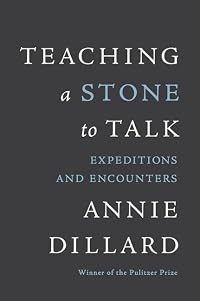
Annie Dillard was born Annie Doak in Pittsburgh, Pennsylvania on April 30, 1945. She received a B.A and an M.A. in English from Hollins College. She writes both fiction and nonfiction books including Tickets for a Prayer Wheel, Holy the Firm, Teaching a Stone to Talk, The Living, and Mornings Like This: Found Poems. She won the 1975 Pulitzer Prize show more for General Nonfiction for Pilgrim at Tinker Creek. She wrote an autobiography entitled An American Childhood. Her work also has appeared in such periodicals as The Atlantic, Harper's Magazine, The Christian Science Monitor, and Cosmopolitan. She taught for 21 years in the English department of Wesleyan University. (Bowker Author Biography) show less
Awards and Honors
Distinctions
Common Knowledge
- Canonical title
- The Living
- Original publication date
- 1992
- Dedication
- for Bob
- First words
- The sailor put down the helm and Ada Fishburn felt the boat round up towards the forest.
Author's Note: Historically, there were four linked communities on Bellingham Bay--Whatcom, Old Bellingham, Sehome, and Fairhaven, which incorporated with each other in various combinations throughout the second half of the n... (show all)ineteenth century. - Last words
- (Click to show. Warning: May contain spoilers.)He judged the instant and let go; he flung himself loose into the stars.
Classifications
Statistics
- Members
- 1,338
- Popularity
- 17,821
- Reviews
- 25
- Rating
- (3.93)
- Languages
- English, French, German
- Media
- Paper, Audiobook, Ebook
- ISBNs
- 21
- ASINs
- 11