There is 1 current discussion about this work.
On This Page
Description
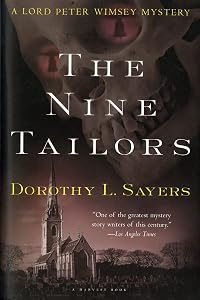
While ringing in the New Year, Lord Peter Wimsey discovers some old crimes: "A rattling good mystery" (Kirkus Reviews).Lord Peter Wimsey and his manservant Bunter are halfway across the wild flatlands of East Anglia when they make a wrong turn, straight into a ditch. They scramble over the rough country to the nearest church, where they find hospitality, dinner, and an invitation to go bell-ringing. This ancient art is steeped in mathematical complexities, and tonight the rector and his show more friends plan to embark on a 9-hour marathon session to welcome the New Year. Lord Peter joins them, taking a step into a society whose cheerful exterior hides a dark, deadly past.
During their stay in this unfamiliar countryside, Lord Peter and Bunter encounter murder, a mutilated corpse, and a decades-old jewel theft for which locals continue to die. In this land where bells toll for the dead, the ancient chimes never seem to stop.
The Nine Tailors is the 11th book in the Lord Peter Wimsey Mysteries, but you may enjoy the series by reading the books in any order.
This ebook features an illustrated biography of Dorothy L. Sayers including rare images from the Marion E. Wade Center at Wheaton College.
. show less
Tags
Recommendations
















Member Reviews
Lord Peter Wimsey, it’s a pleasure to make your acquaintance at last
I’ve read one novel by Dorothy L. Sayers before. I cannot remember which one it was. At the time I found it slow-paced and boring. Isn’t it lucky that we are rarely the same readers we were years ago? I jumped into a group read and was delighted.
As we begin, Wimsey’s car has an unfortunate encounter with a ditch, so he ends up spending a few days in a nearby village. There is a lovely church (the descriptions made my heart beat faster). ”Impressive!” said Wimsey. ”Why, it’s like a young cathedral.”
There is a lot of geekery about church bells and bell ringing. We are talking about English change-ringing, to be exact. (There is a YouTube rabbit hole show more here for you, if you are willing.) What is Kent Treble Bob? I have no idea, but it sounds grand. I don’t think I’ve ever read a mystery so focused on church bells – as a theme, as a symbol, as a plot device – it was fascinating.
The murder mystery is dark, gory, gothic. It is intricate, you need to pay attention. All the major reveals are impressive and heartbreaking. Yet to me, the book was more about the time, the place, the landscape, the people of the village, how people talked, the beautiful way the community came together when disaster struck. I savoured it all slowly, and the book let me do that. I’m grateful and I want more.
Favourite quotes:
”Mouth up, mouth down, they brawled with their tongues of bronze, and through it all that shrill, high, sweet, relentless note went stabbing and shivering.”
”Wimsey saw that the only way to quiet the Rector was to desert him without compunction.”
”I’m a terrific success at pottering around asking sloppy questions. And I can put away quite a lot of beer in a good cause.”
”…they’re all idiots – mostly, that is.”
”Most people are,” said Wimsey, gravely, ”but it isn’t kind to tell them so.”
”Mr. Edward Thorpe, forty-four, very correct and formal, presented a bland Civil-Service front to the impact of Wimsey’s personality.” show less
I’ve read one novel by Dorothy L. Sayers before. I cannot remember which one it was. At the time I found it slow-paced and boring. Isn’t it lucky that we are rarely the same readers we were years ago? I jumped into a group read and was delighted.
As we begin, Wimsey’s car has an unfortunate encounter with a ditch, so he ends up spending a few days in a nearby village. There is a lovely church (the descriptions made my heart beat faster). ”Impressive!” said Wimsey. ”Why, it’s like a young cathedral.”
There is a lot of geekery about church bells and bell ringing. We are talking about English change-ringing, to be exact. (There is a YouTube rabbit hole show more here for you, if you are willing.) What is Kent Treble Bob? I have no idea, but it sounds grand. I don’t think I’ve ever read a mystery so focused on church bells – as a theme, as a symbol, as a plot device – it was fascinating.
The murder mystery is dark, gory, gothic. It is intricate, you need to pay attention. All the major reveals are impressive and heartbreaking. Yet to me, the book was more about the time, the place, the landscape, the people of the village, how people talked, the beautiful way the community came together when disaster struck. I savoured it all slowly, and the book let me do that. I’m grateful and I want more.
Favourite quotes:
”Mouth up, mouth down, they brawled with their tongues of bronze, and through it all that shrill, high, sweet, relentless note went stabbing and shivering.”
”Wimsey saw that the only way to quiet the Rector was to desert him without compunction.”
”I’m a terrific success at pottering around asking sloppy questions. And I can put away quite a lot of beer in a good cause.”
”…they’re all idiots – mostly, that is.”
”Most people are,” said Wimsey, gravely, ”but it isn’t kind to tell them so.”
”Mr. Edward Thorpe, forty-four, very correct and formal, presented a bland Civil-Service front to the impact of Wimsey’s personality.” show less
I am a fan of the other three "queens of crime" from the Brithish interwar period (Allingham, Marsh, and Dame Agatha) but have not until now ventured into Sayers territory. I am glad I finally did! The Nine Tailors is a satisfying and complex mystery with great character development and sense of place/mood/atmosphere, whatever you want to call it. I think Sayers is by far the most "writerly" of the four "queens" and I very much appreciated that. I like Agatha Christie as much as the next fan of classic mysteries, but it has to be admitted that her writing isn't that dynamic to read and she falls back a lot on stale cliches, especially in her later writing. Sayers was sort of the exact opposite of that--her writing is engaging, creative, show more and often quite beautiful.
The quality of the writing made this book much more elevated than your average, run of the mill mystery. The mystery itself is complex but not so convoluted that I couldn't piece parts of it together myself as I was reading. Even after figuring out most of the details, I was compelled to keep reading due to Sayers's skill and Lord Peter's charm. The beautiful evocation of the fen country gives a nuanced and bittersweet portrait of a way of life that was passing away. I am looking forward to reading more Wimsey mysteries, but I hope they don't disappoint after reading The Nine Tailors! show less
The quality of the writing made this book much more elevated than your average, run of the mill mystery. The mystery itself is complex but not so convoluted that I couldn't piece parts of it together myself as I was reading. Even after figuring out most of the details, I was compelled to keep reading due to Sayers's skill and Lord Peter's charm. The beautiful evocation of the fen country gives a nuanced and bittersweet portrait of a way of life that was passing away. I am looking forward to reading more Wimsey mysteries, but I hope they don't disappoint after reading The Nine Tailors! show less
I went into 'The Nine Tailors' expecting a well-written golden-age mystery. I was curious to see Peter Wimsey without Harriet Vane as a balance. I wasn't expecting anything more than some colourful scenery, a bit of wit and an engaging puzzle. I got all those things but they weren't really what the book was about.
'The Nine Tailors' is a story lacquered with lots of layers of imagery and inquiry but, at its heart, I think it's about Sayers' love of the Fens and its people and her understanding, expressed through Wimsey, of her arms-length relationship to it.
I didn't always find it an easy book to read. At the start, I was a bit overwhelmed by a tide of technical details of bell-ringing that I couldn't follow and which, especially in show more the audiobook version, became tedious. I could follow the lengthy descriptions of church architecture more easily because I love to visit old churches but even so, it was a lot to take in.
Eventually, I let go of trying to understand the detail of bells and church and focus on the meaning behind them. A picture emerged of bell-ringing as something that binds a village together. The bells and the church are hundreds of years old. They've stood at the centre of the village, marking all the significant events of village life, for generations. The peals the bell-ringers pull are marvels of mathematics, a sort of Bach in sounding bronze, and yet they are mastered by men with no education but a great deal of commitment. Ringing the bells is a disciplined, collaborative act that requires skill and stamina. The sound of the bells is so strong and so rich that you can lose yourself in it. The book starts with nine hours of bell-ringing. Think of losing yourself in the sound for that long but never letting go of your concentration and constantly having to use your muscle and your wit. That is a mighty meditation.
The bell-ringers are men of the village, with a hierarchy of their own when in the bell tower. The vicar links them to the bells and the music in a way akin to leading the parish in prayer. When Sayers has Lord Peter Wimsey step in at the last moment to ring in the New Year with nine hours of bell-ringing, he puts aside the title and status he was born to and becomes someone judged by his ability to play his part, to collaborate with the other bell-ringers and give himself to the music welcoming the New Year across the village. It seemed to me to be a kind of baptism.
Sayers presents the church as the physical and emotional centre of village life. The vicar and his wife are two of the most engaging characters in the book. He is distracted, obsessed with bell-ringing, proud of the history of his church and is easily distracted from the practicalities of life. His wife is practical and organised and effectively runs the Parish. The two of them represent a link between the village and the rest of English society. They seemed to me to be benign colonists or perhaps transplants who have started to mutate. The church stands above the village and the voice of its bells can be heard everywhere. At one point the church becomes, not for the first time, a refuge for the villagers, a sort of Ark against the floods. I thought these descriptions of bells and church were Sayers' way of showing the spiritual life of the village.
Her love of the place is so deep, it mostly carried me along in an 'isn't that charming' sort of way, like something from an earlier era, perhaps 'Under The Greenwood Tree' or 'Lark Rise To Candleford'. But I'm not from that place or time or faith and one small thing pulled me out of the mood. I learned that, when a man dies, the Tailor bell is rung nine times to mark his death and then once for each year of his life. Suddenly the charming but obscure title to the book got translated in my head as 'The Death Knell' and I imagined the book rewritten as a piece of Noir. It was what I learned next that pulled me out of the cosy world of the book and back into a place I recognise. Although when a man dies, he gets nine bells tolled for him, when a woman dies, she gets six bells tolled for her. I found myself suddenly angry at the fact that, even in death, the Anglican church treated women with less respect than men, and angry again that no one even comments on it.
Wrapped around this depiction of village life and this contemplation on death knells, there is a murder mystery and Peter Wimsey is at the heart of solving it. It's a clever mystery. I couldn't have guessed how the murder was done or by whom. It's also a mystery that adds another layer of symbolism to the book. The cause of death and the consequences of the killing both speak to an almost supernatural force driving justice and atonement.
The mystery decorates rather than drives the plot. The plot moves at a pace so slow, it feels as though you're drifting on the narrative stream with no rudder and no objective other than taking in the view. A TV version of 'Nine Taylors' might get as far as the inquest (about 25% into the book) shortly after the credits but in doing so they'd completely miss the point, which is to immerse yourself in the slow rhythm of life in this isolated village.
As we drifted along, I found myself taking a quiet delight in how Sayers writes. Her prose bubbles with a gentle humour that never sneers or uses sarcasm but rather shows her affection for the people of the village and the way they treat each other.
There were set pieces that I thought quite marvellous. The continuous flow of speech that establishes the characters of the vicar, Mr Venables (great choice of name) is fast and deft and very effective. The way the Sextant and the Vicar talk at cross-purposes when the body is found which, as well as being humorous, shows how a man who is never in a hurry tells a tale to a man who is never quite sure what to do next. The vicar's letter to Wimsey is a masterpiece. The vicar's whole character is on the text of that letter. The description of the Coroner's brisk handling of the inquest feels like fancy camera work in the way it cuts out unnecessary detail and, in the process, establishes the atmosphere of the event.
When I finished the book, I was struck by the way its tone reminded me of Jon McGregor's 'Reservoir 13' which takes a disappearance as its starting point but spends its energy capturing the rhythm of village life. In 'The Nine Tailors' the tracking of the crime is secondary to the immersion into the life of a Fen village. It also uses that solid, unvarying life of that village to reflect on the life Wimsey is living. The book starts and finishes with Wimsey stepping outside his normal life to make up new roles in the village. Yet he cannot escape who he is and what he knows. He remains entangled in the affairs or Red House. Finding the solution as to who died and who was involved in the death brings nothing but disruption and pain. When he finally understands the killing, what used to be a memory that made him smile with affectionate pride has been transformed into something sinister.
I'd wanted to see who Peter Wimsey was without Harriet Vane. In 'The Nine Tailors', Wimsey seems to skim along, dipping in and out of engagement with others. He presents himself as no more than a genial puzzle solver but I think he is constantly trying to step out of the shadow of his own knowledge of the world. Perhaps I'm reading too much into it, but I was struck by the image of Wimsey's car, last to leave the flooding sluice, at the back of the queue of vehicles, axle-deep in water and being pursued by an impersonal but unstoppable flooding tide, as a symbol of the man's life. show less
'The Nine Tailors' is a story lacquered with lots of layers of imagery and inquiry but, at its heart, I think it's about Sayers' love of the Fens and its people and her understanding, expressed through Wimsey, of her arms-length relationship to it.
I didn't always find it an easy book to read. At the start, I was a bit overwhelmed by a tide of technical details of bell-ringing that I couldn't follow and which, especially in show more the audiobook version, became tedious. I could follow the lengthy descriptions of church architecture more easily because I love to visit old churches but even so, it was a lot to take in.
Eventually, I let go of trying to understand the detail of bells and church and focus on the meaning behind them. A picture emerged of bell-ringing as something that binds a village together. The bells and the church are hundreds of years old. They've stood at the centre of the village, marking all the significant events of village life, for generations. The peals the bell-ringers pull are marvels of mathematics, a sort of Bach in sounding bronze, and yet they are mastered by men with no education but a great deal of commitment. Ringing the bells is a disciplined, collaborative act that requires skill and stamina. The sound of the bells is so strong and so rich that you can lose yourself in it. The book starts with nine hours of bell-ringing. Think of losing yourself in the sound for that long but never letting go of your concentration and constantly having to use your muscle and your wit. That is a mighty meditation.
The bell-ringers are men of the village, with a hierarchy of their own when in the bell tower. The vicar links them to the bells and the music in a way akin to leading the parish in prayer. When Sayers has Lord Peter Wimsey step in at the last moment to ring in the New Year with nine hours of bell-ringing, he puts aside the title and status he was born to and becomes someone judged by his ability to play his part, to collaborate with the other bell-ringers and give himself to the music welcoming the New Year across the village. It seemed to me to be a kind of baptism.
Sayers presents the church as the physical and emotional centre of village life. The vicar and his wife are two of the most engaging characters in the book. He is distracted, obsessed with bell-ringing, proud of the history of his church and is easily distracted from the practicalities of life. His wife is practical and organised and effectively runs the Parish. The two of them represent a link between the village and the rest of English society. They seemed to me to be benign colonists or perhaps transplants who have started to mutate. The church stands above the village and the voice of its bells can be heard everywhere. At one point the church becomes, not for the first time, a refuge for the villagers, a sort of Ark against the floods. I thought these descriptions of bells and church were Sayers' way of showing the spiritual life of the village.
Her love of the place is so deep, it mostly carried me along in an 'isn't that charming' sort of way, like something from an earlier era, perhaps 'Under The Greenwood Tree' or 'Lark Rise To Candleford'. But I'm not from that place or time or faith and one small thing pulled me out of the mood. I learned that, when a man dies, the Tailor bell is rung nine times to mark his death and then once for each year of his life. Suddenly the charming but obscure title to the book got translated in my head as 'The Death Knell' and I imagined the book rewritten as a piece of Noir. It was what I learned next that pulled me out of the cosy world of the book and back into a place I recognise. Although when a man dies, he gets nine bells tolled for him, when a woman dies, she gets six bells tolled for her. I found myself suddenly angry at the fact that, even in death, the Anglican church treated women with less respect than men, and angry again that no one even comments on it.
Wrapped around this depiction of village life and this contemplation on death knells, there is a murder mystery and Peter Wimsey is at the heart of solving it. It's a clever mystery. I couldn't have guessed how the murder was done or by whom. It's also a mystery that adds another layer of symbolism to the book. The cause of death and the consequences of the killing both speak to an almost supernatural force driving justice and atonement.
The mystery decorates rather than drives the plot. The plot moves at a pace so slow, it feels as though you're drifting on the narrative stream with no rudder and no objective other than taking in the view. A TV version of 'Nine Taylors' might get as far as the inquest (about 25% into the book) shortly after the credits but in doing so they'd completely miss the point, which is to immerse yourself in the slow rhythm of life in this isolated village.
As we drifted along, I found myself taking a quiet delight in how Sayers writes. Her prose bubbles with a gentle humour that never sneers or uses sarcasm but rather shows her affection for the people of the village and the way they treat each other.
There were set pieces that I thought quite marvellous. The continuous flow of speech that establishes the characters of the vicar, Mr Venables (great choice of name) is fast and deft and very effective. The way the Sextant and the Vicar talk at cross-purposes when the body is found which, as well as being humorous, shows how a man who is never in a hurry tells a tale to a man who is never quite sure what to do next. The vicar's letter to Wimsey is a masterpiece. The vicar's whole character is on the text of that letter. The description of the Coroner's brisk handling of the inquest feels like fancy camera work in the way it cuts out unnecessary detail and, in the process, establishes the atmosphere of the event.
When I finished the book, I was struck by the way its tone reminded me of Jon McGregor's 'Reservoir 13' which takes a disappearance as its starting point but spends its energy capturing the rhythm of village life. In 'The Nine Tailors' the tracking of the crime is secondary to the immersion into the life of a Fen village. It also uses that solid, unvarying life of that village to reflect on the life Wimsey is living. The book starts and finishes with Wimsey stepping outside his normal life to make up new roles in the village. Yet he cannot escape who he is and what he knows. He remains entangled in the affairs or Red House. Finding the solution as to who died and who was involved in the death brings nothing but disruption and pain. When he finally understands the killing, what used to be a memory that made him smile with affectionate pride has been transformed into something sinister.
I'd wanted to see who Peter Wimsey was without Harriet Vane. In 'The Nine Tailors', Wimsey seems to skim along, dipping in and out of engagement with others. He presents himself as no more than a genial puzzle solver but I think he is constantly trying to step out of the shadow of his own knowledge of the world. Perhaps I'm reading too much into it, but I was struck by the image of Wimsey's car, last to leave the flooding sluice, at the back of the queue of vehicles, axle-deep in water and being pursued by an impersonal but unstoppable flooding tide, as a symbol of the man's life. show less
A re-read again. It takes a while for the body to make an appearance, but the story in the interim all starts to make sense as the story progresses. The story has, as an integral part, the very English hobby of bellringing. As a ringer, I like the detail and the way the ringing is so important (although I can see the slight errors, for the weight of bells, that New year's peal would be a lot longer than 9 hours). I like the terminology of the chapter titles and how they are largely ringing terminology. The mystery itself is two that are embrangled. There's a missing emerald necklace that has caused a lot of trouble, then a body turns up, with it's face smashed in and hands missing - presumably to prevent identification and a significant show more portion of the second mystery revolves round trying to answer that question.
It's an inventive mystery, with a lovely interplay between Peter and the policeman, and the villagers are a lovely character study. There's a lot to like about this, and I do like it every time.
Re-read. Still find this fascinating, and enjoy it each time.
Re-read.
I needed to find this out to get an extract from it for a bell themed carol service we're having at the end of the month. And having got it off the shelf, I figured I may as well read it again. As a bellringer, there are inaccuracies. Fenchurch St Peter has a ring of 8 bells, with the tenor weighting 41 cwt (a smidge over 2 tons) which would make it just about the heaviest ring of 8 bells there is. At the top of a tall tower they're going to be a handful. An equivalent ring of bells of that weight takes nearer 4 hours to ring a peal, making the New Year Day peal take nearer 11.5 to 12 hours than the 9 or so that it is reported. But I can live with all of that for the intellectual exercise that solving the problem presents. As a re-read, none of this is about who did what to whom and how, this is about following the intricacies of the solution as it is laid out.
There are 2 interlinked problems here, who stole the Wilbraham Emeralds before the war and where have they been since and set alongside this is who is the corpse that was found in Lady Mary's grave, how did it get there, who put it there and how did it die. They are linked, the resolution to one being tied with the other. It is set over several visits to the village, Lord Peter arriving at first unwillingly, having biffed the car running off the road near Frog's Bridge. "The church lies to the windward of us, I fancy. It would," He then gets involved in ringing a peal for New Year and stays around while the car is fixed, by which time the corpse is deposited in the churchyard. We don;t find out about this until later, when Sir Henry Thorpe does and it put into the same grave as his wife, when the extra body turns up. Who it is and what killed him remains a longstanding question. Lord Peter is invited back to get involved in the solution, which he cheerily does. His enthusiasm wanes when the personal impact on some of the villagers becomes more evident as the tale unfolds. I like this about him, it;s not just an intellectual exercise, he does acknowledge the personal in the problem.
The solution is nicely complicated, but is played out for us in clear steps. The final act takes place in a flooded village when the water rises to reclaim the fens on a temporary basis.
I thoroughly enjoy this every time, despite knowing the ins and outs of the solution. show less
It's an inventive mystery, with a lovely interplay between Peter and the policeman, and the villagers are a lovely character study. There's a lot to like about this, and I do like it every time.
Re-read. Still find this fascinating, and enjoy it each time.
Re-read.
I needed to find this out to get an extract from it for a bell themed carol service we're having at the end of the month. And having got it off the shelf, I figured I may as well read it again. As a bellringer, there are inaccuracies. Fenchurch St Peter has a ring of 8 bells, with the tenor weighting 41 cwt (a smidge over 2 tons) which would make it just about the heaviest ring of 8 bells there is. At the top of a tall tower they're going to be a handful. An equivalent ring of bells of that weight takes nearer 4 hours to ring a peal, making the New Year Day peal take nearer 11.5 to 12 hours than the 9 or so that it is reported. But I can live with all of that for the intellectual exercise that solving the problem presents. As a re-read, none of this is about who did what to whom and how, this is about following the intricacies of the solution as it is laid out.
There are 2 interlinked problems here, who stole the Wilbraham Emeralds before the war and where have they been since and set alongside this is who is the corpse that was found in Lady Mary's grave, how did it get there, who put it there and how did it die. They are linked, the resolution to one being tied with the other. It is set over several visits to the village, Lord Peter arriving at first unwillingly, having biffed the car running off the road near Frog's Bridge. "The church lies to the windward of us, I fancy. It would," He then gets involved in ringing a peal for New Year and stays around while the car is fixed, by which time the corpse is deposited in the churchyard. We don;t find out about this until later, when Sir Henry Thorpe does and it put into the same grave as his wife, when the extra body turns up. Who it is and what killed him remains a longstanding question. Lord Peter is invited back to get involved in the solution, which he cheerily does. His enthusiasm wanes when the personal impact on some of the villagers becomes more evident as the tale unfolds. I like this about him, it;s not just an intellectual exercise, he does acknowledge the personal in the problem.
The solution is nicely complicated, but is played out for us in clear steps. The final act takes place in a flooded village when the water rises to reclaim the fens on a temporary basis.
I thoroughly enjoy this every time, despite knowing the ins and outs of the solution. show less
Read it and loved it a long time ago. Reread as audio and enjoyed it very much and realized again what a wild and meta kind of writing is going on — change ringing math throughout, including in the arrangement of the chapters and parts. Peculiarly British, and fascinating. I also love it when murder mysteries acknowledge the real sorrow and pain that investigations bring up, and this one has that melancholy habit.
Toll-toll-toll; and a pause; toll-toll-toll; and a pause; toll-toll-toll; the nine tailors, or teller-strokes, that mark the passing of a man. The year is dead; toll him out with twelve strokes more, one for every passing month. Then silence. Then, from the faint, sweet tubular chimes of the clock overhead, the four quarters and the twelve strokes of midnight. The ringers grasped their ropes. ‘Go!’
The Bells! The Bells! Esmeraldaaaaaa!.....Okay, okay, wrong book. Well, at least the Esmeralda part.
Lord Peter is such a handy bloke to have around. Not only can he solve mysteries like it's nobody's business, he's also a seasoned change ringer. So, when his car breaks down on New Year's Eve and he and Bunter are taken in at the vicarage show more in Fenchurch St. Paul, he helps his host out by joining a nine-hour-long bell ringing service.
‘Not in the least, Mrs Venables. Nothing would please me more than to ring bells all day and all night. I am not tired at all. I really don’t need rest. I would far rather ring bells. The only thing that worries me is whether I shall be able to get through the peal without making stupid mistakes.’
What the congregation does not know when they ring in the new year, is that at the same time, a man died mysteriously in their midst.
‘A corpse? Well, of course there’s a corpse. Lady Thorpe is buried there. You buried her yourself.’
‘Yes, sir, but this here corpus ain’t Lady Thorpe’s corpus. It’s a man’s corpus, that’s what it is, and it du seem as though it didn’t have no right to be there. So I says to Dick—’
‘A man’s corpse! What do you mean? Is it in a coffin?’
This was a great story. Not only did the mystery prove to be more than a straight-forward who-dunnit, there were also a few more insights into Lord Peter's and other characters war time experiences. Sayers really made sure that her postwar settings did not deny the scars and damage that the First World War had left on the survivors. It's an aspect of the series I very much admire. And all of it is tied up with a lot of humor.
‘Superintendent,’ he said, ‘I think I have been the most unmitigated and unconscionable ass that ever brayed in a sleuthhound’s skin. Now, however, I have solved the entire problem, with one trivial exception. Probably you have done so too.’
‘I’ll buy it,’ said Mr Blundell. ‘I’m like you, my lord, I’m doing no more guessing. What’s the bit you haven’t solved, by the way?’
‘Well, the murder,’ said his lordship, with an embarrassed cough. ‘I can’t quite make out who did that, or how. But that, as I say, is a trifle.' show less
The Bells! The Bells! Esmeraldaaaaaa!.....Okay, okay, wrong book. Well, at least the Esmeralda part.
Lord Peter is such a handy bloke to have around. Not only can he solve mysteries like it's nobody's business, he's also a seasoned change ringer. So, when his car breaks down on New Year's Eve and he and Bunter are taken in at the vicarage show more in Fenchurch St. Paul, he helps his host out by joining a nine-hour-long bell ringing service.
‘Not in the least, Mrs Venables. Nothing would please me more than to ring bells all day and all night. I am not tired at all. I really don’t need rest. I would far rather ring bells. The only thing that worries me is whether I shall be able to get through the peal without making stupid mistakes.’
What the congregation does not know when they ring in the new year, is that at the same time, a man died mysteriously in their midst.
‘A corpse? Well, of course there’s a corpse. Lady Thorpe is buried there. You buried her yourself.’
‘Yes, sir, but this here corpus ain’t Lady Thorpe’s corpus. It’s a man’s corpus, that’s what it is, and it du seem as though it didn’t have no right to be there. So I says to Dick—’
‘A man’s corpse! What do you mean? Is it in a coffin?’
This was a great story. Not only did the mystery prove to be more than a straight-forward who-dunnit, there were also a few more insights into Lord Peter's and other characters war time experiences. Sayers really made sure that her postwar settings did not deny the scars and damage that the First World War had left on the survivors. It's an aspect of the series I very much admire. And all of it is tied up with a lot of humor.
‘Superintendent,’ he said, ‘I think I have been the most unmitigated and unconscionable ass that ever brayed in a sleuthhound’s skin. Now, however, I have solved the entire problem, with one trivial exception. Probably you have done so too.’
‘I’ll buy it,’ said Mr Blundell. ‘I’m like you, my lord, I’m doing no more guessing. What’s the bit you haven’t solved, by the way?’
‘Well, the murder,’ said his lordship, with an embarrassed cough. ‘I can’t quite make out who did that, or how. But that, as I say, is a trifle.' show less
The Nine Tailors is a mystery that lodges itself somewhere between a "fair" mystery (which I tend to associate with Agatha Christie; one in which the mystery can be solved by the reader) and a Sherlock Holmesian story where the protagonist has some esoteric knowledge that the reader does not.
Here, we have a quirky English village which Lord Peter Wimsey -- my first encounter with the famous detective -- visits somewhat accidentally. The first third of the book is an exhausting introduction to bell ringing, which of course sets the stage for the rest of the book. Eventually, we finally get a body, and then the whodunnit begins. There are several twists and turns and diversions along the way, as a few of the townspeople reveal that there show more may be dark secrets among them. (Unfortunately, I didn't think any of the villagers, apart from the Rector, were very distinguishable from the others.)
I wasn't completely impressed with Wimsey, either. He is, at various points, a man who can converse quite intelligently about campanology and hydrology, yet he sometimes chooses t' speak in ver-nak-ler like he's one a' them common people (except for his always-present manservant a few steps behind him). I couldn't pick up any special characteristics about him, unlike, say, Hercule Poirot and his "little grey cells."
As a story, it's OK. There's one clue that is impossible to solve without some major background reading. But another clue -- perhaps the most surprising one -- seemed rather obvious to this careful reader. It does have an unusual ending, and thus has carved out a special place in the "must-read" section of the genre. (I'm not a big fan of audiobooks, but I wonder -- with all the sound effects of the bells in the book -- whether that might be a better recommendation for this story.)
----------------------------
LT Haiku:
The church bells have more
character than the ones
who stay to ring them. show less
Here, we have a quirky English village which Lord Peter Wimsey -- my first encounter with the famous detective -- visits somewhat accidentally. The first third of the book is an exhausting introduction to bell ringing, which of course sets the stage for the rest of the book. Eventually, we finally get a body, and then the whodunnit begins. There are several twists and turns and diversions along the way, as a few of the townspeople reveal that there show more may be dark secrets among them. (Unfortunately, I didn't think any of the villagers, apart from the Rector, were very distinguishable from the others.)
I wasn't completely impressed with Wimsey, either. He is, at various points, a man who can converse quite intelligently about campanology and hydrology, yet he sometimes chooses t' speak in ver-nak-ler like he's one a' them common people (except for his always-present manservant a few steps behind him). I couldn't pick up any special characteristics about him, unlike, say, Hercule Poirot and his "little grey cells."
As a story, it's OK. There's one clue that is impossible to solve without some major background reading. But another clue -- perhaps the most surprising one -- seemed rather obvious to this careful reader. It does have an unusual ending, and thus has carved out a special place in the "must-read" section of the genre. (I'm not a big fan of audiobooks, but I wonder -- with all the sound effects of the bells in the book -- whether that might be a better recommendation for this story.)
----------------------------
LT Haiku:
The church bells have more
character than the ones
who stay to ring them. show less
Members
- Recently Added By
Lists

1001 Books You Must Read Before You Die
1,448 works; 1,136 members

Best Crime Fiction
262 works; 39 members
Best of British Literature
226 works; 41 members

The Top 100 Crime Novels of All Time
100 works; 15 members

Read the book and saw the movie
1,170 works; 192 members

Survey of Mysteries and Crime Fiction
96 works; 17 members

Top 100 Mystery Novels of All Time
98 works; 9 members

Golden Age of Detection
35 works; 10 members

In or About the 1930s
198 works; 27 members

British Mystery
469 works; 14 members

Top Five Books of 2013
1,562 works; 721 members

Books I've Read More Than Once
602 works; 49 members

H.R.F. Keating's 100 Best Crime & Mystery Books
100 works; 8 members

Haycraft Queen Cornerstones
181 works; 3 members
Small Town Fiction
66 works; 13 members

Books About Murder
313 works; 7 members

Christmas Reading
142 works; 5 members
Detective Stories
343 works; 5 members

Books mentioned in Julian Symons’ Bloody Murder
438 works; 6 members

Books With Numbers in the Title
308 works; 13 members

Ambleside Books
459 works; 18 members
Art Bourgeau's Favorites [Mystery Lovers Companion, 1986]
124 works; 2 members
Must Read Detective Stories (Nick Fuller)
278 works; 2 members

Las 10 mejores novelas policiacas clásicas (cicutadry)
10 works; 1 member
Tozai Mystery Best 100 | The Top 100 Mystery Novels
111 works; 3 members
Canon de la narrativa universal del s. XX (cicutadry)
499 works; 3 members
Best Mysteries With a Historical Setting
292 works; 160 members

Books You Read For University
184 works; 3 members

Books Read in 2021
5,361 works; 114 members

Books Read in 2023
5,638 works; 147 members
Folio Society
831 works; 48 members

Literary Works Read in College
316 works; 15 members

1930s
262 works; 5 members

Allie's Wishlist
217 works; 2 members

20th Century Literature
1,161 works; 55 members

1,001 BYMRBYD Concensus
723 works; 27 members

Mensa for Kids Excellence in Reading Award Program (Grades 9-12)
116 works; 3 members

Top Five Books of 2019
387 works; 111 members

Books Read in 2018
4,360 works; 110 members

Canon de la narrativa universal del siglo XX
254 works; 6 members

Books Read in 2013
1,630 works; 51 members
Mensa for Kids Excellence in Reading Award Program (Grades 9-12)
116 works; 5 members
A Novel Cure
742 works; 23 members
BingoDOG - Books With Natural Disasters: Fiction
39 works; 11 members

Top Five Books of 2017
757 works; 231 members

Books Read in 2025
4,128 works; 98 members
Talk Discussions
Current Discussions
MrsLee Memorial Book Discussion: The Nine Tailors by Dorothy L. Sayers in The Green Dragon (November 2025)
Past Discussions
NOVEMBER READ - SPOILERS - The Nine Tailors in The Green Dragon (February 2014)
NOVEMBER READ - NO SPOILERS - The Nine Tailors in The Green Dragon (November 2013)
Author Information

282+ Works 71,016 Members
Dorothy Sayers's impressive reputation as a contemporary master of the classic detective story is eclipsed only by Agatha Christie's. Sayers was born in Oxford and attended Somerville College, where she received a B.A. in 1915 and an M.A. in 1920. During that period, Sayers worked as an instructor of modern languages at Hull High School for Girls show more in Yorkshire and as a reader for a publisher in Oxford. Her early literary work was in poetry; she published several volumes and served as an editor for the journal Oxford Poetry from 1917 to 1919. Sayers also worked as a copywriter for a major advertising firm in London. She was president of the Modern Language Association from 1939 to 1945 and of the Detection Club in the 1950s. Around 1920 Sayers developed the idea for her detective hero Lord Peter Wimsey, and she soon published her first mystery, Whose Body? (1923), in which Lord Peter is introduced. For the next dozen or so years, Sayers wrote prolifically about Wimsey, creating in the process what many critics of the genre consider to be the finest detective novels in the English language. Perhaps her most famous Wimsey mystery was The Nine Tailors (1934). Although Sayers essentially followed the classic form in her detective fiction---a formula in which the plot assumes a greater importance than do the characters---Sayers maintained that a detective hero's greatness depended on how effectively the character was portrayed. All but one of Sayers's mysteries feature Lord Peter Wimsey. By the late 1930s, Sayers had apparently tired of writing detective fiction. She stated in 1947 that she would write no more mysteries, that she wrote detective fiction only when she was young and in need of money. Thus saying, Sayers turned her attention to her early loves, medieval and religious literature, spending her remaining years lecturing on and translating Dante (see Vol. 2). (Bowker Author Biography) show less
Some Editions
Awards and Honors
Notable Lists
Series

Belongs to Publisher Series
Work Relationships
Is contained in
Strong Poison | Have His Carcass | Murder Must Advertise | The Nine Tailors | Gaudy Night by Dorothy L. Sayers
Great Mystery Books, 10 Volumes (Journey into Fear, The 39 Steps, And Then There Were None, Maltese Falcon, The Nine Tailors, The Doorbell Rang, The Confidential Agent, The Big Sleep, Assignment in Brittany, The Daughter of Time) by Various
Has the adaptation
Inspired
Common Knowledge
- Canonical title
- The Nine Tailors
- Original title
- The Nine Taylors
- Alternate titles*
- Kolmesti kuollut
- Original publication date
- 1934-01
- People/Characters
- Peter Death Bredon Wimsey (Lord Peter Wimsey); Mervyn Bunter; Jack Godfrey; Harry Gotobed; Hezekiah Lavender; Suzanne Legros (show all 17); Charles Parker (Chief Inspector); Monsieur Rozier; Hilary Thorpe; James Thoday; Mary Thoday (Mary Deacon); William Thoday; the Rev. Theodore Venables; Agnes Venables; Superintendent Blundell; Potty Peake; Nobby Cranton
- Important places
- Fenchurch St. Paul, England, UK; East Anglia, England, UK
- Related movies
- The Nine Tailors (1974 | IMDb)
- Epigraph
- 704
By the Course Ends 64352
8th the Observation
Call her in the middle with a double, before, wrong and home. Repeated once.
Changes Rung
On an Old Theme
In Two Short Touches
And Two Full Peals - First words
- "That's torn it!" said Lord Peter Wimsey.
[Foreword] From time to time complaints are made about the ringing of church bells. - Quotations
- Five minutes' practice before the glass every day, and you will soon acquire that vacant look so desirable for all rogues, detectives and Government officials.
- Last words
- (Click to show. Warning: May contain spoilers.)Nine tailors make a man.
(Click to show. Warning: May contain spoilers.)[Foreword] The surnames used in these books are all such as I have myself encountered among the people of East Anglia, but every place and person describe is wholly fictitious, as are also the sins and negligences of those entirely imaginary bodies, the Wale Conservancy Board, the Fen Drainage Board and the East Level Waterways Commission. - Blurbers
- Lewis, Sinclair; Morley, Christopher; James, P.D.; Walters, Minette; Rendell, Ruth
- Original language
- English UK
*Some information comes from Common Knowledge in other languages. Click "Edit" for more information.
Classifications
Statistics
- Members
- 4,866
- Popularity
- 2,924
- Reviews
- 124
- Rating
- (4.04)
- Languages
- 14 — Chinese, Czech, Danish, Dutch, English, Finnish, German, Greek, Hungarian, Italian, Norwegian (Bokmål), Norwegian, Spanish, Swedish
- Media
- Paper, Audiobook, Ebook
- ISBNs
- 66
- UPCs
- 1
- ASINs
- 75