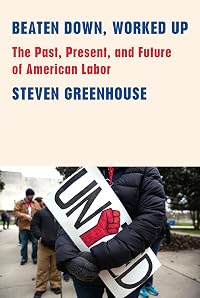
Beaten Down, Worked Up: The Past, Present, and Future of American Labor
by Steven Greenhouse
On This Page
Description
From the longtime New York Times labor correspondent, an in-depth look at working men and women in America, the challenges they face, and how they can be re-empowered In an era when corporate profits have soared while wages have flatlined, millions of Americans are searching for ways to improve their lives, and they're often turning to labor unions and worker action, whether #RedforEd teachers' strikes or the Fight for $15. Wage stagnation, low-wage work, and blighted blue-collar communities show more have become an all-too-common part of modern-day America, and behind these trends is a little-discussed problem: the decades-long decline in worker power. Steven Greenhouse sees this decline reflected in some of the most pressing problems facing our nation today, including income inequality, declining social mobility, the gender pay gap, and the concentration of political power in the hands of the wealthy. He rebuts the often-stated view that labor unions are outmoded-or even harmful-by recounting some of labor's victories, and the efforts of several of today's most innovative and successful worker groups. He shows us the modern labor landscape through the stories of dozens of American workers, from G.M. workers to Uber drivers, and we see how unions historically have empowered-and lifted-the most marginalized, including young women garment workers in New York in 1909, black sanitation workers in Memphis in 1968, and hotel housekeepers today. Greenhouse proposes concrete, feasible ways in which workers' collective power can be-and is being-rekindled and reimagined in the twenty-first century. show lessTags
Recommendations


























Member Reviews
Democratic politicians better read this book if they want to understand why they will continue to lose elections if they don't move leftward. Let me clarify that statement: I'm not talking about the cultural wars that so-called progressives are focused on, but bringing working people more power in the workplace, especially organizing workers into unions to increase their pay and improve their workplace conditions.
I had not expected to enjoy this book when the PBS Now Read This Book Club made it one of their selections. I had expected it to be rather dry.
I was wrong.
Instead of being a complete history of the labor movement, it was episodic, exploring key bits of important history.
These included the Triangle Shirtwaist fire and of course, the 1968 Sanitations Workers’ strike that brought Martin Luther King, Jr. to Memphis, Tennessee where King was assassinated.
It goes on to examine more modern strikes by nurses and teachers who are not just striking for higher wages or better working conditions, but for better care for their patients and pupils.
It also expands on the current issue for a $15 minimum wage. The author argues that a larger piece show more of the pie for workers who are not making even a subsistence living is what will create a healthy economy.
Well written and very informative. show less
I was wrong.
Instead of being a complete history of the labor movement, it was episodic, exploring key bits of important history.
These included the Triangle Shirtwaist fire and of course, the 1968 Sanitations Workers’ strike that brought Martin Luther King, Jr. to Memphis, Tennessee where King was assassinated.
It goes on to examine more modern strikes by nurses and teachers who are not just striking for higher wages or better working conditions, but for better care for their patients and pupils.
It also expands on the current issue for a $15 minimum wage. The author argues that a larger piece show more of the pie for workers who are not making even a subsistence living is what will create a healthy economy.
Well written and very informative. show less
Call it three stars if you've read other labor history and are part of or at least follow the movement today, 4.5 if this is your introductory text.
Ratings
Members
- Recently Added By
Lists

Powell's 50 Books for 50 Years
50 works; 4 members
Author Information

3 Works 264 Members
Steven Greenhouse has been the labor and workplace correspondent for the New York Times since 1995.
Classifications
- Genres
- Nonfiction, Economics, General Nonfiction, Business, History
- DDC/MDS
- 331.880973 — Society, government, & culture Economics Labor economics Labor unions, labor-management bargaining and disputes Labor unions (Trade unions) Standard subdivisions History, geographic treatment, biography North America United States
- LCC
- HD8072.5 .G739 — Social sciences Industries. Land use. Labor Industries. Land use. Labor Labor. Work. Working class By region or country
- BISAC
Statistics
- Members
- 143
- Popularity
- 229,010
- Reviews
- 3
- Rating
- (3.73)
- Languages
- English
- Media
- Paper, Audiobook, Ebook
- ISBNs
- 4
- ASINs
- 2