In Pursuit of the English
by Doris Lessing
On This Page
Description
In Pursuit of the English is a novelist's account of a lusty, quarrelsome, unscrupulous, funny, pathetic, full-blooded life in a working-class rooming house. It is a shrewd and unsentimental picture of Londoners you've probably never met or even read about--though they are the real English. The cast of characters--if that term can be applied to real people--includes: Bobby Brent, a con man; Mrs. Skeffington, a genteel woman who bullies her small child and flings herself down two flights of show more stairs to avoid having another; and Miss Priest, a prostitute, who replies to Lessing's question "Don't you ever like sex?" with "If you're going to talk dirty, I'm not interested." In swift, barbed style, in high, hard, farcical writing that is eruptively funny, Doris Lessing records the joys and terrors of everyday life. The truth of her perception shines through the pages of a work that is a brilliant piece of cultural interpretation, an intriguing memoir and a thoroughly engaging read. show lessTags
Recommendations















Member Reviews
The book is autobiographical, and yet the narrating voice manages to erase itself, while bringing everyone else in relief. In 1949 Lessing and her three year old son left South Africa for England, arriving in grim and bombed-out London (whose ugliness astonished her) with no money or contacts. She found lodgings through the expedient of entering a shop and asking the salesgirl whether she knew of any flats for rent; the salesgirl (Rose) did, in the house she herself lived in, and the year (or so) Lessing spent there is the entire content of the book. The landlords were a working class couple on the make, Dan and Flo, with a teenage son from Flo's previous marriage, and a toddler whose upbringing cried out for Dr. Spock (Flo apparently show more believed every kiss should be followed by a slap and vice versa). Other lodgers included another couple with a small and equally abused child, father being always on the road, mother a neurotic mess; a call girl, and an invisible old couple, barricaded in their rooms, which Dan and Flo fought to get out of the house (the court process ends the book).
From the start Lessing notes that the famed English with their famed "English" characteristics seem to be as rare as unicorns. Nobody she meets fits the bill. She certainly doesn't, as is made clear by landladies asking her--being from Africa--might she not be coloured in fact, or a Jew. The working class doesn't behave "English". Dan and the stepson parade around the house in wifebeaters (I think that's what "singlet" means), flexing muscles and ogling the girls like any of the Med machos. Flo had an Italian grandmother, who taught her to cook--a lot is made of terrific meals, communal on Sundays, accompanied by low jokes and sexual innuendo. Rose the salesgirl isn't so much "English" as a Londoner, a city mouse who spent her entire life within a few blocks. Brent the con man, ex-commando, "a sadist and a psychopath" (as Lessing tells him, conversationally, at one point) could be any flavour of Foreign Legion cannon meat.
I've rarely come across the England emerging from Lessing's pages (possibly entirely due to the sort of books I read), such a very convincingly real place, gritty (but the war practically just ended), grimy, the populace desperately fighting still, not the Germans, but poverty, disappointment, bleakness, and something stifling in the air. show less
From the start Lessing notes that the famed English with their famed "English" characteristics seem to be as rare as unicorns. Nobody she meets fits the bill. She certainly doesn't, as is made clear by landladies asking her--being from Africa--might she not be coloured in fact, or a Jew. The working class doesn't behave "English". Dan and the stepson parade around the house in wifebeaters (I think that's what "singlet" means), flexing muscles and ogling the girls like any of the Med machos. Flo had an Italian grandmother, who taught her to cook--a lot is made of terrific meals, communal on Sundays, accompanied by low jokes and sexual innuendo. Rose the salesgirl isn't so much "English" as a Londoner, a city mouse who spent her entire life within a few blocks. Brent the con man, ex-commando, "a sadist and a psychopath" (as Lessing tells him, conversationally, at one point) could be any flavour of Foreign Legion cannon meat.
I've rarely come across the England emerging from Lessing's pages (possibly entirely due to the sort of books I read), such a very convincingly real place, gritty (but the war practically just ended), grimy, the populace desperately fighting still, not the Germans, but poverty, disappointment, bleakness, and something stifling in the air. show less
[In Pursuit of the English] by Doris Lessing.
“That’s right. We should all be kind to each other. If we was all kind to each other all over the world it would be different. Wouldn’t it now.” said Flo perhaps the unkindest person in a cast of characters that seem to go out of their way to inflict as much misery onto each other as they can get away with.
The book is a slice of life that took place in London in 1950, when an embattled lower working class were attempting to pull themselves up by their bootstraps in a society that was still suffering from the devastation after world war II. There is a huge patch and repair job being carried out piecemeal, in an attempt to save the housing stock, bomb sights are scattered around show more neighbourhoods and so finding somewhere to live for a newcomer to London is not an easy task. Doris Lessing had only a small amount of savings and a two year old son when she started looking in South West London shortly after arriving by boat from Africa and the book is an autobiographical account of those first months spent trying to establish herself in London. It reads like a documentary; a sort of fly on the wall report on a household in bedsit land with Lessing the foreigner, as an ever present observer of the people with whom she lived. She soon became resigned to the intrigues of those people trying to get ahead while maintaining some sympathy for their victims.
Lessing recalls whole conversations and writes them down in the vernacular style in which they were spoken; she has a very good ear and her characters come alive through their phrasing and colloquialisms. I would like to think that this world full of prejudices and ignorance no longer exists, but I am sure it still does, but what I can vouch for is the accuracy of Lessing’s account of the way people behaved back then. I grew up in South West London in a working class suburb in the 1950’s where many people seemed to live on their wits. Many were of course racist, sexist and class conscious to an extraordinary degree and life; with rationing still prevalent and conscription still in force, was a struggle for those not prepared to take advantage of others weaknesses. Children suffered corporal punishment as a matter of course and for the most part escaped from their parents to play in the street, women who went out to work were treated with suspicion and more often than not were in fear of domestic violence. Men solved many of their issues with their fists.
The autobiography starts in Africa, with the author describing a short period in Cape Town where she was waiting for the next boat to England and is able to squeeze in a few of her African vignettes, but the meat of the book deals with her struggle to live and work in London. The flat that she eventually finds is a typical bed sitting room in a large house. It is owned by Dan and Flo who live in the basement and their only concern is to make money and to get ahead. Bobby Brent a typical business/con man rents rooms in the house for his mistress. There is also Rose who becomes Doris’s friend, but who is so full of anxieties, fears and prejudices that depression seems to be the natural order of things. There is also the Skeffingtons a married couple going through a difficult time and somewhere on the first floor a geriatric old couple, who live in appalling conditions and are being targeted by Dan and Flo for eviction.
A house full of squabbling adults and neglected children and Doris with a certain amount of naivety picks her way among them, perhaps knowing that for her, this kind of existence is only temporary. She was a published author at that time, but her main struggle was to find somewhere in the house where she can work. We learn little about Doris as her focus is on the people around her, and the overwhelming picture is of people living together who have an almost complete lack of empathy for one another. There are acts of kindness but they are random at best and Rose is able to reminisce at great length on how people were so much happier during the blitz of the war years. Doris says to Bobby Brent:
“I’ll tell you I said. I think you are a psychopath and a sadist, but luckily for you, in this society it won’t even be noticed. The sky’s the limit as far as I can see.”
Lessing published this book in 1960 and is careful not to give away the location of the household and no doubt she has changed the names of her characters. Cheekily she includes a little scam that Bobby Brent is keen to put to her; where a libellous article is published in the newspapers and the author is sued, but as the insurance will pay the costs, there is money to be made if agreement can be secured in advance to share the proceeds.
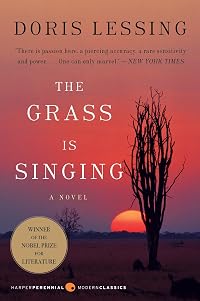
Lessing in her early career based many of her novels and some short stories on her own life and experiences, which is no bad thing. [Martha Quest], [A Proper Marriage] and [A Ripple from the Storm] are semi autobiographical with Martha (the subject of all three novels) and is based on Lessing’s life in Zimbabwe. [Going Home] is a report on her return to Zimbabwe after a period of time in England and her first novel [The Grass is Singing] is a story based around events that she witnessed or heard about. It is no surprise that [In pursuit of the English] is again autobiographical but later in her career she would revisit her early life in Zimbabwe to set the record straight with an official autobiography of those years. She was well versed in writing about herself and probably had a wary eye on being sued for libel.
Although autobiographical we learn little about Lessing, but we do get a fascinating account of life in London among the lower working class in 1950. I soon became interested in the characters and wanted to follow their stories, They can be funny and at times ridiculous, but they are also very human and so laughing at them feels a little condescending. Lessing herself avoids falling into this trap by keeping her opinions to herself and letting the reader make his/her own judgments. The book was first published in 1960 some ten years after the events described and although it is not rated among her finest achievements, it still packs a punch and is well worth exploring: 4 stars show less
“That’s right. We should all be kind to each other. If we was all kind to each other all over the world it would be different. Wouldn’t it now.” said Flo perhaps the unkindest person in a cast of characters that seem to go out of their way to inflict as much misery onto each other as they can get away with.
The book is a slice of life that took place in London in 1950, when an embattled lower working class were attempting to pull themselves up by their bootstraps in a society that was still suffering from the devastation after world war II. There is a huge patch and repair job being carried out piecemeal, in an attempt to save the housing stock, bomb sights are scattered around show more neighbourhoods and so finding somewhere to live for a newcomer to London is not an easy task. Doris Lessing had only a small amount of savings and a two year old son when she started looking in South West London shortly after arriving by boat from Africa and the book is an autobiographical account of those first months spent trying to establish herself in London. It reads like a documentary; a sort of fly on the wall report on a household in bedsit land with Lessing the foreigner, as an ever present observer of the people with whom she lived. She soon became resigned to the intrigues of those people trying to get ahead while maintaining some sympathy for their victims.
Lessing recalls whole conversations and writes them down in the vernacular style in which they were spoken; she has a very good ear and her characters come alive through their phrasing and colloquialisms. I would like to think that this world full of prejudices and ignorance no longer exists, but I am sure it still does, but what I can vouch for is the accuracy of Lessing’s account of the way people behaved back then. I grew up in South West London in a working class suburb in the 1950’s where many people seemed to live on their wits. Many were of course racist, sexist and class conscious to an extraordinary degree and life; with rationing still prevalent and conscription still in force, was a struggle for those not prepared to take advantage of others weaknesses. Children suffered corporal punishment as a matter of course and for the most part escaped from their parents to play in the street, women who went out to work were treated with suspicion and more often than not were in fear of domestic violence. Men solved many of their issues with their fists.
The autobiography starts in Africa, with the author describing a short period in Cape Town where she was waiting for the next boat to England and is able to squeeze in a few of her African vignettes, but the meat of the book deals with her struggle to live and work in London. The flat that she eventually finds is a typical bed sitting room in a large house. It is owned by Dan and Flo who live in the basement and their only concern is to make money and to get ahead. Bobby Brent a typical business/con man rents rooms in the house for his mistress. There is also Rose who becomes Doris’s friend, but who is so full of anxieties, fears and prejudices that depression seems to be the natural order of things. There is also the Skeffingtons a married couple going through a difficult time and somewhere on the first floor a geriatric old couple, who live in appalling conditions and are being targeted by Dan and Flo for eviction.
A house full of squabbling adults and neglected children and Doris with a certain amount of naivety picks her way among them, perhaps knowing that for her, this kind of existence is only temporary. She was a published author at that time, but her main struggle was to find somewhere in the house where she can work. We learn little about Doris as her focus is on the people around her, and the overwhelming picture is of people living together who have an almost complete lack of empathy for one another. There are acts of kindness but they are random at best and Rose is able to reminisce at great length on how people were so much happier during the blitz of the war years. Doris says to Bobby Brent:
“I’ll tell you I said. I think you are a psychopath and a sadist, but luckily for you, in this society it won’t even be noticed. The sky’s the limit as far as I can see.”
Lessing published this book in 1960 and is careful not to give away the location of the household and no doubt she has changed the names of her characters. Cheekily she includes a little scam that Bobby Brent is keen to put to her; where a libellous article is published in the newspapers and the author is sued, but as the insurance will pay the costs, there is money to be made if agreement can be secured in advance to share the proceeds.
Lessing in her early career based many of her novels and some short stories on her own life and experiences, which is no bad thing. [Martha Quest], [A Proper Marriage] and [A Ripple from the Storm] are semi autobiographical with Martha (the subject of all three novels) and is based on Lessing’s life in Zimbabwe. [Going Home] is a report on her return to Zimbabwe after a period of time in England and her first novel [The Grass is Singing] is a story based around events that she witnessed or heard about. It is no surprise that [In pursuit of the English] is again autobiographical but later in her career she would revisit her early life in Zimbabwe to set the record straight with an official autobiography of those years. She was well versed in writing about herself and probably had a wary eye on being sued for libel.
Although autobiographical we learn little about Lessing, but we do get a fascinating account of life in London among the lower working class in 1950. I soon became interested in the characters and wanted to follow their stories, They can be funny and at times ridiculous, but they are also very human and so laughing at them feels a little condescending. Lessing herself avoids falling into this trap by keeping her opinions to herself and letting the reader make his/her own judgments. The book was first published in 1960 some ten years after the events described and although it is not rated among her finest achievements, it still packs a punch and is well worth exploring: 4 stars show less
I am stunned to see how few people have this book, in light of how popular Lessings's other works are. I did not much enjoy Shikasta, the only other book of hers I recall reading, but this one has had a great impact on me. It is in turns funny and fascinating and wrenching, wrenching not because of some sudden incident but because of the long-form harrowing of happiness that comes with our (especially women's) inherited suffering. Doris is witness, not judge, in this book, and as a working class woman I am grateful for that, for her honest but gentle reportage.
a strange book--not really about her. about the really irritating people she lived with after coming to london from rhodesia in the 50s. she was quite close to them but probably never saw them again. i'm not quite sure if she even liked rose. i wondered what happened to oar's second teeth. does she still have them?
Ratings
Members
- Recently Added By
Author Information

264+ Works 37,228 Members
Doris Lessing was born in Kermanshah, Persia (later Iran) on October 22, 1919 and grew up in Rhodesia (the present-day Zimbabwe). During her two marriages, she submitted short fiction and poetry for publication. After moving to London in 1949, she published her first novel, The Grass Is Singing, in 1950. She is best known for her 1954 Somerset show more Maugham Award-winning experimental novel The Golden Notebook. Her other works include This Was the Old Chief's Country, the Children of Violence series, the Canopus in Argos - Archives series, and Alfred and Emily. She has received numerous awards for her work including the 2001 Prince of Asturias Prize in Literature, the David Cohen British Literature Prize, and the 2007 Nobel Prize for Literature. She died on November 17, 2013 at the age of 94. (Bowker Author Biography) show less
Common Knowledge
- Original publication date
- 1960
Classifications
- Genres
- Biography & Memoir, Fiction and Literature
- DDC/MDS
- 828.91403 — Literature & rhetoric English & Old English literatures English miscellaneous writings English miscellaneous writings 1900- English miscellaneous writings 1900-1999 English miscellaneous writings 1945-1999 Diaries, journals, notebooks, reminiscences
- LCC
- DA688 .L42 — History of Europe, Asia, Africa and Oceania Great Britain History of Great Britain England Local history and description London
- BISAC
Statistics
- Members
- 253
- Popularity
- 128,802
- Reviews
- 4
- Rating
- (4.08)
- Languages
- English, German, Spanish
- Media
- Paper, Ebook
- ISBNs
- 10
- ASINs
- 16