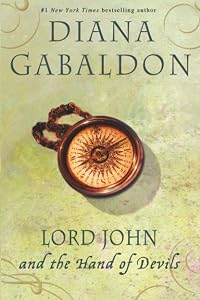
Lord John and the Hand of Devils
by Diana Gabaldon 
Lord John (Collections and Selections — Short Story Collection 0.1-2.1)
On This Page
Description
Diana Gabaldon, #1 New York Times bestselling author of the celebrated Outlander series, delivers three mesmerizing tales of war, intrigue, and espionage that feature one of her most popular characters: Lord John Grey. In Lord John and the Hellfire Club, Lord John glimpses a stranger in the doorway of a gentleman's club-and is stirred by a desperate entreaty to meet with him in private. It is an impulse that will lead Lord John into a maze of political treachery and a dangerous, debauched show more underground society. In Lord John and the Succubus, English soldiers fighting in Prussia are rattled by a lethal creature that appears at night. Called to investigate, Lord John soon realizes that among the spirits that haunt men, none frighten more than the specters conjured by the heart. In Lord John and the Haunted Soldier, Lord John is thrust into the baffling case of an exploding battlefield cannon that ultimately forces him to confront his own ghosts-and the shattering prospect that a traitor is among the ranks of His Majesty's armed forces. show lessTags
Recommendations











Member Reviews
Lord John and the Hellfire Club - Lord John and the Hellfire Club is the first novella in Diana Gabaldon's Lord John Grey series. I'm not sure if it's the shortest story she's ever written, but it's by far the shortest one by her I've read to date. In this novella, she's taken Lord John Grey, a popular secondary character from the Outlander series, and given him a mystery to solve, thereby turning him into an amateur sleuth, which is what I understand he'll be doing throughout the series. It takes place in London sometime after Lord John's return from his time as warden at Ardsmuir Prison where Jamie was held. Harry Quarry, the warden who preceded Lord John, is also a part of the story. He and John share a loose friendship and he's show more related to the murdered man.
The plot is a fairly simple and straightforward one. John is approached by a man he's barely met, asking for a clandestine meeting to discuss something of import that he can trust to no one else, but before the meeting can take place, the man is stabbed almost before John's eyes and dies in his arms. John vows to find the killer, which leads him to a surprising meeting of a secret society know at the Hellfire Club.
As usual Diana Gabaldon has done an exceptional job with her research. Hellfire Clubs actually did exist during that time period, and Sir Francis Dashwood's, the one which John attends, appears to have been the most famous. I also found it interesting to learn more about the perceptions of gay men in that era. Of course, John, out of necessity for his own safety, keeps his sexuality a closely guarded secret, but we do get hints of how he gets around the social mores of the day to engage in intimacies and how he views society's attitudes toward men like him. I felt rather bad for John, because he still pines for Jamie even though he's trying to set aside that unrequited love.
The main reason this was a four-star read for me instead of higher is that parts of the story didn't seem to flow as well as the Outlander books I've read. The details of the first chapter weren't quite gelling in my mind's eye the way this author's work usually does. I had to concentrate pretty intently to fully grasp the situation. Also, Ms. Gabaldon is a highly intelligent person, and it definitely shows in her writing. That's great, except that in this story, she uses more historically accurate language in both her dialogue and prose. This made it a bit more challenging to read, because the dialogue is unfamiliar to my modern ear, and while normally I can pick up on the meaning of unfamiliar words in context, some of the words in the prose still remained a mystery to me. Otherwise I enjoyed Lord John and the Hellfire Club. The mystery was handled well, especially for such a short format. It was a good start to the series, and I look forward to reading more about Lord John's adventures. Star Rating: ****
Lord John and the Succubus - Lord John and the Succubus is a novella in Diana Gabaldon’s Lord John Grey series that falls between Lord John and the Private Matter and Lord John and the Brotherhood of the Blade in the series chronology. Much like with the first novella in this book, the story was rather slow-paced and occasionally I was having trouble following it. Now I admit that it could have been that through part of it I was very sleepy and kept dozing off, and through another part, I was repeatedly interrupted by my family members, so the fault may be partly mine, which is why I only marked it down one star. However, this one seemed a bit more steeped in military history surrounding the Seven Years War, with some geography, troop positions, etc. playing a part here. Normally, I’m very appreciative of Ms. Gabaldon’s attention to detail, but for the most part, military history isn’t at the top of my list of reading preferences, especially when it comes to wars I know very little about, therefore some of the details of this story were lost on me.
I did, however, enjoy the mystery. With this being a shorter story, though, it wasn’t as developed as I’m used to, but it was still good. The title of the novella might lead some readers to believe that this is a supernatural mystery, but the paranormal really only comes into play in the form of legends and superstition. The gist of this part of the story is that Lord John, in his capacity as a liaison officer with the English forces who are allied with the Prussians and Hanoverians, becomes aware of the murder of a Prussian soldier. Many locals believe it was the work of a succubus, which of course, the logical and deductive-reasoning John doesn’t believe for a minute. However, to appease them, he allows the use of his horse in a graveyard ritual, during which the body of an English soldier is also discovered. This leads John to investigate a possible connection between the two cases in an effort to bring an end to the speculation regarding a succubus.
While solving the mystery, John is drawn into some interesting interactions with several secondary characters. He and some other high-ranking officers are staying at the castle of a widowed princess. John, being an attractive man, finds himself having to fend of the princess’s advances. Also, the author toys with the reader regarding a possible relationship between John and his dashing Hanoverian friend, Stephan von Namtzen, who was introduced in the previous book, Lord John and the Private Matter. In the end, we know that John’s attraction to Stephan is real, but we’re never entirely sure if the attraction is reciprocal. I suspect it is, but I’ll be interested to see if anything more comes of it in future stories of the series. John’s valet, Tom Byrd, also introduced in the last book, returns as his efficient and helpful assistant. Then John meets a young teenage soldier out in the field, who he realizes is also gay. He is able to provide the young man with some sage advice, during which we learn of a traumatic incident in John’s own past. It’s little more than a mention, though, and I would have liked a better understanding of how it affected him on an emotional level. John is a courageous soldier, so perhaps there isn’t much more to tell, but I doubt. This story makes it seem like it was simply something that happened that he quickly moved on from, but I think it could definitely be an interesting aspect of his character to explore in more depth if the author chooses to go that way. I’ll be interested to see if Ms. Gabaldon expands upon it later.
Overall, Lord John and the Succubus was an enjoyable novella. It may have been a little slow-paced, but I did like following along with the mystery and in particular, John’s interactions with the other characters. I might not have thought it was as good as Diana Gabaldon’s full-length novels, but it was still a good story. Therefore, I look forward to continuing on with the series soon, and since the next book is a full-length one, perhaps it will be even better. Lord John and the Succubus was originally published in the multi-author anthology Legends II: New Short Novels by the Masters of Modern Fantasy and was later reprinted in this single-author anthology along with two other companion novellas in the Lord John Grey series. Star Rating: ****
Lord John and the Haunted Soldier - Lord John and the Haunted Soldier is a novella in Diana Gabaldon’s Lord John Grey series that falls immediately after Lord John and the Brotherhood of the Blade. I enjoyed Lord John and the Haunted Soldier better than the first two novellas in this anthology. I think that’s because, rather than being a stand-alone story, it’s more of a continuation of events from Lord John and the Brotherhood of the Blade, which made it a little more interesting to me. It also, like the novels, has a more personal flavor to it, involving John’s older half-brother, whom we’ve not met up until this point and other familiar characters from the previous novel. So overall, Lord John and the Haunted Soldier held my attention equally as well as the novels have so far.
As I said this novella picks up where Lord John and the Brotherhood of the Blade left off, with John being called before a Commission of Inquiry. They are investigating the explosion of the cannon that badly injured John and other soldiers, as well as the death of Lieutenant Lister, who’d been in command of the cannon before being decapitated by an enemy cannonball and Lord John took over. The Commission seems to be insinuating that John made a mistake which led to the cannon being destroyed, or even perhaps his half-brother, Edgar, who makes the powder for the cannon might have had something to do with it. This leaves John to figure out exactly what did happen to make sure his and his brother’s good names aren’t dragged through the mud. At the same time, he finds himself agreeing to search for the ill-fated Lister’s fiancée, who was believed to have been with child. The two investigations end up intersecting in surprising ways.
John’s investigation into the cannon leads him down a twisting path of corruption and dirty dealings that also connects up with Bowles, a mysterious figure who’s been lurking in the background throughout the series. The more personal side of the investigation leads to a sad and twisted tale of unrequited love. I enjoyed both because they kept me guessing and wondering what new connections John might find next. I also liked meeting new members of John’s family, who seem like good people. Throughout all this John continues to deal with the pain and fear of death associated with a piece of shrapnel still lodged in his chest. He also continues to pine for Jamie, regrets the heated the words they exchanged in the last book, and finds comfort in writing letters to his old friend. The only reason I knocked off the half star is because there were one or two plot points that were a tad hard to follow and a couple of places that were just a little slow, but otherwise, Lord John and the Haunted Soldier was a very good read. John is an excellent hero who I very much look forward to reading more about in the coming stories. Star Rating: ****1/2 show less
The plot is a fairly simple and straightforward one. John is approached by a man he's barely met, asking for a clandestine meeting to discuss something of import that he can trust to no one else, but before the meeting can take place, the man is stabbed almost before John's eyes and dies in his arms. John vows to find the killer, which leads him to a surprising meeting of a secret society know at the Hellfire Club.
As usual Diana Gabaldon has done an exceptional job with her research. Hellfire Clubs actually did exist during that time period, and Sir Francis Dashwood's, the one which John attends, appears to have been the most famous. I also found it interesting to learn more about the perceptions of gay men in that era. Of course, John, out of necessity for his own safety, keeps his sexuality a closely guarded secret, but we do get hints of how he gets around the social mores of the day to engage in intimacies and how he views society's attitudes toward men like him. I felt rather bad for John, because he still pines for Jamie even though he's trying to set aside that unrequited love.
The main reason this was a four-star read for me instead of higher is that parts of the story didn't seem to flow as well as the Outlander books I've read. The details of the first chapter weren't quite gelling in my mind's eye the way this author's work usually does. I had to concentrate pretty intently to fully grasp the situation. Also, Ms. Gabaldon is a highly intelligent person, and it definitely shows in her writing. That's great, except that in this story, she uses more historically accurate language in both her dialogue and prose. This made it a bit more challenging to read, because the dialogue is unfamiliar to my modern ear, and while normally I can pick up on the meaning of unfamiliar words in context, some of the words in the prose still remained a mystery to me. Otherwise I enjoyed Lord John and the Hellfire Club. The mystery was handled well, especially for such a short format. It was a good start to the series, and I look forward to reading more about Lord John's adventures. Star Rating: ****
Lord John and the Succubus - Lord John and the Succubus is a novella in Diana Gabaldon’s Lord John Grey series that falls between Lord John and the Private Matter and Lord John and the Brotherhood of the Blade in the series chronology. Much like with the first novella in this book, the story was rather slow-paced and occasionally I was having trouble following it. Now I admit that it could have been that through part of it I was very sleepy and kept dozing off, and through another part, I was repeatedly interrupted by my family members, so the fault may be partly mine, which is why I only marked it down one star. However, this one seemed a bit more steeped in military history surrounding the Seven Years War, with some geography, troop positions, etc. playing a part here. Normally, I’m very appreciative of Ms. Gabaldon’s attention to detail, but for the most part, military history isn’t at the top of my list of reading preferences, especially when it comes to wars I know very little about, therefore some of the details of this story were lost on me.
I did, however, enjoy the mystery. With this being a shorter story, though, it wasn’t as developed as I’m used to, but it was still good. The title of the novella might lead some readers to believe that this is a supernatural mystery, but the paranormal really only comes into play in the form of legends and superstition. The gist of this part of the story is that Lord John, in his capacity as a liaison officer with the English forces who are allied with the Prussians and Hanoverians, becomes aware of the murder of a Prussian soldier. Many locals believe it was the work of a succubus, which of course, the logical and deductive-reasoning John doesn’t believe for a minute. However, to appease them, he allows the use of his horse in a graveyard ritual, during which the body of an English soldier is also discovered. This leads John to investigate a possible connection between the two cases in an effort to bring an end to the speculation regarding a succubus.
While solving the mystery, John is drawn into some interesting interactions with several secondary characters. He and some other high-ranking officers are staying at the castle of a widowed princess. John, being an attractive man, finds himself having to fend of the princess’s advances. Also, the author toys with the reader regarding a possible relationship between John and his dashing Hanoverian friend, Stephan von Namtzen, who was introduced in the previous book, Lord John and the Private Matter. In the end, we know that John’s attraction to Stephan is real, but we’re never entirely sure if the attraction is reciprocal. I suspect it is, but I’ll be interested to see if anything more comes of it in future stories of the series. John’s valet, Tom Byrd, also introduced in the last book, returns as his efficient and helpful assistant. Then John meets a young teenage soldier out in the field, who he realizes is also gay. He is able to provide the young man with some sage advice, during which we learn of a traumatic incident in John’s own past. It’s little more than a mention, though, and I would have liked a better understanding of how it affected him on an emotional level. John is a courageous soldier, so perhaps there isn’t much more to tell, but I doubt. This story makes it seem like it was simply something that happened that he quickly moved on from, but I think it could definitely be an interesting aspect of his character to explore in more depth if the author chooses to go that way. I’ll be interested to see if Ms. Gabaldon expands upon it later.
Overall, Lord John and the Succubus was an enjoyable novella. It may have been a little slow-paced, but I did like following along with the mystery and in particular, John’s interactions with the other characters. I might not have thought it was as good as Diana Gabaldon’s full-length novels, but it was still a good story. Therefore, I look forward to continuing on with the series soon, and since the next book is a full-length one, perhaps it will be even better. Lord John and the Succubus was originally published in the multi-author anthology Legends II: New Short Novels by the Masters of Modern Fantasy and was later reprinted in this single-author anthology along with two other companion novellas in the Lord John Grey series. Star Rating: ****
Lord John and the Haunted Soldier - Lord John and the Haunted Soldier is a novella in Diana Gabaldon’s Lord John Grey series that falls immediately after Lord John and the Brotherhood of the Blade. I enjoyed Lord John and the Haunted Soldier better than the first two novellas in this anthology. I think that’s because, rather than being a stand-alone story, it’s more of a continuation of events from Lord John and the Brotherhood of the Blade, which made it a little more interesting to me. It also, like the novels, has a more personal flavor to it, involving John’s older half-brother, whom we’ve not met up until this point and other familiar characters from the previous novel. So overall, Lord John and the Haunted Soldier held my attention equally as well as the novels have so far.
As I said this novella picks up where Lord John and the Brotherhood of the Blade left off, with John being called before a Commission of Inquiry. They are investigating the explosion of the cannon that badly injured John and other soldiers, as well as the death of Lieutenant Lister, who’d been in command of the cannon before being decapitated by an enemy cannonball and Lord John took over. The Commission seems to be insinuating that John made a mistake which led to the cannon being destroyed, or even perhaps his half-brother, Edgar, who makes the powder for the cannon might have had something to do with it. This leaves John to figure out exactly what did happen to make sure his and his brother’s good names aren’t dragged through the mud. At the same time, he finds himself agreeing to search for the ill-fated Lister’s fiancée, who was believed to have been with child. The two investigations end up intersecting in surprising ways.
John’s investigation into the cannon leads him down a twisting path of corruption and dirty dealings that also connects up with Bowles, a mysterious figure who’s been lurking in the background throughout the series. The more personal side of the investigation leads to a sad and twisted tale of unrequited love. I enjoyed both because they kept me guessing and wondering what new connections John might find next. I also liked meeting new members of John’s family, who seem like good people. Throughout all this John continues to deal with the pain and fear of death associated with a piece of shrapnel still lodged in his chest. He also continues to pine for Jamie, regrets the heated the words they exchanged in the last book, and finds comfort in writing letters to his old friend. The only reason I knocked off the half star is because there were one or two plot points that were a tad hard to follow and a couple of places that were just a little slow, but otherwise, Lord John and the Haunted Soldier was a very good read. John is an excellent hero who I very much look forward to reading more about in the coming stories. Star Rating: ****1/2 show less
A collection of three Lord John novellas. All three are excellent pieces of historical fiction full of insights into one of my favourite side characters of the Outlander series. My favourite of the three was the third novella, which looks at the ramifications of events from the previous novel on Lord John's life. All three novels have an element of mystery to them and for fans of the series and/or Lord John, they're a worthwhile read.
This is a collection: one short story, Lord John and the Hellfire Club, and two novellas, Lord John and the Succubus and ...Haunted Soldier. Hellfire Club is slight, a a 20-page short story that is more an idea than an actual story; it's the two novellas that form the meat of the book. Succubus is silly, engaging fun: Grey is in Prussia with the estimable Stephan van Namtzen, aristocrat, soldier and gentleman, and Grey is not at all in love with him. They're solving a mystery of a succubus, or night-hag, a demon who's killing soldiers and... er.... draining their essence, and it's silly and doesn't quite hang together as a plot, but as usual, is redeemed by Grey and van Namtzen and their surrounding cast, who are their usual funny, show more delightful selves.
Haunted Soldier is something different again. It's notable firstly because, as a story in itself, it really doesn't work, but acquires depth and meaning when taken as a sequel to Brotherhood of the Blade, and secondly because it isn't immediately clear who the haunted soldier is. There are several candidates, but by far the most likely is Grey himself, who has returned to England after Crefeld to deal with, among other things, having had a tonne of cannon explode in his arms.
Much as I complain about Galabldon's occasional romance-novel nonsenses, she really can write when she wants to, and never better than here. It's interesting that despite the fact he never acknowledges it, Grey is very obviously clinically depressed throughout this story. His usual characterisation is so crisp and clear that the author can press the metaphorical mute button on it here to great, subtle effect. It's one ot the things she's very good at, actually; everything that happens to him informs his subsequent character development, and it's clear how he changes with experience across the novels. For this reason, I don't think this book does stand alone, despite the publishers' blurb, and I wouldn't recommend it to someone who didn't know the series. Start with one of the novels. show less
Haunted Soldier is something different again. It's notable firstly because, as a story in itself, it really doesn't work, but acquires depth and meaning when taken as a sequel to Brotherhood of the Blade, and secondly because it isn't immediately clear who the haunted soldier is. There are several candidates, but by far the most likely is Grey himself, who has returned to England after Crefeld to deal with, among other things, having had a tonne of cannon explode in his arms.
Much as I complain about Galabldon's occasional romance-novel nonsenses, she really can write when she wants to, and never better than here. It's interesting that despite the fact he never acknowledges it, Grey is very obviously clinically depressed throughout this story. His usual characterisation is so crisp and clear that the author can press the metaphorical mute button on it here to great, subtle effect. It's one ot the things she's very good at, actually; everything that happens to him informs his subsequent character development, and it's clear how he changes with experience across the novels. For this reason, I don't think this book does stand alone, despite the publishers' blurb, and I wouldn't recommend it to someone who didn't know the series. Start with one of the novels. show less
I picked this book up because I kept coming across Diana Gabaldon in the bookshop, and her books looked intriguing. Being a bit wary, as always, of investing in a tome of a new-to-me author (because I've been burned before, but I haven't the heart to eject such books off my shelves), I thought this collection of short stories about a minor character from her historical / time travelling 'Outlander' series (extrapolating from the cover blurb) would be a good introduction.
The stories are :
1 - Lord John and the Hellfire Club
Lord John Grey, in investigating the death of an acquaintance, finds himself embroiled in very strange goings-on.
This story is set in the 18th century when (we learn from obscure hints and innuendo) homosexuality was show more considered an atrocity - which poses a problem for Lord John and certain of his friends. It is divided into three parts, though I felt a bit lost in the first part, as it kept referring to events from the 'Outlander' series and hinting about a red-haired mutual acquaintance of Lord John and his friends. However, once the story got going, part two drew me in.
2 - Lord John and the Succubus
It is 1757 and Lord John Grey is stationed in Saxony, as liaison officer to Hanoverian allies, fighting against the French and Austrians. As well as corporeal enemies, the troops stationed in and around the town of Gundwitz suddenly find themselves facing the threat of a succubus; but does such a thing actually exist? Lord John finds himself involved in the investigation, as well as a possible romance or two.
I must admit that whenever I read a story that takes place in England anytime before WWI, I subconsciously use Jane Austen as my standard, and expect the characters to behave with Victorian propriety, so it startles me when it's written more in Georgette Heyer's style; but that's just my mind-set.
That said, this war-time mystery was enjoyable. Lord John seems to be turning into a detective of sorts, with the action taking place in 18th century Europe.
3 - Lord John and the Haunted Soldier
Lord John is back in London, and - after recovering from an injury resulting from an exploding canon at the front - finds himself in front of an inquisition into the murder of Tom Pilchard i.e. the canon itself. The inquisition suspects that the canon was sabotaged, and Lord John Grey finds that suspicion turned on himself. Feeling that he (or one of his brothers) is being framed, he investigates further.
st
As in the first two stories, Grey finds himself embroiled in a mystery which he sets out to solve. For me, the interest was not so much in trying to solve the mystery (which is what I usually try to do with crime fiction) as in the details of life in that period. The action moved from the Arsenal, where arms and ammunition were tested, to London, the countryside and out on the water, with visits to gentlemen's clubs. I can only assume that the details are accurate (never having studied the era before). Although, as I mentioned before, this gentleman soldier seems to move in more permissive circles than my Jane Austen heroines: for a society where even to be suspected (rightly or wrongly) of being homosexual could mean death or worse, some characters in these stories are fairly blatant with their hints and invitations.
While I didn't love these stories to bits, they are good stories and certainly held my interest. I think I'll be exploring further into this world at a later date.
Having now read other reviews, I'd like to add:
1 - like other reviewers, I agree that the third story is the best, and it lifted my rating by half a star.
2 - unlike other reviewers, this is my first foray into Diana Gabaldon's universe, and I think that does make a difference to how we experienced the book. show less
The stories are :
1 - Lord John and the Hellfire Club
Lord John Grey, in investigating the death of an acquaintance, finds himself embroiled in very strange goings-on.
This story is set in the 18th century when (we learn from obscure hints and innuendo) homosexuality was show more considered an atrocity - which poses a problem for Lord John and certain of his friends. It is divided into three parts, though I felt a bit lost in the first part, as it kept referring to events from the 'Outlander' series and hinting about a red-haired mutual acquaintance of Lord John and his friends. However, once the story got going, part two drew me in.
2 - Lord John and the Succubus
It is 1757 and Lord John Grey is stationed in Saxony, as liaison officer to Hanoverian allies, fighting against the French and Austrians. As well as corporeal enemies, the troops stationed in and around the town of Gundwitz suddenly find themselves facing the threat of a succubus; but does such a thing actually exist? Lord John finds himself involved in the investigation, as well as a possible romance or two.
I must admit that whenever I read a story that takes place in England anytime before WWI, I subconsciously use Jane Austen as my standard, and expect the characters to behave with Victorian propriety, so it startles me when it's written more in Georgette Heyer's style; but that's just my mind-set.
That said, this war-time mystery was enjoyable. Lord John seems to be turning into a detective of sorts, with the action taking place in 18th century Europe.
3 - Lord John and the Haunted Soldier
Lord John is back in London, and - after recovering from an injury resulting from an exploding canon at the front - finds himself in front of an inquisition into the murder of Tom Pilchard i.e. the canon itself. The inquisition suspects that the canon was sabotaged, and Lord John Grey finds that suspicion turned on himself. Feeling that he (or one of his brothers) is being framed, he investigates further.
st
As in the first two stories, Grey finds himself embroiled in a mystery which he sets out to solve. For me, the interest was not so much in trying to solve the mystery (which is what I usually try to do with crime fiction) as in the details of life in that period. The action moved from the Arsenal, where arms and ammunition were tested, to London, the countryside and out on the water, with visits to gentlemen's clubs. I can only assume that the details are accurate (never having studied the era before). Although, as I mentioned before, this gentleman soldier seems to move in more permissive circles than my Jane Austen heroines: for a society where even to be suspected (rightly or wrongly) of being homosexual could mean death or worse, some characters in these stories are fairly blatant with their hints and invitations.
While I didn't love these stories to bits, they are good stories and certainly held my interest. I think I'll be exploring further into this world at a later date.
Having now read other reviews, I'd like to add:
1 - like other reviewers, I agree that the third story is the best, and it lifted my rating by half a star.
2 - unlike other reviewers, this is my first foray into Diana Gabaldon's universe, and I think that does make a difference to how we experienced the book. show less
Gabaldon's writing is of the kind I call "serviceable" but her characters either make you swoon, pant, sweat and holler, or they leave you completely cold. I fall on the non-hollerin' end of category A. I like these people, Lord John especially having a claim on me because he's a shirt-lifter (or Warmbruder, depending on where we are geographically).
This book is a collection of three novellas that Gabaldon wrote about the good Major Lord John Grey. One was written for this collection. Does it matter what they're about? Lord John, in peace or at war, will never suffer a wrong he can right to go unrighted; he will never allow personal comfort or convenience to stand in the way of what duty and honor require him to do; and he will never show more fall out of love with Jamie Fraser, featured in Gabaldon's main time travel romance series as the husband of the time traveler.
So he don't get none. Relax, ewww-ickers.
Anyway, in a marketplace crowded with mystery choices, and quite a fair few eighteenth-century historicals at that, why choose these books with their serviceable writing? Bruce Alexander, for one example, is a better writer. His Blind Justice series is very good.
Simple: Depth. Lord John Grey is part of a well-known alternate world. It's obvious that Gabaldon could act as a tour guide to eighteenth-century England and Scotland, and it's obvious that SOMEwhere in a properly ordered Creation, Jamie and Claire and Lord John are plying their different courses through the time streams. The reason to read this series starts and stops with an individual's familiarity with or receptivity to Gabaldon's world. If you've read Dragonfly in Amber and did not find it so tedious and plodding as to make you beg a merciful Goddess for death or blindness, you're likely to enjoy these books.
Recommended? Oh, sure. Why not. Start with these novellas and see if the character appeals; if so, the novels await your pleasure. show less
This book is a collection of three novellas that Gabaldon wrote about the good Major Lord John Grey. One was written for this collection. Does it matter what they're about? Lord John, in peace or at war, will never suffer a wrong he can right to go unrighted; he will never allow personal comfort or convenience to stand in the way of what duty and honor require him to do; and he will never show more fall out of love with Jamie Fraser, featured in Gabaldon's main time travel romance series as the husband of the time traveler.
So he don't get none. Relax, ewww-ickers.
Anyway, in a marketplace crowded with mystery choices, and quite a fair few eighteenth-century historicals at that, why choose these books with their serviceable writing? Bruce Alexander, for one example, is a better writer. His Blind Justice series is very good.
Simple: Depth. Lord John Grey is part of a well-known alternate world. It's obvious that Gabaldon could act as a tour guide to eighteenth-century England and Scotland, and it's obvious that SOMEwhere in a properly ordered Creation, Jamie and Claire and Lord John are plying their different courses through the time streams. The reason to read this series starts and stops with an individual's familiarity with or receptivity to Gabaldon's world. If you've read Dragonfly in Amber and did not find it so tedious and plodding as to make you beg a merciful Goddess for death or blindness, you're likely to enjoy these books.
Recommended? Oh, sure. Why not. Start with these novellas and see if the character appeals; if so, the novels await your pleasure. show less
I enjoy Gabaldon's writing style very much. She writes with an intricacy that somehow never becomes weighty, and remains prosaic without being verbose. I probably wouldn't have asked for Lord John's backstory, but I'm happy she wrote these books. I'd likely read a book about any of the Outlander characters, as they are all rather intriguing, each in their own ways.
This book is actually made up of three shorter novels:
Hellfire Club, Succubus, and Haunted Soldier. Of these three, I preferred the first two the most.
This book is actually made up of three shorter novels:
Hellfire Club, Succubus, and Haunted Soldier. Of these three, I preferred the first two the most.
Individual Summaries and Reviews: Lord John and the Hand of Devils is a collection of short stories (really one regular length story and two longer novellas) that are interspersed between the full-length Lord John novels.
"Lord John and the Hellfire Club" is the shortest work in the bunch, and chronologically occurs before the Lord John and the Private Matter. In it, Lord John, freshly returned from Scotland, meets a young man who says that he urgently needs his help - but who is then murdered in a crowded street before he can explain himself. Lord John becomes involved with a secret society with some dark rituals before he can unravel what's going on. I thought it was too quick to be really satisfying, and that if it had been in a show more longer format, the ending could have been milked for a lot more.
"Lord John and the Succubus" takes place between Lord John and the Private Matter and Lord John and the Brotherhood of the Blade. Quartered in Germany during the Seven Years' War, Lord John is confronted with two soldiers, both dead by impossible means, and a persistent rumor that the town is being haunted by a succubus. I liked this one a lot, as Gabaldon had more time to develop the mystery as well as fit in some character moments, and a few nicely creepy parts. However, I don't know much about the Seven Years' War, and I had a difficult time keeping track of the regiments and commanders and troop movements, especially since I was lacking a map of the relevant area. Also, by this time, I was beginning to think that Gabaldon was purposefully going to keep poor Lord John from ever getting any lovin', using more and more outlandish coincidences. (This was of course disproven in Brotherhood of the Blade, but I didn't know it yet.
"Lord John and the Haunted Soldier" takes place shortly after the events at the end of Lord John and the Brotherhood of the Blade, and concerns them directly. Lord John is summoned to appear before a military tribunal to be questioned about his part in the Battle of Crefield... only the tribunal appears to be more interested in the explosion of the gun Lord John was commanding than in the death of the gun's former commander, even going so far as to implicate Lord John's half-brother in the deliberate production of faulty powder. Lord John must then attempt to clear his family name while attempting to do what he can for the family of the soldier whose death hangs on his conscience. This was my favorite of the bunch; it had several well-developed little mini-mysteries, one military and one personal, that fit together neatly and kept me intrigued and emotionally involved right to the end.
Overall Review and Recommendation: I don't know how essential these stories are to the understanding of the full-length Lord John books; Gabaldon occasionally introduces characters or events in the short stories that reappear in the books, but I think she does a fine job re-explaining them in the novels. I'm mostly basing that on my experience reading Lord John and the Private Matter, which contains a lot of callbacks to "Lord John and the Hellfire Club", but was perfectly understandable, even though I read them out of order. On the flip side, I think that the stories also stand mostly independent of the books... at least the first two, although "Haunted Soldier" somewhat less. Overall, I'd say they're not required reading, and I wouldn't recommend starting with them, but for fans of the Lord John novels, the stories should be just as enjoyable. 4 out of 5 stars. show less
"Lord John and the Hellfire Club" is the shortest work in the bunch, and chronologically occurs before the Lord John and the Private Matter. In it, Lord John, freshly returned from Scotland, meets a young man who says that he urgently needs his help - but who is then murdered in a crowded street before he can explain himself. Lord John becomes involved with a secret society with some dark rituals before he can unravel what's going on. I thought it was too quick to be really satisfying, and that if it had been in a show more longer format, the ending could have been milked for a lot more.
"Lord John and the Succubus" takes place between Lord John and the Private Matter and Lord John and the Brotherhood of the Blade. Quartered in Germany during the Seven Years' War, Lord John is confronted with two soldiers, both dead by impossible means, and a persistent rumor that the town is being haunted by a succubus. I liked this one a lot, as Gabaldon had more time to develop the mystery as well as fit in some character moments, and a few nicely creepy parts. However, I don't know much about the Seven Years' War, and I had a difficult time keeping track of the regiments and commanders and troop movements, especially since I was lacking a map of the relevant area. Also, by this time, I was beginning to think that Gabaldon was purposefully going to keep poor Lord John from ever getting any lovin', using more and more outlandish coincidences. (This was of course disproven in Brotherhood of the Blade, but I didn't know it yet.
"Lord John and the Haunted Soldier" takes place shortly after the events at the end of Lord John and the Brotherhood of the Blade, and concerns them directly. Lord John is summoned to appear before a military tribunal to be questioned about his part in the Battle of Crefield... only the tribunal appears to be more interested in the explosion of the gun Lord John was commanding than in the death of the gun's former commander, even going so far as to implicate Lord John's half-brother in the deliberate production of faulty powder. Lord John must then attempt to clear his family name while attempting to do what he can for the family of the soldier whose death hangs on his conscience. This was my favorite of the bunch; it had several well-developed little mini-mysteries, one military and one personal, that fit together neatly and kept me intrigued and emotionally involved right to the end.
Overall Review and Recommendation: I don't know how essential these stories are to the understanding of the full-length Lord John books; Gabaldon occasionally introduces characters or events in the short stories that reappear in the books, but I think she does a fine job re-explaining them in the novels. I'm mostly basing that on my experience reading Lord John and the Private Matter, which contains a lot of callbacks to "Lord John and the Hellfire Club", but was perfectly understandable, even though I read them out of order. On the flip side, I think that the stories also stand mostly independent of the books... at least the first two, although "Haunted Soldier" somewhat less. Overall, I'd say they're not required reading, and I wouldn't recommend starting with them, but for fans of the Lord John novels, the stories should be just as enjoyable. 4 out of 5 stars. show less
Members
- Recently Added By
Lists

Historical Fiction
889 works; 91 members

Books - Gabaldon, Diana: Outlander
22 works; 1 member
Author Information

95+ Works 126,236 Members
Diana Gabaldon was born in Flagstaff, Arizona on January 11, 1952. She has a B.S. in zoology, a M.S. in marine biology, and a Ph.D. in quantitative behavioral ecology. She has worked as a university professor and has written freelance for various magazines and companies such as Walt Disney. She writes the Outlander series, which was adapted into a show more television series. (Bowker Author Biography) show less
Diana Gabaldon is a LibraryThing Author, an author who lists their personal library on LibraryThing.
Some Editions
Series

Work Relationships
Common Knowledge
- Canonical title
- Lord John and the Hand of Devils
- Original title
- Lord John and the hand of devils
- Original publication date
- 2007
- People/Characters
- Lord John Grey; Harry Quarry; Lucinda Joffrey; Stephan von Namtzen ("Lord John and the Succubus"); Tom Byrd; Reginald Jones (show all 21); Marcus Fanshawe; Simon Coles; Louisa von Lowenstein; Gertrude von Lowenstein; Siegfried von Lowenstein; Karolus; Helwig; Bodger; Blomberg; Peter Hicks; Dundas; Billman; Hetty; Jakob; Thomas
- Important places
- London, England, UK; Sussex, England, UK; Prussia; Woolwich, England, UK
- Dedication
- To Alex Krislov, Janet McConnaughey, and Margaret J. Campbell, sysops of the Compuserve Books and Writers Community (http://www.community.compus... (show all)erve.com/B...), the best perpetual electronic literary cocktail party in the world. Thanks!
- First words*
- Boek 1: Lord John Grey rukte zijn blik los van de deur.
Boek 2: Greys beheersing van het Duits ging weliswaar met grote sprongen vooruit, maar was ternauwernood toereikend voor dit karwei.
Boek 3: De hel stond vol met klokken, dat wist hij zeker. - Last words*
- (Click to show. Warning: May contain spoilers.)Boek 1: "Dat wordt een mooi litteken."
(Click to show. Warning: May contain spoilers.)Boek 2: Toen hoorde Grey de trommels weer, en zijn handpalmen begonnen te zweten.
(Click to show. Warning: May contain spoilers.)Boek 3: Toen stond hij op, liet zijn flanellen kabaai op de grond vallen, blies de kaars uit en ging liggen, naakt in de duisternis - Blurbers
- Los Angeles Daily News; New York Daily News
- Disambiguation notice
- "Lord John and the Hellfire Club" first appeared with "Lord John and the Private Matter" in October 2003
*Some information comes from Common Knowledge in other languages. Click "Edit" for more information.
Classifications
- Genres
- Fiction and Literature, Historical Fiction, Romance, Mystery, General Fiction, Fantasy
- DDC/MDS
- 813.54 — Literature & rhetoric American literature in English American fiction in English 1900-1999 1945-1999
- LCC
- PS3557 .A22 .L665 — Language and Literature American literature American literature Individual authors 1961-
- BISAC
Statistics
- Members
- 2,046
- Popularity
- 10,229
- Reviews
- 52
- Rating
- (3.71)
- Languages
- 6 — Dutch, English, Finnish, French, German, Spanish
- Media
- Paper, Audiobook, Ebook
- ISBNs
- 36
- ASINs
- 14