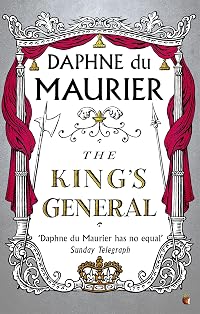
The King's General
by Daphne du Maurier
On This Page
Description
Honor Harris is only eighteen when she first meets Richard Grenvile, proud, reckless - and utterly captivating. But following a riding accident, Honor must reconcile herself to a life alone. As the English Civil war is waged across the country, Richard rises through the ranks of the army, marries and makes enemies, and Honor remains true to him. Decades later, an undaunted Sir Richard, now a general serving King Charles I, finds her. Finally they can share their passion in the ruins of her show more family's great estate on the storm-tossed Cornish coast-one last time before being torn apart, never to embrace again. show lessTags
Recommendations
































Member Reviews
Whenever I read a book by Daphne Du Maurier, I always want to go out and buy all of her books currently in print. Her books generally fall into two categories: suspense (like Rebecca or The Scapegoat); or historical fiction, like (Frenchman’s Creek or The King’s General); or something in between, like The House on the Strand.
The King’s General is set during the English Civil War. Honor Harris falls in love with Richard Grenvile, but her planned marriage to him falls short when she has a rising accident. Many years later, Richard is the King’s General in the West, and Honor is making shift at Menabilly, a house built and owned by the Rashleigh family. Daphne Du Maurier brings a piece of Cornish history to life as Richard and show more Honor’s stormy and often complicated relationship plays out.
Honor and Richard’s relationship isn’t what you might expect. It’s passionate, but at no time in the novel do they ever consummate it. Instead, everything is pretty much hidden under the surface, and there’s a lot that they don’t say about the past and what happened between them. I’m not sure why Honor cut him off completely after her accident, but it adds a lot of suspense to their relationship.
The historical parts of the novel are well researched, though there was a point in the middle where the plot suffered in favor of the Cornish rebellions. The novel is told from the Royalist point of view, but the author isn’t terribly partial to one side or another. There’s also a kind of mystery here, too, involving the house and mysterious visitors in the night and secret hiding spaces. It’s vintage Du Maurier, and she does this type of suspense very well in all of her novels.
Some really wonderful characters enhance the novel’s plot. Honor may be a cripple, but she’s not bitter about it, nor is she nostalgic for times gone by. She’s straightforward and honest, and she has a habit of listening in on conversations. Her crippled state makes people notice her less, and that’s why she’s the perfect character to narrate this story. I loved the tension between Honor and her sister-in-law, the grasping and selfish Gartred Grenvile, with whom she’s always playing literal and figurative games of Patience. Really, this is a well-written novel, and it’s now one of my favorite of Du Maurier’s novels. I wish Sourcebooks would reprint her books at a faster rate! Maybe they’ll reprint The Glass Blowers soon? show less
The King’s General is set during the English Civil War. Honor Harris falls in love with Richard Grenvile, but her planned marriage to him falls short when she has a rising accident. Many years later, Richard is the King’s General in the West, and Honor is making shift at Menabilly, a house built and owned by the Rashleigh family. Daphne Du Maurier brings a piece of Cornish history to life as Richard and show more Honor’s stormy and often complicated relationship plays out.
Honor and Richard’s relationship isn’t what you might expect. It’s passionate, but at no time in the novel do they ever consummate it. Instead, everything is pretty much hidden under the surface, and there’s a lot that they don’t say about the past and what happened between them. I’m not sure why Honor cut him off completely after her accident, but it adds a lot of suspense to their relationship.
The historical parts of the novel are well researched, though there was a point in the middle where the plot suffered in favor of the Cornish rebellions. The novel is told from the Royalist point of view, but the author isn’t terribly partial to one side or another. There’s also a kind of mystery here, too, involving the house and mysterious visitors in the night and secret hiding spaces. It’s vintage Du Maurier, and she does this type of suspense very well in all of her novels.
Some really wonderful characters enhance the novel’s plot. Honor may be a cripple, but she’s not bitter about it, nor is she nostalgic for times gone by. She’s straightforward and honest, and she has a habit of listening in on conversations. Her crippled state makes people notice her less, and that’s why she’s the perfect character to narrate this story. I loved the tension between Honor and her sister-in-law, the grasping and selfish Gartred Grenvile, with whom she’s always playing literal and figurative games of Patience. Really, this is a well-written novel, and it’s now one of my favorite of Du Maurier’s novels. I wish Sourcebooks would reprint her books at a faster rate! Maybe they’ll reprint The Glass Blowers soon? show less
I've been turning back to audiobooks recently. I listen VERY slowly (this 13 hour audiobook took me 3 weeks to listen to). But, it is a nice way to get to some books I might not otherwise make time for, and it's a nice way to spend my commute if I don't want silence (which is my norm).
Juliet Stevenson reads this book, which is the main reason I picked it. I love her reading style. This book is historical fiction that takes place during the English Civil War in the 1600s. It has a great cast of characters. The story is told by Honor Harris, a young woman who falls in love with Richard Grenville. They are planning to elope when Honor has a hunting accident and ends up crippled. This coincides with the beginning of the English Civil War. show more Honor and her friends and family are on the side of the King. She and Richard are separated, but their paths will continue to cross and their love will continue to grow through the dramatic war years. There are great details about the war, and also a sort of gothic mystery feel with a castle with a hidden room and a villain, Richard's beautiful sister, Gertrude.
I really enjoyed this and it worked so well on audio. show less
Juliet Stevenson reads this book, which is the main reason I picked it. I love her reading style. This book is historical fiction that takes place during the English Civil War in the 1600s. It has a great cast of characters. The story is told by Honor Harris, a young woman who falls in love with Richard Grenville. They are planning to elope when Honor has a hunting accident and ends up crippled. This coincides with the beginning of the English Civil War. show more Honor and her friends and family are on the side of the King. She and Richard are separated, but their paths will continue to cross and their love will continue to grow through the dramatic war years. There are great details about the war, and also a sort of gothic mystery feel with a castle with a hidden room and a villain, Richard's beautiful sister, Gertrude.
I really enjoyed this and it worked so well on audio. show less
In England, I imagine there are months devoted in history classes to the reign of Charles I and the rise of Oliver Cromwell, Parliament and Puritan rule--The English Civil War. In the States, it is almost a passing mention in an attempt to cram all of World History into a single year of study. I love the way a historical novel such as this one can help to painlessly fill the gaps in a wanting education.
Then, there is Cornwall. My ancestry is almost exclusively English, I have found through my genealogical research, and if asked I would swear that there is something planted in my DNA that links me to Cornwall. I love it that much. Of course, it might just be my choice of authors, among them Daphne du Maurier, who manage to take you show more there and make you feel it is home.
I have seen the shadows creep on an autumn afternoon from the deep Pridmouth Valley to the summit of the hill, and there stay a moment, waiting on the sun. I have seen, too, the white sea mists of early summer turn the hill to fantasy, so that it becomes, in a single second, a ghost land of enchantment, with no sound coming but the wash of breakers on the hidden beach, where at high noon, the children gather cowrie shells. Dark moods too, of bleak November, when the rain sweeps in a curtain from the southwest. But quietest of all, the evenings of late summer, when the sun has set, and the moon has not yet risen, but the dew is heavy in the long grass.
The magic of Daphne du Maurier is that she can take what would be a romance in the hands of another author and turn it into such a deeper, more meaningful tale, without losing one bit of the fire, passion or mystery. The King’s General is nothing if not romantic. On its surface, it is the story of two star-crossed lovers who lose their chance at happiness but are never willing or able to lose one another. I think it is no mistake that Richard Grenvile’s love should be named Honor Harris, however, for the importance of truth and honor is at an understanding of his heart and the heart of the novel.
Where I am from we despise the memory of Tucumseh Sherman, but he did say something very wise and true, “War is hell”. He probably wasn’t the first to say it. Many men who have watched the unnecessary loss of life and property in many a war must have said it, if only to themselves. It takes a particular kind of man to make a good soldier and only a very select group make great generals. The King’s General, Richard Grenvile, was such a man, and those kinds of men operate on honor, duty, and a willingness to do whatever must be done to win. Sherman burned Atlanta to the ground, Richard destroyed everything he should have held dear; both did it in the earnest belief that the cause they championed was the right one, the only one.
There are so many serious questions one encounters during the course of this novel. There are questions of love, what it should or can overlook in the beloved, what causes it to bloom and what keeps it alive, and if it is true, can it ever die? And what of bonds between fathers and sons? What does one owe the other? What is honor and can any act of contrition clear a dishonored man? What is strength? Physical prowess, mental sharpness, the willingness to die for something you believe in, the willingness to put everything you love at risk?
Daphne du Maurier answers some of these questions and leaves us pondering the others. In the process, she creates a host of characters that are unforgettable and gives us a glimpse of a war and a time that is all but forgotten. History is never so real as when you can put an individual experience to it, when the man hanging on the noose has a name and a smile, when the tomb that is sealed has a person inside and not just a name and dates on its stony surface. show less
Then, there is Cornwall. My ancestry is almost exclusively English, I have found through my genealogical research, and if asked I would swear that there is something planted in my DNA that links me to Cornwall. I love it that much. Of course, it might just be my choice of authors, among them Daphne du Maurier, who manage to take you show more there and make you feel it is home.
I have seen the shadows creep on an autumn afternoon from the deep Pridmouth Valley to the summit of the hill, and there stay a moment, waiting on the sun. I have seen, too, the white sea mists of early summer turn the hill to fantasy, so that it becomes, in a single second, a ghost land of enchantment, with no sound coming but the wash of breakers on the hidden beach, where at high noon, the children gather cowrie shells. Dark moods too, of bleak November, when the rain sweeps in a curtain from the southwest. But quietest of all, the evenings of late summer, when the sun has set, and the moon has not yet risen, but the dew is heavy in the long grass.
The magic of Daphne du Maurier is that she can take what would be a romance in the hands of another author and turn it into such a deeper, more meaningful tale, without losing one bit of the fire, passion or mystery. The King’s General is nothing if not romantic. On its surface, it is the story of two star-crossed lovers who lose their chance at happiness but are never willing or able to lose one another. I think it is no mistake that Richard Grenvile’s love should be named Honor Harris, however, for the importance of truth and honor is at an understanding of his heart and the heart of the novel.
Where I am from we despise the memory of Tucumseh Sherman, but he did say something very wise and true, “War is hell”. He probably wasn’t the first to say it. Many men who have watched the unnecessary loss of life and property in many a war must have said it, if only to themselves. It takes a particular kind of man to make a good soldier and only a very select group make great generals. The King’s General, Richard Grenvile, was such a man, and those kinds of men operate on honor, duty, and a willingness to do whatever must be done to win. Sherman burned Atlanta to the ground, Richard destroyed everything he should have held dear; both did it in the earnest belief that the cause they championed was the right one, the only one.
There are so many serious questions one encounters during the course of this novel. There are questions of love, what it should or can overlook in the beloved, what causes it to bloom and what keeps it alive, and if it is true, can it ever die? And what of bonds between fathers and sons? What does one owe the other? What is honor and can any act of contrition clear a dishonored man? What is strength? Physical prowess, mental sharpness, the willingness to die for something you believe in, the willingness to put everything you love at risk?
Daphne du Maurier answers some of these questions and leaves us pondering the others. In the process, she creates a host of characters that are unforgettable and gives us a glimpse of a war and a time that is all but forgotten. History is never so real as when you can put an individual experience to it, when the man hanging on the noose has a name and a smile, when the tomb that is sealed has a person inside and not just a name and dates on its stony surface. show less
A rollicking yarn based on real characters of English Civil War, with some running mysteries that keep one intrigued. Grenville comes across as a cold calculating bastard who insults everybody from top to bottom but has a soft streak for the narrator/heroine. The relationship strains belief somewhat ( unless you believe that woman really prefer awful men); she knows how bad he is and occasionally tries to restrain him. She's a helpless cripple after a youthful riding accident (with him) and i keep wondering what happened in their intimate moments. Early in the book it seems she's incapable of sex, but later on she describes herself as his lover and does go to bed with him (in the literal sense), and after all there are ways to have sex show more without the use of one's legs.The mechanics of the final closing of the hiding-place are also a bit hard to grasp.Characters, feelings, nature and military detail are admirably done. Exquisitely read by Juliet Stevenson ( not the edition listed by Lib Thing). show less
I had had this book on my shelf for quite a long time, bought it in impulse after having read Rebecca three years ago and having fallen in love with Du Maurier's captivating writing style.
I didn't seem to find the right moment to plunge into it, even more after the disappointment I had with "The loving spirit", Du Maurier's first novel.
Haven't I been losing time by reading far more mediocre books these past years!
The King's General is a book which has it all. A haunting castle which reminded me of Manderley quite dearly, a strong and unusual heroine, and a most-of-the-time hated hero. History, love and mystery mix together creating a unique setting for this novel.
Honor and Richard, a couple which are never truly together but who remain show more faithful to each other in their own ways. Honor Harris, the main character, falls in love with Richard, a soldier with dubious reputation, when she is barely eighteen. He is taken with her innocence and the way she looks at life, fair and strong willed in all her actions, Honor takes the best out of Richard.
When their life together is about to really start, Honor suffers an accident while horse riding and she is left crippled for the rest of her life, this misfortune making an even much stronger woman of her as she casts Richard away for his own sake, sacrificing her own happiness and getting prepared for a life of solitude, a punishment she is ready to bear, with pride and elegance.
What she isn't prepared for is to meet Richard, ten years after the accident, when he has become a key figure in the Civil War fighting for his King, and find her passion for him still alive. And Richard, much corrupted by time and bitterness finds his only calming balm in Honor's sensible reasoning and understanding.
Honor becomes then Richard's only and true confidant and plays an important role in the events that take place in Cornwall during the Civil War, taking in all of Richard's flaws with unconditional love and devotion, but always being true to her inner sense of justice.
I never thought I could enjoy a book about war and political strategy as much as I did enjoy this one.
Expect twists and turns and some lessons during this awesome ride, one you shouldn't miss for the world.
Don't wait anymore, go get it and read it on the spot! show less
I didn't seem to find the right moment to plunge into it, even more after the disappointment I had with "The loving spirit", Du Maurier's first novel.
Haven't I been losing time by reading far more mediocre books these past years!
The King's General is a book which has it all. A haunting castle which reminded me of Manderley quite dearly, a strong and unusual heroine, and a most-of-the-time hated hero. History, love and mystery mix together creating a unique setting for this novel.
Honor and Richard, a couple which are never truly together but who remain show more faithful to each other in their own ways. Honor Harris, the main character, falls in love with Richard, a soldier with dubious reputation, when she is barely eighteen. He is taken with her innocence and the way she looks at life, fair and strong willed in all her actions, Honor takes the best out of Richard.
When their life together is about to really start, Honor suffers an accident while horse riding and she is left crippled for the rest of her life, this misfortune making an even much stronger woman of her as she casts Richard away for his own sake, sacrificing her own happiness and getting prepared for a life of solitude, a punishment she is ready to bear, with pride and elegance.
What she isn't prepared for is to meet Richard, ten years after the accident, when he has become a key figure in the Civil War fighting for his King, and find her passion for him still alive. And Richard, much corrupted by time and bitterness finds his only calming balm in Honor's sensible reasoning and understanding.
Honor becomes then Richard's only and true confidant and plays an important role in the events that take place in Cornwall during the Civil War, taking in all of Richard's flaws with unconditional love and devotion, but always being true to her inner sense of justice.
I never thought I could enjoy a book about war and political strategy as much as I did enjoy this one.
Expect twists and turns and some lessons during this awesome ride, one you shouldn't miss for the world.
Don't wait anymore, go get it and read it on the spot! show less
I would not rate this as one of the stronger du Maurier novels. The love affair that runs through it I can only describe as unpleasant and dysfunctional. Honor Harris meets Richard Grenvile as a young woman (he is about 10 years older) and I think we are meant to believe that she has a strong personality to match his and that is why she falls for his seduction. However, I never really got that part of personality and Grenvile, despite Honor constantly thinking it is so, seems to have no redeeming features of goodness. He bullies her and offends just about everyone he ever encounters, including her whole extended family, and she makes excuses and follows him everywhere as he is on the Royalist side of the English Civil War and managing show more to annoy just about anyone he fights with. There were a whole series of plots and counterplots that never quite made sense and I was thoroughly sick of the Honor and Richard story by the time it was over. show less
This was historical fiction concerning The English Civil War. The story is beautifully told by the protagonist, Honor Harris, one-time love of Sir Richard Grenvile, the King's General in the West. (Cornwall) Du Maurier spins a great, but painful romance as well as exposing the psychological and emotional toll the war takes on the locals. I had to do some pre-reading to be able to really get into this novel as I wanted to understand more about the English Civil War. I was well prepared for this novel. I really enjoyed the author's end notes as she let the reader know what happened to every historical personage who had a part in the novel. One of the best reads thus far in 2024! 448 pages
Members
- Recently Added By
Lists

Favourite Virago Modern Classics
183 works; 38 members

Historical Fiction
889 works; 91 members

Publisher's Weekly Bestsellers - Part II - 1940 - 1979
355 works; 5 members

Books with Noble Titles
179 works; 11 members

Huxley's Reading Log 2019
24 works; 1 member

Historical Fiction Books
99 works; 5 members

United Kingdom and Ireland
37 works; 1 member

Library TBR
64 works; 1 member

Books Read in 2019
4,052 works; 108 members

Books Read in 2021
5,361 works; 113 members

THE WAR ROOM
813 works; 24 members
Best Audiobooks
240 works; 114 members

Books We Want To Read Again For The First Time
384 works; 160 members
Author Information

204+ Works 57,518 Members
Daphne Du Maurier was born in London on May 13, 1907 and educated in Paris. In 1932, she married Lieutenant-General Sir Frederick Browning. She began writing short stories of mystery and suspense for magazines in 1928, a collection of which appeared as The Apple Tree in 1952. Her first novel, The Loving Spirit, was published in 1931. Her tightly show more woven, highly suspenseful plots and her strong characters make her stories perfect for adaptation to film or television. Among her many novels that were made into successful films are Jamaica Inn (1936), Rebecca (1938), Frenchman's Creek (1941), Hungry Hill (1943), My Cousin Rachel (1952), and The Scapegoat (1957). Her short story, The Birds (1953), was brought to the screen by director Alfred Hitchcock in a treatment that has become a classic horror-suspense film. She died on April 19, 1989 at the age of 81. (Bowker Author Biography) show less
Some Editions
Awards and Honors
Distinctions
Series
Belongs to Publisher Series
Ullstein (98/99)
Virago Modern Classics (499)
Work Relationships
Is contained in
The Great West Country Novels : Frenchmans Creek, The House on the Strand, Jamaica Inn, The Kings General, My Cousin Rachel and Rebecca. by Daphne Du Maurier
Has the adaptation
Common Knowledge
- Canonical title
- The King's General
- Original title
- The King's General
- Original publication date
- 1946
- People/Characters*
- Honor Harris; Sir Richard Grenvile (The King's General)
- Important places
- Cornwall, England, UK
- Important events
- English Civil War
- Related movies
- Le général du roi (2014 | IMDb)
- Dedication
- To My Husband, also a general, but, I trust, a more discreet one
- First words
- September, 1653. The last of summer. The first chill winds of autumn. The sun no longer strikes my eastern window as I wake, but, turning laggard, does not top the hill before eight o'clock.
- Quotations*
- 'I hated you first. I like you better now,' I told him. 'It's hard that I had to make you vomit before I won your approval,' he answered. I laughed, and then fell to groaning again, for the swan was not entirely dissipated. '... (show all)Lean against my shoulder, so,' he said to me. 'Poor little one, what an ending to an eighteenth birthday.' I could feel him shake with silent laughter, and yet his voice and hands were strangely tender, and I was happy with him. (London/Paris: The Albatross 1949, p. 30)
- Last words
- (Click to show. Warning: May contain spoilers.)'One day,' I said, 'when the snow melts, when the thaw breaks, when the spring comes.'
*Some information comes from Common Knowledge in other languages. Click "Edit" for more information.
Classifications
- Genres
- Fiction and Literature, General Fiction, Historical Fiction, Romance
- DDC/MDS
- 823.912 — Literature & rhetoric English & Old English literatures English fiction 1900- 1901-1999 1901-1945
- LCC
- PZ3 .D8916 — Language and Literature Fiction and juvenile belles lettres Fiction and juvenile belles lettres Fiction in English
- BISAC
Statistics
- Members
- 1,298
- Popularity
- 18,710
- Reviews
- 32
- Rating
- (3.92)
- Languages
- 11 — Czech, Dutch, English, Finnish, French, German, Italian, Norwegian (Bokmål), Romanian, Russian, Swedish
- Media
- Paper, Audiobook, Ebook
- ISBNs
- 44
- UPCs
- 1
- ASINs
- 54