
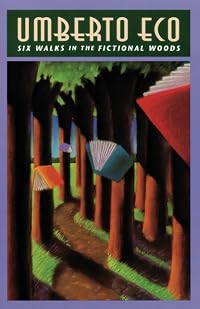
Six Walks in the Fictional Woods
by Umberto Eco
On This Page
Description
In six lectures covering everything from James Bond to antisemitic conspiracy theories, Umberto Eco offers a master class in the philosophy of fiction. Dissecting the rhythms and ambiguities of narrative, Eco illuminates fiction's intrusions into life, highlighting the ways that literary works conscript readers' experiences and expectations.Tags
Recommendations

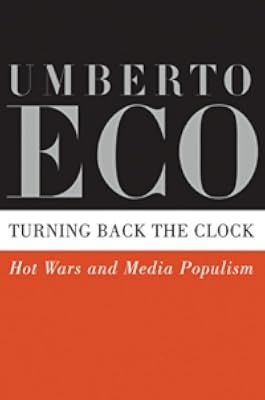
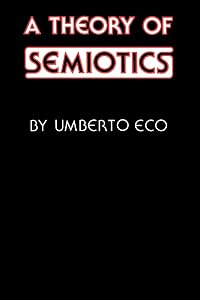
Member Reviews
Obviously I'm obsessed with Eco and nobody can stop me. Again, part of this is that he's extremely well-read and I like his taste and so I pick up his books looking for reading recommendations as much as anything else. Mostly what I picked up from this is that I've got to read [b:Sylvie|337463|Sylvie|Gérard de Nerval|https://d.gr-assets.com/books/1173854772s/337463.jpg|1444752] by Nerval and will do so probably in the fall.
It's great to just read about writing, to read about fiction, because really it's all I want to talk about in my day-to-day life. I like what Eco puts words around in regard to the reader's suspension of reality. How we'll accept any internally-consistent world, how we will trust the author and the story in a way we show more wouldn't outside of the novel. He analyses the rules and expectations of writing that make it work and the thing is that it's all stuff the reader implicitly knows. I was reminded of the course I took in cognitive linguistics where we spent ages discussing why the human brain understood something in a second. We know how stories work even if we have never tried to describe how we know, or what it is that we're responding to, or anything. I can see people feeling frustrated by an in-depth discussion of something that seems "obvious" or automatic, but I love it whether or not it matters.
I love the evocation of living within the works, how the places can take on their own reality. It really seems as if Eco paces through those fictional woods and that we go with him. I also love the discussion of characters that take on their own reality, as its something that's fascinated me for a while now. What is it that made those characters alive?
It's also interesting reading this book after having read [b:The Prague Cemetery|10314376|The Prague Cemetery|Umberto Eco|https://d.gr-assets.com/books/1327902035s/10314376.jpg|14511050], because in the final lecture you can see that he is heading very clearly towards that book, and might have already started writing it. show less
It's great to just read about writing, to read about fiction, because really it's all I want to talk about in my day-to-day life. I like what Eco puts words around in regard to the reader's suspension of reality. How we'll accept any internally-consistent world, how we will trust the author and the story in a way we show more wouldn't outside of the novel. He analyses the rules and expectations of writing that make it work and the thing is that it's all stuff the reader implicitly knows. I was reminded of the course I took in cognitive linguistics where we spent ages discussing why the human brain understood something in a second. We know how stories work even if we have never tried to describe how we know, or what it is that we're responding to, or anything. I can see people feeling frustrated by an in-depth discussion of something that seems "obvious" or automatic, but I love it whether or not it matters.
I love the evocation of living within the works, how the places can take on their own reality. It really seems as if Eco paces through those fictional woods and that we go with him. I also love the discussion of characters that take on their own reality, as its something that's fascinated me for a while now. What is it that made those characters alive?
It's also interesting reading this book after having read [b:The Prague Cemetery|10314376|The Prague Cemetery|Umberto Eco|https://d.gr-assets.com/books/1327902035s/10314376.jpg|14511050], because in the final lecture you can see that he is heading very clearly towards that book, and might have already started writing it. show less
This is my kind of book. That means that it combines reading with philosophy, providing the reader with enough thought-provoking moments and reading ideas to last half a lifetime. Add to that the wonder and beauty of the Umberto Eco's prose and you have a gem of a book. It is not surprising that this is another in the series of Charles Eliot Norton lectures that have given us great short works by such literary masters as Milosz, Steiner and Pamuk, to name only three. Eco's lessons include arguing that when reading fiction the author's biography is not relevant or suggesting that the reader be aware of the potential confusions of fiction and real life when reading. There are more lessons and examples in this short book than many longer show more ones, but that is just another sign of the quality of Eco's essays. I highly recommend this to serious and fun-loving readers everywhere. show less
As a student of literature who spent much time resenting teachers for their 'universal themes' approaches to classic works, it was with great delight and not a little surprise that I realized how much Eco had to say to me, the hardened anti-analytic cynic, about enjoying the layers of fiction.
More and more of my interactions with fiction are defined by the question of fact: what is 'fact' in this moment, what is 'real', who says it, do you trust that speaker, how do you explain it someone else... and that's where it gets fun and complex and the work of fiction that can hold up to such scrutiny is beloved for its steadfastness and courage in the face of simple story and language games. Eco's discussion of the multi-faceted nature of our show more interactions with fiction yielded up one other, highly illuminating observation.
He observes that we as people are far more emotionally attached to the 'truth' of fiction than to the 'truth' of history, a thought I keep company with as often as I can, as it reminds me very gently to be married to something other than a perception of the first sight of illusion. Real life is infinitely more complicated, but also more mutable and with far more possibilities for error. show less
More and more of my interactions with fiction are defined by the question of fact: what is 'fact' in this moment, what is 'real', who says it, do you trust that speaker, how do you explain it someone else... and that's where it gets fun and complex and the work of fiction that can hold up to such scrutiny is beloved for its steadfastness and courage in the face of simple story and language games. Eco's discussion of the multi-faceted nature of our show more interactions with fiction yielded up one other, highly illuminating observation.
He observes that we as people are far more emotionally attached to the 'truth' of fiction than to the 'truth' of history, a thought I keep company with as often as I can, as it reminds me very gently to be married to something other than a perception of the first sight of illusion. Real life is infinitely more complicated, but also more mutable and with far more possibilities for error. show less
The six related essays collected in this book are the Charles Eliot Norton Lectures (http://en.wikipedia.org/wiki/Charles_Eliot_Norton_Lectures) Eco delivered in 1993. I mostly enjoyed them, but I enjoyed the later ones more than I did the first. The earlier ones reminded me too much of the struggle I had with my philo esurvey course back in college. I expected that philosophers would use the rules of logic as tools so they could work effectively with some content they found worthy of attention. I was taught to look only at the form of the argument and assess the effectiveness of the logic, never mind the content. Since I had signed up for content, I was not terribly happy with the course.
Beginning with the first of these lecture show more essays, Eco talks about the goals of “model narrators” and “model readers”. Model readers are somewhat like model philosophy students, more engaged with the abstract intention of the author and the structure of the document than with the actual narrative content being read. They interrogate it rather than “go with the flow” of the narrative. Sounds painful.
My own idea of relationship with a piece of writing is one of conversation without abstraction of the details of either myself or the writer out of the discussion. I am not “… a voice without a body or sex or any history …” nor am I terribly interested in trying to fake it. I am not a “model reader”, I teeter back and forth between whole hearted engagement with the work as it is, on its own terms, and intruding myself, my life and my meanings into the conversation.
Nevertheless, as I continued through the essays, I began to engage more and more and found myself fascinated. Once Eco began talking about the permeable boundary between the real world and fiction and how fiction can invade and alter actual events, he had my attention. He included a fascinating discussion of the historic evolution of what are now known as The Protocols of the Learned Elders of Zion.
I will re-read this book and I am planning to continue to read both his fiction and his non-fiction. show less
Beginning with the first of these lecture show more essays, Eco talks about the goals of “model narrators” and “model readers”. Model readers are somewhat like model philosophy students, more engaged with the abstract intention of the author and the structure of the document than with the actual narrative content being read. They interrogate it rather than “go with the flow” of the narrative. Sounds painful.
My own idea of relationship with a piece of writing is one of conversation without abstraction of the details of either myself or the writer out of the discussion. I am not “… a voice without a body or sex or any history …” nor am I terribly interested in trying to fake it. I am not a “model reader”, I teeter back and forth between whole hearted engagement with the work as it is, on its own terms, and intruding myself, my life and my meanings into the conversation.
Nevertheless, as I continued through the essays, I began to engage more and more and found myself fascinated. Once Eco began talking about the permeable boundary between the real world and fiction and how fiction can invade and alter actual events, he had my attention. He included a fascinating discussion of the historic evolution of what are now known as The Protocols of the Learned Elders of Zion.
I will re-read this book and I am planning to continue to read both his fiction and his non-fiction. show less
Nominally a book about reading, this collection of six lectures by Umberto Eco also yields insight into writing. Philosophical, thought-provoking, but often funny, the lectures use literary examples from Dumas, Nerval and Flaubert, but also from Fleming and Christie. It considers the way fiction manipulates us, the way we use fiction, and even the ways we expect or force our world to conform to narrative. Fascinating.
Eco is quite good at explaining somewhat difficult concepts about fictional narratives and even adds a bit of humour. In the sixth talk, he reviews the history of the fictional 'Protocols of the Elders of Zion'. His book on the topic, 'The Prague Cemetery' came out later, so he must have been preparing it. I wish I had read this lecture before I read that book. Would have helped me understand it a bit better.
By reading narrative, we escape the anxiety that attacks us when we try to say something true about the world. -- Umberto Eco
Six Walks in the Fictional Woods records a series of lectures that Professor Eco delivered in 1993. The concern is narrative and the distance between fictional truth and actual or historical truth. This is but one target in the copse of topics. The ideal reader is but another. Joyce is quoted saying that the ideal reader for [b:Finnegans Wake|11013|Finnegans Wake|James Joyce|https://d202m5krfqbpi5.cloudfront.net/books/1336408055s/11013.jpg|322098] would have an ideal insomnia. There are also distinctions made between a level one read (pleasure seeker) and a second level of reader which is a more serious bent, one show more seeking verisimilitude amidst a tangle of symbols and allusions.
These are enjoyable tangents across the face of fiction, A scholar's wink to the necessity of narrative. Eco states so at the collection's conclusion. "It offers us the opportunity to employ limitlessly our faculties for perceiving the world and reconstructing the past." show less
Six Walks in the Fictional Woods records a series of lectures that Professor Eco delivered in 1993. The concern is narrative and the distance between fictional truth and actual or historical truth. This is but one target in the copse of topics. The ideal reader is but another. Joyce is quoted saying that the ideal reader for [b:Finnegans Wake|11013|Finnegans Wake|James Joyce|https://d202m5krfqbpi5.cloudfront.net/books/1336408055s/11013.jpg|322098] would have an ideal insomnia. There are also distinctions made between a level one read (pleasure seeker) and a second level of reader which is a more serious bent, one show more seeking verisimilitude amidst a tangle of symbols and allusions.
These are enjoyable tangents across the face of fiction, A scholar's wink to the necessity of narrative. Eco states so at the collection's conclusion. "It offers us the opportunity to employ limitlessly our faculties for perceiving the world and reconstructing the past." show less
Members
- Recently Added By
Lists

SHOULD Read Books!
354 works; 9 members

Italian Literature
556 works; 41 members
Author Information

504+ Works 115,299 Members
Umberto Eco was born in Alessandria, Italy on January 5, 1932. He received a doctorate of philosophy from the University of Turin in 1954. His first book, Il Problema Estetico in San Tommaso, was an extension of his doctoral thesis on St. Thomas Aquinas and was published in 1956. His first novel, The Name of the Rose, was published in 1980 and won show more the Premio Strega and the Premio Anghiar awards in 1981. In 1986, it was adapted into a movie starring Sean Connery. His other works include Foucault's Pendulum, The Island of the Day Before, Baudolino, The Prague Cemetery, and Numero Zero. He also wrote children's books and more than 20 nonfiction books including Serendipities: Language and Lunacy. He taught philosophy and then semiotics at the University of Bologna. He also wrote weekly columns on popular culture and politics for L'Espresso. He died from cancer on February 19, 2016 at the age of 84. (Bowker Author Biography) show less
All Editions
Some Editions
Series
Belongs to Publisher Series
Common Knowledge
- Canonical title*
- Zes wandelingen door fictieve bossen
- Original title
- Six Walks in the Fictional Woods
- Alternate titles*
- Seks turer i fortellingenes skoger
- Original publication date
- 1992-1993 (original English lectures) (original English lectures); 1994 (original publication in English) (original publication in English)
- First words
- I would like to begin by evoking the memory of Italo Calvino, who eight years ago was invited to give his six Norton lectures but who had time to write only five of them before leaving us.
- Quotations
- Děti si hrají s panenkami, koníky či pouštějí draky, aby se seznámily s fyzikálními zákony vesmíru a s prací, kterou budou jednoho dne skutečně vykonávat. Podobně tak číst fikci znamená hrát hru, jíž dÃ... (show all)¡váme smysl množství věcí, které se udály nebo se dějí či se stanou v reálném světě. Čtením vypravování unikáme úzkosti, která nás přepadne, když se snažíme sdělit něco pravdivého o tomto světě.
(s. 116-117)
knihách Meze interpretace a Interpretace a přílišná interpretace jsem trval na rozdílu mezi interpretováním textu a užíváním textu, avšak řekl jsem, že není zakázáno použít textu ke snění. V této před... (show all)nášce jsem „použil“ Tři mušketýry, abych mohl prožít vzrušující dobrodružství ve světě historie a učenosti. Musím přiznat, že jsem si vychutnával procházky pařížskými ulicemi, když jsem pátral po těch, které zmiňuje Dumas, a bavilo mne studovat plány města ze 17. století (mimochodem všechny byly velice nepřesné). S literárním textem si můžete dělat, co se vám zlíbí. Bavilo mě hrát si na paranoidního čtenáře a kontrolovat, jestli Paříž 17. století odpovídá Dumasovu popisu.
(s. 143) - Last words
- (Click to show. Warning: May contain spoilers.)But since life is cruel, for you and for me, here I am.
- Original language*
- Engels
*Some information comes from Common Knowledge in other languages. Click "Edit" for more information.
Classifications
Statistics
- Members
- 1,021
- Popularity
- 25,357
- Reviews
- 13
- Rating
- (3.98)
- Languages
- 19 — Catalan, Chinese, Czech, Dutch, English, Estonian, French, German, Greek, Hungarian, Italian, Norwegian (Bokmål), Norwegian, Polish, Portuguese, Romanian, Russian, Spanish, Turkish
- Media
- Paper, Audiobook, Ebook
- ISBNs
- 36
- ASINs
- 7