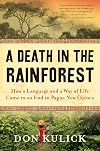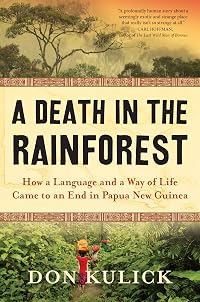
A Death in the Rainforest: How a Language and a Way of Life Came to an End in Papua New Guinea
by Don Kulick
On This Page
Description
As a young anthropologist, Kulick went to the tiny village of Gapun in New Guinea to document the death of the native language, Tayap. He arrived knowing that you can't study a language without understanding the daily lives of the people who speak it: how they talk to their children, how they argue, how they gossip, how they joke. Over the course of thirty years, he returned again and again to document Tayap before it disappeared entirely. Here he takes us inside the difficult-to-get-to show more village of two hundred people in the middle of a tropical rainforest. In doing so he looks at the impact of Western culture on the farthest reaches of the globe. -- adapted from jacket show lessTags
Recommendations
































Member Reviews
Fascinating, and very approachable story of Kulick's anthropological studies of a remote village in Papua New Guinea. The first half focuses on his work to document their unique, and probably soon to be extinct, language. The second half focuses more on recounting stories that are culturally significant, funny, or tell us interesting practical aspects of his stays in the village. Kulick is very grounded. He doesn't aim for inspiration, or to call out a tragedy. Yet his writing is solid, and the book is compulsively readable. I read it all at once; I could not put it down.
> I was surprised that a word for something as striking and lovely as a rainbow could somehow slip away from village memory … Old villagers' squabbles over the show more rainbow helped me to see how their inability to agree on proper Tayap was a feature of village life that was contributing to the language's demise. … In Gapun, nothing is communal, nothing is equally owned and shared by everyone. Everything—every area of land, every sago palm, every coconut palm, every mango tree, every pot, plate, ax, machete, discarded spear shaft, broken kerosene lamp, and every anything else one can think of—is owned by someone. This includes people's names and the right to bestow them, as well as knowledge of myths, songs, and curing chants. … In their own view, villagers don't "share" a language. Instead, each speaker owns his or her own version of the language. The older those speakers become, the more they regard their version as the proper one and everyone else's as a "lie." And so speakers are predisposed to not regard the loss of Tayap as particularly traumatic.
> Sadly, though, she and those other women are the last generation of Tayap speakers who will have the competence to be able to tell their husbands: "Stuff your sago into the opening of your friend's prick and get a thread and sew it up so he can carry it down to his village in his balls!" After them, all that will be left is "shitty ass" and "hole."
> When I lived in Gapun, I had spent a great deal of time explaining to the villagers that not all white people in the world know one another. They assumed they did. No, I would say, the countries are a lot bigger than Gapun and the surrounding villages. There are a lot of white people and we can't all know one another. It's impossible. Bill Foley was the first white person who came into Gapun since I had left fourteen years previously. The first question the villagers asked him was whether he knew me. "Sure I do," he answered cheerfully.
> As far as I was ever able to tell from the way villagers talk about the world, they all—and I really do mean all of them, including the ones who have been to school and who have seen maps and maybe even globes—imagine the world to be arranged in a kind of mystic arc, starting from under the ground of Papua New Guinea, the last country, progressively curving upwards towards Belgium, which borders on Heaven, and ending in Rome, the country where the Pope lives with Jesus and his mother, Mary, and her husband, God.
> The attack by rascals that left Kawri dead resulted in me abandoning my research in Papua New Guinea and not returning for almost fifteen years. The rumors that I would be robbed of everything I had at the end of my second long-term stay in 2009 led me to enlist a helicopter to pluck me out of the village like a raisin from a bun.
> The villagers' caregiving practices gave me pause at first: the blithe handing over of butcher knives to grasping babies; the continual ordering to fetch this, do that; the violent threats. Over time, though, I came to see that the style of caregiving practiced by Gapun mothers resulted in exceptionally capable and competent young children.
> The only people in the village I have ever observed beating a child—that is, holding the child by an arm and hitting him or her repeatedly with a straw broom, a stick, or, in one particularly egregious case, a bicycle chain that the child's father had acquired somewhere—were all men like Rafael who strongly identified as good Catholics, and who also spent a few years attending the primary school that used to exist in the neighboring village of Wongan. In my darkest moments, I sometimes think that the only practical knowledge that Christianity and Western education has given the villagers of Gapun is proficiency in how to beat their children. show less
> I was surprised that a word for something as striking and lovely as a rainbow could somehow slip away from village memory … Old villagers' squabbles over the show more rainbow helped me to see how their inability to agree on proper Tayap was a feature of village life that was contributing to the language's demise. … In Gapun, nothing is communal, nothing is equally owned and shared by everyone. Everything—every area of land, every sago palm, every coconut palm, every mango tree, every pot, plate, ax, machete, discarded spear shaft, broken kerosene lamp, and every anything else one can think of—is owned by someone. This includes people's names and the right to bestow them, as well as knowledge of myths, songs, and curing chants. … In their own view, villagers don't "share" a language. Instead, each speaker owns his or her own version of the language. The older those speakers become, the more they regard their version as the proper one and everyone else's as a "lie." And so speakers are predisposed to not regard the loss of Tayap as particularly traumatic.
> Sadly, though, she and those other women are the last generation of Tayap speakers who will have the competence to be able to tell their husbands: "Stuff your sago into the opening of your friend's prick and get a thread and sew it up so he can carry it down to his village in his balls!" After them, all that will be left is "shitty ass" and "hole."
> When I lived in Gapun, I had spent a great deal of time explaining to the villagers that not all white people in the world know one another. They assumed they did. No, I would say, the countries are a lot bigger than Gapun and the surrounding villages. There are a lot of white people and we can't all know one another. It's impossible. Bill Foley was the first white person who came into Gapun since I had left fourteen years previously. The first question the villagers asked him was whether he knew me. "Sure I do," he answered cheerfully.
> As far as I was ever able to tell from the way villagers talk about the world, they all—and I really do mean all of them, including the ones who have been to school and who have seen maps and maybe even globes—imagine the world to be arranged in a kind of mystic arc, starting from under the ground of Papua New Guinea, the last country, progressively curving upwards towards Belgium, which borders on Heaven, and ending in Rome, the country where the Pope lives with Jesus and his mother, Mary, and her husband, God.
> The attack by rascals that left Kawri dead resulted in me abandoning my research in Papua New Guinea and not returning for almost fifteen years. The rumors that I would be robbed of everything I had at the end of my second long-term stay in 2009 led me to enlist a helicopter to pluck me out of the village like a raisin from a bun.
> The villagers' caregiving practices gave me pause at first: the blithe handing over of butcher knives to grasping babies; the continual ordering to fetch this, do that; the violent threats. Over time, though, I came to see that the style of caregiving practiced by Gapun mothers resulted in exceptionally capable and competent young children.
> The only people in the village I have ever observed beating a child—that is, holding the child by an arm and hitting him or her repeatedly with a straw broom, a stick, or, in one particularly egregious case, a bicycle chain that the child's father had acquired somewhere—were all men like Rafael who strongly identified as good Catholics, and who also spent a few years attending the primary school that used to exist in the neighboring village of Wongan. In my darkest moments, I sometimes think that the only practical knowledge that Christianity and Western education has given the villagers of Gapun is proficiency in how to beat their children. show less
This is an easy read about the likeable members of a tribe in Papua, New Guinea. First of all, I have to give the author props for having the gumption to head into the darkest of rainforests (the only way to reach the village of Gapun is to traverse rivers and thick forests for hours) multiple times.
At first, the author’s statement that all Papuans not-so-secretly want to be white people was a bit off-putting. As I read further, I understood what he meant – they wanted to be successful, not necessarily turning their back on their race.
I also marveled at the author’s dedication to learning, then transcribing Tayap, the difficult language of Gapun. There are gender-related endings to words, which confused him in the beginning, but show more then he was able to create a large body of work describing the grammar and vocabulary of the Gapuners. Their language is slowly being replaced by one called Tok Pisin, which is a pidgin version of English. The lamentable reason for this loss of language is that the younger generations don’t wish to learn to speak Tayap – they feel that is for old people and choose to speak Tok Pisin instead. Once the elders of the tribe pass away, so will Tayap, preserved only in the author’s memory and his comprehensive body of work. That seems poignant to me; working so hard to preserve something that is vanishing before your very eyes. The fact that this language was confined to less than 500 humans at the time of writing is mind -boggling. Another poignant thought is that while these villagers were sharing their language with the author, they were also sharing the memories of their lives. As Kulick puts it: “Today, those recordings are all that remains of their stories, songs, and explanations”.
The author relates stories of his time in Gapun, complete with self-deprecating humor and details that will make you cringe (imagine eating grubs or maggots?) or make you smile ( an intrepid youngster dubs himself the “security” guarding the author and subsequently stays by his side zealously).
DEATH OF A LANGUAGE is a wonderfully written book that will make you think about many things -the loss of this language, the circle of life, and the strength of this anthropologist who devoted so much of his life to these villagers. show less
At first, the author’s statement that all Papuans not-so-secretly want to be white people was a bit off-putting. As I read further, I understood what he meant – they wanted to be successful, not necessarily turning their back on their race.
I also marveled at the author’s dedication to learning, then transcribing Tayap, the difficult language of Gapun. There are gender-related endings to words, which confused him in the beginning, but show more then he was able to create a large body of work describing the grammar and vocabulary of the Gapuners. Their language is slowly being replaced by one called Tok Pisin, which is a pidgin version of English. The lamentable reason for this loss of language is that the younger generations don’t wish to learn to speak Tayap – they feel that is for old people and choose to speak Tok Pisin instead. Once the elders of the tribe pass away, so will Tayap, preserved only in the author’s memory and his comprehensive body of work. That seems poignant to me; working so hard to preserve something that is vanishing before your very eyes. The fact that this language was confined to less than 500 humans at the time of writing is mind -boggling. Another poignant thought is that while these villagers were sharing their language with the author, they were also sharing the memories of their lives. As Kulick puts it: “Today, those recordings are all that remains of their stories, songs, and explanations”.
The author relates stories of his time in Gapun, complete with self-deprecating humor and details that will make you cringe (imagine eating grubs or maggots?) or make you smile ( an intrepid youngster dubs himself the “security” guarding the author and subsequently stays by his side zealously).
DEATH OF A LANGUAGE is a wonderfully written book that will make you think about many things -the loss of this language, the circle of life, and the strength of this anthropologist who devoted so much of his life to these villagers. show less
A non-traditional telling of a very traditional anthropological experience. For multiple many-month stints since the 1980s, Don Kulick hiked and canoed his way deep into the Papua New Guinean swamp to live among villagers whose endangered language tipped over to unrecoverable. He explains the trajectory of and reasons for the language's death, which are rooted deeply in the local culture, and he provides colorful descriptions of that culture, entirely lacking the usual studied neutrality of anthropology.
Highly entertaining and itself potentially of anthropological interest, this book is a captivating account of people and beliefs in contact with an outside world that has left them behind, of which Kulick himself is a privileged show more representative. Some of the most interesting cultural accounts to me are those of the villagers' attitude toward children -- the surly first words that villagers hear in their babies' babbling, the highly capable children who handle knives from the moment they can grasp, the association of both children and the village's native language Tayap with animalistic urges compared to the association of maturity and the regional pidgin with reason, and so on.
Fascinating material, engagingly written. We don't have that many more "uncontacted" regions left, much less regions that have had an anthropologist embedded to watch an entire generation grow up and raise children of its own. This book is likely to stand as one of the only and the last non-academic accounts of a substantial cultural shift toward regional (and eventually worldwide?) monocultures. show less
Highly entertaining and itself potentially of anthropological interest, this book is a captivating account of people and beliefs in contact with an outside world that has left them behind, of which Kulick himself is a privileged show more representative. Some of the most interesting cultural accounts to me are those of the villagers' attitude toward children -- the surly first words that villagers hear in their babies' babbling, the highly capable children who handle knives from the moment they can grasp, the association of both children and the village's native language Tayap with animalistic urges compared to the association of maturity and the regional pidgin with reason, and so on.
Fascinating material, engagingly written. We don't have that many more "uncontacted" regions left, much less regions that have had an anthropologist embedded to watch an entire generation grow up and raise children of its own. This book is likely to stand as one of the only and the last non-academic accounts of a substantial cultural shift toward regional (and eventually worldwide?) monocultures. show less
As a linguist trained in language documentation and revitalization, I was interested in anthropologist's view of language decline. This book is meant for a general audience, so it's not one of his academic works. I think I'd rather read one of his academic works on Tayap, but this is what my library has. Overall, I thought it was a quite uneven description of Kulick's time spent with the inhabitants of Gapun, a village where the language Tayap is in decline.
Kulick identifies as an anthropologist - not a linguistic anthropologist - but one of his main purposes in commencing fieldwork in Papua New Guinea was to document the Tayap language, so one can assume he has substantial training in linguistics. He clearly doesn't hold linguists in show more high esteem, however, because he has nothing good to say about linguists anywhere in the entire book. He repeatedly claims that linguists believe this or that outdated theory about language death/shift (but he, of course, would never think that). When I started graduate studies in language revitalization nearly two decades ago, all the issues he claims linguists ignore were already either well accepted or hotly debated and had been for decades. If he really thinks linguists researching language death do so without concern for the societies which speak them, he's been living under a rock. He's either unaware of common themes in his own purported subfield or he's purposely misrepresenting linguistics to make himself look better. Neither reflects well on the author.
The most puzzling is a section where he says that the children of Gapun couldn't possibly be making a choice to use Tok Pisin instead of their ancestral language, Tayap, because children aren't capable of that. Uh... yes, they are. There's a substantial body of research that shows even infants are capable of differentiating languages they hear around them, and that they show preferences between languages to boot. They may not consciously choose to reject one language over another, but they certainly have preferences. Just a few months ago, my own (then) 3-year-old child started making statements that he didn't want to speak Greek, just "normal" (English), and he's almost entirely stopped attempting to interact in Greek. For an entire book about the reasons why a village has stopped using its traditional language, I think it's pretty inexcusable for the author to make such a glaring mistake. (Not that I think the children of Gapun are to blame for the loss of their language. It's a complicated situation with many underlying causes. I just want an author who doesn't present linguistic information contrary to linguistic knowledge.)
There's a lot of interesting information here, especially about how language shift has played out in Gapun in the last 100 years or so. Just don't expect the author's statements about linguistics to be all that accurate (unfortunately). show less
Kulick identifies as an anthropologist - not a linguistic anthropologist - but one of his main purposes in commencing fieldwork in Papua New Guinea was to document the Tayap language, so one can assume he has substantial training in linguistics. He clearly doesn't hold linguists in show more high esteem, however, because he has nothing good to say about linguists anywhere in the entire book. He repeatedly claims that linguists believe this or that outdated theory about language death/shift (but he, of course, would never think that). When I started graduate studies in language revitalization nearly two decades ago, all the issues he claims linguists ignore were already either well accepted or hotly debated and had been for decades. If he really thinks linguists researching language death do so without concern for the societies which speak them, he's been living under a rock. He's either unaware of common themes in his own purported subfield or he's purposely misrepresenting linguistics to make himself look better. Neither reflects well on the author.
The most puzzling is a section where he says that the children of Gapun couldn't possibly be making a choice to use Tok Pisin instead of their ancestral language, Tayap, because children aren't capable of that. Uh... yes, they are. There's a substantial body of research that shows even infants are capable of differentiating languages they hear around them, and that they show preferences between languages to boot. They may not consciously choose to reject one language over another, but they certainly have preferences. Just a few months ago, my own (then) 3-year-old child started making statements that he didn't want to speak Greek, just "normal" (English), and he's almost entirely stopped attempting to interact in Greek. For an entire book about the reasons why a village has stopped using its traditional language, I think it's pretty inexcusable for the author to make such a glaring mistake. (Not that I think the children of Gapun are to blame for the loss of their language. It's a complicated situation with many underlying causes. I just want an author who doesn't present linguistic information contrary to linguistic knowledge.)
There's a lot of interesting information here, especially about how language shift has played out in Gapun in the last 100 years or so. Just don't expect the author's statements about linguistics to be all that accurate (unfortunately). show less
The author set out to document a dying language that had never been documented. He learns the pidgin English of Papua New Guinea and with that as a verbal Rosetta Stone he goes to a remote village where the last two hundred people (or much less since the young do not care to learn or even pass on the language to their progeny) speak their own unique language. He interviews the most elderly - they have already forgotten their word for rainbow- and desperately tries to capture the vocabulary, grammar, idioms, etc for posterity before its too late. All the while he tries-and succeeds- to hold his nose and avoid passing judgement on the abject ignorance and gullibility of his subjects’, e. g., the natives think white people are the show more spirits of dead natives and have arrived in New Guinea via an extension of the New York subway. He gets in quite a few zingers consistently through the course of the book without offending anyone. At the end he recounts a letter given to him to take back home to a person he knows he cannot find; its essentially a wish list from a child to Santa Claus. But after repeatedly lambasting the villagers for succumbing to con artists the author does so himself. This is one of those books that is a snapshot of a culture that will soon be lost. show less
Moving account of a linguist’s many trips to a tribe in remote Papua New Guinea and his search to understand why their unique language was dying out. In the end I found it to be incredibly sad, the villagers’ hard often brutalised lives and their attempts to achieve positive change in their lives which usually made things worse. However, perhaps I should also be inspired by Don Kulick’s exhortation to learn from the villagers and their culture.
I don't usually think of myself as a reader of anthropological nonfiction, but I found this book engrossing. It was well-written, entertaining, and enjoyably educational. I would definitely recommend if you have any interest on languages, cultures, and how the two intertwine.
Members
- Recently Added By
Lists

Recommend the 20 best books you've read in the last five years
2,168 works; 601 members
Author Information

11+ Works 617 Members
Awards and Honors
Awards
Classifications
- Genres
- Anthropology, Nonfiction, General Nonfiction, Biography & Memoir
- DDC/MDS
- 305.8009957 — Society, government, & culture Social sciences, sociology & anthropology Social group - Age, Gender, Ethnicity Ethnic and national groups standard subdivisions / Ethnic and national groups with ethnic origins from more than one continent, of European descent standard subdivisions Biography And History Pacific New Guinea
- LCC
- GN671 .N5 .K845 — Geography, Anthropology and Recreation Anthropology Anthropology Ethnology. Social and cultural anthropology Ethnic groups and races By region or country
- BISAC
Statistics
- Members
- 129
- Popularity
- 253,754
- Reviews
- 11
- Rating
- (3.96)
- Languages
- English
- Media
- Paper, Audiobook, Ebook
- ISBNs
- 5
- ASINs
- 2