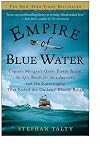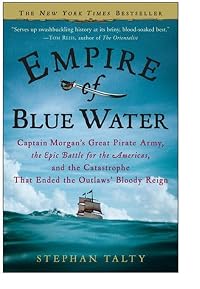
Empire of Blue Water: Captain Morgan's Great Pirate Army, the Epic Battle for the Americas, and the Catastrophe That Ended the Outlaws' Bloody Reign
by Stephan Talty
On This Page
Description
The real story of the pirates of the Caribbean. Henry Morgan, a twenty-year-old Welshman, crossed the Atlantic in 1655, hell-bent on making his fortune. Over the next three decades, his exploits in the Caribbean as a privateer in the service of the English became legendary. His daring attacks on the mighty Spanish Empire on land and at sea determined the fates of kings and queens, and his victories helped shape the destiny of the New World. Morgan gathered disaffected European sailors and show more soldiers, hard-bitten adventurers, runaway slaves, and vicious cutthroats, and turned them into the most feared army in the Western Hemisphere. They terrorized Spanish merchant ships and devastated the cities where great riches in silver, gold, and gems lay waiting. His last raid, a daring assault on the fabled city of Panama, helped break Spain's hold on the Americas forever.--From publisher description. show lessTags
Recommendations








Member Recommendations
DistortedSmile An awesome collection of imagery from the days of sailing the high seas!
Member Reviews
This is very engaging history of the The Brethren, Capt. Henry Morgan's real Pirates of the Caribbean. Along with the drama of a fireship ruse and a city-destroying earthquakes, it is interesting the actuality of buccaneer life. Rather than a criminal navy, they were more like a criminal marine corps: ships were a conveyance to get them to coastal settlements and departure points for laying siege, such as the pivotal struggle for Panama City having marched over 50 miles inland.
While it is not develed into detail, buccaneer psychology is partly analyzed. Why did they continue after even having money, instead choosing to be profligate and tying themselves to their lives of kidnapping, slaving, ransoming, torture, and theft. It actually show more appears they were an anarchistic collective of murderous sociopaths. show less
While it is not develed into detail, buccaneer psychology is partly analyzed. Why did they continue after even having money, instead choosing to be profligate and tying themselves to their lives of kidnapping, slaving, ransoming, torture, and theft. It actually show more appears they were an anarchistic collective of murderous sociopaths. show less
Seriously, pirates. I don’t know when, where or how my love of them began, maybe all little kids are born with a fascination of the pirate’s life. From Peter Pan’s arch-nemesis Captain Hook to Will Turner in the first Pirates of the Caribbean to Alvilda, the protagonist of my current writing project who is based on the Viking pirate princess Alfhild, my love runs deep. When a coworker first told me about Cinnamon & Gunpowder, I jumped at the chance to read it for the sole reason that it featured a female pirate! Everywhere that I’ve traveled from the Outer Banks in North Carolina to Nassau in the Bahamas, I have visited each locale’s respective pirate attractions and museums.
In addition to pirates, I also love a good show more non-fiction book that can be affectionately referred to as “novelistic nonfiction” as exemplified by Erik Larson, among other authors. Talty’s prose also falls into the subgenre of nonfiction. I find that, as a bookseller, when I recommend nonfiction to primarily fiction readers, this trait is ideal. The pages turn quickly, the action moves at a good clip and the book holds the readers interest. Gone are the days of nonfiction being judged as dry and without character – half the time when reading I have to remind myself that the people in Empire of Blue Water are/were real people – not characters. Though when referencing Henry Morgan, the myths about him are hard to ignore.
Additionally, Empire of Blue Water is not just about Henry Morgan, but about a great many other pirates who lived and raided around the same time, as well as the political culture of the colonies in the Caribbean, South, Central & North America. It is a fascinating and compelling read, and, of course, PIRATES! show less
In addition to pirates, I also love a good show more non-fiction book that can be affectionately referred to as “novelistic nonfiction” as exemplified by Erik Larson, among other authors. Talty’s prose also falls into the subgenre of nonfiction. I find that, as a bookseller, when I recommend nonfiction to primarily fiction readers, this trait is ideal. The pages turn quickly, the action moves at a good clip and the book holds the readers interest. Gone are the days of nonfiction being judged as dry and without character – half the time when reading I have to remind myself that the people in Empire of Blue Water are/were real people – not characters. Though when referencing Henry Morgan, the myths about him are hard to ignore.
Additionally, Empire of Blue Water is not just about Henry Morgan, but about a great many other pirates who lived and raided around the same time, as well as the political culture of the colonies in the Caribbean, South, Central & North America. It is a fascinating and compelling read, and, of course, PIRATES! show less
The Romantic Age of Piracy (as opposed to the "Golden Age", which is now) is the stuff of legend and Hollywood epics. In reality, it came about as a means to wage wars by proxy when treaties interfered with direct military conflict. The unlikely Spanish Empire grew large and fat on treasures from the Americas, and relieving them of this source of wealth allowed poor nations such as England to compete as a world power.
Rather than condone piracy outright, Britain, France and others commissioned "privateer" ships; privately owned ships where the captain is given a Letter of Marque allowing him to legally prey upon enemies of the state. This legal distinction may or may not save the captain and crew from execution because of piracy. Some of show more the revenue brought in was staggering, however, there was not much affinity between the buccaneers (named for a dried meat the were fond of stocking) and the governments that originally instigated their activities. Sure, there were some plain-old scoundrels, but a pirate ship was a very democratic thing and the captain's authority was entirely on the sufferance of the crew.
Which makes the activities of Captain Henry Morgan all the more remarkable. Bearing authority from the British government, he waged a privateering war against Spain. More remarkable, and something I hadn't heard of, was his leading an actual pirate army on a campaign on the isthmus of Panama. Despite suffering hardships and supply shortages, the pirate army succeeded in combating inferior Spanish forces, resulting in entire towns paying massive ransoms for the pirates to simply go away.
Empire of Blue Water is not a romantic, swashbuckling tale but it is a fascinating look at the political aspects of the institution of piracy in the Caribbean during colonial times. show less
Rather than condone piracy outright, Britain, France and others commissioned "privateer" ships; privately owned ships where the captain is given a Letter of Marque allowing him to legally prey upon enemies of the state. This legal distinction may or may not save the captain and crew from execution because of piracy. Some of show more the revenue brought in was staggering, however, there was not much affinity between the buccaneers (named for a dried meat the were fond of stocking) and the governments that originally instigated their activities. Sure, there were some plain-old scoundrels, but a pirate ship was a very democratic thing and the captain's authority was entirely on the sufferance of the crew.
Which makes the activities of Captain Henry Morgan all the more remarkable. Bearing authority from the British government, he waged a privateering war against Spain. More remarkable, and something I hadn't heard of, was his leading an actual pirate army on a campaign on the isthmus of Panama. Despite suffering hardships and supply shortages, the pirate army succeeded in combating inferior Spanish forces, resulting in entire towns paying massive ransoms for the pirates to simply go away.
Empire of Blue Water is not a romantic, swashbuckling tale but it is a fascinating look at the political aspects of the institution of piracy in the Caribbean during colonial times. show less
Have you ever wanted to know the truth about the Pirates of the Caribbean?
Have you ever wondered the difference between a pirate, a privateer, and a buccaneer?
Did you question how Captain Henry Morgan could have been both a pirate and a knight?
Have you ever heard of the great earthquake that occurred in Port Royal, Jamaica, in 1692?
This book provides the answers to these queries and more. The author has found an impressive number of primary sources from which to draw information. Talty is particularly adept at describing the vicious battles initiated by the pirates in their insatiable desire for plunder. He does not shy away from describing the cruelty, torture, and debauchery of a piratical life. One wonders how these criminals can be show more as romanticized as they are in entertainment.
Talty provides an in-depth biography of Morgan (1635-1688), while also imparting a wealth of information on English, Spanish, and French history. The reader learns details about battles on the Spanish Main, including Granada, Portobelo, Maracaibo, and Panama. It explains the reasons behind the rise and fall of the pirates under Morgan. I found it gripping, informative, and eye-opening. show less
Have you ever wondered the difference between a pirate, a privateer, and a buccaneer?
Did you question how Captain Henry Morgan could have been both a pirate and a knight?
Have you ever heard of the great earthquake that occurred in Port Royal, Jamaica, in 1692?
This book provides the answers to these queries and more. The author has found an impressive number of primary sources from which to draw information. Talty is particularly adept at describing the vicious battles initiated by the pirates in their insatiable desire for plunder. He does not shy away from describing the cruelty, torture, and debauchery of a piratical life. One wonders how these criminals can be show more as romanticized as they are in entertainment.
Talty provides an in-depth biography of Morgan (1635-1688), while also imparting a wealth of information on English, Spanish, and French history. The reader learns details about battles on the Spanish Main, including Granada, Portobelo, Maracaibo, and Panama. It explains the reasons behind the rise and fall of the pirates under Morgan. I found it gripping, informative, and eye-opening. show less
Who doesn't love pirates?
- How are they not stumbling drunk all of the time? I assume that some of them were, but they also had to get things done occasionally, and I'm not sure how they consumed that much rum and still kept the ship right side up.
- What happened to the Spanish? I understand their king for much of the Morgan years was a grossly deformed madman, but its like they just gave up. The empire is terribly managed in a lot of ways. It is easy to criticize and hard to do, but there seem to be a lot of areas in which they could have improved.
- Why are there not petty kingdoms forming in the Americas? It seems like a gang or well armed hooligans could set up shop and rule over a big swathe of territory and possibly pass show more unnoticed if they stayed away from highly visible spots.
- The pirates seem to have had a high degree of racial and ethnic harmony. There were white pirates, Indian pirates, black pirates, and every mixture of the three. It probably wasn't always rosy, but it seems pretty progressive that a free black man could serve alongside whites and collect an equal share of the loot at the same time that slavery was legal throughout the Americas. Were pirates getting jumped in back alleys and sold as slaves? show less
- How are they not stumbling drunk all of the time? I assume that some of them were, but they also had to get things done occasionally, and I'm not sure how they consumed that much rum and still kept the ship right side up.
- What happened to the Spanish? I understand their king for much of the Morgan years was a grossly deformed madman, but its like they just gave up. The empire is terribly managed in a lot of ways. It is easy to criticize and hard to do, but there seem to be a lot of areas in which they could have improved.
- Why are there not petty kingdoms forming in the Americas? It seems like a gang or well armed hooligans could set up shop and rule over a big swathe of territory and possibly pass show more unnoticed if they stayed away from highly visible spots.
- The pirates seem to have had a high degree of racial and ethnic harmony. There were white pirates, Indian pirates, black pirates, and every mixture of the three. It probably wasn't always rosy, but it seems pretty progressive that a free black man could serve alongside whites and collect an equal share of the loot at the same time that slavery was legal throughout the Americas. Were pirates getting jumped in back alleys and sold as slaves? show less
Objective account of the career of Henry Morgan, pirate, privateer, lieutenant governor of Jamaica, model for Captain Blood, and posthumous rum salesman. “Larger than life” seems very trite yet very appropriate; Morgan managed to sack Portobello and Panama in the face of numerically superior enemy forces, and escaped from an inescapable ambush in Maracaibo Bay, seemingly just by believing he could. The other interesting character is the city of Port Royal, supposedly the wickedest city in the Western Hemisphere and inhabited by a variety of people eager to part successful pirates from their loot. Background includes the histories of 17th century Spain and England and the personalities of the major statesmen of both places. Author show more Stephen Talty introduces a fictional English pirate ordinary seamen to emphasize day-to-day pirate life was not all chests of doubloons and ladies of negotiable virtue; this doesn’t quite seem to fit in tone with the rest of the book, but isn’t really objectionable. Port Royal’s demise is Biblical, as the inhabitants get to discover why it’s a bad idea to build a coastal city on saturated sand in an earthquake and tsunami zone. Ironically, Morgan wasn’t spared, despite being deceased; compression waves popped his coffin out of the ground and the following tsunami washed it out to sea, never to be seen again. Perhaps he would have preferred it that way.
This would be a good book for younger readers enthused by Pirates of the Caribbean, as an example of how truth can be more exciting than fiction; you might want to be prepared to explain what a matelote is, though. show less
This would be a good book for younger readers enthused by Pirates of the Caribbean, as an example of how truth can be more exciting than fiction; you might want to be prepared to explain what a matelote is, though. show less
A well researched and thorough biography of English privateer Henry Morgan.
I appreciated the context provided within the first few chapters, i.e., the relations between Spain and England and the ongoing conflicts over New World holdings. The discussion of the significant differences between the Spanish hierarchical method as contrasted with the English freewheeling privateers was interesting as well. The final chapter on the earthquake which destroyed Port Royal was also appreciated.
Inexplicably, while the majority of the book describes Morgan’s numerous campaigns, at some point my attention started to wander. Each campaign seemed a bit too much like another. Also, what seems to be the case with all books concerning pirates, while the show more real life adventures were incredible by any standards, the author decided to include unnecessary exaggeration.
Nonetheless, a good book and an interesting read. show less
I appreciated the context provided within the first few chapters, i.e., the relations between Spain and England and the ongoing conflicts over New World holdings. The discussion of the significant differences between the Spanish hierarchical method as contrasted with the English freewheeling privateers was interesting as well. The final chapter on the earthquake which destroyed Port Royal was also appreciated.
Inexplicably, while the majority of the book describes Morgan’s numerous campaigns, at some point my attention started to wander. Each campaign seemed a bit too much like another. Also, what seems to be the case with all books concerning pirates, while the show more real life adventures were incredible by any standards, the author decided to include unnecessary exaggeration.
Nonetheless, a good book and an interesting read. show less
Members
- Recently Added By
Lists

Books Read in 2013
1,630 works; 51 members

r/AskHistorians' Recommended Books
1,068 works; 19 members
Author Information

20+ Works 2,684 Members
Stephan Talty is the best-selling author of The Black Hand and Agent Garbo, and coauthor of A Captain's Duty. His books have been made into two films, the Oscar-winning Captain Phillips and Only the Brave. He lives outside New York City with his family.
Common Knowledge
- People/Characters
- Henry Morgan; Don Juan Perez de Guzman; Philip IV, King of Spain; Manuel Rivero Pardal; Dr. Hans Sloane; Alexander VI, Pope (Rodrigo de Borja, 1431-1503) (show all 87); Lord Arlington; Don Cristobal Arnaldo y Sassi; Philip Ashton; William Beeston (Sir); Blackbeard / Edward Teach / Edward Thatch; Anne Bonny; Don Agustín de Bracamonte; Joseph Bradley; Fernand Brandel; Edward Browne; Richard Browne; Robert Burton; Don Alonzo de Campos y Espinosa; Mary Carleton; Carlos II, King of Spain; Catherine of Braganza; Miguel de Cervantes; Charles II, King of England, Scotland, and Ireland; Winston Churchill; Winston Churchill; Edward Collier; Cuthbert Collingwood (Admiral); Christopher Columbus; Thomas Companella; Hernán Cortés; José Crespo; Oliver Cromwell; William Dampier; René Descartes (1596-1650); Richard Dobson; Sir Francis Drake; Peter Earle; Elizabeth I, Queen of England; Edward Ellyn; John Esquemeling; John Evelyn; Ferdinand II of Aragon; John Fillmore; William Fogg; François I, King of France; Sir John Gage; Thomas Gage; Thomas Gauldy; William Godolphin; Francisco González Salado; Ulysses S. Grant; Edmund Halley; Francisco de Harro; Dr. Heath; Henrietta Maria, Queen Consort of England, Scotland, and Ireland; Henry VIII, King of England; Diego Huallpa; William Jackson; Captain Johnson; Don Juan José de Austria; Joseph Knapman (Captain); Charles Leslie; Don Pedro de Lisardo; Francis L'Ollonais; Captain Low; Raveneau de Lussan; Sir Thomas Lynch; Niccolò Machiavelli; Juan de Mallvegui (Sergeant); Jorge Manrique; Edward Mansfield; Mariana (queen regent of Spain); Don Francisco de Marichalar; Cotton Mather; Prince Maurice; William Maurice; Giuseppe Mercalli; John Milton; Christopher Mings; Sir Thomas Modyford; Conde de Molina; Christopher Monck, 2nd Duke of Albemarle; George Monck, 1st Duke of Albemarle; Elizabeth Morgan; John Morris; Father Nithard
- Important places
- Atlantic Ocean; Barbados; Boston, Massachusetts, USA; Caribbean Region; Caribbean Sea; Cartagena, Murcia, Spain (show all 24); Costa Rica; Cuba; England, UK; Gibraltar; Grenada; Hispaniola; Jamaica; Madagascar; Maracaibo, Venezuela; Massachusetts, USA; North Atlantic Ocean; Panama; Portobelo, Costa Rica; Port Royal, Jamaica; Portugal; Puerto del Principe, Cuba; Spain; Venezuela
- Important events
- Anglo-Spanish War (1585 | 1604); Age of Sail
- Epigraph
- Impious was the man who first spread sail and braved the dangers of the frantic deep.
Augustus - Original language
- English
Classifications
- Genres
- History, Nonfiction, General Nonfiction, Biography & Memoir
- DDC/MDS
- 972.904 — History & geography History of North America Mexico, Central America, West Indies, Bermuda West Indies (Antilles) and Bermuda; Caribbean West Indies (Antilles) and Bermuda; Caribbean
- LCC
- F2161 .T35 — Local History of the United States, Canada and Latin America Latin America. Spanish America Caribbean area. Caribbean Sea
- BISAC
Statistics
- Members
- 786
- Popularity
- 35,671
- Reviews
- 23
- Rating
- (3.71)
- Languages
- English
- Media
- Paper, Audiobook, Ebook
- ISBNs
- 12
- ASINs
- 10