
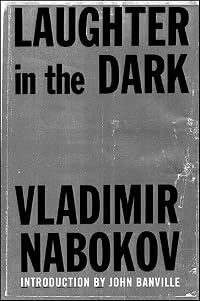
Laughter in the Dark
by Vladimir Nabokov
On This Page
Description
Albinus, a respectable, middle-aged man and aspiring filmmaker, abandons his wife for a lover half his age: Margot, who wants to become a movie star herself. When Albinus introduces her to Rex, an American movie producer, disaster ensues. What emerges is an elegantly sardonic and irresistibly ironic novel of desire, deceit, and deception, a curious romance set in the film world of Berlin in the 1930s.Tags
Recommendations

















Member Recommendations
Member Reviews
As the narrator of Laughter in the Dark notes, “although there is plenty of space on a gravestone to contain…a man’s life, detail is always welcome.” Here the details of the life and death of Albert Albinus begin with smug self satisfaction and ennui, degrade into unrequited lust, collapse in fits of self delusion, farce, and debauchery, and end in self recrimination, cuckoldry, and murder. And while you might have been just as enriched by the tombstone version of his life, there is something of a brisk tour-de-force in Nabokov’s willingness to give himself over to the absurdities of his plot and, more especially, of his characters.
Albert is a middle-aged man in Berlin between the wars, who is comfortably middle-class. But his show more predilection is for very young women — very young — and despite restraining that impulse throughout his marriage to Elizabeth, he is tempted when he encounters young Margot ushering at a local cinema. To Albert she is all that innocence implies. Alas, Margot is far less, or more, and quickly settles on Albert as her ticket out of poverty and possibly into life on the other side of the silver screen. It’s all a bit sordid but mundane. However, when Margot’s first and only true love, Axel, turns up, complications ensue. Fortunately Axel is quite willing to borrow Margot’s affection at Albert’s expense and their shenanigans engender the laughter in the dark of the title.
This is a light romp that doesn’t stand up against Nabokov’s more serious comedies. But it does reveal that even early in his career he was already full of mirth at the expense of many of his characters and quite willing to point the finger at his readers as well. show less
Albert is a middle-aged man in Berlin between the wars, who is comfortably middle-class. But his show more predilection is for very young women — very young — and despite restraining that impulse throughout his marriage to Elizabeth, he is tempted when he encounters young Margot ushering at a local cinema. To Albert she is all that innocence implies. Alas, Margot is far less, or more, and quickly settles on Albert as her ticket out of poverty and possibly into life on the other side of the silver screen. It’s all a bit sordid but mundane. However, when Margot’s first and only true love, Axel, turns up, complications ensue. Fortunately Axel is quite willing to borrow Margot’s affection at Albert’s expense and their shenanigans engender the laughter in the dark of the title.
This is a light romp that doesn’t stand up against Nabokov’s more serious comedies. But it does reveal that even early in his career he was already full of mirth at the expense of many of his characters and quite willing to point the finger at his readers as well. show less
33. Laughter in the Dark by Vladimir Nabokov
translation from Russian by Nabokov in 1965
-- English translation history: first translated as Camera Obscura by Winifred Roy in 1936, then as Laughter in the Dark by Nabokov in 1938. And then updated by Nabokov in 1965.
published: serialized in Sovremennye zapiski in 1932, published as Kamera Obskura (Камера Обскура) in 1933
format: 286-page paperback
acquired: February
read: Jun 8-17
time reading: 5 hr 11 min, 1.2 min/page
rating: 4
locations: Berlin, Germany, France and Switzerland
about the author 1899 – 1977. Russia born, educated at Trinity College in Cambridge, 1922, lived in Berlin (1922-1937), Paris, the US (1941-1961) and Montreux, Switzerland (1961-1977)
"Once upon a time show more there lived in Berlin, Germany, a man called Albinus. He was rich, respectable, happy; one day he abandoned his wife for the sake of a youthful mistress; he loved; was not loved; and his life ended in disaster."
Nabokov was known to call all fiction essentially fairy tales, but his takes it to the extreme with this playful opening paragraph. I was wondering how he could follow up on it, and I kept wondering for another 100 pages as creates a somewhat stereotypical 17-yr-old semi-prostitute and a somewhat stereotypical the middle-aged married clueless and generally harmless Albinus who falls in love with her. But then the book begins to hit its stride, and once it does, it begins to do a lot of different things, becoming a terrific read that I flew through. It's notably a visual book, with an art critic, cinematic ties, and constant descriptions of the atmosphere, light, and characters. And there is, in contrast, layered themes on blindness. First the blindness in the darkness in the cinema, then the blindness and selfishness of love, and then actual blindness. When a character loses their sight, the book for me took on a mythological feel - everything becomes simplified, surrounded by unknowns, because everything we "saw" is missing. If you're thinking of Plato's cave, you're on the right track.
It was after I read this that I came across an article on the Tolstoy references. Albinus is a 1930 male counterpart to Anna Karenina, and the books visuals play off Tolstoy's, and its themes off Tolstoy's in playful ways. It is, in a sense, an ode to Tolstoy, a wonderful one.
This becomes my favorite Nabokov. Recommended to anyone interested.
2020
https://www.librarything.com/topic/318836#7194651 show less
translation from Russian by Nabokov in 1965
-- English translation history: first translated as Camera Obscura by Winifred Roy in 1936, then as Laughter in the Dark by Nabokov in 1938. And then updated by Nabokov in 1965.
published: serialized in Sovremennye zapiski in 1932, published as Kamera Obskura (Камера Обскура) in 1933
format: 286-page paperback
acquired: February
read: Jun 8-17
time reading: 5 hr 11 min, 1.2 min/page
rating: 4
locations: Berlin, Germany, France and Switzerland
about the author 1899 – 1977. Russia born, educated at Trinity College in Cambridge, 1922, lived in Berlin (1922-1937), Paris, the US (1941-1961) and Montreux, Switzerland (1961-1977)
"Once upon a time show more there lived in Berlin, Germany, a man called Albinus. He was rich, respectable, happy; one day he abandoned his wife for the sake of a youthful mistress; he loved; was not loved; and his life ended in disaster."
Nabokov was known to call all fiction essentially fairy tales, but his takes it to the extreme with this playful opening paragraph. I was wondering how he could follow up on it, and I kept wondering for another 100 pages as creates a somewhat stereotypical 17-yr-old semi-prostitute and a somewhat stereotypical the middle-aged married clueless and generally harmless Albinus who falls in love with her. But then the book begins to hit its stride, and once it does, it begins to do a lot of different things, becoming a terrific read that I flew through. It's notably a visual book, with an art critic, cinematic ties, and constant descriptions of the atmosphere, light, and characters. And there is, in contrast, layered themes on blindness. First the blindness in the darkness in the cinema, then the blindness and selfishness of love, and then actual blindness. When a character loses their sight, the book for me took on a mythological feel - everything becomes simplified, surrounded by unknowns, because everything we "saw" is missing. If you're thinking of Plato's cave, you're on the right track.
It was after I read this that I came across an article on the Tolstoy references. Albinus is a 1930 male counterpart to Anna Karenina, and the books visuals play off Tolstoy's, and its themes off Tolstoy's in playful ways. It is, in a sense, an ode to Tolstoy, a wonderful one.
This becomes my favorite Nabokov. Recommended to anyone interested.
2020
https://www.librarything.com/topic/318836#7194651 show less
"I must keep quiet for a little space and then walk very slowly along that bright sand of pain, towards that blue, blue wave. What bliss there is in blueness. I never knew how blue blueness could be. What a mess life has been. Now I know everything. Coming, coming, coming to drown me. There it is. How it hurts. I can't breathe..."
Starts off by summarizing the whole narrative of the novel without entirely jeopardizing the impact of the detailed narrative, Laughter in the Dark is such a splendid tragicomedy. Dry humor keeps the otherwise overtly familiar plot interesting and engaging. With most of its characters tied to the magic of films and film-making, its entirety could be treated as such: an almost hilarious, horrific, and hypnotic show more take on a film genre that hasn't got, possibly, a term for itself. It's a mixture of horror, film noir, thriller, drama, comedy, romance, slasher, and mockumentary while diligently preserving realism at best amidst the idealism of its characters. It is another of Nabokov's tale of a middle aged man, Albinus, pining, wooing, and worshipping a 17-year old girl of filth (though both of them are filth), naïvety and deceit but this time, depending on how you look into it, the girl gains the upper hand. Albinus' decent down the misery and misfortune well was unapologetically satisfying. Laughter in the Dark made me, pardon me for this, laugh in the dark as I turn the final pages realizing I've devoured it all in one day. It is, indeed, quite a cinematic experience on its own.
Some stunning excerpts from the master word-weaver, Nabokov:
** "No, you can't take a pistol and plug a girl you don't even know, simply because she attracts you."
** "One can't build up one's life on the quicksands of misfortune."
** "In my opinion, an artist must let himself be guided solely by his sense of beauty: that will never deceive him."
** "Death seems to be merely a bad habit, which nature is at present powerless to overcome."
** "Solitude has developed in him a spinsterish touchiness, and now he was deriving a morbid pleasure from feeling hurt."
** "Death is often the point of life's joke." show less
Starts off by summarizing the whole narrative of the novel without entirely jeopardizing the impact of the detailed narrative, Laughter in the Dark is such a splendid tragicomedy. Dry humor keeps the otherwise overtly familiar plot interesting and engaging. With most of its characters tied to the magic of films and film-making, its entirety could be treated as such: an almost hilarious, horrific, and hypnotic show more take on a film genre that hasn't got, possibly, a term for itself. It's a mixture of horror, film noir, thriller, drama, comedy, romance, slasher, and mockumentary while diligently preserving realism at best amidst the idealism of its characters. It is another of Nabokov's tale of a middle aged man, Albinus, pining, wooing, and worshipping a 17-year old girl of filth (though both of them are filth), naïvety and deceit but this time, depending on how you look into it, the girl gains the upper hand. Albinus' decent down the misery and misfortune well was unapologetically satisfying. Laughter in the Dark made me, pardon me for this, laugh in the dark as I turn the final pages realizing I've devoured it all in one day. It is, indeed, quite a cinematic experience on its own.
Some stunning excerpts from the master word-weaver, Nabokov:
** "No, you can't take a pistol and plug a girl you don't even know, simply because she attracts you."
** "One can't build up one's life on the quicksands of misfortune."
** "In my opinion, an artist must let himself be guided solely by his sense of beauty: that will never deceive him."
** "Death seems to be merely a bad habit, which nature is at present powerless to overcome."
** "Solitude has developed in him a spinsterish touchiness, and now he was deriving a morbid pleasure from feeling hurt."
** "Death is often the point of life's joke." show less
Once upon a time there lived in Berlin, Germany, a man called Albinus. He was rich, respectable, happy; one day he abandoned his wife for the sake of a youthful mistress; he loved; was not loved; and his life ended in disaster.
Prior to this novel, I was reading Munro which got me thinking about the succinctness of the short story form. Most novels can be condensed into short stories (and some for the better!) but some books I read as much for the writing as for the plot.
And this was exactly the case with this novel. Nabokov may have summarised his entire plot in the first paragraph but with that prose - you can almost feel the relish with which he must have chosen/written every word -, I could've easily read a few hundred more pages of show more it.
I was actually confused about the vibrancy and luxuriousness of the writing because it was clear that the story was originally in another language but how was the translator able to capture exactly how I imagine Nabokov would have written the book if he wrote it in English, knowing what little I know of him from Lolita. It turns out that was exactly what happened: According to a New Yorker article, displeased with the original translation, Nabokov re-"translated" his story from Russian and made structural edits to it along the way, so in a sense, his English translation is probably the best version of this story.
This was only my second Nabokov, after Lolita. Dark comedy and a real love of the English language seem to be his forte, but I sure hope the middle-aged men lusting after pubescent girls is not a recurring theme in his other books. show less
Prior to this novel, I was reading Munro which got me thinking about the succinctness of the short story form. Most novels can be condensed into short stories (and some for the better!) but some books I read as much for the writing as for the plot.
And this was exactly the case with this novel. Nabokov may have summarised his entire plot in the first paragraph but with that prose - you can almost feel the relish with which he must have chosen/written every word -, I could've easily read a few hundred more pages of show more it.
I was actually confused about the vibrancy and luxuriousness of the writing because it was clear that the story was originally in another language but how was the translator able to capture exactly how I imagine Nabokov would have written the book if he wrote it in English, knowing what little I know of him from Lolita. It turns out that was exactly what happened: According to a New Yorker article, displeased with the original translation, Nabokov re-"translated" his story from Russian and made structural edits to it along the way, so in a sense, his English translation is probably the best version of this story.
This was only my second Nabokov, after Lolita. Dark comedy and a real love of the English language seem to be his forte, but I sure hope the middle-aged men lusting after pubescent girls is not a recurring theme in his other books. show less
Excellent early Nabokov, which I last read nearly 40 years ago. Still, lots of the scenes remain in memory. The opening is great: 'Once upon a time there lived in Berlin, Germany, a man called Albinus. He was rich, respectable, happy; one day he abandoned his wife for the sake of a youthful mistress; he loved; was not loved; and his life ended in disaster. This is the whole of the story and we might have left it at that had there not been profit and pleasure in the telling; and although there is plenty of space on a gravestone to contain, bound in moss, the abridged version of a man's life, detail lis always welcome."
So the author gives away a lot of the plot at the get-go, but there is still a lot of profit and pleasure in reading the show more whole sorry story. In some ways a precursor to Lolita, the femme fatale in this book is only 16, but it's not her age, or totally her age that is Albinus' undoing; she's a fickle, child who has had no proper upbringing, and she treats Albinus miserably. That's one thing that's a bit hard to get about the novel, why he loves her so. In any case, he does, and it is his undoing. One of my favorite early Nabokov novels, it rewarded this rereading. show less
So the author gives away a lot of the plot at the get-go, but there is still a lot of profit and pleasure in reading the show more whole sorry story. In some ways a precursor to Lolita, the femme fatale in this book is only 16, but it's not her age, or totally her age that is Albinus' undoing; she's a fickle, child who has had no proper upbringing, and she treats Albinus miserably. That's one thing that's a bit hard to get about the novel, why he loves her so. In any case, he does, and it is his undoing. One of my favorite early Nabokov novels, it rewarded this rereading. show less
A wicked black comedy, with a most delightful (and delightfully named) amoral villain, Axel Rex. The opening lines are the finest this side of Lolita:
I don't recall Nabokov being this playful in his previous novels; one can almost see the mature Nabokov emerging for the first time. This mostly comes through the character of Rex. Take his exchange with Albinus after Rex and Margot, Albinus' young mistress, have begun both a torrid affair right under Albinus' nose and a larger conspiracy to defraud Albinus:
Nabokov also alludes to criticism of his own novels at this time, the fraught 1930's:
A fairy tale in the opening, a rich amusing allusive stew throughout, the novel becomes a sort of film noir by the ending, with a blind man with a revolver stalking a young woman through an apartment in a recreation of the film scene that was playing at the theater when Albinus first met Margot. A fitting end to a brilliant novel. show less
Once upon a time there lived in Berlin, Germany, a man called Albinus. He was rich, respectable, happy; one day he abandoned his wife for the sake of a youthful mistress; he loved; was not loved; and his life ended in disaster.This opening, so suggestive of a fairy tale, was absent from the original novel, Nabokov's sixth, as published in Russian in 1932. An English translation appeared in 1936, and Wikipedia will tell you that Nabokov was so displeased with the translation's quality that he made his own, which he published in 1938, and which is the one we have today. A fascinating article show more in The New Yorker from 2014, however, shows that this version of events is not quite accurate, and that the poor translator in 1936 was rather thrown under the bus. Tracking down one of the seven known copies of the 1936 translation still in existence (most having been destroyed in a warehouse bombing/fire in WWII) in the Nabokov papers at the NYPL, the New Yorker writer found it to be Nabokov's own personal copy - and that the first 4 pages are complete different, with Nabakov having ruthlessly marked them out of existence. The opening lines in the 1938 publication are brand new. Indeed, he changed so much of the plot and frame that Nabokov's 1938 English language version of this book, the very first of his works that he wrote in English, is more of a re-write than merely a new translation, and it created a much better book.
I don't recall Nabokov being this playful in his previous novels; one can almost see the mature Nabokov emerging for the first time. This mostly comes through the character of Rex. Take his exchange with Albinus after Rex and Margot, Albinus' young mistress, have begun both a torrid affair right under Albinus' nose and a larger conspiracy to defraud Albinus:
"Is this a catalogue?" asked Rex. "May I have a look at it? Girls, girls, girls," he continued with marked disgust, as he considered the reproductions. "Square girls, slanting girls, girls with elephantiasis..."Ah, the broad-minded, sly Albinus, who is ever so blind. Then this exchange Rex has with an actress, which is also a hint of the literary allusions and wordplay that Nabokov would come to so richly embody:
"And why, pray," asked Albinus slyly, "do girls bore you so?"
Rex explained quite frankly.
"Well, that's only a matter of taste, I suppose," said Albinus, who prided himself on his broad-mindedness.
"By the way, do tell me, my dear, how did you come to hit on your stage name? It sort of disturbs me."Ahahaha.
"Oh, that's a long story," she answered wistfully. "If you come to tea with me one day, I shall perhaps tell you more about it. The boy who suggested this name committed suicide."
"Ah - and no wonder. But I wanted to know... Tell me, have you read Tolstoy?"
"Doll's Toy?" queried Dorianna Karenina. "No, I'm afraid not. Why?"
Nabokov also alludes to criticism of his own novels at this time, the fraught 1930's:
"I don't know, gentlemen, what you think of Udo Conrad," said Albinus, joining in the fray. "It would seem to me that he is that type of author with exquisite vision and a divine style which might please you, Herr Rex, and that if he isn't a great writer it is because - and here, Herr Baum, I am with you - he has a contempt for social problems which, in this age of social upheavals, is disgraceful and, let me add, sinful."Oh, that Conrad, so carefree and unconcerned with social problems!
A fairy tale in the opening, a rich amusing allusive stew throughout, the novel becomes a sort of film noir by the ending, with a blind man with a revolver stalking a young woman through an apartment in a recreation of the film scene that was playing at the theater when Albinus first met Margot. A fitting end to a brilliant novel. show less
I love the opening line to “Laughter in the Dark”, which pretty much sums it up:
“Once upon a time there lived in Berlin, Germany, a man called Albinus. He was rich, respectable, happy; one day he abandoned his wife for the sake of a youthful mistress; he loved; was not loved; and his life ended in disaster.
This is the whole of the story and we might have left it at that had there not been profit and pleasure in the telling; and although there is plenty of space on a gravestone to contain, bound in moss, the abridged version of a man’s life, detail is always welcome.”
Some of that detail: Albinus ends up completely used by Margot, his young lover. He does ridiculous things, like missing his own daughter’s funeral. She cheats show more on him in turn with Rex, who takes full advantage and pushes the limit sadistically. One feels pity for Albinus as he quite literally ends up in the dark, mocked and utterly humiliated; on the other hand, there is a sense of justice in the cuckolding.
Quotes:
On beauty:
“And alongside of these feeble romances there had been hundreds of girls of whom he had dreamed but whom he had never got to know; they had just slid past him, leaving for a day or two that hopeless sense of loss which makes beauty what it is: a distant lone tree against golden heavens; ripples of light on the inner curve of a bridge; a thing quite impossible to capture.”
I love this playful description of somewhat random items from a wedding:
“They were married in Munich in order to escape the onslaught of their many Berlin acquaintances. The chestnuts were in full bloom. A much treasured cigarette case was lost in a forgotten garden. One of the waiters at the hotel could speak seven languages. Elisabeth proved to have a tender little scar – the result of appendicitis.”
On a reality check in the May-September romance:
“In a passing mirror he saw a pale grave gentleman walking beside a schoolgirl in her Sunday dress. Cautiously, he stroked her smooth arm and the glass drew dim.”
On sex:
“This had been the night of which he had dreamed for years. The very way in which she had drawn her shoulder blades together and purred when he first kissed her downy back had told him that he would get exactly what he wanted, and what he wanted was not the chill of innocence. As in his most reckless visions, everything was permissible; a puritan’s love, priggish reserve, was less known in this new free world than white bears in Honolulu.
Her nudity was as natural as though she had long been wont to run along the shore of his dreams. There had been something delightfully acrobatic about her bed manners. And afterward she would skip out and prance up and down the room, swinging her girlish hips and gnawing at a dry roll left over from supper.”
On settling:
“To Margot’s credit it must be admitted that she did try her utmost to remain quite faithful to him. But not matter how tender and thoughtful he was in his love-making, she knew, all along, that for her it would always be love minus something, whereas the least touch of her first lover had always been a sample of everything.”
On the shock of discovering an affair:
“He had the obscure sensation of everything’s being suddenly turned the other way round, so that he had to read it all backward if he wanted to understand. It was a sensation devoid of any pain or astonishment. It was simply something dark and looming, and yet smooth and soundless, coming toward him; and there he stood, in a kind of dreamy, helpless stupor, not even trying to avoid that ghostly impact, as if it were some curious phenomenon which could do him no harm so long as this stupor lasted.” show less
“Once upon a time there lived in Berlin, Germany, a man called Albinus. He was rich, respectable, happy; one day he abandoned his wife for the sake of a youthful mistress; he loved; was not loved; and his life ended in disaster.
This is the whole of the story and we might have left it at that had there not been profit and pleasure in the telling; and although there is plenty of space on a gravestone to contain, bound in moss, the abridged version of a man’s life, detail is always welcome.”
Some of that detail: Albinus ends up completely used by Margot, his young lover. He does ridiculous things, like missing his own daughter’s funeral. She cheats show more on him in turn with Rex, who takes full advantage and pushes the limit sadistically. One feels pity for Albinus as he quite literally ends up in the dark, mocked and utterly humiliated; on the other hand, there is a sense of justice in the cuckolding.
Quotes:
On beauty:
“And alongside of these feeble romances there had been hundreds of girls of whom he had dreamed but whom he had never got to know; they had just slid past him, leaving for a day or two that hopeless sense of loss which makes beauty what it is: a distant lone tree against golden heavens; ripples of light on the inner curve of a bridge; a thing quite impossible to capture.”
I love this playful description of somewhat random items from a wedding:
“They were married in Munich in order to escape the onslaught of their many Berlin acquaintances. The chestnuts were in full bloom. A much treasured cigarette case was lost in a forgotten garden. One of the waiters at the hotel could speak seven languages. Elisabeth proved to have a tender little scar – the result of appendicitis.”
On a reality check in the May-September romance:
“In a passing mirror he saw a pale grave gentleman walking beside a schoolgirl in her Sunday dress. Cautiously, he stroked her smooth arm and the glass drew dim.”
On sex:
“This had been the night of which he had dreamed for years. The very way in which she had drawn her shoulder blades together and purred when he first kissed her downy back had told him that he would get exactly what he wanted, and what he wanted was not the chill of innocence. As in his most reckless visions, everything was permissible; a puritan’s love, priggish reserve, was less known in this new free world than white bears in Honolulu.
Her nudity was as natural as though she had long been wont to run along the shore of his dreams. There had been something delightfully acrobatic about her bed manners. And afterward she would skip out and prance up and down the room, swinging her girlish hips and gnawing at a dry roll left over from supper.”
On settling:
“To Margot’s credit it must be admitted that she did try her utmost to remain quite faithful to him. But not matter how tender and thoughtful he was in his love-making, she knew, all along, that for her it would always be love minus something, whereas the least touch of her first lover had always been a sample of everything.”
On the shock of discovering an affair:
“He had the obscure sensation of everything’s being suddenly turned the other way round, so that he had to read it all backward if he wanted to understand. It was a sensation devoid of any pain or astonishment. It was simply something dark and looming, and yet smooth and soundless, coming toward him; and there he stood, in a kind of dreamy, helpless stupor, not even trying to avoid that ghostly impact, as if it were some curious phenomenon which could do him no harm so long as this stupor lasted.” show less
Members
- Recently Added By
Lists

20th Century Literature
1,161 works; 55 members

Books set in Berlin
46 works; 4 members

1930s
262 works; 5 members

2015 Reading challenge
18 works; 1 member

All Things Russia
459 works; 11 members
Author Information

427+ Works 96,000 Members
Vladimir Vladimirovich Nobokov was born April 22, 1899 in St. Petersburg, Russia to a wealthy family. He attended Trinity College, Cambridge. When he left Russia, he moved to Paris and eventually to the United States in 1940. He taught at Wellesley College and Cornell University. Nobokov is revered as one of the great American novelists of the show more 20th Century. Before he moved to the United States, he wrote under the pseudonym Vladimir Serin. Among those titles, were Mashenka, his first novel and Invitation to a Beheading. The first book he wrote in English was The Real Life of Sebastian Knight. He is best know for his work Lolita which was made into a movie in 1962. In addition to novels, he also wrote poetry and short stories. He was a finalist for the National Book Award for Fiction seven times, but never won it. Nabokov died July 2, 1977. show less
Some Editions
Awards and Honors
Distinctions
Series
Belongs to Publisher Series
Work Relationships
Is contained in
Common Knowledge
- Canonical title
- Laughter in the Dark
- Original title
- Камера Обскура; Camera obscura
- Alternate titles*
- Laughter in the Dark
- Original publication date
- 1932
- People/Characters
- Albert Albinus; Margot Peters; Axel Rex; Paul Hochenwart; Elisabeth Albinus; Irma Albinus (show all 23); Otto Peters; Frau Levandovsky; Frieda; Kaspar; Kurt; Dr. Lampert; Sonia Hirsch; Boris von Ivanoff; Olga Waldheim; Dorianna Karenina; Herr Baum; Blanche von Nacht; Rosa von Nacht; Herr Grossman; Udo Conrad; Emilia; Herr Schiffermiller
- Important places
- Berlin, Germany; Germany; Zürich, Zürich, Switzerland; Switzerland; France
- Related movies
- Laughter in the Dark (1969 | IMDb)
- First words
- Once upon a time there lived in Berlin, Germany, a man called Albinus.
- Blurbers
- Updike, John
- Original language
- Russian
*Some information comes from Common Knowledge in other languages. Click "Edit" for more information.
Classifications
- Genres
- Fiction and Literature, General Fiction
- DDC/MDS
- 891.7342 — Literature & rhetoric Literatures of other languages East Indo-European and Celtic literatures Russian and East Slavic languages Russian fiction USSR 1917–1991 Early 20th century 1917–1945
- LCC
- PG3476 .N3 .K313 — Language and Literature Slavic languages and literatures. Baltic languages. Albanian language Slavic. Baltic. Albanian Russian literature Individual authors and works 1917-1960
- BISAC
Statistics
- Members
- 2,145
- Popularity
- 9,506
- Reviews
- 44
- Rating
- (3.87)
- Languages
- 18 — Danish, Dutch, English, Finnish, French, German, Greek, Hungarian, Italian, Japanese, Farsi/Persian, Polish, Portuguese, Romanian, Russian, Spanish, Swedish, Turkish
- Media
- Paper, Audiobook, Ebook
- ISBNs
- 71
- ASINs
- 35