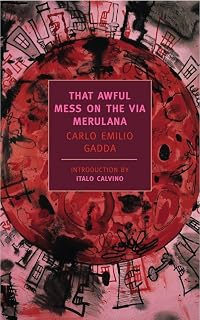
That Awful Mess on Via Merulana
by Carlo Emilio Gadda
On This Page
Description
In a large apartment house in central Rome, two crimes are committed within a matter of days: a burglary, in which a good deal of money and precious jewels are taken, and a murder, as a young woman whose husband is out of town is found with her throat cut. Called in to investigate, melancholy Detective Ciccio, a secret admirer of the murdered woman and a friend of her husband’s, discovers that almost everyone in the apartment building is somehow involved in the case, and with each new show more development the mystery only deepens and broadens. Gadda’s sublimely different detective story presents a scathing picture of fascist Italy while tracking the elusiveness of the truth, the impossibility of proof, and the infinite complexity of the workings of fate, showing how they come into conflict with the demands of justice and love. Italo Calvino, Pier Paolo Pasolini, and Alberto Moravia all considered That Awful Mess on the Via Merulana to be the great modern Italian novel. Unquestionably, it is a work of universal significance and protean genius: a rich social novel, a comic opera, an act of political resistance, a blazing feat of baroque wordplay, and a haunting story of life and death. show lessTags
Recommendations












Member Reviews
This isn't really a good choice for non-native-speakers to read in Italian. Much of it (narrative as well as dialogue) is in various shades of dialect, there is a lot of wordplay, free association, intertextuality and all the rest of it. I probably missed four-fifths of it, but it will be fun to re-read some time and pick up a few more of the jokes. I think I did get all the physics references, at least, and some of the musical ones!
It looks like a crime story, with conspicuous allusions to Poe's "Murders in the Rue Morgue", and it seems to have influenced a lot of modern crime writers, but it is obviously a lot more than that. Gadda was writing in the forties and fifties, but the story is set in March 1927 (Gadda is very precise about show more dates, vague as he is about other things), in the early days of fascism, and there are quite a few barbed references to the fascists as well as a general underlying questioning of the whole idea of state power. The dialect is an important part of this undermining of authority, of course, and we also see (for example) police officers visiting an illegal brothel/bar/fortune-teller/sewing-workshop as customers, without the narrator treating it as anything worth commenting on.
There's also a lot of questioning of conventional ideas of narrative — notoriously including the complete elimination of what's usually the most important element of a crime story, the capture of the criminal and the resolution of the case. That's left as an exercise for the reader. And Gadda has a lot of fun interrupting the progress of the story at critical points with apparently irrelevant descriptive passages and flights of fancy. Apparently, where most writers spend the final editing period cutting the text, Gadda did the reverse, inserting delay-passages wherever he felt things were moving too fast. It's quite typical of the whole that the policeman, Commissario Ingravallo, finally gets issued with a car only about ten pages before the end of the book. Up to that point he's been travelling by tram and on foot. There's even a ludicrous sequence where two officers go to conduct investigations in the countryside on a motorcycle. When they arrest two suspects, they have to commandeer a horse and cart to transport them back to the station (it's not made clear how they get the motorbike back...).
Opinions about Gadda's sexuality seem to vary, but the motorbike passages at least have a very strong homoerotic flavour about them, with a lot of stuff about gleaming uniforms and throbbing machinery between the legs (think Tom of Finland...). And there's also a bit in the early part of the book where a bachelor civil servant gets very nervous when the police ask questions about the unusual number of delivery boys calling at his apartment ("Well, you can't expect someone in my position to walk through the streets carrying a ham and a bottle of olive oil...").
A very interesting book, but one it isn't easy to make sense of! show less
It looks like a crime story, with conspicuous allusions to Poe's "Murders in the Rue Morgue", and it seems to have influenced a lot of modern crime writers, but it is obviously a lot more than that. Gadda was writing in the forties and fifties, but the story is set in March 1927 (Gadda is very precise about show more dates, vague as he is about other things), in the early days of fascism, and there are quite a few barbed references to the fascists as well as a general underlying questioning of the whole idea of state power. The dialect is an important part of this undermining of authority, of course, and we also see (for example) police officers visiting an illegal brothel/bar/fortune-teller/sewing-workshop as customers, without the narrator treating it as anything worth commenting on.
There's also a lot of questioning of conventional ideas of narrative — notoriously including the complete elimination of what's usually the most important element of a crime story, the capture of the criminal and the resolution of the case. That's left as an exercise for the reader. And Gadda has a lot of fun interrupting the progress of the story at critical points with apparently irrelevant descriptive passages and flights of fancy. Apparently, where most writers spend the final editing period cutting the text, Gadda did the reverse, inserting delay-passages wherever he felt things were moving too fast. It's quite typical of the whole that the policeman, Commissario Ingravallo, finally gets issued with a car only about ten pages before the end of the book. Up to that point he's been travelling by tram and on foot. There's even a ludicrous sequence where two officers go to conduct investigations in the countryside on a motorcycle. When they arrest two suspects, they have to commandeer a horse and cart to transport them back to the station (it's not made clear how they get the motorbike back...).
Opinions about Gadda's sexuality seem to vary, but the motorbike passages at least have a very strong homoerotic flavour about them, with a lot of stuff about gleaming uniforms and throbbing machinery between the legs (think Tom of Finland...). And there's also a bit in the early part of the book where a bachelor civil servant gets very nervous when the police ask questions about the unusual number of delivery boys calling at his apartment ("Well, you can't expect someone in my position to walk through the streets carrying a ham and a bottle of olive oil...").
A very interesting book, but one it isn't easy to make sense of! show less
Baroque, ornate, dense, tangled, funny, brilliant unfinished 400-page rant from Carlo Emilio Gadda[ai:Carlo Emilio Gadda|299133|Carlo Emilio Gadda|https://d.gr-assets.com/authors/1280678291p2/299133.jpg] thwarts logical conclusions and forces the reader to go along for the ride in the many-layered, stinky, cacaphony of corruption and magic depicted as 1927 Rome. Ostensibly a detective novel, there's a theft, a murder, and a host of descriptions of Mussolini-era Italy in 1927 including the memorable references to Il Doochay as "Death's Head," "Fierce Face," the Shit...the syphilitic Swaggerer." But the investigation is incomplete, derailed like the train, and the tale ends inconclusively, indeed an inventive "mess."
The book club show more discussion was lively and mostly enthusiastic. One member even produced a fantastic glossary of the book's elaborate vocabulary.
William Weaver's translation was masterful in dealing with Gadda's imaginative vocabulary, made-up words, puns and double-meanings. show less
The book club show more discussion was lively and mostly enthusiastic. One member even produced a fantastic glossary of the book's elaborate vocabulary.
William Weaver's translation was masterful in dealing with Gadda's imaginative vocabulary, made-up words, puns and double-meanings. show less
Halfway through:
Made a foray into one of the more difficult books I’ve ever read—and that’s saying something since I never shrink from a challenging read. But this thing . . . hooboy. Its language is evocative, invented, infinitely referential and most probably lost in translation. But it still has a power and rhythm that is undeniable under all that varicolored wrapping. The fact that someone has written a murder mystery and I care less about the identity of the killer halfway through the novel and more about the world engulfing that bloody act is an accomplishment alone. That it is also gorgeously confusing and makes the brain itch with urushiol-soaked taffeta is worth every damn paragraph. I can’t wait to get to Italo show more Calvino’s introduction when I’m done.
“The glinting eyes of the hereditary syphilitic (also syphilitic in his own right), the illiterate day-laborer’s jaws, the rachitic acromegalic face already filled the pages of Italia Illustrata: already, once they were confirmed, all the Maria Barbisas of Italy were beginning to fall in love with him, already they began to invulvulate him, Italy’s Magdas, Milenas, Filomenas, as soon as they stepped down from the altar: in white veils, crowned with orange blossoms, photographed coming out of the narthex, dreaming of orgies and the educatory exploits of the swinging cudgel.”
—That Awful Mess on the Via Merulana by Carlo Emilio Gadda
Upon completion:
Never will I come across a book quite like this again. Some honeybees that bumped against sepals on their way to the heart of the flower:
“A widespread and delicate ovaricity, that’s the word, permeated the whole stalk of their soul: like ancient essences, in the ground and the meadows of the Marsica, in the stalk of a flower: pressed at length until they explode in the sweet perfume of the corolla: but their corolla, these women’s, was the nose, which they could blow as much as they pleased.”
“If you’re carrying a heavy suitcase, you don’t get past the Customs in Paradise . . .”
“Don’t do good if you are not prepared to receive evil.”
—That Awful Mess on the Via Merulana show less
Made a foray into one of the more difficult books I’ve ever read—and that’s saying something since I never shrink from a challenging read. But this thing . . . hooboy. Its language is evocative, invented, infinitely referential and most probably lost in translation. But it still has a power and rhythm that is undeniable under all that varicolored wrapping. The fact that someone has written a murder mystery and I care less about the identity of the killer halfway through the novel and more about the world engulfing that bloody act is an accomplishment alone. That it is also gorgeously confusing and makes the brain itch with urushiol-soaked taffeta is worth every damn paragraph. I can’t wait to get to Italo show more Calvino’s introduction when I’m done.
“The glinting eyes of the hereditary syphilitic (also syphilitic in his own right), the illiterate day-laborer’s jaws, the rachitic acromegalic face already filled the pages of Italia Illustrata: already, once they were confirmed, all the Maria Barbisas of Italy were beginning to fall in love with him, already they began to invulvulate him, Italy’s Magdas, Milenas, Filomenas, as soon as they stepped down from the altar: in white veils, crowned with orange blossoms, photographed coming out of the narthex, dreaming of orgies and the educatory exploits of the swinging cudgel.”
—That Awful Mess on the Via Merulana by Carlo Emilio Gadda
Upon completion:
Never will I come across a book quite like this again. Some honeybees that bumped against sepals on their way to the heart of the flower:
“A widespread and delicate ovaricity, that’s the word, permeated the whole stalk of their soul: like ancient essences, in the ground and the meadows of the Marsica, in the stalk of a flower: pressed at length until they explode in the sweet perfume of the corolla: but their corolla, these women’s, was the nose, which they could blow as much as they pleased.”
“If you’re carrying a heavy suitcase, you don’t get past the Customs in Paradise . . .”
“Don’t do good if you are not prepared to receive evil.”
—That Awful Mess on the Via Merulana show less
Baroque, ornate, dense, tangled, funny, brilliant unfinished 400-page rant from Carlo Emilio Gadda[ai:Carlo Emilio Gadda|299133|Carlo Emilio Gadda|https://d.gr-assets.com/authors/1280678291p2/299133.jpg] thwarts logical conclusions and forces the reader to go along for the ride in the many-layered, stinky, cacaphony of corruption and magic depicted as 1927 Rome. Ostensibly a detective novel, there's a theft, a murder, and a host of descriptions of Mussolini-era Italy in 1927 including the memorable references to Il Doochay as "Death's Head," "Fierce Face," the Shit...the syphilitic Swaggerer." But the investigation is incomplete, derailed like the train, and the tale ends inconclusively, indeed an inventive "mess."
The book club show more discussion was lively and mostly enthusiastic. One member even produced a fantastic glossary of the book's elaborate vocabulary.
William Weaver's translation was masterful in dealing with Gadda's imaginative vocabulary, made-up words, puns and double-meanings. show less
The book club show more discussion was lively and mostly enthusiastic. One member even produced a fantastic glossary of the book's elaborate vocabulary.
William Weaver's translation was masterful in dealing with Gadda's imaginative vocabulary, made-up words, puns and double-meanings. show less
L'ottovolante linguistico costruito da Gadda spinge a forza il lettore, fra accelerazioni, rallentamenti e cambi di altitudine, da un registro all'altro, ondeggiando fra un romanesco reso all'impronta e un italiano barocco e pieno di neologismi. A tratti il disorientamento si fa forte, ma a tenere attenti e coinvolti c'è la brillante idea di un giallo da molti definito "assoluto", che intriga con la sua resa dell'irrazionale, labirintico procedere a vuoto delle indagini. Fra le pieghe del racconto emergono una caratterizzazione dei personaggi eccezionale e ironica, oltre a una critica di una società decisamente lontana nei suoi tratti più legati al quotidiano (la storia è ambientata nel 1927 e Gadda la scrive nel '57) ma show more culturalmente ancora piuttosto calzante sull'ethos italico. Libro - e autore - apparentemente soggetto a un progressivo oblio, senza dubbio da recuperare per chiunque tenda a capire l'evoluzione della letteratura italiana. show less
An exceptional work of genre blending that, much like Alain Robbe-Grillet's 'The Erasers' takes the crime genre as it's starting point.
Nothing in this book is simple. Gadda brilliantly conveys the complexity and chaos inherent in society, and the ways in which the facts of any event (whether it be a robbery, a murder, or the way a society accepts being ruled by a dictator like Mussolini) become almost impossible to separate from speculation, gossip, and the personal opinions of all involved. Although there is much condemnation of Mussolini's rule in this book there is an equal amount of exploration into how such a thing can be allowed to happen.
The narrative itself is fragmentary, taking in several different characters and locations, show more and Gadda uses this to portray the complexities of urban and rural Italian life and thought. The language is complex and evocative, and some people (those who struggle with Joyce, Beckett or Proust, for example) may find it a difficult read. But it's worth persevering with as this is a crime novel that leaves you wanting more, to the point at which you no longer care about who committed the crimes in question but are merely disappointed that the book has ended. Gadda's style is like that of a slightly drunken, over-talkative uncle in that there will be digressions you don't quite grasp, some fairly objectionable views on women, and stories that go nowhere or peter out in a storm of thinking about thinking itself. Yet you sit, enthralled, unable to tear yourself away, because there's something so wonderfully original about it all, and occasionally insightful, that the style of other writers may seem a little flat for a while afterward. show less
Nothing in this book is simple. Gadda brilliantly conveys the complexity and chaos inherent in society, and the ways in which the facts of any event (whether it be a robbery, a murder, or the way a society accepts being ruled by a dictator like Mussolini) become almost impossible to separate from speculation, gossip, and the personal opinions of all involved. Although there is much condemnation of Mussolini's rule in this book there is an equal amount of exploration into how such a thing can be allowed to happen.
The narrative itself is fragmentary, taking in several different characters and locations, show more and Gadda uses this to portray the complexities of urban and rural Italian life and thought. The language is complex and evocative, and some people (those who struggle with Joyce, Beckett or Proust, for example) may find it a difficult read. But it's worth persevering with as this is a crime novel that leaves you wanting more, to the point at which you no longer care about who committed the crimes in question but are merely disappointed that the book has ended. Gadda's style is like that of a slightly drunken, over-talkative uncle in that there will be digressions you don't quite grasp, some fairly objectionable views on women, and stories that go nowhere or peter out in a storm of thinking about thinking itself. Yet you sit, enthralled, unable to tear yourself away, because there's something so wonderfully original about it all, and occasionally insightful, that the style of other writers may seem a little flat for a while afterward. show less
Wow. Let’s call it a world-weary philosphical mystery set in Fascist Italy, and written with Joycean linguistic skills. Let’s say it has breath-taking perceptive/descriptive prowess (and this clearly goes for the translator - William Weaver - as well), arresting imagery (one lady appears like a ‘floured gecko;’ Mussolini is pissing in the open mouths of his adoring public, & c & c..), keen psychological insight, and gives a fresh pungency to that mix of humor and heartbreak that has become all too familiar for crime readers. Let’s say it gets pretty dense, but for people not put-off by that ‘Joycean’ above, this is a rare treat. Yes, the mystery is life itself, and human folly, but there is a technical, criminal quandary show more as well. Doppio espresso w/ a twist: rich, bitter, astringent Euro-mystery. show less
Members
- Recently Added By
Lists

Books Set in Italy
167 works; 19 members

Italian Literature
558 works; 40 members

1950s
340 works; 22 members

Canon de la narrativa universal del siglo XX
254 works; 6 members
Best Crime Fiction
262 works; 39 members

Cerebral Mysteries
34 works; 21 members

20th Century Literature
1,161 works; 55 members

Murder Mysteries
57 works; 11 members
Survey of Classic Crime
39 works; 7 members

Best Italian Novels
25 works; 3 members

Books Set in Rome
98 works; 2 members

Canon de la narrativa universal del s. XX (cicutadry)
499 works; 3 members
Lista dei 100 migliori libri italiani degli ultimi 200 anni
100 works; 1 member
Author Information

83+ Works 2,852 Members
Some Editions
Awards and Honors
Series
Belongs to Publisher Series
Work Relationships
Common Knowledge
- Canonical title
- That Awful Mess on Via Merulana
- Original title
- Quer pasticciaccio brutto de via Merulana
- Alternate titles
- That Awful Mess on the Via Merulana
- Original publication date
- 1957
- People/Characters
- Francesco Ingravallo "Don Ciccio"; Liliana Balducci; Remo Balducci
- Important places
- Roma, Lazio, Italia; Via Merulana
- Related movies*
- Un maledetto imbroglio
- First words
- Everybody called him Don Ciccio by now.
- Last words
- (Click to show. Warning: May contain spoilers.)That black, vertical fold above the two eyebrows of rage, in the pale white face of the girl, paralyzed him, prompted him to reflect: to repent, almost.
- Blurbers
- Pasolini, Pier Paolo; Enright, D. J.
- Original language
- Italian
*Some information comes from Common Knowledge in other languages. Click "Edit" for more information.
Classifications
- Genres
- Fiction and Literature, General Fiction, Mystery
- DDC/MDS
- 853.912 — Literature & rhetoric Italian, Romanian & related literatures Italian fiction 1900- 20th Century 1900-1945
- LCC
- PQ4817 .A33 .Q413 — Language and Literature French, Italian, Spanish and Portuguese literatures Italian literature Individual authors, 1900-1960
- BISAC
Statistics
- Members
- 1,407
- Popularity
- 16,878
- Reviews
- 33
- Rating
- (3.62)
- Languages
- 10 — Catalan, Dutch, English, Finnish, French, German, Greek, Italian, Polish, Spanish
- Media
- Paper, Audiobook, Ebook
- ISBNs
- 42
- UPCs
- 1
- ASINs
- 21