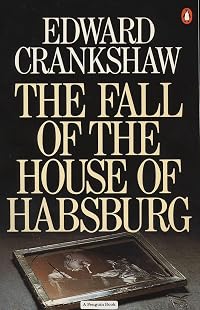
The Fall of the House of Habsburg
by Edward Crankshaw
On This Page
Description
The downfall of the Habsburg monarchy was more than just the end of a great and powerful dynasty. It meant the destruction of the old European order and marked a turning point in world history.Tags
Recommendations




















Member Reviews
The Austrian Empire disintegrated with the conclusion of World War I. This history traces the long decline in its fortunes that took place in Franz Josef's long reign. The military disasters of Solferino and Koniggratz, the failure to gain ascendancy over Prussia in a modern Germany, the determination of the Magyars to thwart any political moves by Austria that didn't accord with Hungarian nationalism, the unhappy marriage to Archduchess Elizabeth, her assassination, the subjection of Franz Josef to his unbearable mother, Sophie, his brother's assassination as France's stool-pigeon in Mexico, his son's suicide pact at Mayerling, his heir and nephew's assassination at Sarajevo, Franz Josef's adherence to duty above all, all pile up into show more an imperial tragedy.
The writing is informed, opinionated and backed up with authoritative references.
The final ignominy of this disaster is best illustrated by Emperor Karl's decision to quit office on 11 November 1918. It was signed in pencil. (Karl succeeded Franz Josef, who died in November 1916, a burnt out Emperor). show less
The writing is informed, opinionated and backed up with authoritative references.
The final ignominy of this disaster is best illustrated by Emperor Karl's decision to quit office on 11 November 1918. It was signed in pencil. (Karl succeeded Franz Josef, who died in November 1916, a burnt out Emperor). show less
Solid writing and lot's of material on the end of Austria-Hungary. It is a generally sympathetic account, but not to a detrimental degree. I came away with a strange feeling of pity for a man who ruled 40 million people for 70 years. A statement made by Nicholas 1 of russia came to mind, to the effect that while possessed of "unlimited" power, he was nearly in many ways powerless by the constraints of duty. This is a good addition to your library of the period 1848 - 1914.
I have read many books on the start of the First World War. I have read many books on the First World War in general. This is the first book I have read which dealt exclusively on the House of Habsburg under the reign of Franz Josef. I knew about his brother, son and of course the Archduke Franz Ferdinand. With all this reading behind me, I still found this book very interesting. At times it was quite dry. However, it is well worth ploughing through these dry portions to read the complete work. The information on his wife, Elizabeth, was all new to me. How Franz Josef managed the empire was also new to me. I have to say, this book contained a great deal of enlightment for me on the Austro-Hungarian Empire and the abilities of Franz show more Josef to keep the empire together during very trying times.
The interplay of the various ethnic groups within the empire was fascinating to me; all new information. Well worth the time to read and digest all the characters involved during the reign of the Emporer Franz Josef. show less
The interplay of the various ethnic groups within the empire was fascinating to me; all new information. Well worth the time to read and digest all the characters involved during the reign of the Emporer Franz Josef. show less
1036 The Fall of the House of Habsburg, by Edward Crankshaw (read 7 Dec 1969) I found the subject matter of this book quite familiar. Back in June 1945 I read Bertita Harding's Golden Fleece, which was the story of Franz Josef and his wife Elizabeth--and it made a searing impression on me. In July 1945 I read her Phantom Crown, which was the story of Franz Josef's brother Maximilian, and in Aug 1945 I read her Imperial Twilight--the story of Franz Josef's successor. In June 1957 I read Joseph Redlich's biography of Franz Josef. In December 1966 I read The Road to Sarajevo. This book, The Fall of the House of Habsburg, is a study of Austria from Franz Josef's accession on December 2, 1848, till his death on 21 Nov 1916. It is a show more sympathetic survey, and since I'd like to be sympathetic to a good Catholic family I read it with enjoyment. show less
Ratings
Members
- Recently Added By
Lists

Books Cited in Wasteland by W. Scott Poole
120 works; 1 member
Author Information

29+ Works 1,817 Members
Common Knowledge
- Original publication date
- 1963
- People/Characters
- Franz Joseph, Emperor of Austria; Elisabeth, Empress of Austria; Habsburg Family
- Important places
- Vienna, Austria; Austria-Hungary
- Dedication
- For A. D. Peters
with affection and gratitude - First words
- Preface: The Habsburg Monarchy is gone and largely forgotten.
Prologue: The House of Austria: Not many mourned the death of the Habsburg Monarchy in 1918; far more rejoiced.
Chapter 1: Pre-March: The Metternich era is often thought of as a period of stagnation. - Last words
- (Click to show. Warning: May contain spoilers.)The stage was set for the dictators.
- Original language
- English
Classifications
- Genres
- History, Nonfiction, General Nonfiction
- DDC/MDS
- 943.604 — History & geography History of Europe Central Europe: Germany, Austria, Switzerland, Czech, Poland, Hungary Austria and Liechtenstein
- LCC
- DB85 .C7 — History of Europe, Asia, Africa and Oceania Austria – Liechtenstein – Hungary – Czechoslovakia History of Austria. Liechtenstein. Hungary. Czechoslovakia History By period 1521- 19th-20th centuries
- BISAC
Statistics
- Members
- 336
- Popularity
- 94,861
- Reviews
- 4
- Rating
- (3.75)
- Languages
- English, German, Italian
- Media
- Paper
- ISBNs
- 7
- UPCs
- 1
- ASINs
- 12