On This Page
Description
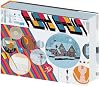
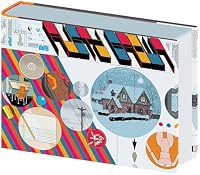
"Rusty Brown" is a fully interactive, full-color articulation of the time-space interrelationships of six complete consciousnesses on a single midwestern American day and the tiny piece of human grit about which they involuntarily orbit. A sprawling, special snowflake accumulation of the biggest themes and the smallest moments of life, "Rusty Brown" literately and literally aims at nothing less than the coalescence of one half of all of existence into a single museum-quality picture story, show more expertly arranged to present the most convincingly ineffable and empathetic illusion of experience for both life-curious readers and traditional fans of standard reality. From childhood to old age, no frozen plotline is left unthawed in the entangled stories of a child who awakens without superpowers, a teen who matures into a paternal despot, a father who stores his emotional regrets on the surface of Mars and a late-middle-aged woman who seeks the love of only one other person on planet Earth. show lessTags
Recommendations


Member Reviews
Four stars because it ends in an “intermission”! If I’d known it was only part one, I might have just waited for the omnibus edition.
Otherwise, this thing is gorgeous. The art is the ultra-clean style that I associate these days with “art comics” that have been tentatively accepted as literature. But also, this book is literature.
There’re no guns, fights, heroes, villains or quests in Rusty Brown. It follows a group of “ordinary” people who file into a school in Omaha, Nebraska one winter morning. There’s Chalky and Alice, two siblings nervous to start their first day of school. There’s Rusty, a hopeless fantasist and geek, and his dad, a lecherous and depressed man going through a mid-life crisis. There’s even show more Chris Ware himself, moonlighting as an aging public school art teacher. We meet each of the books’ characters, and gradually flesh them out into agonizingly real people.
Rusty Brown reads like you just found a pile of old photos at a thrift store and you’re trying to piece back together a person’s life. What happened to this person? How did their precious family photos end up sold at a secondhand store?
Chris Ware casts the moments of his characters’ lives as breadcrumbs for you to follow to their tragic, true selves. The graphic storytelling is beautiful, and the characters are written (and drawn) with incredibly empathy.
I see a lot of reviews here mention the book is incredibly depressing. That’s true - but it’s a curious form of depressing because there’s no obvious theme in Rusty Brown. Its tragedy isn’t a tool used to preach some philosophy. There’s no real moralizing or judgement about how the characters’ lives should have been lived, or how they should have been treated. I have a feeling Chris Ware might say, “I didn’t write it to be depressing, this is just how peoples’ lives are. I’m not interested in fantasy.” show less
Otherwise, this thing is gorgeous. The art is the ultra-clean style that I associate these days with “art comics” that have been tentatively accepted as literature. But also, this book is literature.
There’re no guns, fights, heroes, villains or quests in Rusty Brown. It follows a group of “ordinary” people who file into a school in Omaha, Nebraska one winter morning. There’s Chalky and Alice, two siblings nervous to start their first day of school. There’s Rusty, a hopeless fantasist and geek, and his dad, a lecherous and depressed man going through a mid-life crisis. There’s even show more Chris Ware himself, moonlighting as an aging public school art teacher. We meet each of the books’ characters, and gradually flesh them out into agonizingly real people.
Rusty Brown reads like you just found a pile of old photos at a thrift store and you’re trying to piece back together a person’s life. What happened to this person? How did their precious family photos end up sold at a secondhand store?
Chris Ware casts the moments of his characters’ lives as breadcrumbs for you to follow to their tragic, true selves. The graphic storytelling is beautiful, and the characters are written (and drawn) with incredibly empathy.
I see a lot of reviews here mention the book is incredibly depressing. That’s true - but it’s a curious form of depressing because there’s no obvious theme in Rusty Brown. Its tragedy isn’t a tool used to preach some philosophy. There’s no real moralizing or judgement about how the characters’ lives should have been lived, or how they should have been treated. I have a feeling Chris Ware might say, “I didn’t write it to be depressing, this is just how peoples’ lives are. I’m not interested in fantasy.” show less
First, I had to wait until I acquired a magnifying glass (with a light) to read this particular book. The font is small. Very small. Mr. Ware mentions a microscope early in the book, and I don't think this is a coincidence. It's almost like the book was supposed to be double in size but the publisher changed the size. BUT there are LIVES in this book. A handful of loosely connected people over many years. These cartoon people become REAL people. Ware is meticulous in these details. Little hints on a page indicate much more. Mr. Ware worked on this over 18 years. All of this requires quite a lot of skill. I especially liked a spacey sci-fi story with a psychotic astronaut written by one of the characters. I couldn't have read this show more without a magnifying glass (with light) but it was worth it. These characters will stay with me. show less
A dense work which really deserves the 'graphic novel' moniker. It focuses on the lives of several lonely teachers and students at a small school in Omaha, Nebraska. Ware uses elaborate panel construction to show multifaceted stories. The one about school bully and slacker Jordan Lint showed his entire life. Other stories tackle a painfully shy man whose first sexual experience is shaped by a rather crazy woman, and a teacher who endures regular racism at the school. Just like a modern novel, the book ends(?) ambiguously. I felt it dived quite deeply into its protagonists. I was annoyed by the regular use of very small text, though I didn't mind the micro-panels.
Everybody is raving about this book, calling it a masterwork and amazing ect. ect. ect. So of course I had to read it and find out for myself.
And... I don't get it :( I appreciate the effort that clearly went into it, and the stylistic changes, and the ambition. But the order of the panels is not intuitive, the text is so small at times as to be illegible (and I'm young!), and some of the characters seemed unnecessary (the eponymous Rusty Brown, Chalky White, and his sister). And at 356 pages, it's only half the story.
I did love "The Seeing-Eye Dogs of Mars," though - that's something I'd read for fun on it's own. (I found it very interesting that the main character was also named Rusty - was this tongue-in-cheek on Ware's part? Or was show more his father so in love with the name he gave it to his son?) show less
And... I don't get it :( I appreciate the effort that clearly went into it, and the stylistic changes, and the ambition. But the order of the panels is not intuitive, the text is so small at times as to be illegible (and I'm young!), and some of the characters seemed unnecessary (the eponymous Rusty Brown, Chalky White, and his sister). And at 356 pages, it's only half the story.
I did love "The Seeing-Eye Dogs of Mars," though - that's something I'd read for fun on it's own. (I found it very interesting that the main character was also named Rusty - was this tongue-in-cheek on Ware's part? Or was show more his father so in love with the name he gave it to his son?) show less
A great book to kill time with Chris Ware's consistent trademark style of characters penned with jellybean heads and button noses, set in a very realistic (almost boring) everyday situations. This book was particularly fun inasmuch as one of the characters was named "Chris", an artist-teacher, portrayed as an unattractive bachelor, hanging out with his students. At the end of the book is the story of another teacher reunited with her long lost child (now a grown woman), a particularly heartfelt depiction.
Overall I don't think the book was so much about storytelling as it was about using graphics to portray everyday life, which is extremely well done.
Overall I don't think the book was so much about storytelling as it was about using graphics to portray everyday life, which is extremely well done.
I've sampled Chris Ware here and there over the years, but I think this is the first full book of his that I have read, and frankly, I just don't get all the acclaim heaped on him. Pathetic and awful people live pathetic and awful lives in teeny tiny little panels.
I guess we can never have enough stories about toxic white males?
I guess we can never have enough stories about toxic white males?
My least favorite of Ware's books until the long concluding Joanne Cole story, which was surprising and moving and nudged it past 3.5 stars.
Members
- Recently Added By
Lists

Kirkus Starred Fiction Reviews of Books Published in 2019
411 works; 12 members

Top Five Books of 2020
982 works; 350 members

Comic artists
9 works; 1 member
Author Information

68+ Works 10,343 Members
Awards and Honors
Awards
Distinctions
Series

Belongs to Publisher Series
Work Relationships
Common Knowledge
- Canonical title
- Rusty Brown
- Original publication date
- 2019
- People/Characters
- William K. Brown ('Woody'); Alison White ('Alice'); Calcium White ('Chalky'); Jason Lint (Jordan Wellington Lint III); Jordan Wellington Lint III ('Jason'); Joanna Cole (show all 34); Franklin Christenson Ware; Rusty Brown; Sandy Brown; Supergirl; Brett Hornslach (Bretislav Milos Hornslach); Stephanie; Mr McClintock; Louise Stovall; Gretchen; Earman (Rusty Brown); Norva; Chip; Sarah; Kathleen Kramer ('Kathy'); Charles Lint; Linda Lint; Scott Andrew Foxworthy; Tracy Weatherail Gentry; Leslie Lint; Zachary Lint; Gabriel J. Lint ('Gabe'); Charli; Levi Lint; Mary Elizabeth Lint; George; Jeanine Cole; James Doering ('Jay'); Janice Woods
- Important places
- Omaha, Nebraska, USA; Waukosha, Michigan, USA; Mars; Crawford, Nebraska, USA
- First words
- "No two are alike," any schoolchild will tell you.
- Last words
- (Click to show. Warning: May contain spoilers.)So...1961...right? The Blair Children's Home and Aid Society? January 24th?
- Original language
- English
Classifications
- Genre
- Graphic Novels & Comics
- DDC/MDS
- 741.5 — Arts & recreation Drawing & decorative arts Drawing and drawings Comic books, graphic novels, fotonovelas, cartoons, caricatures, comic strips
- LCC
- PN6727 .W285 .R87 — Language and Literature Literature (General) Literature (General) Collections of general literature Comic books, strips, etc.
- BISAC
Statistics
- Members
- 442
- Popularity
- 68,995
- Reviews
- 9
- Rating
- (4.30)
- Languages
- 6 — Dutch, English, French, Italian, Portuguese (Portugal), Spanish
- Media
- Paper
- ISBNs
- 7