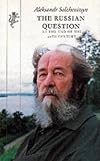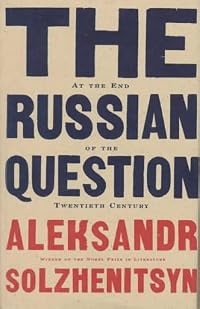
The Russian Question at the End of the Twentieth Century: Toward the End of the Twentieth Century
by Aleksandr Solzhenitsyn
On This Page
Description
On the occasion of his return to the country from which he was expelled twenty years ago, Russia's greatest living writer gives us a succinct and impassioned impression of his beliefs and hopes for his homeland. Beginning with an overview of the last five hundred years of Russian history, Aleksandr Solzhenitsyn highlights his country's accomplishments and mistakes, analyzing the disaster of the Soviet years and painting a brutally vivid picture of the current state of affairs. Although he show more sees Russia in moral, economic, and social disarray, he also sees the possibility of a way out for a new generation who, with a renewed understanding of their history, can surmount the obstacles of the day and create a just and independent society - a Russian future. Provocative, spirited, and timely, The Russian Question speaks not only to Russians, whose destiny Solzhenitsyn has returned to share, but also to the Western world that received him in exile, awarded him a Nobel Prize in Literature, and made him one of the most widely read writers of our time. show lessTags
Recommendations





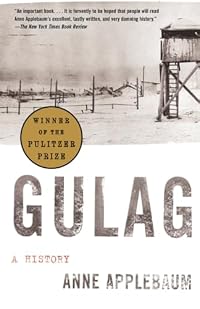
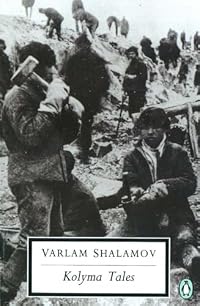
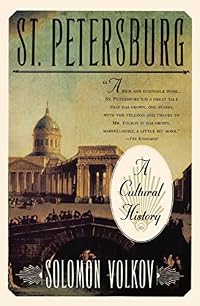

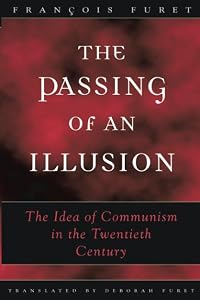
















Member Reviews
La tarea de encontrar puntos de referencia en la terrible confusión del poscomunismo es urgente, y la situación grave : la nación rusa, agotada, desorientada, desalentada, apática, ya no puede garantizar su propia supervivencia. Con la lucidez de quien ve cómo afloran las guerras civiles sobre el cadáver de los imperios, el autor traza un balance de los trece reinos más importantes de la dinastía Romanov y de los setenta años de dictadura bolchevique. A los rusos se les ha explotado, sometido, diezmado, siempre en nombre de una política criminal. ¿Qué hacer hoy ? Solzhenitsyn deja entrever un camino que arranca de la necesidad de recuperar la memoria colectiva.
Dec 23, 2022Spanish
Ratings
Members
- Recently Added By
Author Information

352+ Works 44,558 Members
Aleksandr Solzhenitsyn was born on December 11, 1918 in Kislovodsk in the northern Caucusus Mountains. He received a degree in physics and math from Rostov University in 1941. He served in the Russian army during World War II but was arrested in 1945 for writing a letter criticizing Stalin. He spent the next decade in prisons and labor camps and, show more later, exile, before being allowed to return to central Russia, where he worked as a high school science teacher. His first novel, One Day in the Life of Ivan Denisovich, was published in 1962. In 1970, he was awarded the Nobel Prize for Literature. In 1974, he was arrested for treason and exiled following the publication of The Gulag Archipelago. He moved to Switzerland and later the U. S. where he continued to write fiction and history. When the Soviet Union collapsed, he returned to his homeland. His other works include The First Circle and The Cancer Ward. He died due to a heart ailment on August 3, 2008 at the age of 89. (Bowker Author Biography) show less
Series
Belongs to Publisher Series
Harvill (201)
Classifications
- Genres
- Nonfiction, History, General Nonfiction
- DDC/MDS
- 947.086 — History & geography History of Europe Eastern European Counties and Russia Russian & Slavic History by Period 1855- 1991-
- LCC
- DK510.76 .S6513 — History of Europe, Asia, Africa and Oceania Russia. Soviet Union. Former Soviet Republics – Poland History of Russia. Soviet Union. Former Soviet Republics Local history and description Russia (Federation). Russian S.F.S.R.
Statistics
- Members
- 82
- Popularity
- 386,767
- Reviews
- 1
- Rating
- (4.25)
- Languages
- 6 — English, French, German, Hungarian, Italian, Spanish
- Media
- Paper
- ISBNs
- 7
- ASINs
- 2