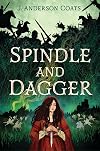
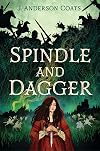
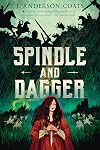
Spindle and Dagger
by J. Anderson Coats 
On This Page
Description
"Wales, 1109. Three years ago, a warband raided Elen's home. Her baby sister could not escape the flames. Her older sister fought back and almost killed the warband's leader, Owain ap Cadwgan, before being killed herself. Despite Elen's own sexual assault at the hands of the raiders, she saw a chance to live and took it. She healed Owain's wound and spun a lie: Owain ap Cadwgan, son of the king of Powys, cannot be killed, not by blade nor blow nor poison. Owain ap Cadwgan has the protection show more of Saint Elen, as long as he keeps her namesake safe from harm and near him always. For three years, Elen has had plenty of food, clothes to wear, and a bed to sleep in that she shares with the man who brought that warband to her door. Then Owain abducts Nest, the wife of a Norman lord, and her three children, triggering full-out war. As war rages, and her careful lies threaten to unravel, Elen begins to look to Nest and see a different life -- if she can decide, once and for all, where her loyalties lie" -- show lessTags
Recommendations

Member Reviews
Spectacular history, and very realistic about the experiences of women in war, particularly focusing on the trauma of surviving the slaughter of your family and rape. Somehow I didn't realize quite how dark it would be. Elen is an extraordinary character -- her strength in refusing to relinquish her own humanity and kindness in the face of never ending cruelty is amazing, and ultimately offers her freedom. It is, however, extremely triggering, and her dissociative episodes are sometimes confusing. I guess it's the kind of book that you want to hand to abusers so they never become abusers, but it's also a bleak tale.
Advanced Reader's Copy provided by Edelweiss.
Advanced Reader's Copy provided by Edelweiss.
Spindle and Dagger tells the survival story of Elen, a young girl taken in a raid by a warband in Wales, 1109. She saves the life of the warband’s leader, even after being traumatized by the event, and weaves a story that if the leader keeps her close and keeps her safe, the goddess she prays to will protect him. Elen seems to be surviving well, though not thriving, until the warband kidnaps an enemies family, and Elen decides to work toward her own goals.
I loved this book. I enjoyed the setting, though it is set in a time period I do not usually read about. I enjoyed Elen’s growth as a character. Elen goes from having flashbacks of her trauma all the time to being able to make her own escape plans and goals. She is able to dream show more bigger than her circumstances, and the people around her become unexpected allies. I especially loved the historical note from the author, which just added an air of authenticity to the story. Spindle and Dagger is definitely fictional, but the idea came from what could be real events. I honestly thought the story would not end well, but the ending saved the story from being too dark. I would definitely recommend this book to other historical fiction readers.
*I was given a complimentary copy of this book by the publisher in exchange for an honest review.* show less
I loved this book. I enjoyed the setting, though it is set in a time period I do not usually read about. I enjoyed Elen’s growth as a character. Elen goes from having flashbacks of her trauma all the time to being able to make her own escape plans and goals. She is able to dream show more bigger than her circumstances, and the people around her become unexpected allies. I especially loved the historical note from the author, which just added an air of authenticity to the story. Spindle and Dagger is definitely fictional, but the idea came from what could be real events. I honestly thought the story would not end well, but the ending saved the story from being too dark. I would definitely recommend this book to other historical fiction readers.
*I was given a complimentary copy of this book by the publisher in exchange for an honest review.* show less
 This review was written for LibraryThing Early Reviewers.
A testament to good writing is that you feel a genuine empathy and attachment to the characters. You get upset when bad things happen to them and you feel joy when things go well. That is how I felt regarding the main characters in J. Anderson Coats new novel “Spindle and Dagger”. Set in 11th century Wales, the story follows Elen a Welsh peasant whose family a few years before had been slaughtered in front of her by the soldiers of a Welsh Prince. She herself is then raped by the same soldiers and she ends up saving herself by healing the Prince’s wounds and convincing him that a Saint Elen will protect him and keep him alive as long as she is kept safe. The main plot then revolves around her keeping this lie alive and how it show more starts to crumble when the same Prince kidnaps another Nobel’s wife and children.
Coats has created a world that is alive and genuine. She has crafted characters that you truly want to succeed and save themselves. Emotionally I was drawn to the two main female characters of Elen and Nest, the kidnapped Princess. Coats gives us a look not just into these two fictional characters lives, but also shows the devastating existence most females went through in that same time period. She also does a very good job making the villains in the story be more than just one-dimensional tropes. She makes them human, which makes their behavior all the more tragic. The only thing that bothered me was the cover graphic. It was done in a way that implies this is a YA book. But the subject matter and the plot is most certainly Adult. show less
Coats has created a world that is alive and genuine. She has crafted characters that you truly want to succeed and save themselves. Emotionally I was drawn to the two main female characters of Elen and Nest, the kidnapped Princess. Coats gives us a look not just into these two fictional characters lives, but also shows the devastating existence most females went through in that same time period. She also does a very good job making the villains in the story be more than just one-dimensional tropes. She makes them human, which makes their behavior all the more tragic. The only thing that bothered me was the cover graphic. It was done in a way that implies this is a YA book. But the subject matter and the plot is most certainly Adult. show less
This review was written for LibraryThing Early Reviewers.I thought this book was written for Young Adults because that is what this author is best known for writing. However, I'm not sure I would feel comfortable giving this book to just any teenager. There are quite a few adult themes and I think I would recommend a reader be adult. (Of course I may be out of touch with what teenagers are reading these days so maybe it is commonplace; I do think that the author has branched out into historical fiction for an older audience here.)
Elen and her family were poor farmers living in Wales in the early twelfth century. The son of the king of Powys, Owain ap Cadwgan, raided their home with his warband. Elen was the only one who survived. She did it by healing Owain's wound and telling him that he was show more guarded by St. Elen who would not let anyone kill him as long as he kept Elen by his side. So Elen became Owain's companion and bedmate. But the horrors of the raid on her home and the killing of her sisters and parents remained with her. She thought she was safe with Owain and that was her primary goal. Then Owain came home from raiding the castle of a Norman lord with the lord's wife, Nest, and three children in tow. This sparks a manhunt for Owain and anyone with him. There goes Elen's safety and security and she needs to re-evaluate her choices.
It seemed to me that the author did a good job of researching the time period. I especially appreciated the pronunciation guide provided at the beginning of the book. I'm not quite sure I buy Elen's decision to throw her lot in with Owain after he and his men killed the rest of her family. It does make for an interesting dynamic though especially when Nest comes on the scene. show less
Elen and her family were poor farmers living in Wales in the early twelfth century. The son of the king of Powys, Owain ap Cadwgan, raided their home with his warband. Elen was the only one who survived. She did it by healing Owain's wound and telling him that he was show more guarded by St. Elen who would not let anyone kill him as long as he kept Elen by his side. So Elen became Owain's companion and bedmate. But the horrors of the raid on her home and the killing of her sisters and parents remained with her. She thought she was safe with Owain and that was her primary goal. Then Owain came home from raiding the castle of a Norman lord with the lord's wife, Nest, and three children in tow. This sparks a manhunt for Owain and anyone with him. There goes Elen's safety and security and she needs to re-evaluate her choices.
It seemed to me that the author did a good job of researching the time period. I especially appreciated the pronunciation guide provided at the beginning of the book. I'm not quite sure I buy Elen's decision to throw her lot in with Owain after he and his men killed the rest of her family. It does make for an interesting dynamic though especially when Nest comes on the scene. show less
This review was written for LibraryThing Early Reviewers.After a warband burned her home, killed her family, and assaulted her, Elen did what she had to do to protect herself. She healed Owain ap Cadwagan and spun a lie that said Saint Elen would keep the man safe from harm as long as the saint's namesake (Elen herself) was kept safe and close. She has a kind of life but after three years, she begins to envision a new life for herself.
I'm not going to lie. Parts of this story were difficult to get through. The language is more modern than I would have expected (occasionally, Owain would say "Hey" to get Elen's attention) and slang that I would personally never agree to. There is mention of sexual assault, though never in great detail, and it's never far from Elen's memory.
Still, this was an show more interesting novel. Elen's desperation to keep herself safe and the regret she has when she gets what she was after were intriguing. She made connections with people when she could, dreamed of better things, was ashamed when her dreams didn't come true, and came across as a very real person. It was even more interesting when I reached the end and realized part of this story was based on things that very well could have happened.
I would recommend this to older teen readers. I received a free copy from the author and all opinions expressed are my own. show less
I'm not going to lie. Parts of this story were difficult to get through. The language is more modern than I would have expected (occasionally, Owain would say "Hey" to get Elen's attention) and slang that I would personally never agree to. There is mention of sexual assault, though never in great detail, and it's never far from Elen's memory.
Still, this was an show more interesting novel. Elen's desperation to keep herself safe and the regret she has when she gets what she was after were intriguing. She made connections with people when she could, dreamed of better things, was ashamed when her dreams didn't come true, and came across as a very real person. It was even more interesting when I reached the end and realized part of this story was based on things that very well could have happened.
I would recommend this to older teen readers. I received a free copy from the author and all opinions expressed are my own. show less
This review was written for LibraryThing Early Reviewers.A quiet story one girl become woman finding a place for herself admist unglorious medieval realities.
When raiders slaughtered Elen’s family, she traded desperate promises for a chance to live. Owain ap Cadwgan would never fall to the sword, so long as he kept the blessing of Saint Elen by protecting her the girl who bore her name. So says Elen, and to her relief, Owain believes. But as the years pass, Elen begins to wonder if it would have been better to have never made the bargain at all.
The writing reads easy, although this slow, character-driven historical-fiction is not for everyone. In many ways, I was reminded of Tess of the Road, although lacking such a strong character voice.
Elen’s journey doesn’t jump out as heroic. She show more doesn’t become a fighter, or plot vengeance, or indulge in petty sabotage against her overlords. Her entire struggle is coping with traumatic memories and coming to a place of being able to hope for living a normal, peaceful life.
To the author, I say thank you, thank you for the welsh pronunciation guide. I’m sure I still got it all wrong, but I liked being able to try.
I think I remember seeing some debate as to whether this is really a YA book. Yes, it is. Nothing explicit, and the instances of abuse are alluded to in such a way that it would pass over your head if you didn’t know what to look for.
**Thanks to Netgalley and Candlewick for the ARC** show less
When raiders slaughtered Elen’s family, she traded desperate promises for a chance to live. Owain ap Cadwgan would never fall to the sword, so long as he kept the blessing of Saint Elen by protecting her the girl who bore her name. So says Elen, and to her relief, Owain believes. But as the years pass, Elen begins to wonder if it would have been better to have never made the bargain at all.
The writing reads easy, although this slow, character-driven historical-fiction is not for everyone. In many ways, I was reminded of Tess of the Road, although lacking such a strong character voice.
Elen’s journey doesn’t jump out as heroic. She show more doesn’t become a fighter, or plot vengeance, or indulge in petty sabotage against her overlords. Her entire struggle is coping with traumatic memories and coming to a place of being able to hope for living a normal, peaceful life.
To the author, I say thank you, thank you for the welsh pronunciation guide. I’m sure I still got it all wrong, but I liked being able to try.
I think I remember seeing some debate as to whether this is really a YA book. Yes, it is. Nothing explicit, and the instances of abuse are alluded to in such a way that it would pass over your head if you didn’t know what to look for.
**Thanks to Netgalley and Candlewick for the ARC** show less
Well...I will start the review by saying that I am not sure why this book is marked as YA. Is it because, apart from one instance, there isn't any death shown? Perhaps the accessible language? I hope so, because the tag really only applies if you squint so hard you can only see "isn't death" and "-ssible language".
So what makes this book so dark? Enjoying the story through the eyes of a person suffering from severe PTSD and a sprinkle of Stockholm syndrome on top is a start. This is the first book I read that shows episodes of such severity from first person perspective in an age when mental illnesses were not really a thing so the heroine is left to fend for herself and her problems. It is quite brutal. Nothing is said explicitly, you show more see everything through quick flashes of Elen's traumatic experiences from when she was 14 years old.
Unfortunately, everyone else but Elen were one of the points why I had to lower my score. Apart from the main "antagonist" and Nest, everyone was a blank. Some characterization on Rhys, but rest is seen through the lens of Elen and she basically only fears people and we don't really know much beyond that. Nest has a supporting role and we also don't learn much about her besides her role in the story and the main antagonist is basically an idiot. Not like he is not intimidating, but his actions through the stories actually grate on anyone with half a brain.
Which brings me to the second issue - the historicity. Now, historical fiction is a broad genre. Usually it being set in an era from the past already makes it historical fiction. Some readers may put it into a bit higher standard and search for actual historical fact. I do not believe there was much of it here and you will not leave this story with much knowledge. Let me show some points:
The author makes a good point in saying that so far in history you only really work with legends and they tend to favor the side writing them. I do not believe the way to "even the odds" is to simply turn it upside down and now favor the other side. It makes it equally nonsensical.
The Normans were not good people like this book tries to show (for sake of plot). They were a product of their age, sure, but they were brutal conquerors and they definitely were not magnanimous to those perceived as enemy - in this case Welsh into which lands they wanted to expand. I understand this story needed some good guys but they were TOO good. Also they were so scarce that even any semblance of threat by them was nonexistent.
The main antagonist was an absolute donkey. I have no idea why the author didn't make him more sinister and smart. Considering the history of the character, I highly doubt he was as big of an imbecile as shown and the reason given doesn't really work. He is legitimately laughably stupid. It was jarring and honestly infuriating and always made me wonder why is he even the bad guy when all he is doing is the equivalent of walking into poles or, more appropriately, blindfolding self and walking into traffic.
Leather armor...historically it probably existed, but mostly limited to protecting limbs and even then on poorer fighting men. Most people running around in the story would have chain-mail. Normans had it, Donkey boy would have it too being a prince. His band would prolly steal it off corpses. I felt everyone just ran around in leather.
Lastly - the language. It felt modern. Not a negative though as it just made reading the story accessible to modern reader.
Solid book, worth a read and with it being so beautiful in physical print, it would be a shame not to have it decorate a shelf. Seriously that cover is gorgeous. show less
So what makes this book so dark? Enjoying the story through the eyes of a person suffering from severe PTSD and a sprinkle of Stockholm syndrome on top is a start. This is the first book I read that shows episodes of such severity from first person perspective in an age when mental illnesses were not really a thing so the heroine is left to fend for herself and her problems. It is quite brutal. Nothing is said explicitly, you show more see everything through quick flashes of Elen's traumatic experiences from when she was 14 years old.
Unfortunately, everyone else but Elen were one of the points why I had to lower my score. Apart from the main "antagonist" and Nest, everyone was a blank. Some characterization on Rhys, but rest is seen through the lens of Elen and she basically only fears people and we don't really know much beyond that. Nest has a supporting role and we also don't learn much about her besides her role in the story and the main antagonist is basically an idiot. Not like he is not intimidating, but his actions through the stories actually grate on anyone with half a brain.
Which brings me to the second issue - the historicity. Now, historical fiction is a broad genre. Usually it being set in an era from the past already makes it historical fiction. Some readers may put it into a bit higher standard and search for actual historical fact. I do not believe there was much of it here and you will not leave this story with much knowledge. Let me show some points:
The author makes a good point in saying that so far in history you only really work with legends and they tend to favor the side writing them. I do not believe the way to "even the odds" is to simply turn it upside down and now favor the other side. It makes it equally nonsensical.
The Normans were not good people like this book tries to show (for sake of plot). They were a product of their age, sure, but they were brutal conquerors and they definitely were not magnanimous to those perceived as enemy - in this case Welsh into which lands they wanted to expand. I understand this story needed some good guys but they were TOO good. Also they were so scarce that even any semblance of threat by them was nonexistent.
The main antagonist was an absolute donkey. I have no idea why the author didn't make him more sinister and smart. Considering the history of the character, I highly doubt he was as big of an imbecile as shown and the reason given doesn't really work. He is legitimately laughably stupid. It was jarring and honestly infuriating and always made me wonder why is he even the bad guy when all he is doing is the equivalent of walking into poles or, more appropriately, blindfolding self and walking into traffic.
Leather armor...historically it probably existed, but mostly limited to protecting limbs and even then on poorer fighting men. Most people running around in the story would have chain-mail. Normans had it, Donkey boy would have it too being a prince. His band would prolly steal it off corpses. I felt everyone just ran around in leather.
Lastly - the language. It felt modern. Not a negative though as it just made reading the story accessible to modern reader.
Solid book, worth a read and with it being so beautiful in physical print, it would be a shame not to have it decorate a shelf. Seriously that cover is gorgeous. show less
Members
- Recently Added By
Author Information
9+ Works 675 Members
J. Anderson Coats is a LibraryThing Author, an author who lists their personal library on LibraryThing.
Some Editions
Awards and Honors
Awards
Common Knowledge
- People/Characters
- Nest ferch Rhys
- Important places
- Wales, UK
Classifications
Statistics
- Members
- 62
- Popularity
- 499,415
- Reviews
- 13
- Rating
- (3.63)
- Languages
- English
- Media
- Paper, Audiobook, Ebook
- ISBNs
- 7
- ASINs
- 1