On This Page
Description
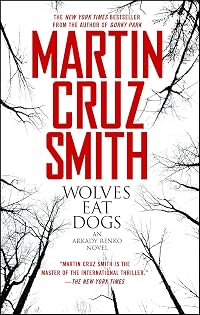
In the wake of a businessman's suicide, Moscow detective Arkady Renko investigates secrets and international plots that may have driven him to his death, in a case that leads Renko to discover crimes in the area surrounding Chernobyl.Tags
Recommendations







Member Reviews
I just really love Cruz Smith's Arkady Renko spy thrillers. I like his other books too, but there's just something about these... I was really sad that after I read this book, there'd be no more that I hadn't read... and then I went online, and there's a new one out due next month! Yay! "Stalin's Ghost" is now on my wishlist...
In "Wolves Eat Dogs," the fifth in the series, investigator Renko is at the scene of the death of a prominent Russian businessman, who appears to have leaped out his window to his death - an obvious suicide. However, Renko has a hunch there's something more to this death - a feeling that's not looked kindly upon by either his superiors or the dead man's associates, who feel that any hint of a potential crime would show more tarnish Russian business' already-not-too-shining reputation.
Nevertheless, Renko stays doggedly on the case, and soon his persistence takes him to the wastelands of Chernobyl....
The crime (of course there's a crime!) is almost presciently relevant in today's political scene, and Cruz Smith really effectively not only does his research but uses it - I fully believed in the place and characters. I recently read a National Geographic article about the current state of the lands around Chernobyl, so I know that much of what Cruz Smith writes is accurate - but after reading his book, I feel that not only do I know, I understand.
Plus, the book was exciting and fun! show less
In "Wolves Eat Dogs," the fifth in the series, investigator Renko is at the scene of the death of a prominent Russian businessman, who appears to have leaped out his window to his death - an obvious suicide. However, Renko has a hunch there's something more to this death - a feeling that's not looked kindly upon by either his superiors or the dead man's associates, who feel that any hint of a potential crime would show more tarnish Russian business' already-not-too-shining reputation.
Nevertheless, Renko stays doggedly on the case, and soon his persistence takes him to the wastelands of Chernobyl....
The crime (of course there's a crime!) is almost presciently relevant in today's political scene, and Cruz Smith really effectively not only does his research but uses it - I fully believed in the place and characters. I recently read a National Geographic article about the current state of the lands around Chernobyl, so I know that much of what Cruz Smith writes is accurate - but after reading his book, I feel that not only do I know, I understand.
Plus, the book was exciting and fun! show less
Cynical, melancholy Moscow special investigator Arkardy Renko has a serious problem. One of Moscow's newly minted billionaires has taken a fatal plunge off of a twenty-story condominium - suicide or murder? As Renko dryly observes "We prefer suicides. Suicides don't demand work, or drive up the crime rate."
In his fifth book featuring his laconic, down-trodden detective, Martin Cruz Smith is at the top of his game. Wolves Eat Dogs takes Renko, filling his role as Moscow's most dogged and quixotic gumshoe, from the heady environs of the new Russian elite down a twisted, wayward path into a deadly quietly radioactive heart of darkness, the 30-mile Exclusion Zone surrounding Chernobyl.
Tautly written, intriguing and quite frankly offering a show more more humane glimpse of the Russian pysche then western fiction typically offers, Wolves Eat Dogs is a terrific and unique mystery, with Renko, as ever, leading the reader deeper and deeper into uncharted territory - in this case, the Chernobyl Exclusion Zone, with its eerie abandoned towns, burgeoning wildlife, icon-thieves, corrupt car parts dealers and obsessive scientests. Smith weaves an involving and immersive mystery with first-rate characters and plotting, in a very unique setting. show less
In his fifth book featuring his laconic, down-trodden detective, Martin Cruz Smith is at the top of his game. Wolves Eat Dogs takes Renko, filling his role as Moscow's most dogged and quixotic gumshoe, from the heady environs of the new Russian elite down a twisted, wayward path into a deadly quietly radioactive heart of darkness, the 30-mile Exclusion Zone surrounding Chernobyl.
Tautly written, intriguing and quite frankly offering a show more more humane glimpse of the Russian pysche then western fiction typically offers, Wolves Eat Dogs is a terrific and unique mystery, with Renko, as ever, leading the reader deeper and deeper into uncharted territory - in this case, the Chernobyl Exclusion Zone, with its eerie abandoned towns, burgeoning wildlife, icon-thieves, corrupt car parts dealers and obsessive scientests. Smith weaves an involving and immersive mystery with first-rate characters and plotting, in a very unique setting. show less
This is the fifth in Martin Cruz Smith's Arkady Renko series, and it's outstandingly good - a return to the form of the first in the series, the famous "Gorky Park".
Renko is the classic god cop in a bad place: dogged, incorruptible and determined on uncovering the truth whatever the cost to himself. What lifts this book to heights the previous few entries in the series haven't matched in that much of it is set in the Zone of Exclusion around the Chernobyl nuclear plant. Smith does a great job of describing the eerie setting, teeming with wildlife but also home to scientific research teams and fugitive humans.
While it's not enormously hard, once the Chernobyl section of the book gets underway, to work out whodunnit, that really doesn't show more matter in this case - and how Renko saves his skin (or rather has it saved for him) provides the twist I didn't see coming. A tremendously good read even if you are not especially fond of thrillers. show less
Renko is the classic god cop in a bad place: dogged, incorruptible and determined on uncovering the truth whatever the cost to himself. What lifts this book to heights the previous few entries in the series haven't matched in that much of it is set in the Zone of Exclusion around the Chernobyl nuclear plant. Smith does a great job of describing the eerie setting, teeming with wildlife but also home to scientific research teams and fugitive humans.
While it's not enormously hard, once the Chernobyl section of the book gets underway, to work out whodunnit, that really doesn't show more matter in this case - and how Renko saves his skin (or rather has it saved for him) provides the twist I didn't see coming. A tremendously good read even if you are not especially fond of thrillers. show less
I surprised myself by being really engaged in it. I don’t usually read detective stories or thrillers, but the setting really sucked me in into this one. A big part of the story is set in contemporary Chernobyl- the site of the 1986 nuclear power plant disaster, or more precisely in the Zone of Exclusion, which is bigger than Chernobyl itself, mainly abandoned and guarded by militia. Due to still exorbitantly high radiation levels the place is inhabited only by a handful of scientists, crooks and a couple of old people living there illegally. The site itself reminds me of Picnic by the Roadside, a sci-fi book by Borys and Arkadij Strugatsky, and Stalker – the Russian movie from the 70s based on it. The book and the movie are about a show more site aliens left on Earth as they just stopped by without showing any interest in humanity or any desire for interaction with it. Weird, haunting and dangerous, permeated with strange and sometimes deadly properties, it’s just like Chernobyl nowadays, and immediately coming to mind as an analogy. Interesting, though, that since the human activity practically ceased in Chernobyl, animals are thriving- big packs of wolves, wild boars, deer, moose and some bison roam the land. Fish grow to gigantic dimensions and populate what was once the plant’s cooling pond, and strange birds- like white swallows- sing. A unique experiment is underway.
Anyway, I found it very interesting in this respect, and I liked the main character to boot, so it was good reading. show less
Anyway, I found it very interesting in this respect, and I liked the main character to boot, so it was good reading. show less
When a new Russian billionaire falls to his death poor old Renko just can't stop himself nosing around some of the odd corners of an apparent suicide, but he heardly expects as a result to end up zooming around the irradiated Exclusion Zone of Chernobyl with its ragged population of scientists, militia, hustlers, and displaced natives who have snuck back in. What's it all got to do with deadly tiny pieces of radioactive material found in a salt shaker under the dead man. Renko has little to go on, and in the haunting site of so much death, what can it possibly matter. But Renko does what Renko does, going down these mean irradiated streets who is not himself mean and irradiated.
(First published at Blogcritics at http://blogcritics.org/archives/2005/05/22/144853.php)
Martin Cruz Smith introduced Arkady Renko in Gorky Park in 1982 as a Moscow detective, when Moscow was still the capital of the Evil Empire. He brought him back three more times in succeeding years, as the world changed. In this fifth novel, Renko is an investigator for the Moscow prosecutor, investigating fraud and corruption among the new Russian oligarchs.
[The following may contain minor spoilers.]
The story is that the head of a financial empire leaps to his death from his apartment, for no apparent reason. The dead man had been a promising physicist in the old Russia, and had become a successful businessman—as corrupt as many. His closet was show more full of salt. At the risk of spoiling the story, his apartment was radioactive—someone had put a few grains of cesium in the salt, and has been tormenting the deceased this way for weeks. The dead man's lieutenant is later found dead on the outskirts of Chernobyl, which leads Renko to the dead zone around the reactor site, north of Kiev, looking for the connections between the dead men, the dead zone and the 1986 nuclear accident.
In the dead zone, he encounters brutal and corrupt police, scavengers and old Ukranian peasants trying to hold on to their lives on the land, at the end of their years. The land and the wildlife, in spite of the radiation, are making a comeback, to the delight of a sinister ecologist.
Smith's understanding of Russia is more likely based on literature and news than on close contact with the land and the people, but he is conscientious and respectful. He fills his narrative with geographic and historical details. While he has several stock characters, he avoids stereotypes. Renko was a mildly exotic detective in 1982—honest, a little idealistic in a brutal and corrupt system, hoping for better, daring to care. In 2004, after years of corruption and violence, he still dares to hope.
Smith is a superior writer. His non-Renko novels, for instance Stallion Gate and Rose are good, and the Renko series is solidly written. This particular book has most of the strengths of his other work—solid characters, a vivid sense of place, a carefully-developed plot. The murder method and some plot elements of this book are a little over the top. On the other hand, Smith's visualization of the dead zone is dramatic and thoughtful. It isn't among his best books, but it is a solid part of the series. show less
Martin Cruz Smith introduced Arkady Renko in Gorky Park in 1982 as a Moscow detective, when Moscow was still the capital of the Evil Empire. He brought him back three more times in succeeding years, as the world changed. In this fifth novel, Renko is an investigator for the Moscow prosecutor, investigating fraud and corruption among the new Russian oligarchs.
[The following may contain minor spoilers.]
The story is that the head of a financial empire leaps to his death from his apartment, for no apparent reason. The dead man had been a promising physicist in the old Russia, and had become a successful businessman—as corrupt as many. His closet was show more full of salt. At the risk of spoiling the story, his apartment was radioactive—someone had put a few grains of cesium in the salt, and has been tormenting the deceased this way for weeks. The dead man's lieutenant is later found dead on the outskirts of Chernobyl, which leads Renko to the dead zone around the reactor site, north of Kiev, looking for the connections between the dead men, the dead zone and the 1986 nuclear accident.
In the dead zone, he encounters brutal and corrupt police, scavengers and old Ukranian peasants trying to hold on to their lives on the land, at the end of their years. The land and the wildlife, in spite of the radiation, are making a comeback, to the delight of a sinister ecologist.
Smith's understanding of Russia is more likely based on literature and news than on close contact with the land and the people, but he is conscientious and respectful. He fills his narrative with geographic and historical details. While he has several stock characters, he avoids stereotypes. Renko was a mildly exotic detective in 1982—honest, a little idealistic in a brutal and corrupt system, hoping for better, daring to care. In 2004, after years of corruption and violence, he still dares to hope.
Smith is a superior writer. His non-Renko novels, for instance Stallion Gate and Rose are good, and the Renko series is solidly written. This particular book has most of the strengths of his other work—solid characters, a vivid sense of place, a carefully-developed plot. The murder method and some plot elements of this book are a little over the top. On the other hand, Smith's visualization of the dead zone is dramatic and thoughtful. It isn't among his best books, but it is a solid part of the series. show less
I was glad to follow along once again with my sturdy investigator Arkady Renko, and to be able to return for a Russian history lesson. I thought this was a complex story that I had to read carefully, but Martin Cruz Smith ensured that all the parts were pulled together to make for an exciting read. I wouldn't rate Wolves as one of Mr. Smith's best novels, but it still was a fantastic read.
Highly recommend to all Martin Cruz Smith fans.
Highly recommend to all Martin Cruz Smith fans.
Members
- Recently Added By
Published Reviews
ThingScore 100
Intricately plotted, smartly written, and tastefully ghoulish, Smith's new Wolves Eat Dogs chronicles the ongoing travails of Arkady Renko, the cynical Moscow detective Smith introduced in Gorky Park, giving him a stormy new love affair and a creepy brainteaser of a mystery to unravel.
added by MikeBriggs
Lists

Top Five Books of 2013
1,562 works; 715 members

Stories set in a cold Mother Russia
24 works; 1 member

Top Five Books of 2017
757 works; 231 members
Author Information

37+ Works 18,962 Members
Martin Cruz Smith is a writer of suspense novels. He was born in Reading, Pennsylvania, on November 3, 1942 but grew up in New Mexico and the Philadelphia area. Smith earned a B.A. from the University of Pennsylvania. Smith worked for local television stations, newspapers, and the Associated Press. His early work was published under the names show more Simon Quinn, Jake Logan, and Martin Smith. Smith is best known for a series of suspense/thrillers featuring Investigator Arkady Renko. The first of these books, Gorky Park, was published in 1981 and adapted as a film starring William Hurt and Lee Marvin two years later. An earlier film of his work, Nightwing, directed by Arthur Hiller, was released in 1979. Smith is a member of the Authors League of America and the Authors Guild. In 2013 his title Tatiana made The New York Times Best Seller List. The Girl from Venice also became a bestseller. (Bowker Author Biography) show less
Some Editions
Series

Belongs to Publisher Series
Work Relationships
Common Knowledge
- Canonical title
- Wolves Eat Dogs
- Original title
- Wolves Eat Dogs
- Original publication date
- 2004
- People/Characters
- Arkady Renko; Pasha Ivanov
- Important places
- Russia; Ukraine; Moscow, Russia; Chernobyl, Ukraine
- Dedication
- For Em
- First words
- Moscow swam in color.
- Last words
- (Click to show. Warning: May contain spoilers.)No one slept, and no one said a word.
Classifications
Statistics
- Members
- 1,436
- Popularity
- 16,354
- Reviews
- 34
- Rating
- (3.68)
- Languages
- 10 — Czech, Dutch, English, French, German, Italian, Croatian, Slovak, Spanish, Portuguese (Portugal)
- Media
- Paper, Audiobook, Ebook
- ISBNs
- 46
- ASINs
- 9