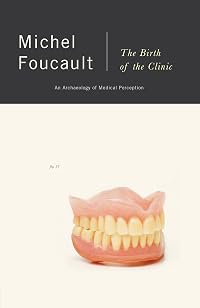
The Birth of the Clinic: An Archaeology of Medical Perception
by Michel Foucault
On This Page
Description
In this remarkable book Michel Foucault, one of the most influential thinkers of recent times, calls us to look critically at specific historical events in order to uncover new layers of significance. In doing so, he challenges our assumptions not only about history, but also about the nature of language and reason, even of truth. The scope of such an undertaking is vast, but by means of his uniquely engaging narrative style, Foucault's penetrating gaze is skilfully able to confront our own. show more After reading his words our perceptions are never quite the same again. show lessTags
Recommendations























Member Reviews
This Foucault monograph charts the emergence of what we might call "scientific medicine" across the eighteenth century, a way of seeing the body that is more rational and systematic than what came before. Of course, since this is Foucault, it's all about politics and power, and he both invents new words and redefines old ones and alternates between the deeply profound and the frustratingly obscure, and spends a lot of time telling you that things are the way he says they are without doing what a contemporary Anglophone critic might consider the necessary legwork to back it up. But it's all about cultivating a way of seeing that is ethically superior to the untrained eye, making it basically my jam. So: use with caution.
Some random show more points of interest and my thoughts:
* Foucault is here quoting the French doctor Charles-Louis Dumas's Discours sur les progrès futurs de la science de l'homme (1804). show less
Some random show more points of interest and my thoughts:
- Like a lot of scientific sight, the vision of what Foucault calls the "clinic" purports that to see things as they are, you need an understanding of theories first: "Clinical medicine is not, therefore, a medicine concerned only with the first degree of empiricism, seeking to reduce, by some kind of methodical scepticism, all its knowledge and teaching to observation of the visible alone. At this first stage, medicine is not defined as clinical unless it is also defined as encyclopedic knowledge of nature and knowledge of man in society" (72).
- Foucault draws a distinction between different forms of scientific sight in the realm of medicine: "The practice required of the officer of health was a controlled empiricism: a question of knowing what to do after seeing; experience was integrated at the level of perception, memory, and repetition, that is, at the level of the example." Theory doesn't help you treat simple illnesses, experience does. On the other hand, "In the clinic, it was a question of a much more subtle and complex structure in which the integration of experience occurred in a gaze that was at the same time knowledge, a gaze that exists, that was master of its truth, and free of all example, even if at times it had made use of them" (81-2).
- Sometimes Foucault makes my points so straightforwardly it makes me wonder if I have any point of my own to make at all: "'One must, as far as possible, make science ocular'. So many powers, from the slow illumination of obscurities, the ever-prudent reading of the essential, the calculation of times and risks, to the master of the heart and the majestic confiscation of paternal authority, are just so many forms in which the sovereignty of the gaze gradually establishes itself-- the eye that knows and decides, the eye that governs" (88-9).
- Also consistent with my own interests is the idea that seeing humans scientifically is quite difficult: "Medicine as an uncertain kind of knowledge is an old theme [...]. It was to be found, reinforced by recent history, in the traditional opposition between the art of medicine and the knowledge of inert things: 'The science of man is concerned with too complicated an object, it embraces a multitude of too varied facts, it operates on too subtle and too numerous elements always to give the immense combinations of which it is capable the uniformity, evidence, and certainty that characterize the physical sciences and mathematics'*" (96-7).
- Foucault discusses the different forms observation takes in the clinic; one way that it manifests is not in the sight of the eye per se but in asking questions to build observations. Foucault describes one four-stage method of observation: first you observe with the eye, question the patient about what they feel, and re-observe; second, you ask general questions about the patient's past; third, you observe over time, as the disease progresses; and last, you prescribe during convalescence. "In this regular alternation of speech and gaze, the disease gradually declares its truth [...]. [T]he questionnaire without the examination and the examination without the interrogation were doomed to an endless task: it belongs to neither to fill the gaps within the province of the other" (112). This actually reminds me a lot of the method of detection Arthur Conan Doyle would perfect in the Sherlock Holmes stories-- you must both ask questions and see carefully to find truth.
* Foucault is here quoting the French doctor Charles-Louis Dumas's Discours sur les progrès futurs de la science de l'homme (1804). show less
I see The Birth of the Clinic by Michel Foucault, here ably and even passionately translated by A.M. Sheridan Smith, is part of the "World of Man: A Library of Theory and Research in the Human Sciences" series edited by R. D. Laing. I’d like to find a complete list of this Library, somewhere.
The 18th century development medicine as a practice in French and European history is the declared content here, with noted French personages and the disruptions of The French Revolution. However, what is striking and moving is the subtext, a reverential, mystical, even fetishistic exploration of the doctor’s inspection and interview, here translated as the medical ‘gaze’. From the Preface, “This book is about space, about language, and show more about death; it is about the act of seeing, the gaze.” And later, “The observing gaze refrains from intervening: it is silent and gestureless. Observation leaves things as they are; there is nothing hidden to it in what is given.” Then at length, “The clinical gaze is a gaze that burns things to their furthest truth. The attention with which it observes and the movement by which it states are in the last resort taken up again in this paradoxical act of consuming. The reality, whose language it spontaneously reads in order to restore it as it is, is not as adequate to itself as might be supposed: its truth is given in a decomposition that is much more than a reading since it involves the freeing of an implicit structure. … The clinical gaze is not that of an intellectual eye that is able to perceive the unalterable purity of essences beneath phenomena. It is a gaze of the concrete sensibility, a gaze that travels from body to body, and whose trajectory is situated in the space of sensible manifestation. For the clinic, all truth is sensible truth; `theory falls silent or almost always vanishes at the patient's bed-side to be replaced by observation and experience; for on what are observation and experience based if not on the relation of our senses? And where would they be without these faithful guides?”
There are several other phrases that are striking and evocative, conjured by Smith from Foucault’s French. I would love to hear a Nick Cave album inspired by these thoughts:
• “The artisanal skill of the brain-breaker”
• “the didactic totality of an ideal experience”
• “sympathy preserves the fundamental form by ranging over time and space; causality dissociates the simultaneities and intersections in order to maintain the essential purities.”
• “…the perception of death in life does not have the same function in the nineteenth century as at the Renaissance. Then it carried with it reductive significations: differences of fate, for tune, conditions were effaced by its universal gesture; it drew each irrevocably to all; the dances of skeletons depicted, on the underside of life, a sort of egalitarian saturnalia; death unfailingly compensated for fortune. Now, on the contrary, it is constitutive of singularity; it is in that perception of death that the individual finds himself, escaping from a monotonous, average life; in the slow, half subterranean, but already visible approach of death, the dull, common life becomes an individuality at last; a black border isolates it and gives it the style of its own truth. Hence the importance of the Morbid. The macabre implied a homogeneous perception of death, once its threshold had been crossed. The morbid authorizes a subtle perception of the way in which life finds in death its most differentiated figure.”
• Etc.
This makes poetic and reverential the import of “The doctor will ‘see’ you now.” show less
The 18th century development medicine as a practice in French and European history is the declared content here, with noted French personages and the disruptions of The French Revolution. However, what is striking and moving is the subtext, a reverential, mystical, even fetishistic exploration of the doctor’s inspection and interview, here translated as the medical ‘gaze’. From the Preface, “This book is about space, about language, and show more about death; it is about the act of seeing, the gaze.” And later, “The observing gaze refrains from intervening: it is silent and gestureless. Observation leaves things as they are; there is nothing hidden to it in what is given.” Then at length, “The clinical gaze is a gaze that burns things to their furthest truth. The attention with which it observes and the movement by which it states are in the last resort taken up again in this paradoxical act of consuming. The reality, whose language it spontaneously reads in order to restore it as it is, is not as adequate to itself as might be supposed: its truth is given in a decomposition that is much more than a reading since it involves the freeing of an implicit structure. … The clinical gaze is not that of an intellectual eye that is able to perceive the unalterable purity of essences beneath phenomena. It is a gaze of the concrete sensibility, a gaze that travels from body to body, and whose trajectory is situated in the space of sensible manifestation. For the clinic, all truth is sensible truth; `theory falls silent or almost always vanishes at the patient's bed-side to be replaced by observation and experience; for on what are observation and experience based if not on the relation of our senses? And where would they be without these faithful guides?”
There are several other phrases that are striking and evocative, conjured by Smith from Foucault’s French. I would love to hear a Nick Cave album inspired by these thoughts:
• “The artisanal skill of the brain-breaker”
• “the didactic totality of an ideal experience”
• “sympathy preserves the fundamental form by ranging over time and space; causality dissociates the simultaneities and intersections in order to maintain the essential purities.”
• “…the perception of death in life does not have the same function in the nineteenth century as at the Renaissance. Then it carried with it reductive significations: differences of fate, for tune, conditions were effaced by its universal gesture; it drew each irrevocably to all; the dances of skeletons depicted, on the underside of life, a sort of egalitarian saturnalia; death unfailingly compensated for fortune. Now, on the contrary, it is constitutive of singularity; it is in that perception of death that the individual finds himself, escaping from a monotonous, average life; in the slow, half subterranean, but already visible approach of death, the dull, common life becomes an individuality at last; a black border isolates it and gives it the style of its own truth. Hence the importance of the Morbid. The macabre implied a homogeneous perception of death, once its threshold had been crossed. The morbid authorizes a subtle perception of the way in which life finds in death its most differentiated figure.”
• Etc.
This makes poetic and reverential the import of “The doctor will ‘see’ you now.” show less
Een stuk wetenschapsgeschiedenis, neigend naar wetenschapssociologie, ware het niet dat Foucault juist niet verklarend wil bezig zijn. Hij beschrijft de ontwikkeling van het kijken naar patiënten en hun ziektes vanaf het midden van de 18de eeuw tot begin 19de eeuw in Frankrijk. Aan het begin van die vijftig jaar keek men nog oppervlakkig naar symptomen van ziektes, die op een middeleeuwse manier werden gekenmerkt. Aan het eind van die vijftig jaar kijkt men vanuit de pathologische anatomie naar zieke lichamen en weefsels op een zeer nauwkeurige manier. Een ziekte is niet meer een vreemde essentie die het lichaam van buitenaf in bezit neemt, maar is het leven zelf dat strijd levert tegen de dood.
Naast de inhoudelijke kant van deze show more ontwikkeling, gaat het Foucault met name om een methodologie. Hij beschrijft deze ontwikkeling niet als één waarbij heroïsche individuen langzamerhand de vanuit ons perspectief gezien vanzelfsprekende waarheid aan het licht brengen. Het kennende subject is niet leidend, maar de reorganisatie van het weten. Waarmee bijvoorbeeld wordt bedoeld de overgang van een academische medische wetenschap die hoegenaamd los stond van de medische praktijk en waarin alle kennis over ziekten al vastlag in de zogeheten nosologie, naar een klinische, praktische wetenschap. Bij deze laatste hoort tevens het snel na de dood kunnen bestuderen van lijken die vanuit de kliniek beschikbaar komen. Deze reorganisatie, waar de vele hervormingen in verband met de Franse Revolutie zeker een rol in speelden, is op zich natuurlijk geen proces geweest waarbij een beperkt aantal individuen bewust ergens op hebben aangestuurd. En het is deze 'toevallige' organisatie van het weten dat een bepaald soort weten mogelijk maakt. Tegelijkertijd wil Foucault geen verklaring geven voor de reorganisatie van het weten. In die zin is het geen sociologie.
Het Frans academische taalgebruik maakt het boek moeilijker leesbaar dan nodig is, denk ik. Anderzijds maakt het zeer subtiele interpretaties op en levert het juweeltjes van passages. De vraag is of het overtuigend is. show less
Naast de inhoudelijke kant van deze show more ontwikkeling, gaat het Foucault met name om een methodologie. Hij beschrijft deze ontwikkeling niet als één waarbij heroïsche individuen langzamerhand de vanuit ons perspectief gezien vanzelfsprekende waarheid aan het licht brengen. Het kennende subject is niet leidend, maar de reorganisatie van het weten. Waarmee bijvoorbeeld wordt bedoeld de overgang van een academische medische wetenschap die hoegenaamd los stond van de medische praktijk en waarin alle kennis over ziekten al vastlag in de zogeheten nosologie, naar een klinische, praktische wetenschap. Bij deze laatste hoort tevens het snel na de dood kunnen bestuderen van lijken die vanuit de kliniek beschikbaar komen. Deze reorganisatie, waar de vele hervormingen in verband met de Franse Revolutie zeker een rol in speelden, is op zich natuurlijk geen proces geweest waarbij een beperkt aantal individuen bewust ergens op hebben aangestuurd. En het is deze 'toevallige' organisatie van het weten dat een bepaald soort weten mogelijk maakt. Tegelijkertijd wil Foucault geen verklaring geven voor de reorganisatie van het weten. In die zin is het geen sociologie.
Het Frans academische taalgebruik maakt het boek moeilijker leesbaar dan nodig is, denk ik. Anderzijds maakt het zeer subtiele interpretaties op en levert het juweeltjes van passages. De vraag is of het overtuigend is. show less
(Source: http://www.flickr.com/photos/patrick-costello/6186206079/sizes/m/in/photostream/...
Beneath the outstretched arms of the statue, Christus Consolatur, at the illustrious Johns Hopkins Hospital in Baltimore, there is a simple inscription: ûÂûCome unto me all ye that are weary and heavy laden and I will give you rest.ûÂû This simple phrase reflects the hopes and aspirations of many who turn to the medical profession.
Foucault here attempts an 'archaeology' of the medical field - he reconstructs a history of ideas of how medicine was perceived - through a study of French medicine in the late 18th and early 19th century, and brushes away the sediment which obscure the origins of the field. He discards the old narratives show more as myths and offers his own metanarrative.
Several main points about his analysis stuck with me. First, his history of the clinique, which is translated here as 'clinic' but might instead mean something more like 'teaching hospital'. He uses the phrase 'birth' of the clinic because it did not gradually form, it suddenly instantly became a new institution.
Second, his episteme history of medicine, comparing past analysis of how physicians looked at the body, the soul, humors, parts of the body vs. the whole, and so forth. He cites Morgagni, the founder of anatomical pathology, and Bichat, who differentiates tissues from organs. His history of pathology also expands into experimentation and prodding of the dead or dying, with the dissection of corpses.
Third, because he is Foucault, after all, he ties this into power dynamics. Outbreaks of illness as a sign of poor governmentality or God's displeasure. The role of physicians, after the 19th century, began to take over that of churchmen and pre-modern physicians, offering physical healing whereas the church could offer only spiritual healing instead of blessings and prayers, or arbitrary procedures which are at best a placebo.
Most interesting to me was his description of the 'medical gaze' in Chapter 6. Separating the physical symptoms of the illness from the person, and comparing it with an ideal terminology-'textbook' version of said disease. This is more of an analysis of the physical symptoms, even to the extent of disregarding the person.
For example. Imagine you are at the dentist. I know it's uncomfortable, but please try. They place the curved pick in your mouth and ask if you have been flossing. You mum show less
My knowledge of the history of medical theory is practically non-existent, and I'm embarrassed to say that I know next to nothing about the French Revolution, so large sections of this book didn't really register with me. It seems like Foucault is using a slightly more direct style than is his wont, but this effect is largely eliminated by the obscurity of his historical references. As with much of his writing, I felt that I understood the beginning and end of the narrative arc pretty well without being entirely clear on what happened in the middle. I was, in fact, all set to give this a mediocre rating; what changed my mind was the clear and fantastic ending. It really is a great statement of Foucault's (early?) philosophy as a whole, show more and an unusually elegant formulation. show less
foucault examines how the study of disease evolves from an examination of the ills of the body to an examination of the ill in spite of the body (and a number of entanglements in addition to that seemingly chronological evolution). honestly, this was a drag, given how intricately it studied each medical institution's view on the definition and practice of medicine in france's medical history. just did not get much out of this one.
Members
- Recently Added By
Lists

Deathreads
78 works; 2 members
Author Information

362+ Works 50,117 Members
Michel Foucault was born on October 15, 1926, in Poitiers, France, and was educated at the Sorbonne, in Paris. He taught at colleges all across Europe, including the Universities of Lill, Uppsala, Hamburg, and Warsaw, before returning to France. There he taught at the University of Paris and the College of France, where he served as the chairman show more of History of Systems of Thought until his death. Regarded as one of the great French thinkers of the twentieth century, Foucault's interest was in the human sciences, areas such as psychiatry, language, literature, and intellectual history. He made significant contributions not just to the fields themselves, but to the way these areas are studied, and is particularly known for his work on the development of twentieth-century attitudes toward knowledge, sexuality, illness, and madness. Foucault's initial study of these subjects used an archaeological method, which involved sifting through seemingly unrelated scholarly minutia of a certain time period in order to reconstruct, analyze, and classify the age according to the types of knowledge that were possible during that time. This approach was used in Madness and Civilization: A History of Insanity in the Age of Reason, for which Foucault received a medal from France's Center of Scientific Research in 1961, The Birth of the Clinic, The Order of Things, and The Archaeology of Knowledge. Foucault also wrote Discipline and Punishment: The Birth of the Prison, a study of the ways that society's views of crime and punishment have developed, and The History of Sexuality, which was intended to be a six-volume series. Before he could begin the final two volumes, however, Foucault died of a neurological disorder in 1984. (Bowker Author Biography) An outstanding philosopher and intellectual figure on the contemporary scene, Foucault has been influential in both philosophy and the recent interpretation of literature. Trained in philosophy and psychology, he was named to a chair at the College de France in 1970. He also taught in various departments of French literature as a visiting professor in the United States. Until 1968 he was a major figure in the critical movement known as structuralism, a method of intellectual inquiry based on the idea that all human behavior and achievement arises from an innate ability to organize, or "structure," human experiences. In both The Order of Things (1966) and The Archaeology of Knowledge (1969) he was interested in the organization of human knowledge and in the transformations of intellectual categories. His influential history of the prison, Discipline and Punish (1975), contributed to the study of the relationship of power and various forms of knowledge, as did the several volumes of an unfinished History of Sexuality published just before his death. (Bowker Author Biography) show less
Some Editions
Series
Belongs to Publisher Series
Work Relationships
Common Knowledge
- Canonical title
- The Birth of the Clinic: An Archaeology of Medical Perception
- Original title
- Naissance de la clinique. Une archéologie du regard médical
- Original publication date
- 1963; 1973 (English: Smith) (English: Smith); 1969 (1. ed. italiana) (1. ed. italiana)
- First words
- This book is about space, about language, and about death; it is about the act of seeing, the gaze.
- Original language
- Francese
- Canonical DDC/MDS
- 362.11
Classifications
- Genres
- Philosophy, Nonfiction, Sociology, History, General Nonfiction, Literature Studies and Criticism, Science & Nature
- DDC/MDS
- 362.11 — Society, government, & culture Social problems and social services Social Welfare People with physical illnesses Hospitals
- LCC
- R133 .F6913 — Medicine Medicine (General) History of medicine. Medical expeditions
- BISAC
Statistics
- Members
- 1,462
- Popularity
- 16,070
- Reviews
- 11
- Rating
- (3.85)
- Languages
- 14 — Chinese, Czech, Danish, Dutch, English, Finnish, French, German, Italian, Japanese, Polish, Portuguese, Spanish, Turkish
- Media
- Paper, Ebook
- ISBNs
- 47
- ASINs
- 10