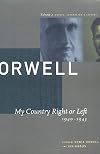
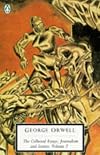
The Collected Essays, Journalism and Letters of George Orwell, Volume 2: My Country Right or Left, 1940-1943
by George Orwell 
The collected essays, journalism, and letters of George Orwell (2)
On This Page
Description
George Orwell is a major figure in twentieth-century literature. During his lifetime he published ten books and two collections of essays. Orwell seldom "reported" and he never took a line other than the one himself felt at the moment of writing. His essays are certainly some of the greatest in that most difficult genre. His widow and her co-editor have collected everything Orwell would have considered an essay, all the journalism that was not purely ephemeral, and those letters which show more contribute to our understanding of his life and writing. The material is arranged chronologically, and gives a continuous picture of Orwell's life as well as his work. -- From publisher's description. show lessTags
Recommendations





















Member Reviews
This second volume of Orwell’s collected works cover the period from 1940-1943. This was a time when Orwell had published several novels and made a name for himself as an investigative journalist and socialist writer, and as such there are far fewer letters to other writers and far more published opinion pieces and articles.
Given that the book covers the opening years of World War II, when Orwell was living in London, I was disappointed to find that surprisingly little of the book involved the war – even when bombs must have been raining down around him during the Blitz, he was still writing book reviews and discussing poetry and the state of contemporary literature. When the war was discussed, it was in political terms, without any show more of the personal angle which I preferred in his earlier writing, such as Down and Out In Paris And London or Homage to Catalonia. Then, of course, I found that the book has an appendix of 100+ pages covering his war-time journals. I can understand why the editors chose not to intermingle them with the rest of the book – a lot of the diary entries contain observations and winning phrases which he’d specifically noted down for later use, so you’d end up with too much repetition – but if I’d known it was there beforehand I probably would have chosen to read the diaries alongside the rest of the book, just for chronological continuity.
In any case, the war-time journals themselves are one of the best parts of the book – I always love Orwell, but his writing is much more enjoyable when there’s a personal aspect to it. It’s fascinating to read a day-by-day (or sometime week-by-week) account of the Blitz in general, let alone coming from the pen of such a gifted and famous writer. Much of his diaries – like much of the rest of the book – consist of political observations, arguments and predictions, but there are also lots of brief fragments of feelings and impressions on the whole situation scattered throughout. The entirety of his entry for October 19, 1940:
The unspeakable depression of lighting the fires every morning with papers of a year ago, and getting glimpses of optimistic headlines as they go up in smoke.
Or an addendum to a mostly political entry on November 23:
Characteristic war-time sound, in winter: the musical tinkle of raindrops on your tin hat.
Or, amusingly, on 27 March, 1941:
Abusive letter from H.G. Wells, who addresses me as “you shit,” among other things.
The predominant thing I took away from the book as a whole – something that was also present in the first volume – was how political WWII was. As a war, it’s been completely deified by modern society. Now, I believe (as Orwell did at the time) that Nazi Germany was nonetheless in the wrong, and the Allies in the right, terms I wouldn’t use to describe any war of the past decade. But right or wrong, Orwell’s writing clearly demonstrates how overwhelmingly political any war is – the complex plotting between conservatives and liberals, right-wing and left-wing, socialists and fascists and pacifists and communists. Many of his essays and diary entries are devoted to nutting out the motives behind propaganda and political decisions, or measuring the morale of a hoodwinked public. We take it as a given that everybody in England pitched in, with stiff upper lip, to defeat the Nazis. That was never true – there were grumblings and demonstrations and people quite potently arguing that England should stay uninvolved, or even join Germany. Antisemitism was rife, sometimes even from Orwell himself, and the US soldiers stationed in the UK were deeply disliked by the locals. Perhaps half a century from now people will think the Iraq War was universally condemned, with every single person in coalition countries united against it, when in fact many supported it. It can go either way, regardless of how the war itself pans out. The only reason I thought the Iraq War was so complex and politically motivated, and that WWII wasn’t, is that I happened to be alive during the Iraq War. Historical wars settle on an accepted narrative, for better or worse. Even the Vietnam War is starting to settle into a general consensus – just not the one the US would like.
So, as always, Orwell makes me think about stuff, whether I agree with him or not. I’m very much looking forward to the next book and keeping an eye out for a hint of the Holocaust. He hasn’t mentioned anything about it yet, and I still can’t wrinkle out of Wikipedia and history books whether or not people in Allied countries knew it was happening. show less
Given that the book covers the opening years of World War II, when Orwell was living in London, I was disappointed to find that surprisingly little of the book involved the war – even when bombs must have been raining down around him during the Blitz, he was still writing book reviews and discussing poetry and the state of contemporary literature. When the war was discussed, it was in political terms, without any show more of the personal angle which I preferred in his earlier writing, such as Down and Out In Paris And London or Homage to Catalonia. Then, of course, I found that the book has an appendix of 100+ pages covering his war-time journals. I can understand why the editors chose not to intermingle them with the rest of the book – a lot of the diary entries contain observations and winning phrases which he’d specifically noted down for later use, so you’d end up with too much repetition – but if I’d known it was there beforehand I probably would have chosen to read the diaries alongside the rest of the book, just for chronological continuity.
In any case, the war-time journals themselves are one of the best parts of the book – I always love Orwell, but his writing is much more enjoyable when there’s a personal aspect to it. It’s fascinating to read a day-by-day (or sometime week-by-week) account of the Blitz in general, let alone coming from the pen of such a gifted and famous writer. Much of his diaries – like much of the rest of the book – consist of political observations, arguments and predictions, but there are also lots of brief fragments of feelings and impressions on the whole situation scattered throughout. The entirety of his entry for October 19, 1940:
The unspeakable depression of lighting the fires every morning with papers of a year ago, and getting glimpses of optimistic headlines as they go up in smoke.
Or an addendum to a mostly political entry on November 23:
Characteristic war-time sound, in winter: the musical tinkle of raindrops on your tin hat.
Or, amusingly, on 27 March, 1941:
Abusive letter from H.G. Wells, who addresses me as “you shit,” among other things.
The predominant thing I took away from the book as a whole – something that was also present in the first volume – was how political WWII was. As a war, it’s been completely deified by modern society. Now, I believe (as Orwell did at the time) that Nazi Germany was nonetheless in the wrong, and the Allies in the right, terms I wouldn’t use to describe any war of the past decade. But right or wrong, Orwell’s writing clearly demonstrates how overwhelmingly political any war is – the complex plotting between conservatives and liberals, right-wing and left-wing, socialists and fascists and pacifists and communists. Many of his essays and diary entries are devoted to nutting out the motives behind propaganda and political decisions, or measuring the morale of a hoodwinked public. We take it as a given that everybody in England pitched in, with stiff upper lip, to defeat the Nazis. That was never true – there were grumblings and demonstrations and people quite potently arguing that England should stay uninvolved, or even join Germany. Antisemitism was rife, sometimes even from Orwell himself, and the US soldiers stationed in the UK were deeply disliked by the locals. Perhaps half a century from now people will think the Iraq War was universally condemned, with every single person in coalition countries united against it, when in fact many supported it. It can go either way, regardless of how the war itself pans out. The only reason I thought the Iraq War was so complex and politically motivated, and that WWII wasn’t, is that I happened to be alive during the Iraq War. Historical wars settle on an accepted narrative, for better or worse. Even the Vietnam War is starting to settle into a general consensus – just not the one the US would like.
So, as always, Orwell makes me think about stuff, whether I agree with him or not. I’m very much looking forward to the next book and keeping an eye out for a hint of the Holocaust. He hasn’t mentioned anything about it yet, and I still can’t wrinkle out of Wikipedia and history books whether or not people in Allied countries knew it was happening. show less
The momentum is not dampened between Vol 1 and Vol 2 but it does begin to slow down a bit roughly third of the way in (mainly due to the many detailed war-related passages). However, the ever evolving sociopolitical outlook of Blair retains its intrigue throughout the second series of essays and letters making it a bit more personable for anyone willing to admit the central role of subjectivity in all aspects of human history.
It is always a pleasure to read something by Orwell. I found his prose a model of lucidity. Since this covers a large part of the WWII period, and has letters and diaries I find it a large fund of quotable materials. It also contains GO's long review of T.S. Eliot's collection of Kipling's poetry, which I also have read. A good book for dipping, and well edited as regards coherence.
Ratings
Members
- Recently Added By
Lists

Mustich's 1000 Books to Read Before You Die: A Life Changing List
1,001 works; 19 members

In Our Time books
4,934 works; 2 members
Author Information

387+ Works 221,004 Members
George Orwell was born Eric Arthur Blair on June 25, 1903 in Motihari in Bengal, India and later studied at Eton College for four years. He was an assistant superintendent with the Indian Imperial Police in Burma. He left that position after five years and moved to Paris, where he wrote his first two books: Burmese Days and Down and Out in Paris show more and London. He then moved to Spain to write but decided to join the United Workers Marxist Party Militia. After being decidedly opposed to communism, he served in the British Home Guard and with the Indian Service of the BBC during World War II. After the war, he wrote for the Observer and was literary editor for the Tribune. His best known works are Animal Farm and 1984. His other works include A Clergyman's Daughter, Keep the Aspidistra Flying, The Road to Wigan Pier, Homage to Catalonia, and Coming Up for Air. He died on January 21, 1950 at the age of 46. (Bowker Author Biography) show less
George Orwell has a Legacy Library. Legacy libraries are the personal libraries of famous readers, entered by LibraryThing members from the Legacy Libraries group.
All Editions
Awards and Honors
Distinctions
Notable Lists
Series

Belongs to Publisher Series
Work Relationships
Common Knowledge
- Canonical title
- The Collected Essays, Journalism and Letters of George Orwell, Volume 2: My Country Right or Left, 1940-1943
- Original title
- My country right or left, 1940-1943
- Original publication date
- 1968
- First words
- At present the formation of new words is a slow process.
- Quotations
- [April 1940] I am kept very busy with the garden, spring sewing being in full swing. I am aiming to raise 6 cwt of potatoes against the famine I foresee next winter.
[March 1941] Crocuses out everywhere, a few wallflowers budding, snowdrops just at their best.
[April 1941] Sowed 40 or 50 lb. of potatoes, which might give 200 to 600 lb. according to the season, etc.
[1932, Hayes, Middlesex] I have got a few square feet of garden, but have had rotten results owing to rain, slugs and mice.
[July 1933] The heat here is fearful but it is good for my marrows and pumpkins, which are swelling almost visibly. We have had lashing of peas, beans just beginning, potatoes rather poor, owing to the drought I suppose.
[1936 Wallington, Hertfordshire] The garden is potentially good but has been left in the most frightful state I have ever seen. I am afraid it will be a year before I can get it nice. - Disambiguation notice
- This is volume 2 of the 4-volume set
Classifications
- Genres
- Nonfiction, Literature Studies and Criticism
- DDC/MDS
- 828.91209 — Literature & rhetoric English & Old English literatures English miscellaneous writings English miscellaneous writings 1900- English miscellaneous writings 1900-1999 English miscellaneous writings 1900-1945 Individual authors not limited to or chiefly identified with one specific form.
- LCC
- PR6029 .R8 .A6 — Language and Literature English English Literature 1900-1960
- BISAC
Statistics
- Members
- 556
- Popularity
- 53,139
- Reviews
- 3
- Rating
- (4.18)
- Languages
- Czech, English, French
- Media
- Paper
- ISBNs
- 9
- ASINs
- 11