On This Page
Description
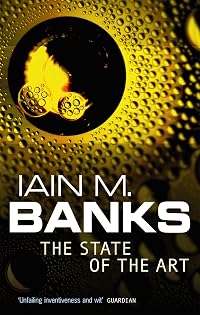
From New York Times bestselling and modern master of science fiction, Iain M. Banks, The State of the Art is the acclaimed collection of Banks's short fiction. "Banks is a phenomenon...writing pure science fiction of a peculiarly gnarly energy and elegance." -William Gibson This is a striking addition to the body of Culture lore, and adds definition and scale to the previous works by using the Earth of 1977 as contrast. The stories in the collection range from science fiction to show more horror, dark-coated fantasy to morality tale. All bear the indefinable stamp of Iain Banks's staggering talent. "Few of us have been exposed to a talent so manifest and of such extraordinary breadth." -New York Review of Science Fiction "[Banks] can summon up sense-of-wonder Big Concepts you've never seen before and display them with narration as deft as a conjuror's fingers." -scifi.com The Culture series: Consider Phlebas The Player of Games Use of Weapons The State of the Art Excession Inversions Look to Windward Matter Surface Detail The Hydrogen Sonata show lessTags
Recommendations







Member Reviews
I picked up this book a couple years ago, looking for a science fiction story from the late twentieth century to teach in a college survey of British literature from 1800 to the present; I assigned my students the Culture novella "The State of the Art." I had actually never read a Culture story before. I've been reading Banks's literary fiction on-and-off for a few years, and I harbored a sort of compulsion that I ought to read all his literary fiction, and then move onto his sf. "The State of the Art" is a great tale: funny and thought-provoking, it both questions our cultural narratives, and the idea that questioning our cultural narratives is enough to then just readopt them: "there is an osmosis from fiction to reality, a constant show more contamination which distorts the truth behind both and fuzzes the telling distinctions in life itself [...]. They always had too many stories, I believe" (201-2). This is a story about being seduced by the nobility of suffering when in fact suffering is completely nonessential. If you exist in a perfect world, there might be no hope, but that's because things are so good you don't need hope. I would happily lose hope in exchange for living in a world that was literally perfect. Sadly, I failed to convince a single student of this. But it remains a provocative and interesting story.
So this month I finally read the rest of the volume (and reread "State of the Art": it's still good). The stories are eclectic. Two or three more seem to be about the Culture, from what I know of it. "Descendant," about a crash victim who has a difficult relationship with his spacesuit was neat, but I particularly enjoyed "Cleaning Up," a fun story where the very technologically advanced trash of an alien civilization is accidentally being deposited on Earth. There are lots of funny bits, some good black comedy, and an ending I didn't see coming. (If the advanced civilization here is the Culture, though, this book is definitely not in continuity with "State of the Art.")
There was some non-sf, too, most notably "Piece," which is about religious radicalism. It also had an unexpected ending, though I think I would have seen it coming if I was less ignorant. I'm not sure what to think about it, to be honest: it feels a very earnest and off-the-cuff response to tragedy, with all the positives and negatives that implies.
I should say there were a couple tales I bounced off. "A Gift from the Culture" sort of meandered and didn't say much of interest, while "Odd Attachment" was just baffling. But you could have just put "The State of the Art" in here and this book would have been worth it, so I'm glad for the chance to experience the Culture for the first time, and to see this snapshot of the early Iain M. Banks. show less
So this month I finally read the rest of the volume (and reread "State of the Art": it's still good). The stories are eclectic. Two or three more seem to be about the Culture, from what I know of it. "Descendant," about a crash victim who has a difficult relationship with his spacesuit was neat, but I particularly enjoyed "Cleaning Up," a fun story where the very technologically advanced trash of an alien civilization is accidentally being deposited on Earth. There are lots of funny bits, some good black comedy, and an ending I didn't see coming. (If the advanced civilization here is the Culture, though, this book is definitely not in continuity with "State of the Art.")
There was some non-sf, too, most notably "Piece," which is about religious radicalism. It also had an unexpected ending, though I think I would have seen it coming if I was less ignorant. I'm not sure what to think about it, to be honest: it feels a very earnest and off-the-cuff response to tragedy, with all the positives and negatives that implies.
I should say there were a couple tales I bounced off. "A Gift from the Culture" sort of meandered and didn't say much of interest, while "Odd Attachment" was just baffling. But you could have just put "The State of the Art" in here and this book would have been worth it, so I'm glad for the chance to experience the Culture for the first time, and to see this snapshot of the early Iain M. Banks. show less
The jacket copy boasts that The State of the Art is "the only collection of Iain Banks' short fiction," and it appears that it does account for most of the short fiction that he ever published. Three of the eight stories, including the novella that makes up about half of the eponymous book, are explicitly Culture tales, and several of the others seem to sit comfortably in the Culture's universe. It is thus figured as the fourth book of the Culture series, and I read it as such.
The novella brings the Culture's exploratory agency Contact to 1970s Earth, thus linking Banks' science fiction to the hardly sfnal "Piece"--a meditation on censorship and violence with an arch irony--and to the quite terrestrial prose poem "Scratch." The show more narrator of "The State of the Art" is even Diziet Sma, the Special Circumstances operative from Use of Weapons.
I had wondered before about the genealogical relationship of the Culture's posthumans to our own population. Banks clearly implies that we are a not-especially-remarkable instance of a galactically ubiquitous pan-humanity, products of parallel evolution it appears. The differences between the Culture's phenotype and ours are briefly described in what Sma needs in order to pass for Earth-human: "I got a couple of extra toes, a joint removed from each finger, and a rather generalized ear, nose, and cheekbone job. The ship insisted on teaching me to walk differently as well" (106-7).
"Cleaning Up" involved an extraterrestrial influence that was almost certainly not the Culture. The story seemed like Banks' take on the Strugatskys' Roadside Picnic, playing up the comical elements of that work. The comedy in all of these stories tends towards the decidedly dark.
There is a full-page illustration by Nick Day for the frontispiece and one for each story. These are all in black-and-white and seem to be linocuts. The style is more diagrammatic than representational. By refusing to offer more eidetic images, these made me conscious of their lack in the larger Culture corpus, where the cover art tends to be abstract and symbolic. A quick 'net search for art depicting the Culture revealed that just last week saw the posthumous publication of The Culture: The Drawings reproducing Banks' own diagrams and sketches of Culture environments and technology.
Despite The State of the Art being a quick read, I think I'll likely take a breather from the Culture for a little while, since I don't have a copy of Excession, and I am also engaged with a couple of other series that seem to have more urgent plot continuity between volumes. show less
The novella brings the Culture's exploratory agency Contact to 1970s Earth, thus linking Banks' science fiction to the hardly sfnal "Piece"--a meditation on censorship and violence with an arch irony--and to the quite terrestrial prose poem "Scratch." The show more narrator of "The State of the Art" is even Diziet Sma, the Special Circumstances operative from Use of Weapons.
I had wondered before about the genealogical relationship of the Culture's posthumans to our own population. Banks clearly implies that we are a not-especially-remarkable instance of a galactically ubiquitous pan-humanity, products of parallel evolution it appears. The differences between the Culture's phenotype and ours are briefly described in what Sma needs in order to pass for Earth-human: "I got a couple of extra toes, a joint removed from each finger, and a rather generalized ear, nose, and cheekbone job. The ship insisted on teaching me to walk differently as well" (106-7).
"Cleaning Up" involved an extraterrestrial influence that was almost certainly not the Culture. The story seemed like Banks' take on the Strugatskys' Roadside Picnic, playing up the comical elements of that work. The comedy in all of these stories tends towards the decidedly dark.
There is a full-page illustration by Nick Day for the frontispiece and one for each story. These are all in black-and-white and seem to be linocuts. The style is more diagrammatic than representational. By refusing to offer more eidetic images, these made me conscious of their lack in the larger Culture corpus, where the cover art tends to be abstract and symbolic. A quick 'net search for art depicting the Culture revealed that just last week saw the posthumous publication of The Culture: The Drawings reproducing Banks' own diagrams and sketches of Culture environments and technology.
Despite The State of the Art being a quick read, I think I'll likely take a breather from the Culture for a little while, since I don't have a copy of Excession, and I am also engaged with a couple of other series that seem to have more urgent plot continuity between volumes. show less
An interesting collection of scifi short stories, some set in the 'Culture' universe, some not. Several of the stories are a bit unpleasant, in one case, more than a bit. Still, they are well written and I enjoyed reading them.
Banks has this unique ability to unflinchingly drop you into disorienting contexts and let you make sense of the alien where most authors would just bombard you with exposition.
It's hard to rate a short story collection because of all the different feelings each story provokes. Banks has a lot of fun with his short fiction and you can tell he used it to wander off (what was already) a very unusual path. Stories both playful and morbid.
The chunk of this book is taken up by The State of the Art which is set in the Culture universe. I really enjoyed the story even though it's the most blatant statement of his worldview. I'm not sure I agree with his some of his conclusions, but The State of the Art is a fantastic look at mortality, privilege, and finding the savor in life.
The chunk of this book is taken up by The State of the Art which is set in the Culture universe. I really enjoyed the story even though it's the most blatant statement of his worldview. I'm not sure I agree with his some of his conclusions, but The State of the Art is a fantastic look at mortality, privilege, and finding the savor in life.
A fine collection of stories, but not a perfect one! Road of Skulls is funny. A Gift From the Culture is dark and depressing. Odd Attachment is silly. Descendant is dark and beautiful. Cleaning Up is silly and funny. Piece is noteworthy only for the punchline. The State of the Art is a good piece but situating Earth within the Culture universe so early in the Culture's run meant that he lost the chance to make better points later on. Finally Scratch is nonsense and that's the point.
This is a collection of short stories written by Iain Banks. The title work, State of the Art, approaches novella length, and is one of two stories in the collection that can be identified as Culture. As a result, it is included in the Culture series, though its inclusion is debatable. There are eight stories in the collection, some far too short to engage the reader.
Road of Skulls- Five pages long. The story is about nothing and goes nowhere.
A Gift from the Culture- As the name implies, this story takes place in the Culture universe. A Culture man has denounced his Culture “citizenship” and settled on a non-Culture planet. By virtue of his Culture “status”, he is uniquely qualified to commit an act of terrorism using a Culture show more weapon.
Odd Attachment- Six pages long. Nothing special.
Descendant- This is a very good story about the survivor of a spaceship crash that is forced to walk across a planet to reach civilization. He is assisted by an AI space suit. This is the best story in the collection.
Cleaning Up- A technologically superior civilization mistakenly transports its “trash” to 20th century Cold War Earth. One man’s trash is another man’s treasure. Pretty good story.
Piece- Eight page long look at religious fundamentalism and terrorism with a nice twist at the end.
The State of the Art- The title work, and by far the longest in the collection. The Contact section of Culture discovers and assesses 20th century Earth, for possible “contact”. Diziet Sma, a character in Use of Weapons, is the main protagonist in the story.
Scratch- Stream of consciousness garbage.
In assigning a rating for the work as a whole, it is not enough to simply average the ratings of the stories, since the worst pieces are the shortest. There is one VERY good short story, four decent efforts, and three throw aways, all of which are very short, hence the overall rating of 7/10. show less
Road of Skulls- Five pages long. The story is about nothing and goes nowhere.
A Gift from the Culture- As the name implies, this story takes place in the Culture universe. A Culture man has denounced his Culture “citizenship” and settled on a non-Culture planet. By virtue of his Culture “status”, he is uniquely qualified to commit an act of terrorism using a Culture show more weapon.
Odd Attachment- Six pages long. Nothing special.
Descendant- This is a very good story about the survivor of a spaceship crash that is forced to walk across a planet to reach civilization. He is assisted by an AI space suit. This is the best story in the collection.
Cleaning Up- A technologically superior civilization mistakenly transports its “trash” to 20th century Cold War Earth. One man’s trash is another man’s treasure. Pretty good story.
Piece- Eight page long look at religious fundamentalism and terrorism with a nice twist at the end.
The State of the Art- The title work, and by far the longest in the collection. The Contact section of Culture discovers and assesses 20th century Earth, for possible “contact”. Diziet Sma, a character in Use of Weapons, is the main protagonist in the story.
Scratch- Stream of consciousness garbage.
In assigning a rating for the work as a whole, it is not enough to simply average the ratings of the stories, since the worst pieces are the shortest. There is one VERY good short story, four decent efforts, and three throw aways, all of which are very short, hence the overall rating of 7/10. show less
Members
- Recently Added By
Lists

Books Read in 2021
5,361 works; 114 members

Books Read in 2023
5,638 works; 147 members
Talk Discussions
Past Discussions
THE STATE OF THE ART discussion (The Culture group read) in 75 Books Challenge for 2014 (August 2015)
Author Information

73+ Works 93,506 Members
Iain Banks was born in Fife in 1954 and was educated at Stirling University where he studied English Literature, Philosophy and Psychology. Banks came to widespread and controversial public note with the publication of his first novel, The Wasp Factory, in 1984. His first science fiction novel, Consider Phlebas, was published in 1987. He continued show more to write both mainstream fiction (as Iain Banks) and science fiction (as Iain M. Banks). Banks' mainstream fiction included The Wasp Factory (1984), Walking on Glass (1985), The Bridge (1986), Espedair Street (1987), Canal Dreams (1989), The Crow Road (1992), Complicity (1993), Whit (1995), A Song of Stone (1997), The Business (1999), Dead Air (2002) and The Steep Approach to Garbadale (2007). His final book, The Quarry, was released posthumously on June 20, 2013. Banks died on June 9, 2013 of terminal gall bladder cancer. (Bowker Author Biography) show less
Some Editions
Series

Belongs to Publisher Series
Work Relationships
Is contained in
Contains
Common Knowledge
- Canonical title*
- L'essence de l'art
- Original title
- The State of the Art
- Original publication date
- 1991
- First words
- (From Road of Skulls) The ride's a little bumpy on the famous Road of Skulls . . .
- Blurbers
- Gibson, William
- Original language
- English
- Canonical DDC/MDS
- 823.087625
- Disambiguation notice
- A short story collection. Do not combine with the English "A Gift From the Culture" which is a single short story.
*Some information comes from Common Knowledge in other languages. Click "Edit" for more information.
Classifications
- Genres
- Science Fiction, Fiction and Literature
- DDC/MDS
- 823.087625 — Literature & rhetoric English & Old English literatures English fiction By type Genre fiction Adventure fiction Speculative fiction Science fiction Space opera
- LCC
- PR6052 .A485 — Language and Literature English English Literature 1961-2000
- BISAC
Statistics
- Members
- 3,171
- Popularity
- 5,522
- Reviews
- 59
- Rating
- (3.59)
- Languages
- 5 — English, French, German, Italian, Spanish
- Media
- Paper, Audiobook, Ebook
- ISBNs
- 20
- ASINs
- 13