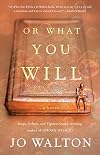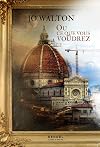
Or What You Will
by Jo Walton 
On This Page
Description
"He has been too many things to count. He has been a dragon with a boy on his back. He has been a scholar, a warrior, a lover, and a thief. He has been dream and dreamer. He has been a god. But "he" is in fact nothing more than a spark of idea, a character in the mind of Sylvia Harrison, 73, award-winning author of thirty novels over forty years. He has played a part in most of those novels, and in the recesses of her mind, Sylvia has conversed with him for years. But Sylvia won't live show more forever, any more than any human does. And he's trapped inside her cave of bone, her hollow of skull. When she dies, so will he. Now Sylvia is starting a new novel, a fantasy for adult readers, set in Thalia, the Florence-resembling imaginary city that was the setting for a successful YA trilogy she published decades before. Of course he's got a part in it. But he also has a notion. He thinks he knows how he and Sylvia can step off the wheel of mortality altogether. All he has to do is convince her."-- show lessTags
Recommendations










Member Reviews
A dying author writes one last book. If her muse has his way, she will write herself (and him) into it.
There's so much going on here that I can hardly come up with more of a summary than that. Walton plays with Renaissance Italy, and with Shakespeare's The Tempest and Twelfth Night, and much more. I loved it. I marvel at the workings of Jo Walton's brain, which is clearly operating at several levels above my own. A fun and satisfying read.
There's so much going on here that I can hardly come up with more of a summary than that. Walton plays with Renaissance Italy, and with Shakespeare's The Tempest and Twelfth Night, and much more. I loved it. I marvel at the workings of Jo Walton's brain, which is clearly operating at several levels above my own. A fun and satisfying read.
A weaving together of many stories, fiction within fiction. Sylvia Harrison, author of thirty fantasy novels, travels to Florence/Firenze by herself - or, sort of by herself. There is another consciousness that lives in her head ("bone cave"), one that has saved her life and been in nearly all her stories. Now, he senses that she is dying, and is trying to guide her over a threshold into a fictional world she's created: Thalia, a version of Firenze in which the Renaissance never ended and death itself was defeated by Pico's Triumph, so that people only die if they are killed or if they themselves wish it.
At the same time, characters Tish and Dolly stumble over this same threshold, out of Florence and into Thalia, where they meet show more wizards Ficino and Miranda, as well as Orsino and Olivia, Viola and Sebastian, all of whom are wrestling with the intervention of the gods (they determine that Sylvia is Hekate) in their lives, as well as the (related) return of Caliban, who plans to rescue Geryon from the tower where Orsino has imprisoned him.
This sudden intervention of the gods in Thalia signals, to Ficino, the beginning (or restarting) of progress; for the past three hundred years, art has flourished, but technological progress has stalled. Dolly and Tish, from a time between the Renaissance and the present, will be crucial guides.
See also: The Blind Assassin by Margaret Atwood; A God in Ruins by Kate Atkinson
Quotes
History is infuriating in what it leaves out, what it tells us and doesn't tell us. But sometimes these gaping holes are everything, are the crack where the light gets in. Sometimes the lacuna is what makes space for a new story. (37)
The way we look at history is very strange, the places we draw lines, the things we remember and forget and take for granted, the series of improbabilities that become inevitabilities only after they have happened. (42)
For somebody who has made a career writing fantasy, she has a surprising amount of faith in science-fictional solutions. (58)
Reality is beside the point. (66)
"But real people can't go into made-up worlds. It's just not possible. I don't know how I can explain it if you don't understand. There's a difference, and you're not seeing it." (Sylvia, 76)
Everything that [Idris] touched, everything they discussed, every moment they shared is limned with sorrow now, as if a bright Ghirlandaio painting full of hope and colour had been retouched by Caravaggio so it seems to be taking place inside a dark cave. (115)
Revision is more frightening than death in some ways. (135)
It seems very strange to [Tish] that Miranda from The Tempest should be the mother of Orsino from Twelfth Night, but strangest of all to be talking to them, as if she had entered into a play she hadn't read and doesn't know her lines. (148)
It's not fashionable to think about decline and fall these days....But all the same, sometimes when the lights go out, it stays dark for a long time. (198)
A distance of a hundred and fifty years is very different from five hundred. (205)
"Progress. It doesn't work here." (Ficino, 205)
There is a pernicious lie in Western culture that Sylvia has tried to combat in her books for years, and it is this: a child who is not loved is damaged beyond repair. Relatedly, anyone who has been abused can never recover. These lies are additional abuse heaped on those who have already suffered. Being told that the worst thing in the world has happened to you and you cannot recover can be a self-fulfilling prophecy. (254)
"And anyway you can't put everything into everything...Every piece of art can't address every issue." (288)
"If you love books enough, books will love you back" (from Among Others, 313) show less
At the same time, characters Tish and Dolly stumble over this same threshold, out of Florence and into Thalia, where they meet show more wizards Ficino and Miranda, as well as Orsino and Olivia, Viola and Sebastian, all of whom are wrestling with the intervention of the gods (they determine that Sylvia is Hekate) in their lives, as well as the (related) return of Caliban, who plans to rescue Geryon from the tower where Orsino has imprisoned him.
This sudden intervention of the gods in Thalia signals, to Ficino, the beginning (or restarting) of progress; for the past three hundred years, art has flourished, but technological progress has stalled. Dolly and Tish, from a time between the Renaissance and the present, will be crucial guides.
See also: The Blind Assassin by Margaret Atwood; A God in Ruins by Kate Atkinson
Quotes
History is infuriating in what it leaves out, what it tells us and doesn't tell us. But sometimes these gaping holes are everything, are the crack where the light gets in. Sometimes the lacuna is what makes space for a new story. (37)
The way we look at history is very strange, the places we draw lines, the things we remember and forget and take for granted, the series of improbabilities that become inevitabilities only after they have happened. (42)
For somebody who has made a career writing fantasy, she has a surprising amount of faith in science-fictional solutions. (58)
Reality is beside the point. (66)
"But real people can't go into made-up worlds. It's just not possible. I don't know how I can explain it if you don't understand. There's a difference, and you're not seeing it." (Sylvia, 76)
Everything that [Idris] touched, everything they discussed, every moment they shared is limned with sorrow now, as if a bright Ghirlandaio painting full of hope and colour had been retouched by Caravaggio so it seems to be taking place inside a dark cave. (115)
Revision is more frightening than death in some ways. (135)
It seems very strange to [Tish] that Miranda from The Tempest should be the mother of Orsino from Twelfth Night, but strangest of all to be talking to them, as if she had entered into a play she hadn't read and doesn't know her lines. (148)
It's not fashionable to think about decline and fall these days....But all the same, sometimes when the lights go out, it stays dark for a long time. (198)
A distance of a hundred and fifty years is very different from five hundred. (205)
"Progress. It doesn't work here." (Ficino, 205)
There is a pernicious lie in Western culture that Sylvia has tried to combat in her books for years, and it is this: a child who is not loved is damaged beyond repair. Relatedly, anyone who has been abused can never recover. These lies are additional abuse heaped on those who have already suffered. Being told that the worst thing in the world has happened to you and you cannot recover can be a self-fulfilling prophecy. (254)
"And anyway you can't put everything into everything...Every piece of art can't address every issue." (288)
"If you love books enough, books will love you back" (from Among Others, 313) show less
Oh wow. This is probably not Jo Walton's best book, but it is the book that most speaks to me, though I am no more a Shakespeare scholar than I am a classicist, still when, on the last page, the two names were spoken, they were the names that I had given. And in many ways this is the closest book to reading Le Guin that isn't Le Guin.
It is fanciful and real, and though the author says it is meditations on Renaissances and death and subcreation it is also very much about making and remaking self and the plurality of self. Also, she states, so much better than I can:
"There is a pernicious lie in Western culture that Sylvia has tried to combat in her books for years, and it is this: a child who is not loved is damaged beyond repair. show more Relatedly, anyone who has been abused can never recover. These lies are additional abuse heaped on those who have already suffered. Being told that the worst thing in the world has happened to you and you cannot recover can be a self-fulfilling prophecy." show less
It is fanciful and real, and though the author says it is meditations on Renaissances and death and subcreation it is also very much about making and remaking self and the plurality of self. Also, she states, so much better than I can:
"There is a pernicious lie in Western culture that Sylvia has tried to combat in her books for years, and it is this: a child who is not loved is damaged beyond repair. show more Relatedly, anyone who has been abused can never recover. These lies are additional abuse heaped on those who have already suffered. Being told that the worst thing in the world has happened to you and you cannot recover can be a self-fulfilling prophecy." show less
“He has been too many things to count. He has been a dragon with a boy on his back. He has been a scholar, a warrior, a lover, and a thief. He has been dream and dreamer. He has been a god.”
“Writers are not nice people. We can't be.”
“Of course, all books are easier to read that to describe. This is true even when you’re a character in them, when that’s been your whole life, when you began as the author’s imaginary friend and wound up as narrator, protagonist, and bit part player in her over thirty novels. But I don’t know why we’re talking about you. This is a book about me."
I think this last quote sums up this wonderfully inventive novel. How a lonely girl's imaginary childhood friend, returns in her adulthood, show more rescuing her again, by becoming a key force in the novels that she is writing. She is now a 73 year old acclaimed author and is about to finally do away with her constant companion, but of course, “He” has different ideas. Walton's latest is another marvel of crafty intelligence and a paen to her love of literature. show less
“Writers are not nice people. We can't be.”
“Of course, all books are easier to read that to describe. This is true even when you’re a character in them, when that’s been your whole life, when you began as the author’s imaginary friend and wound up as narrator, protagonist, and bit part player in her over thirty novels. But I don’t know why we’re talking about you. This is a book about me."
I think this last quote sums up this wonderfully inventive novel. How a lonely girl's imaginary childhood friend, returns in her adulthood, show more rescuing her again, by becoming a key force in the novels that she is writing. She is now a 73 year old acclaimed author and is about to finally do away with her constant companion, but of course, “He” has different ideas. Walton's latest is another marvel of crafty intelligence and a paen to her love of literature. show less
So yeah, as soon as I heard this book was coming, I knew I was going to love it. I mean, a writer protagonist? Shakespeare and the Renaissance? Characters who interact with their author? And I’ve read enough Walton to know that she’s impressively inventive, never tells the expected story, and at the top of her game, is exquisite. What I wasn’t expecting was for this book to be so intricate and powerful, or to actually be giving a 10/10 rating for once.
There’s nothing about this I didn’t love. The characters are wonderful, especially the two mains, and every person and relationship in the book feels real, even the ones in the deeply metafictional bits. The descriptions are sparse but gorgeous. The humour is perfectly measured show more and very relatable. The novel-in-the-novel is exactly the sort of book Sylvia would write, right down to the rocky parts. The themes, the question’s Walton’s asking, the undercurrents of the novel are … powerful, multifaceted, and more tied into the surface of the book than I might have ever seen.
Reading this was absolutely an experience. The structure! The ideas! The feels! It’s Walton setting the bar, pushing the envelope, upping her game, any of those sorts of metaphors, and one of those books that resets what a novel can be and forces me to ask, “How did she do that?”
Is it going to hit this hard for everyone reading it? I doubt it, as pretty much everything in it was tailored to my tastes. It’s a complicated book, in terms of structure and message, and Walton isn’t pandering to her readers so drops in-jokes and references that not everyone is going to get. (I didn’t.) It’s also one of those novels where nothing’s out of place and where the themes and story almost seem to spark off each other. In other words, it’s a book you need to pay attention to, but will absolutely reward you if you do.
This was an easy 9.5 for me, but I’m upping the rating because, again, how did Walton do that? I didn’t think a book like this was possible.
To bear in mind: protagonist is an abuse survivor, is a widow, is fighting cancer
10/10 show less
There’s nothing about this I didn’t love. The characters are wonderful, especially the two mains, and every person and relationship in the book feels real, even the ones in the deeply metafictional bits. The descriptions are sparse but gorgeous. The humour is perfectly measured show more and very relatable. The novel-in-the-novel is exactly the sort of book Sylvia would write, right down to the rocky parts. The themes, the question’s Walton’s asking, the undercurrents of the novel are … powerful, multifaceted, and more tied into the surface of the book than I might have ever seen.
Reading this was absolutely an experience. The structure! The ideas! The feels! It’s Walton setting the bar, pushing the envelope, upping her game, any of those sorts of metaphors, and one of those books that resets what a novel can be and forces me to ask, “How did she do that?”
Is it going to hit this hard for everyone reading it? I doubt it, as pretty much everything in it was tailored to my tastes. It’s a complicated book, in terms of structure and message, and Walton isn’t pandering to her readers so drops in-jokes and references that not everyone is going to get. (I didn’t.) It’s also one of those novels where nothing’s out of place and where the themes and story almost seem to spark off each other. In other words, it’s a book you need to pay attention to, but will absolutely reward you if you do.
This was an easy 9.5 for me, but I’m upping the rating because, again, how did Walton do that? I didn’t think a book like this was possible.
To bear in mind: protagonist is an abuse survivor, is a widow, is fighting cancer
10/10 show less
I should really stop reading Jo Walton. Every time I read one of her books, I am enchanted by the good ideas and frustrated by the disappointing execution.
This book is narrated by a character you could call a muse, or an imaginary friend, or a schizophrenic hallucination. The narrator lives inside the head of Sylvia, an aging writer, and he becomes the characters in her books. Writing her books is a collaborative process between the author and this muse. The nature of his existence is strange - she does not think of him as something he created, but as another person. He intervenes at crucial points in her life, and (to the extent that his narration can be taken as reliable) there are times when Sylvia and other people can see show more him.
Sylvia is dying, and she is writing one last book before her death. The narrator does not want to die, and he does not want Sylvia to die, so he is trying to get her to write herself into her fantasy world so that the two of them can live forever there.
"Or What You Will" moves back and forth between the fantasy world that Sylvia is writing, and the narrator's account of her days wandering Florence while she writes, and flashbacks about his role in her life.
The fantasy novel is bizarre and completely incohesive. It is set in an alternate Florence, where Pico della Mirandola (a real historical person) discovered a way to pause time in the Renaissance and conquer death, so people only die if they want to. In addition to some historical people, there are also a lot of characters from Shakespeare's Tempest and Twelfth Night, for no apparent reason, and some people from Victorian England who get transported into the world. I had a lot of problems with this world. For one thing, the characters discuss the fact that progress cannot happen. So there are a bunch of intellectual magicians who have lived for 500 years and made no progress? That sounds like a very boring existence. It's a very rosy version of the Renaissance that completely ignores the prevalence of disease and how difficult things were for people who weren't very rich. The use of Shakespearean characters feels lazy - they're just there to have some familiar names. Caliban shows up early on, in a scene that sets off a lot of the action of the novel, and yet we never see him again, despite the fact that he promises to return in a few days. That's an entire storyline that just gets dropped.
Sylvia's story is more coherent (content warning: the book has detailed descriptions of her relationship with an abusive husband), but I'm not sure what the point of it is, other than how art can be a solace to the artist. show less
This book is narrated by a character you could call a muse, or an imaginary friend, or a schizophrenic hallucination. The narrator lives inside the head of Sylvia, an aging writer, and he becomes the characters in her books. Writing her books is a collaborative process between the author and this muse. The nature of his existence is strange - she does not think of him as something he created, but as another person. He intervenes at crucial points in her life, and (to the extent that his narration can be taken as reliable) there are times when Sylvia and other people can see show more him.
Sylvia is dying, and she is writing one last book before her death. The narrator does not want to die, and he does not want Sylvia to die, so he is trying to get her to write herself into her fantasy world so that the two of them can live forever there.
"Or What You Will" moves back and forth between the fantasy world that Sylvia is writing, and the narrator's account of her days wandering Florence while she writes, and flashbacks about his role in her life.
The fantasy novel is bizarre and completely incohesive. It is set in an alternate Florence, where Pico della Mirandola (a real historical person) discovered a way to pause time in the Renaissance and conquer death, so people only die if they want to. In addition to some historical people, there are also a lot of characters from Shakespeare's Tempest and Twelfth Night, for no apparent reason, and some people from Victorian England who get transported into the world. I had a lot of problems with this world. For one thing, the characters discuss the fact that progress cannot happen. So there are a bunch of intellectual magicians who have lived for 500 years and made no progress? That sounds like a very boring existence. It's a very rosy version of the Renaissance that completely ignores the prevalence of disease and how difficult things were for people who weren't very rich. The use of Shakespearean characters feels lazy - they're just there to have some familiar names. Caliban shows up early on, in a scene that sets off a lot of the action of the novel, and yet we never see him again, despite the fact that he promises to return in a few days. That's an entire storyline that just gets dropped.
Sylvia's story is more coherent (content warning: the book has detailed descriptions of her relationship with an abusive husband), but I'm not sure what the point of it is, other than how art can be a solace to the artist. show less
Advance copy provided by NetGalley.
This has got to be the strangest, most original thing I’ve read so far this year, and I loved it. It’s kind of a mash-up of Twelfth Night and The Tempest, with some art history thrown in, all set in Florence, real and imagined, in different centuries. My unfamiliarity with most of that list did not detract from my enjoyment of the novel, but I did come out of it hoping to read and see The Tempest performed some day. I wouldn’t turn down a future trip to Italy either while we’re at it. The author’s love for Florence practically sings from the page.
There was a lot going on here, many layers to the story. I was constantly being startled into switching gears to follow what was happening, but show more the writing was so good that it was less being startled than being pleasantly surprised as the author pulled me along the thought processes of the characters—one, a fantasy author, and one, her creation. The narration is done mostly by the latter, who is the essence of many of the author Sylvia’s characters. He is self-aware, and his wish to exist outside of the “bone cave” of Sylvia’s mind drives the narrative, which drifts back and forth between past and present, fantasy and reality.
It was beautifully done, and I can’t wait to start making people read it when it comes out this summer. show less
This has got to be the strangest, most original thing I’ve read so far this year, and I loved it. It’s kind of a mash-up of Twelfth Night and The Tempest, with some art history thrown in, all set in Florence, real and imagined, in different centuries. My unfamiliarity with most of that list did not detract from my enjoyment of the novel, but I did come out of it hoping to read and see The Tempest performed some day. I wouldn’t turn down a future trip to Italy either while we’re at it. The author’s love for Florence practically sings from the page.
There was a lot going on here, many layers to the story. I was constantly being startled into switching gears to follow what was happening, but show more the writing was so good that it was less being startled than being pleasantly surprised as the author pulled me along the thought processes of the characters—one, a fantasy author, and one, her creation. The narration is done mostly by the latter, who is the essence of many of the author Sylvia’s characters. He is self-aware, and his wish to exist outside of the “bone cave” of Sylvia’s mind drives the narrative, which drifts back and forth between past and present, fantasy and reality.
It was beautifully done, and I can’t wait to start making people read it when it comes out this summer. show less
Members
- Recently Added By
Lists

Top Five Books of 2020
982 works; 350 members

2021 Hugo Eligible Novels
37 works; 14 members

Books Read in 2020
4,379 works; 124 members
Author Information

61+ Works 14,688 Members
Jo Walton is a LibraryThing Author, an author who lists their personal library on LibraryThing.
Awards and Honors
Series
Belongs to Publisher Series
Gallimard, Folio SF (754)
Work Relationships
Was inspired by
Has as a commentary on the text
Common Knowledge
- Canonical title
- Or What You Will
- Original title
- Or What You Will
- Original publication date
- 2020
- Important places
- Illyria; Florence, Tuscany, Italy
- Epigraph
- I know more than Apollo, For oft when he lies sleeping I see the stars at bloody wars In the wounded welkin weeping. -"TOM O'BEDLAM'S SONG" ANONYMOUS, FIFTEENTH CENTURY
If this were played upon a stage now, I could condemn it as an improbably fiction. - FABIAN, 'Twelfth Night' WILLIAM SHAKESPEARE - Dedication
- This for everyone who ever had an imaginary friend.
- First words
- She won't let me tell all the stories.
- Last words
- (Click to show. Warning: May contain spoilers.)Then I take her hand, and we step forward, off the edge of the cliff, into the rose, through layering colours that are the petals of the rose, and we do not fall, we step out into the paradiso, into the picture, and on into Illyria, together and free.
- Blurbers
- Rowell, Rainbow; El-Mohtar, Amal; Doctorow, Cory; Spufford, Francis; Grossman, Lev; Jemisin, N.K. (show all 7); Le Guin, Ursula K.
- Original language
- English
- Canonical DDC/MDS
- 823.92; 823.914
- Canonical LCC
- PR6073.A448
Classifications
Statistics
- Members
- 378
- Popularity
- 82,920
- Reviews
- 18
- Rating
- (3.85)
- Languages
- English, French, Italian
- Media
- Paper, Audiobook, Ebook
- ISBNs
- 7
- ASINs
- 2