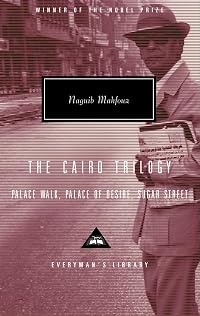
The Cairo Trilogy: Palace Walk, Palace of Desire, Sugar Street
by Naguib Mahfouz
The Cairo Trilogy (Collections and Selections — Omnibus 1-3)
On This Page
Description
Naguib Mahfouz's magnificent epic trilogy of colonial Egypt appears here in one volume for the first time. The Nobel Prize—winning writer's masterwork is the engrossing story of a Muslim family in Cairo during Britain's occupation of Egypt in the early decades of the twentieth century.The novels of The Cairo Trilogy trace three generations of the family of tyrannical patriarch Al-Sayyid Ahmad Abd al-Jawad, who rules his household with a strict hand while living a secret life of show more self-indulgence. Palace Walk introduces us to his gentle, oppressed wife, Amina, his cloistered daughters, Aisha and Khadija, and his three sons–the tragic and idealistic Fahmy, the dissolute hedonist Yasin, and the soul-searching intellectual Kamal. Al-Sayyid Ahmad's rebellious children struggle to move beyond his domination in Palace of Desire, as the world around them opens to the currents of modernity and political and domestic turmoil brought by the 1920s. Sugar Street brings Mahfouz's vivid tapestry of an evolving Egypt to a dramatic climax as the aging patriarch sees one grandson become a Communist, one a Muslim fundamentalist, and one the lover of a powerful politician.
Throughout the trilogy, the family's trials mirror those of their turbulent country during the years spanning the two World Wars, as change comes to a society that has resisted it for centuries. Filled with compelling drama, earthy humor, and remarkable insight, The Cairo Trilogy is the achievement of a master storyteller.
. show less
Tags
Recommendations























Member Recommendations
paulkid These books are fathers-and-sons family epics that are set around the turn of the (20th) century. They both have philosophical and coming-of-age themes as well.
20

Member Reviews
The story of three generations of an Egyptian family at the beginning of the 20th century. Provides a window into the process of change in Egyptian private and public life, especially with respect to class and gender issues. Unfortunately I’m only getting around to reviewing it like 9 months after I read it, so I am not going to delve too specifically into plot developments.
I loved the first installment of the trilogy, Palace Walk, in which very little "actually happened". Mahfouz simply describes early 20th century Cairo - the people, the places - and shows us what life was like for one very traditional family in a time of tremendous social and political change. I felt like I got such an amazing sense of place and tradition and show more character out of this book. The second installment, Palace of Desire, almost killed me. This one concentrates much more narrowly on a single character who is, frankly, annoying and delves much more into his philosophies and political views. It is much more male-focused and the women of the family, who were such interesting personalities, kind of fade away. The third book, Sugar Street really focuses on the youngest generation, the grandchildren of the patriarch Ahmad abd al-Jawad, and is a better combination of political and personal. This book was fascinating, especially when read in comparison with the first book – the lives of the women and men were so different only 40 years later! In my mind, Palace Walk is the strongest of the three books.
Structurally, Mahfouz uses a number of interesting techniques throughout the book. He is continually creating parallels between characters – fathers and sons, mothers and daughters, sisters and brothers – and showing them re-enact each other’s lives in slightly different circumstances. This sounds like it could be boring, but it was really engaging and reinforced the sense of both continuity and change. Political activism is very different for Fahmy, his younger brother Kamal (their age difference is so great as to almost count as a different generation), and their nephews Ridwan, Khalil, and Ahmad. Within the same generation, it means very different things depending on whether one is Muslim, like Kamal, or Christian, like his friend Riyad. Marriage is contracted and lived very differently for Amina, her daughters, and the women her grandsons marry.
Mahfouz also increases the diversity of the physical landscape and the number and types of characters as the story goes on, showing (rather than telling) how the lives of the al-Jawad family broadened over time due to changing social and political structures. The first book concentrates almost exclusively on the immediate and extended family, a few friends of Ahmad abd al-Jawad who are so close they are basically family, and the family’s immediate neighbors. These people are all the same religion and members of the same socio-economic class. Outsiders rarely intrude and when they do, their presence usually leads to a calamity. The characters rarely leave the familiar confines of the house or their neighborhood. When they do, it usually signals a calamity. Subsequent books introduce characters of different religions, different socio-economic classes (both higher and lower), Europeanized Egyptians, different political persuasions, and different sexual persuasions. The characters get out more – the center of gravity shifts to new homes, new neighborhoods, universities, newspaper offices, and the public space in general. All of this brilliantly shows the significant social changes that occurred in Egypt over this approximately 40-year period.
Without revealing any spoilers, another technique Mahfouz uses to show continuity in the face of change is that each book ends with a death and a birth – even as life is ending and one part of the family’s world dies out, another life begins and their line continues. I thought that was beautiful – a little tragedy mixed with a little happiness.
Overall, this is such an amazing book. Despite being weak in certain spots, the cumulative result is nearly perfect. Highly recommended to anyone. show less
I loved the first installment of the trilogy, Palace Walk, in which very little "actually happened". Mahfouz simply describes early 20th century Cairo - the people, the places - and shows us what life was like for one very traditional family in a time of tremendous social and political change. I felt like I got such an amazing sense of place and tradition and show more character out of this book. The second installment, Palace of Desire, almost killed me. This one concentrates much more narrowly on a single character who is, frankly, annoying and delves much more into his philosophies and political views. It is much more male-focused and the women of the family, who were such interesting personalities, kind of fade away. The third book, Sugar Street really focuses on the youngest generation, the grandchildren of the patriarch Ahmad abd al-Jawad, and is a better combination of political and personal. This book was fascinating, especially when read in comparison with the first book – the lives of the women and men were so different only 40 years later! In my mind, Palace Walk is the strongest of the three books.
Structurally, Mahfouz uses a number of interesting techniques throughout the book. He is continually creating parallels between characters – fathers and sons, mothers and daughters, sisters and brothers – and showing them re-enact each other’s lives in slightly different circumstances. This sounds like it could be boring, but it was really engaging and reinforced the sense of both continuity and change. Political activism is very different for Fahmy, his younger brother Kamal (their age difference is so great as to almost count as a different generation), and their nephews Ridwan, Khalil, and Ahmad. Within the same generation, it means very different things depending on whether one is Muslim, like Kamal, or Christian, like his friend Riyad. Marriage is contracted and lived very differently for Amina, her daughters, and the women her grandsons marry.
Mahfouz also increases the diversity of the physical landscape and the number and types of characters as the story goes on, showing (rather than telling) how the lives of the al-Jawad family broadened over time due to changing social and political structures. The first book concentrates almost exclusively on the immediate and extended family, a few friends of Ahmad abd al-Jawad who are so close they are basically family, and the family’s immediate neighbors. These people are all the same religion and members of the same socio-economic class. Outsiders rarely intrude and when they do, their presence usually leads to a calamity. The characters rarely leave the familiar confines of the house or their neighborhood. When they do, it usually signals a calamity. Subsequent books introduce characters of different religions, different socio-economic classes (both higher and lower), Europeanized Egyptians, different political persuasions, and different sexual persuasions. The characters get out more – the center of gravity shifts to new homes, new neighborhoods, universities, newspaper offices, and the public space in general. All of this brilliantly shows the significant social changes that occurred in Egypt over this approximately 40-year period.
Without revealing any spoilers, another technique Mahfouz uses to show continuity in the face of change is that each book ends with a death and a birth – even as life is ending and one part of the family’s world dies out, another life begins and their line continues. I thought that was beautiful – a little tragedy mixed with a little happiness.
Overall, this is such an amazing book. Despite being weak in certain spots, the cumulative result is nearly perfect. Highly recommended to anyone. show less
The Cairo trilogy covers decades of life in an exceptional nation through the story of one extended family, the Jawads. While the focus of these books is on personal life, the family is impinged by politics, war and foreign occupation - as well as traffic hazards, illness and the health and education systems. The trilogy opens during the Great War and English colonialism and closes at the end of WW2, as Egypt enters six decades of dictatorship.
Palace Walk
In an ultra-conservative society the Jawad family lives in its most conservative area, in the old quarter of town. Even here, however, they stand out as extreme.
The middle-aged patriarch is Ahmed Jawad (al-Sayyid Ahmed abd al-Jawad). Sombre or belligerent towards his family, he is show more easy and charming with customers in his shop, and the life of the party with his friends - and he parties often, at various venues, with male friends and female 'entertainers'. He gets home after midnight to a wife routinised into awakening herself to meet his various noctural needs.
He keeps his wife Amina housebound. She peers through the latticework of her enclosed front balcony. "There was nothing to attract the eye except the minarets of the ancient seminaries of Qala'un and Barquq which loomed like ghostly giants enjoying a night out by the light of the gleaming stars. It was a view that had grown on her over a quarter of a century. She never tired of it. Perhaps boredom was an irrelevant concept for a life as monotonous as hers." Her world is family life, piety, and the jinn that haunt dark corners of the house. His daughters Khadija and Aisha are also locked up, unseen and unmentioned. When an Islamic cleric known to the family uttered their names during a conversation with him - a modest enough form of public exposure - it "sounded odd to al-Sayyid Ahmad", and had "a strange and unpleasant impact on him". When a wedding eventuates, the gaity and licence that it allows to the Jawad women grates on him.
The 20 year old Khadija asserts herself with sarcasm, while acting emotionally as a second mother. She inspects her vast nose before the mirror, full of secret fear that she will not marry. ("We were talking about you", one of her brothers jests. "We were saying that if every woman looked like you, men would be spared all heartaches.") She comforts herself that at least she is beautifully fat. Aisha, her 16-year old younger sister, is mild, slim, blonde and blue-eyed, with a family role as "the useless personification of good looks and charm". Aisha allows a dashing young policeman to view at a momentarily-opened window: it fills her older sister with jealousy, but also with dread that their father might learn of it.
The sons play bigger roles. Yasin, the eldest, was the child of Ahmad's first wife, who'd left him, bridling at his tyranny. Yasin had a confused early life, with a distracted mother and a chain of her passing male friends. He later views this period through the lens of his father's austere religion, and was revulsed. Yasin lacks finer feeling: warm and easygoing, but cynical, mentally lazy. Above all he is led along by his lust.
The younger sons, children of Amina, have taken on her sensitivity. Fahmy is capable of a romantic desire for the sequestered girl next door, available for illicit chats across the roof as she hung out washing, but he is also drawn to the cause of national liberation from colonial rule. (When Amina exposes herself to ridicule by explaining the behaviour of the English rulers along the only model she knows, family life, Yasin smilingly urges her on for his entertainment, but Fahmy irritably puts a stop to it.)
The youngest, Kamal, cleaves most strongly to his mother, and sisters, perhaps because Ahmad is at his harshest towards the little boy, perhaps because his physical appearance is unappealing. He inhabits his mother's phantom world of spirits and Islamic piety, drawing deep inspiration and sustenance from the presence of the martyr al-Husayn at a nearby mosque.
Palace Walk traces the family and its fortunes up to the unsuccessful revolution of 1919, a mass movement that will surely evoke parallels with Egypt today.
Palace of Desire
Ahmed Jawab is facing his midlife crisis, and the main form of it is that his old female 'friends' no longer stir him, despite their best efforts. Instead his lust turns, idly at first, to one of their their support staff, the young flautist Zanuba. He is used to dictating terms to his women, crediting his success to charisma - so he's baffled when Zanuba remains cold. Pressure only makes her prickly and spiteful. He decides to move on from her but discovers, to his alarm, that he cannot. She is only available though money, and a great deal of it.
Yasin, meanwhile, gets married, for some good, regular, socially sanctioned sex. When monogamy loses its freshness, the search for sex hoiks up again. He bullocks his way through social protocols, class layers, delicate interfamily understandings and alliances - into all sorts of trouble, including a dalliance with a middle-aged woman whose personal disarray seems to parallel to that of Yasin's father. Indeed, Yasin's path intertwines with that of his father in remarkable ways.
Kamal takes his own road to folly. All his imagination and sensibilities fasten on the beauty and poise of Aida, older sister of one of his rich school friends. Her baby sister adores Kamal effusively, a counterpoint to the remoteness and reserve of Aida herself. For all it's intensity Kamal's love is courtly, immaterial. In his own way he is just as disconnected from the hearts and minds of women as the other men in his family - unaware that while the men's road through life may meander, the women must run on the rails of matrimony or whoredom.
Sugar Street
Sugar St concludes the story of Ahmed Jawad and his immediate family, while also introducing the third generation. I thought the characters of the grandchildren were not well developed. They appear more as symbols of wider social changes. Personal trajectories diverge as individual rise or sink on the social scale and illustrate what is happening to the country, while backstage, seedy politicians squabble, the king and the English manoeuvre, the pure hopes raised by the 1919 revolution sink into a quagmire. Sugar Street, it turns out, is a place of unrelieved bitterness. Each character's road becomes a blind alley, as Egypt turns from degraded semi-colony to a military prison, a maze with no exit. Until 2011. show less
Palace Walk
In an ultra-conservative society the Jawad family lives in its most conservative area, in the old quarter of town. Even here, however, they stand out as extreme.
The middle-aged patriarch is Ahmed Jawad (al-Sayyid Ahmed abd al-Jawad). Sombre or belligerent towards his family, he is show more easy and charming with customers in his shop, and the life of the party with his friends - and he parties often, at various venues, with male friends and female 'entertainers'. He gets home after midnight to a wife routinised into awakening herself to meet his various noctural needs.
He keeps his wife Amina housebound. She peers through the latticework of her enclosed front balcony. "There was nothing to attract the eye except the minarets of the ancient seminaries of Qala'un and Barquq which loomed like ghostly giants enjoying a night out by the light of the gleaming stars. It was a view that had grown on her over a quarter of a century. She never tired of it. Perhaps boredom was an irrelevant concept for a life as monotonous as hers." Her world is family life, piety, and the jinn that haunt dark corners of the house. His daughters Khadija and Aisha are also locked up, unseen and unmentioned. When an Islamic cleric known to the family uttered their names during a conversation with him - a modest enough form of public exposure - it "sounded odd to al-Sayyid Ahmad", and had "a strange and unpleasant impact on him". When a wedding eventuates, the gaity and licence that it allows to the Jawad women grates on him.
The 20 year old Khadija asserts herself with sarcasm, while acting emotionally as a second mother. She inspects her vast nose before the mirror, full of secret fear that she will not marry. ("We were talking about you", one of her brothers jests. "We were saying that if every woman looked like you, men would be spared all heartaches.") She comforts herself that at least she is beautifully fat. Aisha, her 16-year old younger sister, is mild, slim, blonde and blue-eyed, with a family role as "the useless personification of good looks and charm". Aisha allows a dashing young policeman to view at a momentarily-opened window: it fills her older sister with jealousy, but also with dread that their father might learn of it.
The sons play bigger roles. Yasin, the eldest, was the child of Ahmad's first wife, who'd left him, bridling at his tyranny. Yasin had a confused early life, with a distracted mother and a chain of her passing male friends. He later views this period through the lens of his father's austere religion, and was revulsed. Yasin lacks finer feeling: warm and easygoing, but cynical, mentally lazy. Above all he is led along by his lust.
The younger sons, children of Amina, have taken on her sensitivity. Fahmy is capable of a romantic desire for the sequestered girl next door, available for illicit chats across the roof as she hung out washing, but he is also drawn to the cause of national liberation from colonial rule. (When Amina exposes herself to ridicule by explaining the behaviour of the English rulers along the only model she knows, family life, Yasin smilingly urges her on for his entertainment, but Fahmy irritably puts a stop to it.)
The youngest, Kamal, cleaves most strongly to his mother, and sisters, perhaps because Ahmad is at his harshest towards the little boy, perhaps because his physical appearance is unappealing. He inhabits his mother's phantom world of spirits and Islamic piety, drawing deep inspiration and sustenance from the presence of the martyr al-Husayn at a nearby mosque.
Palace Walk traces the family and its fortunes up to the unsuccessful revolution of 1919, a mass movement that will surely evoke parallels with Egypt today.
Palace of Desire
Ahmed Jawab is facing his midlife crisis, and the main form of it is that his old female 'friends' no longer stir him, despite their best efforts. Instead his lust turns, idly at first, to one of their their support staff, the young flautist Zanuba. He is used to dictating terms to his women, crediting his success to charisma - so he's baffled when Zanuba remains cold. Pressure only makes her prickly and spiteful. He decides to move on from her but discovers, to his alarm, that he cannot. She is only available though money, and a great deal of it.
Yasin, meanwhile, gets married, for some good, regular, socially sanctioned sex. When monogamy loses its freshness, the search for sex hoiks up again. He bullocks his way through social protocols, class layers, delicate interfamily understandings and alliances - into all sorts of trouble, including a dalliance with a middle-aged woman whose personal disarray seems to parallel to that of Yasin's father. Indeed, Yasin's path intertwines with that of his father in remarkable ways.
Kamal takes his own road to folly. All his imagination and sensibilities fasten on the beauty and poise of Aida, older sister of one of his rich school friends. Her baby sister adores Kamal effusively, a counterpoint to the remoteness and reserve of Aida herself. For all it's intensity Kamal's love is courtly, immaterial. In his own way he is just as disconnected from the hearts and minds of women as the other men in his family - unaware that while the men's road through life may meander, the women must run on the rails of matrimony or whoredom.
Sugar Street
Sugar St concludes the story of Ahmed Jawad and his immediate family, while also introducing the third generation. I thought the characters of the grandchildren were not well developed. They appear more as symbols of wider social changes. Personal trajectories diverge as individual rise or sink on the social scale and illustrate what is happening to the country, while backstage, seedy politicians squabble, the king and the English manoeuvre, the pure hopes raised by the 1919 revolution sink into a quagmire. Sugar Street, it turns out, is a place of unrelieved bitterness. Each character's road becomes a blind alley, as Egypt turns from degraded semi-colony to a military prison, a maze with no exit. Until 2011. show less
This is a story to savor and Mahfouz, who was born in Cairo in 1911, begins it slowly introducing each character through their individual actions and thoughts so the reader gradually becomes acquainted with the family of Ahmad Abd al-Jawad. It is almost two hundred pages into the novel when, suddenly, there is an explosion of sorts as the plot "thickens" as has often been said. Luxuriating in the life of this family, learning the culture and the particular eccentricities of its patriarch, this reader is finding Mahfouz a subtle creator and novelist in the tradition of Dickens, Mann and Tolstoy. The life of the al-Jawad family with mother Amina, her daughters, sons and stepson, becomes a living force as the personalities emerge from the show more pages of the novel. Behind it all is the great city of Cairo. I am looking forward to the events to come as I continue reading this fascinating trilogy. show less
An earlier reviewer mentioned Dickens and the descriptions of Cairo and its people do have that flavor. Unfortunately, the characters are almost all so flawed or unpleasant that I couldn't care much what happened to them, which isn't much.
For example, the father is a chauvinist, demanding, insensitive, and a hypocrite. These flaws and more are well described, and you learn exactly who this man is. But after pages and pages of this man, I was repulsed and didn't want to read any more about him, no matter how well written. The author does a wonderful job of making this man come alive, but he isn't someone I want to spend any time with. After the first few hundred pages, I wanted to say, "Enough, I get it".
Maybe if I'd read only the first show more book, I wouldn't have gotten so fed up with these people. Or maybe I can't accept the idea of abuse as acceptable or the abused not rising up to take on the abuser, even in other times. show less
For example, the father is a chauvinist, demanding, insensitive, and a hypocrite. These flaws and more are well described, and you learn exactly who this man is. But after pages and pages of this man, I was repulsed and didn't want to read any more about him, no matter how well written. The author does a wonderful job of making this man come alive, but he isn't someone I want to spend any time with. After the first few hundred pages, I wanted to say, "Enough, I get it".
Maybe if I'd read only the first show more book, I wouldn't have gotten so fed up with these people. Or maybe I can't accept the idea of abuse as acceptable or the abused not rising up to take on the abuser, even in other times. show less
Multi-generational story set in the early 1900's. Drama is quite soap opera esque, both character and historically driven. I think Tolstoy is a fair comparison for those aspects, lots of character hopping, very high emotions.
Obviously for it's setting and time period some of the characters can be quite uncomfortable to read. They are quiet on the extreme ends of their beliefs and social practices even for the time. I believe it is done to heighten the generational divides, and bring attention too how some of the events in the book effect the characters. There is rape and abuse shown from their perspectives, as well as the perspectives of other characters. The books certanly glorifies aspects of all this, not to say it isn't its own show more source of drama, or that is always shown positively. Still something to beware of if these are difficult subjects to read for you.
Also it's best to go in with some knowledge of the historical events the book is based around, or at least do some reading on the side. The family drama is far more in the forefront, so it often more references these things as they exist in the background of these characters lives, until something personally significant happens. show less
Obviously for it's setting and time period some of the characters can be quite uncomfortable to read. They are quiet on the extreme ends of their beliefs and social practices even for the time. I believe it is done to heighten the generational divides, and bring attention too how some of the events in the book effect the characters. There is rape and abuse shown from their perspectives, as well as the perspectives of other characters. The books certanly glorifies aspects of all this, not to say it isn't its own show more source of drama, or that is always shown positively. Still something to beware of if these are difficult subjects to read for you.
Also it's best to go in with some knowledge of the historical events the book is based around, or at least do some reading on the side. The family drama is far more in the forefront, so it often more references these things as they exist in the background of these characters lives, until something personally significant happens. show less
The first book, Palace Walk, I reviewed alone. The next two books in the trilogy, Palace of Desire, and Sugar Street, aren't as good as the first book, imo. Palace of Desire covers the time frame when Kamal and the rest of his siblings are grown up, in their 20s. It's dominated by Kamal's lengthy inner conversations, mostly concerning his love for a girl named Aïsha, the sister of his classmate, who is extremely vain and conceited, and enjoys using Kamal to make a rich boy marry her quickly. Kamal suffers deeply from this, and the endless monologues with himself are tiring to Wade through. The father is his usual puto self, as in the first book, getting drunk every night and partying with sex workers, though he's now in his 50s.
Sugar show more Street is the last book of the trilogy, and covers the time when Kamal's siblings' children have become young adults. It's Also rather tiresome, as there are still lengthy monologues from Kamal talking to himself, and his nephews by his sister Khadija are also fond of lengthy inner conversations. Khadija has grown enormous, but her long-suffering mother Amina is withering away from a long life of being dominated under her "master" (her husband), who is finally suffering the ill effects of a lifetime of nightly partying. He's got crippling high blood pressure, and blocked arteries that are forcing his heart to work overtime. Quite satisfying to read of the downfall of this disgusting macho character. The writing is telling of Mahfouz's personality, and I suppose a part of it is infected by the times (early twentieth century through WWII). It's fascinating for its exploration of Egyptian culture. show less
Sugar show more Street is the last book of the trilogy, and covers the time when Kamal's siblings' children have become young adults. It's Also rather tiresome, as there are still lengthy monologues from Kamal talking to himself, and his nephews by his sister Khadija are also fond of lengthy inner conversations. Khadija has grown enormous, but her long-suffering mother Amina is withering away from a long life of being dominated under her "master" (her husband), who is finally suffering the ill effects of a lifetime of nightly partying. He's got crippling high blood pressure, and blocked arteries that are forcing his heart to work overtime. Quite satisfying to read of the downfall of this disgusting macho character. The writing is telling of Mahfouz's personality, and I suppose a part of it is infected by the times (early twentieth century through WWII). It's fascinating for its exploration of Egyptian culture. show less
This is a magnificent and wide-ranging work, covering decades of Egyptian history - I suspect my enjoyment was lessened by a lack of knowledge of the political history. But the beautifully drawn portraits of the family members and their circles more than make up for this, and the succession of births, marriages, affairs and deaths is often deeply moving.
Members
- Recently Added By
Lists

Recommend the 20 best books you've read in the last five years
2,168 works; 606 members

Top-Rated Books on LibraryThing
272 works; 117 members

501 Must-Read Books
529 works; 72 members

Best of World Literature
435 works; 52 members

1950s
340 works; 22 members
Best African Books
126 works; 46 members

Nobel Price Winners
222 works; 20 members

Middle East Fiction
179 works; 16 members
Best African and African diaspora books
111 works; 4 members

egypt novels
16 works; 2 members

Allie's Wishlist
217 works; 2 members

Arab and Arab Diaspora Literature We Recommend
112 works; 53 members

The 10 Best Arabic Novels Ever
10 works; 1 member
Talk Discussions
Past Discussions
Group Read: The Cairo Trilogy by Naguib Mahfouz in Reading Globally (August 2012)
Author Information

332+ Works 19,151 Members
Naguib Mahfouz was born in Cairo, Egypt on December 11, 1911. He received a degree in philosophy from the University of Cairo. He took on several civil service and government department jobs to supplement his income while writing, but retired from that career in 1971. During his lifetime, he wrote more than 30 novels including The Games of Fate, show more The Cairo Trilogy, Children of Gebelawi, The Thief and the Dogs, Autumn Quail, Small Talk on the Nile, and Miramar. He received numerous awards including the Egyptian State Prize, the Presidential Medal from the American University in Cairo, and the Nobel Prize for Literature in 1988. He died as a result of a head injury on August 30, 2006 at the age of 94. (Bowker Author Biography) show less
Some Editions
Awards and Honors
Awards
Notable Lists
Series

Belongs to Publisher Series
Work Relationships
Contains
Has as a reference guide/companion
Common Knowledge
- Canonical title
- The Cairo Trilogy: Palace Walk, Palace of Desire, Sugar Street
- Original title
- ثلاثية القاهرة
- Alternate titles*
- The Cairo Trilogy: Palace Walk, Palace of Desire, Sugar Street
- Original publication date
- 2001 (thus) (thus)
- People/Characters
- Ahmad abd al-Jawad; Amina (al-Jawad's wife); Yasin (al-Jawad's eldest son); Khadija (al-Jawad's eldest daughter); Fahmy (al-Jawad's middle son); Aisha (al-Jawad's youngest daughter) (show all 27); Kamal (al-Jawad's youngest son); Umm Hanafi (al-Jawad servant); Zaynab (Yasin's first wife); Maryam (a neighbor, Yasin's second wife); Bahija (Maryam's mother); Zanuba (an instrumentalist, Yasin's third wife); Ridwan abd al-Jawad (Yasin's son); Karima abd al-Jawad (Yasin's daughter); Ibrahim Shawkat (Khadija's husband); Abd al-Muni'm Shawkat (Khadija's eldest son); Ahmad Shawkat (Khadija's youngest son); Khalil Shawkat (Aisha's husband); Na'ima Shawkat (Aisha's daughter); Sawsan Hammad (Ahmad Shawkat's wife); Husayn Shaddad (Kamal's friend); Aïda Shaddad (Husayn's eldest sister); Budur Shaddad (Husayn's youngest sister); Hasan Salim (Kamal's friend); Riyad Qaldas (Kamal's friend); Jalila (a singer); Zubayda (a singer)
- Important places
- Cairo, Egypt
- Original language*
- Arabisch
*Some information comes from Common Knowledge in other languages. Click "Edit" for more information.
Classifications
- Genres
- General Fiction, Fiction and Literature, Historical Fiction
- DDC/MDS
- 892.736 — Literature & rhetoric Literatures of other languages Afro-Asiatic literatures Arabic (Egypt, Lebanon, Palestine, Saudi Arabia, Sudan) Arabic fiction 1945–2000
- LCC
- PJ7846 .A46 .C35 — Language and Literature Oriental languages and literatures Oriental philology and literature Arabic Arabic literature Individual authors or works
- BISAC
Statistics
- Members
- 1,266
- Popularity
- 19,372
- Reviews
- 18
- Rating
- (4.34)
- Languages
- 7 — Arabic, English, French, German, Hebrew, Italian, Norwegian (Bokmål)
- Media
- Paper, Ebook
- ISBNs
- 8
- ASINs
- 6