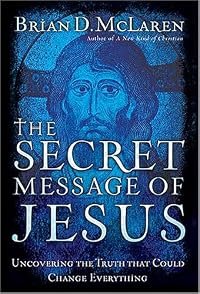
The Secret Message of Jesus: Uncovering the Truth that Could Change Everything
by Brian D. McLaren
On This Page
Description
Brian McLaren, the man that TIME magazine said 'could find a way for . . . Christians to march into the future despite their theological differences,' has penned his most unsettling and revolutionary book to date. In The Secret Message of Jesus, McLaren clears away the dust of two thousand years of the Christian religion to get to the most important questions facing Christendom: Could it be that the church has misunderstood or, in some cases, intentionally distorted Jesus' core message? What show more if Jesus was right, but right in different ways than Christians ever realized? What if many Christians have carried on a religion that somewhere along the way missed rich and radical treasures hidden in the essential message of Jesus of Nazareth? McLaren calls us to look hard, think deeply, and search long with him . . . even if the answers overturn conventional ideas, priorities, and practices. show lessTags
Recommendations























Member Recommendations
Member Reviews
Refreshing, as always, to see McLaren’s take on things. This book, he claims, was aimed toward “a broad, nonscholarly, and in many cases nonreligious audience”, and he did a very good job of writing something that can easily be understood and appreciated by Christians and non-Christians alike, something that people at any level of theological interest can reflect upon.
Written in a way that is easy to read and digest, this book shows us another way of looking at the message of Jesus - one that’s not as wrapped up in the more traditional way of understanding, one that shows us more than what we find in the traditional explanation. He goes into the political issues of the time, the different responses to the Roman occupation, show more showing us how Jesus’ response compares and differs from the other Jewish responses at the time. He also goes into the idea of “the kingdom” being attainable and achievable here and now, if only we would strive to see it be in our lives and in the world. Most of the Christians we hear try to tell us, or at least leave the impression, that the point is gaining our ticket to some sort of exclusive club after this life is over, and it’s nice to see someone saying that such thinking misses at least some of the point of Jesus and his message, which is meant to be applied to *this* life. Not that he seems to be denying an afterlife – but that seems to be beside the point of his main focus, which is to show us how the message of Jesus is meant to be understood and applied in our lives and our faiths in each and every moment, instead of seeing faith as merely a looking forward to a future moment or time.
Whether one is a Christian or not, this side of Jesus and his message is something I would recommend everyone take the time to consider. McLaren is an author I highly recommend to Christians and non-Christians alike. He offers a fresh perspective, and I’m constantly pleased in my exploration of his books. :) show less
Written in a way that is easy to read and digest, this book shows us another way of looking at the message of Jesus - one that’s not as wrapped up in the more traditional way of understanding, one that shows us more than what we find in the traditional explanation. He goes into the political issues of the time, the different responses to the Roman occupation, show more showing us how Jesus’ response compares and differs from the other Jewish responses at the time. He also goes into the idea of “the kingdom” being attainable and achievable here and now, if only we would strive to see it be in our lives and in the world. Most of the Christians we hear try to tell us, or at least leave the impression, that the point is gaining our ticket to some sort of exclusive club after this life is over, and it’s nice to see someone saying that such thinking misses at least some of the point of Jesus and his message, which is meant to be applied to *this* life. Not that he seems to be denying an afterlife – but that seems to be beside the point of his main focus, which is to show us how the message of Jesus is meant to be understood and applied in our lives and our faiths in each and every moment, instead of seeing faith as merely a looking forward to a future moment or time.
Whether one is a Christian or not, this side of Jesus and his message is something I would recommend everyone take the time to consider. McLaren is an author I highly recommend to Christians and non-Christians alike. He offers a fresh perspective, and I’m constantly pleased in my exploration of his books. :) show less
McLaren prefers in many parts of his book to set up this dichotomy: "traditional" Christians (who prefer traditional doctrine and ethics) and "New" Christians (who are engaged in conversations about new ways of understanding the bible, Jesus, and are concerned with social justice).Like arguments against any straw man, I think McLaren makes some good points and some bad ones. I've read some of his articles and blog posts, and after reading this book, I realized the struggle I have with reading McLaren: I don't know what Christians he is talking about. Certainly, each Christian has a little bit of a legalist in them, each is guilty of not welcoming with love all those who are in need of Christ. There are some who take traditional doctrine show more to un-Christian and unbiblical ends. Christians are always seduced by non-engagement with the culture (particularly when the culture generally doesn't invite us to engage). Yet, when I read McLaren's works, I don't get the feeling that he has much grace toward Christians (at least, Anglo-American Christians, toward whom his critique is targeted) and that he is reacting against conservative, legalistic, fundamentalist Christian tendencies rather than soberly responding to them. As a result, what comes across is a need to re-invent Christian doctrine to facilitate the kind of Christian he wants to see. That is the goal of this book.So what does the book say? Well, first of all, McLaren posits that we have been missing the real message of the Gospel for 2,000 years (and, guess what?, a guy in Baltimore just figured it out!). He states that the real message of the Gospel is that of the Kingdom. He defines the kingdom as: ...a life that is full and overflowing, a higher life that is centered in an interactive relationship with God and with Jesus. Let's render it simply 'an extraordinary life to the full centered in a relationship with God.' (By the way, I don't expect you to be satisfied with this as a full definition of the kingdom of God. I'm not satisfied with it myself. But it's one angle, one dimension, one facet.(p. 37)This is the closest thing to a thesis statement that one is going to find in the book. Well, at least its part of his thesis: if Jesus's secret message is the kingdom of God, then this is his definition of the kingdom. Unfortunately, I don't know how to proceed with his work when his very definition of the thing he is talking about is shoddy.McLaren goes on to explain that we are secret agents of this kingdom. He says that Christians can imagine "seeing everyone as potential agents of the kingdom". Once again, McLaren doesn't clearly define his terms for me. As such, this statement could be taken to mean one of two things:1) that Muslim, Hindu, Jewish, Ba'Hai, and other religions are just as legitimate claims to salvation as Christianity and that those who follow these religions are working toward building the kingdom of God.2) that everyone in the world is capable of responding to the call of Christ, repenting, and becoming faithful followers of Jesus.I'd like to think that McLaren believes in option #2. It would seem, however, that he's speaking more to option #1.He then goes on to describe how Christianity is a religion against state violence (chapter 17 "The Peaceable Kingdom"). I think he does a good job of synthesizing some of the work of John Howard Yoder and Stanley Hauerwas here. However, one gets the impression from his sweeping view of Church history that Christianity had nothing to contribute but violence and death from the time of Constantine until modern times (p. 153-154). Surely, the Church contributed more to art, culture, music, social cohesion, etc., and didn't just go around hacking up non-Christians through the Crusades? Of course, the Crusades were horrible and a sin we should repent of and never commit again. However, it isn't our only history.I was loving Chapter 18 ("The Borders of the Kingdom"). McLaren's discussion is of how naive inclusiveness allows people into the church who are divisive. He claims that exclusiveness was against Jesus's Commission, so that's not the alternative. Then, he argues for a third way: "to be truly inclusive, the kingdom must exclude exclusive people (p. 169)." I try to say this in the most charitable way possible: this is nonsense. How do I determine exclusiveness? Apparently, there is a presupposition about what "exclusiveness" means for his reader - or rather he chooses to not define exclusiveness so that his reader can do so (which, to me, is more confusing than it is freeing). Excluding exclusive people would exclude those who are excluding exclusive people because they are also being exclusive. See how this gets confusing? I think the church should define who it excludes: those who teach false doctrine (i.e., Jesus wasn't resurrected, didn't live, the Trinity is false, all will be saved regardless of faith, etc.), those who are religious hypocrites (who judged salvation based on works rather than faith), and those who persist in sin despite frequent counsel (1 Titus 5:20).McLaren avoids - at all junctures in his exegesis - the references Jesus makes to personal sin. These ideas are rather cast as commands toward social justice. The closest he gets to addressing personal sin and regeneration of the heart is in Chapter 17: ...we need to realize that both our enemies and we ourselves have a common enemy: the very internal darkness Jesus' secret message addresses - the dark drives of lust, greed, anger, and hate that thrust us into conflict and war...the secret message of Jesus, by dealing with the root cause of war in this way, does not promise the easiest, fastest, safest and msot convenient method of ending violent conflict - but offers, I believe, the only sure one. (p156)Here, McLaren completely overlooks the need for repentance of sin for salvation and instead demonstrates that it's about improving social conditions. Now, surely, one of the effects of a regenerate heart is love towards ones brothers and sisters and - hopefully - living peaceably with all (Rom 12:18). But is that all that repentance is about? Surely, God saves us from eternal death! And I think it is because we can see ourselves as sinners in need of a God who will forgive us, we are then able to forgive the small errors of our brothers and sisters and live peaceably with them. Because Christ forgave his oppressors who nailed him to a cross, we can forgive others as well.But McLaren seems to side-step salvation altogether. Here's one quote where he actually speaks of salvation: What would it mean if, at this moment, many readers actually began to believe that another world is possible, that Jesus may in fact have been right, that the secret message of the kingdom of God - though radical, though unprecedented in its vision, though requiring immense faith to believe it is possible - may in fact be the only authentically saving message we have? (p. 128) These are his concluding remarks from his Chapter on forgiving enemies. If McLaren believes that our forgiveness of our enemies is the only "authentically saving message" that we have, then he has abandoned the Gospel. I can't think he actually believes what he is saying there. If Christianity is only about forgiving our enemies in this life, then Christ didn't need to be nailed to a cross for our sins and - by allowing it to happen - God's work was unnecessary and disgustingly unjust because he allowed his Son to be tortured and killed for no good reason at all. I can't believe in that God.McLaren concludes his work with this comment on his own view on the book: If this reading of the Gospels is accurate, why didn't scholars see it a hundred or five hundred or eigtheen hundred years ago? Critics might reply that the answer is obvious: this reading isn't rooted in the text of the Gospels at all; it's like a smudge on the glasses of recent scholars , saying more about our contemporary perspetive than about Jesus himself.... I don't believe this criticism is legitimate...[t:]his reading of the biblical text - that at the heart of Jesus's message is this rich and radical idea of the kingdom of God being "at hand" and "coming down" here and now - accounts for far more of the biblical text than any other I've seen. Traditional readings, which assume Jesus has come primarily to solve the timeless problem of original sin so we can go "up" to a timeless heaven "by and by" after we die, do indeed acount for some of Jesus' words and actions, but not with the intensity and resoance of this reading....in my opinion, [this study:] brings the text together and makes sense of its details as no other reading I've ever come across. (pp. 210-211). I don't agree. I think this reading accounts for some of the biblical text but certainly not far more than other readings I've read. I think Augustine's treatise on the Trinity accounts for more. I think Aquinas's Summa accounts for more. I think Calvin's Institutes, Luther's Catechism, St. Basil's treatise on the Holy Spirit, and the works of the Church Fathers and Doctors account for much more of the Bible and stay faithful to it. Innovative doesn't mean correct.Unfortunately, much of McLaren's reading is reductionism gone wild. He feels the need to downplay or silence traditional doctrine because it does not fit with the paradigm he has. I think you can argue many (though certainly not all) of his same conclusions in and through the Biblical text and traditional doctrine while staying orthodox. I don't know why he feels he needs to work outside of that mold but he does.And, in the epilogue, he talks about how fresh and new and original his approach to the Gospel is. Cute. Please pat yourself on the back later. show less
McLaren prefers in many parts of his book to set up this dichotomy: "traditional" Christians (who prefer traditional doctrine and ethics) and "New" Christians (who are engaged in conversations about new ways of understanding the bible, Jesus, and are concerned with social justice).Like arguments against any straw man, I think McLaren makes some good points and some bad ones. I've read some of his articles and blog posts, and after reading this book, I realized the struggle I have with reading McLaren: I don't know what Christians he is talking about. Certainly, each Christian has a little bit of a legalist in them, each is guilty of not welcoming with love all those who are in need of Christ. There are some who take traditional doctrine show more to un-Christian and unbiblical ends. Christians are always seduced by non-engagement with the culture (particularly when the culture generally doesn't invite us to engage). Yet, when I read McLaren's works, I don't get the feeling that he has much grace toward Christians (at least, Anglo-American Christians, toward whom his critique is targeted) and that he is reacting against conservative, legalistic, fundamentalist Christian tendencies rather than soberly responding to them. As a result, what comes across is a need to re-invent Christian doctrine to facilitate the kind of Christian he wants to see. That is the goal of this book.So what does the book say? Well, first of all, McLaren posits that we have been missing the real message of the Gospel for 2,000 years (and, guess what?, a guy in Baltimore just figured it out!). He states that the real message of the Gospel is that of the Kingdom. He defines the kingdom as: ...a life that is full and overflowing, a higher life that is centered in an interactive relationship with God and with Jesus. Let's render it simply 'an extraordinary life to the full centered in a relationship with God.' (By the way, I don't expect you to be satisfied with this as a full definition of the kingdom of God. I'm not satisfied with it myself. But it's one angle, one dimension, one facet.(p. 37)This is the closest thing to a thesis statement that one is going to find in the book. Well, at least its part of his thesis: if Jesus's secret message is the kingdom of God, then this is his definition of the kingdom. Unfortunately, I don't know how to proceed with his work when his very definition of the thing he is talking about is shoddy.McLaren goes on to explain that we are secret agents of this kingdom. He says that Christians can imagine "seeing everyone as potential agents of the kingdom". Once again, McLaren doesn't clearly define his terms for me. As such, this statement could be taken to mean one of two things:1) that Muslim, Hindu, Jewish, Ba'Hai, and other religions are just as legitimate claims to salvation as Christianity and that those who follow these religions are working toward building the kingdom of God.2) that everyone in the world is capable of responding to the call of Christ, repenting, and becoming faithful followers of Jesus.I'd like to think that McLaren believes in option #2. It would seem, however, that he's speaking more to option #1.He then goes on to describe how Christianity is a religion against state violence (chapter 17 "The Peaceable Kingdom"). I think he does a good job of synthesizing some of the work of John Howard Yoder and Stanley Hauerwas here. However, one gets the impression from his sweeping view of Church history that Christianity had nothing to contribute but violence and death from the time of Constantine until modern times (p. 153-154). Surely, the Church contributed more to art, culture, music, social cohesion, etc., and didn't just go around hacking up non-Christians through the Crusades? Of course, the Crusades were horrible and a sin we should repent of and never commit again. However, it isn't our only history.I was loving Chapter 18 ("The Borders of the Kingdom"). McLaren's discussion is of how naive inclusiveness allows people into the church who are divisive. He claims that exclusiveness was against Jesus's Commission, so that's not the alternative. Then, he argues for a third way: "to be truly inclusive, the kingdom must exclude exclusive people (p. 169)." I try to say this in the most charitable way possible: this is nonsense. How do I determine exclusiveness? Apparently, there is a presupposition about what "exclusiveness" means for his reader - or rather he chooses to not define exclusiveness so that his reader can do so (which, to me, is more confusing than it is freeing). Excluding exclusive people would exclude those who are excluding exclusive people because they are also being exclusive. See how this gets confusing? I think the church should define who it excludes: those who teach false doctrine (i.e., Jesus wasn't resurrected, didn't live, the Trinity is false, all will be saved regardless of faith, etc.), those who are religious hypocrites (who judged salvation based on works rather than faith), and those who persist in sin despite frequent counsel (1 Titus 5:20).McLaren avoids - at all junctures in his exegesis - the references Jesus makes to personal sin. These ideas are rather cast as commands toward social justice. The closest he gets to addressing personal sin and regeneration of the heart is in Chapter 17: ...we need to realize that both our enemies and we ourselves have a common enemy: the very internal darkness Jesus' secret message addresses - the dark drives of lust, greed, anger, and hate that thrust us into conflict and war...the secret message of Jesus, by dealing with the root cause of war in this way, does not promise the easiest, fastest, safest and msot convenient method of ending violent conflict - but offers, I believe, the only sure one. (p156)Here, McLaren completely overlooks the need for repentance of sin for salvation and instead demonstrates that it's about improving social conditions. Now, surely, one of the effects of a regenerate heart is love towards ones brothers and sisters and - hopefully - living peaceably with all (Rom 12:18). But is that all that repentance is about? Surely, God saves us from eternal death! And I think it is because we can see ourselves as sinners in need of a God who will forgive us, we are then able to forgive the small errors of our brothers and sisters and live peaceably with them. Because Christ forgave his oppressors who nailed him to a cross, we can forgive others as well.But McLaren seems to side-step salvation altogether. Here's one quote where he actually speaks of salvation: What would it mean if, at this moment, many readers actually began to believe that another world is possible, that Jesus may in fact have been right, that the secret message of the kingdom of God - though radical, though unprecedented in its vision, though requiring immense faith to believe it is possible - may in fact be the only authentically saving message we have? (p. 128) These are his concluding remarks from his Chapter on forgiving enemies. If McLaren believes that our forgiveness of our enemies is the only "authentically saving message" that we have, then he has abandoned the Gospel. I can't think he actually believes what he is saying there. If Christianity is only about forgiving our enemies in this life, then Christ didn't need to be nailed to a cross for our sins and - by allowing it to happen - God's work was unnecessary and disgustingly unjust because he allowed his Son to be tortured and killed for no good reason at all. I can't believe in that God.McLaren concludes his work with this comment on his own view on the book: If this reading of the Gospels is accurate, why didn't scholars see it a hundred or five hundred or eigtheen hundred years ago? Critics might reply that the answer is obvious: this reading isn't rooted in the text of the Gospels at all; it's like a smudge on the glasses of recent scholars , saying more about our contemporary perspetive than about Jesus himself.... I don't believe this criticism is legitimate...[t:]his reading of the biblical text - that at the heart of Jesus's message is this rich and radical idea of the kingdom of God being "at hand" and "coming down" here and now - accounts for far more of the biblical text than any other I've seen. Traditional readings, which assume Jesus has come primarily to solve the timeless problem of original sin so we can go "up" to a timeless heaven "by and by" after we die, do indeed acount for some of Jesus' words and actions, but not with the intensity and resoance of this reading....in my opinion, [this study:] brings the text together and makes sense of its details as no other reading I've ever come across. (pp. 210-211). I don't agree. I think this reading accounts for some of the biblical text but certainly not far more than other readings I've read. I think Augustine's treatise on the Trinity accounts for more. I think Aquinas's Summa accounts for more. I think Calvin's Institutes, Luther's Catechism, St. Basil's treatise on the Holy Spirit, and the works of the Church Fathers and Doctors account for much more of the Bible and stay faithful to it. Innovative doesn't mean correct.Unfortunately, much of McLaren's reading is reductionism gone wild. He feels the need to downplay or silence traditional doctrine because it does not fit with the paradigm he has. I think you can argue many (though certainly not all) of his same conclusions in and through the Biblical text and traditional doctrine while staying orthodox. I don't know why he feels he needs to work outside of that mold but he does.And, in the epilogue, he talks about how fresh and new and original his approach to the Gospel is. Cute. Please pat yourself on the back later. show less
McLaren presents the secret underlying message of Jesus that the Kingdom of God is here and now. This message has not received the attention that it deserves throughout the centuries for a variety of reasons. Those who accept this message will find that they will need to alter their lives in radical ways to be citizens of this Kingdom. As expected, the book is highly readable, and McLaren draws his readers into his ideas. However, there is much to dislike. First, his idea of the Kingdom is wrong. He draws some conclusions based on poor Greek exegesis and proceeds to the next argument. Unfortunately, when the foundation is flawed, so is the building. Second, the idea of Kingdom is much bigger than McLaren understands. In his rush to show more emphasize the "now," he has neglected the "later." The New Testament has much to say about the Kingdom in the future tense. Third, McLaren's ethical implications of the whole matter are simplistic like so many others of a center-left political bent. On one hand, he mentions two world wars as evidence of the failure of Christianity to live the Kingdom life. On the other, he tells how his group participates in a gathering for justice on behalf of those in Darfur. How does he expect justice and mercy to reign if not through the sword of the righteous. Finally, McLaren ignores the role of personal salvation in Kingdom living. Without this, who is in the Kingdom? How are people empowered to live this Kingdom ethic? As usual, McLaren is thought provoking and interesting. However, in his quest to find the secret message of Jesus, he has missed the real message of Jesus. show less
One of two things has happened:
1. Brian McLaren has toned down the controversial aspects of his writing.
2. I’ve grown more comfortable with the controversy.
Maybe it’s a mixture of both. I started reading McLaren’s New Kind of Christian books and was challenged, outraged, and enlightened. Now that he’s transplanted his theology from the world of fiction into the land of teaching he’s lost a bit of his zip.
This book is full of good material about Jesus and his agenda. McLaren situates Jesus in his culture, painting him as a Jewish revolutionary. If you’re new to this way of understanding Jesus, McLaren’s book serves as a quick introduction to some of the major ideas.
If, on the other hand, you’ve read N. T. Wright, Walter show more Brueggemann, and Dallas Willard, you’ll find nothing new here: just a popularizing of their ideas.
[One last thought: does the socially-conscious Protestant church really need to venerate Dr. Martin Luther King, Jr. the way the Roman church venerates Mary?] show less
1. Brian McLaren has toned down the controversial aspects of his writing.
2. I’ve grown more comfortable with the controversy.
Maybe it’s a mixture of both. I started reading McLaren’s New Kind of Christian books and was challenged, outraged, and enlightened. Now that he’s transplanted his theology from the world of fiction into the land of teaching he’s lost a bit of his zip.
This book is full of good material about Jesus and his agenda. McLaren situates Jesus in his culture, painting him as a Jewish revolutionary. If you’re new to this way of understanding Jesus, McLaren’s book serves as a quick introduction to some of the major ideas.
If, on the other hand, you’ve read N. T. Wright, Walter show more Brueggemann, and Dallas Willard, you’ll find nothing new here: just a popularizing of their ideas.
[One last thought: does the socially-conscious Protestant church really need to venerate Dr. Martin Luther King, Jr. the way the Roman church venerates Mary?] show less
The book is about the Kingdom of God as understood in the first century, and also relevant today. today. Those who follow Christ are described by the author as ‘agents’ of the Kingdom, our job being to spread the message of Jesus: of peace, reconciliation, and so on.
The first few chapters set the scene in the historical and Jewish cultural contexts in which Jesus lived as a man on earth. The second section looks at how the author sees the message, in contrast to how some fundamentalist churches tend to portray it, and the final section looks at what it means in the 21st century.
The writing is good, the author's views clearly expressed, and there's plenty of Biblical backing. The book covers portions of the ‘sermon on the show more mount’, for instance, and reminds readers about the meanings of the ‘parables of the Kingdom’, from the perspective of the first century audience.
I’m puzzled about the idea of it being a ‘secret’ message. This is broadly how I understood the Christian message growing up in an Anglican Church in the UK; it was explored more fully in RE lessons at my secondary school, and is similar to much of what I have read over the years.
Still, this book gives some excellent and thoughtful writing about the Kingdom of God in its many aspects, and much to think about. If it weren't for the title and insistence that this is a 'new' understanding, I'd have given it five stars. show less
The first few chapters set the scene in the historical and Jewish cultural contexts in which Jesus lived as a man on earth. The second section looks at how the author sees the message, in contrast to how some fundamentalist churches tend to portray it, and the final section looks at what it means in the 21st century.
The writing is good, the author's views clearly expressed, and there's plenty of Biblical backing. The book covers portions of the ‘sermon on the show more mount’, for instance, and reminds readers about the meanings of the ‘parables of the Kingdom’, from the perspective of the first century audience.
I’m puzzled about the idea of it being a ‘secret’ message. This is broadly how I understood the Christian message growing up in an Anglican Church in the UK; it was explored more fully in RE lessons at my secondary school, and is similar to much of what I have read over the years.
Still, this book gives some excellent and thoughtful writing about the Kingdom of God in its many aspects, and much to think about. If it weren't for the title and insistence that this is a 'new' understanding, I'd have given it five stars. show less
Brian McLaren is one of my favorite Christian authors. I have read three other books written by him. "The Secret Message of Jesus" is the fourth one. This one seems to be quite different than others written by him. In his other works he seems to offer new insight, a new paradigm, even a new hermeneutic. Whereas, in "The Secret Message of Jesus" he merely expounds upon an existing theme. This theme, which McLaren calls the secret message of Jesus is really no secret. It is the kingdom of God. The kingdom of God is here... now in our midst. For, the kingdom of God is within you. McLaren spends a majority of the book describing what this looks like in everyday life. Although I thoroughly agree with McLaren's views, I give this a 3-star show more rating simply for the fact that there doesn't seem to be any new or fresh insight that is typical of McLaren's works. Nevertheless, it McLaren type fashion, there are many wonderful quotes worth mentioning. Here are a few:
"Believing untrue things, however sincerely, can have it's own unintended consequences."
"This carpenter's son from Galilee challenges every existing political movement to a radical rethinking and dares everyone to imagine and consider his revolutionary alternative."
"So here, "eternal life" means knowing, and knowing means an interactive relationship with the only true God and with Jesus Christ, his messenger."
"Kingdom of God... Let's render it simply an extraordinary life to the full centered in a relationship with God."
"A parable renders its hearers not as experts, not as know-it-alls, not as scholars... but as children."
"We will understand neither signs and wonders in particular nor the idea of the kingdom of God in general if we try to shrink them into our restrictive universe. We have to meet these phenomena in their natural habitat."
"God, the good King, is present, working from the inside. The King is in the kingdom, and the kingdom is among us here and now... for those who have eyes to see and ears to hear. The King is present in the mess and chaos of everyday life on earth, bringing healing, sight, perception, liberation, wholeness, wholesomeness, movement, health, fullness, nourishment, sanity, and balance. The incursion of the kingdom of God has begun. We are under a gentle, compassionate assault by a kingdom of peace and healing and forgiveness and life."
"For Jesus' secret message of the kingdom to be realized, it must first expose the evil of all alternative kingdoms or regimes or systems of ideologies. And, for that evil to be exposed, it must be drawn out of the shadows, where it hides in secret."
"When Christianity sees itself more as a belief system or set of rituals for the select few and less as a way of daily life available to all, it loses the "magic" of the kingdom." show less
"Believing untrue things, however sincerely, can have it's own unintended consequences."
"This carpenter's son from Galilee challenges every existing political movement to a radical rethinking and dares everyone to imagine and consider his revolutionary alternative."
"So here, "eternal life" means knowing, and knowing means an interactive relationship with the only true God and with Jesus Christ, his messenger."
"Kingdom of God... Let's render it simply an extraordinary life to the full centered in a relationship with God."
"A parable renders its hearers not as experts, not as know-it-alls, not as scholars... but as children."
"We will understand neither signs and wonders in particular nor the idea of the kingdom of God in general if we try to shrink them into our restrictive universe. We have to meet these phenomena in their natural habitat."
"God, the good King, is present, working from the inside. The King is in the kingdom, and the kingdom is among us here and now... for those who have eyes to see and ears to hear. The King is present in the mess and chaos of everyday life on earth, bringing healing, sight, perception, liberation, wholeness, wholesomeness, movement, health, fullness, nourishment, sanity, and balance. The incursion of the kingdom of God has begun. We are under a gentle, compassionate assault by a kingdom of peace and healing and forgiveness and life."
"For Jesus' secret message of the kingdom to be realized, it must first expose the evil of all alternative kingdoms or regimes or systems of ideologies. And, for that evil to be exposed, it must be drawn out of the shadows, where it hides in secret."
"When Christianity sees itself more as a belief system or set of rituals for the select few and less as a way of daily life available to all, it loses the "magic" of the kingdom." show less
Members
- Recently Added By
Author Information

58+ Works 12,581 Members
Brian D. McLaren is a prominent, controversial evangelical pastor. He was recognized as one of Time magazine's "25 Most Influential Evangelicals in America" in 2005, and is the founding pastor of Cedar Ridge Community Church in Spencerville, Maryland. Born in 1956, Brian McLaren graduated from the University of Maryland, College Park, with BA and show more MA degrees in English. After several years of teaching English and consulting in higher education, he left academia in 1986 to become the founding pastor of Cedar Ridge Community Church, a nondenominational church in the Baltimore-Washington region. Many of the books that McLaren has authored, including the "A New Kind of Christian" trilogy, deal with Christianity in the context of the cultural shift towards a new emerging church movement. (Bowker Author Biography) show less
Some Editions
Common Knowledge
- Original publication date
- 2006
- People/Characters
- Jesus Christ
- First words
- For many years, I have been seeking something.
(From the Introduction)
What if Jesus of Nazareth was right--more right, and right in different ways, than we have ever realized?
Classifications
Statistics
- Members
- 1,238
- Popularity
- 19,815
- Reviews
- 20
- Rating
- (3.68)
- Languages
- English, German, Portuguese, Spanish
- Media
- Paper, Audiobook, Ebook
- ISBNs
- 10
- UPCs
- 2
- ASINs
- 5