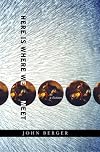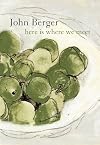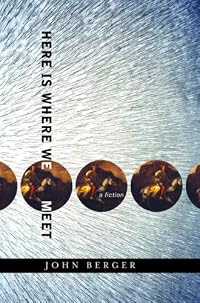
Here Is Where We Meet: A Story of Crossing Paths
by John Berger
On This Page
Description
Booker Prize-winning author John Berger, one of the most widely admired writers of our time, returns us to the captivating play and narrative allure of his previous novels-G. and Pig Earth among them-with a shimmering fiction drawn from chapters of his own life. One hot afternoon in Lisbon, the narrator finds his long-dead mother seated on a park bench. "The dead don't stay where they are buried," she tells him. And so begins a remarkable odyssey, told in simple yet gorgeous prose, that show more carries us from the London Blitz in 1943, to a Polish market, to a Paleolithic cave, to the Ritz Hotel in Madrid. Here Is Where We Meet is a unique literary journey that moves freely through time and space but never loses its foothold in the sensuous present. show lessTags
Recommendations













Member Reviews
This is a beautiful piece of writing, a sort of psychogeography crossed with memoir, in which John Berger explores places that are important to him at the same time as he engages with memories of people who were important to him. Here the dead are as active in Berger’s life and thoughts as the living. The opening encounter set in Lisbon wonderfully captures the tone that Berger wants to set. He is surprised to find his mother in this city that he loves. She too loved it and has chosen it as the place in which she and he can meet. His interactions with her are sensitive and instructive — she often chides him or reminds him not to be fanciful but always tell the truth in his writing. Which immediately has us wondering what truth he is show more conveying through this particular writing. Note: he is certainly not telling us that the dead walk the earth. Rather, it is the influence on us of people who may have died that remains operative.
The result is a fascinating, lyrical, and very human approach to memoir. So readable and yet almost uncomfortably intimate. Filled with history and esoteric facts, yet what will stay with you is his mother laughing as she must have when she was 17.
Warmly recommended. show less
The result is a fascinating, lyrical, and very human approach to memoir. So readable and yet almost uncomfortably intimate. Filled with history and esoteric facts, yet what will stay with you is his mother laughing as she must have when she was 17.
Warmly recommended. show less
What a fine writer John Berger (1926-2017) was, unfortunately I only discovered him after his death. This little book seems to be an outsider in his oeuvre: it is a very original collection of memories of close friends and relatives, wrapped in meandering stories. The captivating opening story, Lisboa, is bathed in a magically realistic atmosphere that does justice to both the city and its philosophical underlay: in Lisbon, Berger to his surprise meets his mother, who has been dead for 15 years; while they wander through the city, they reminisce, his mother tells about the wisdom she learned after her death (!), and so it shouldn’t surprise that the saudade is also discussed. In another 7 very diverse stories Berger gives insights show more into his personal life and into the essence of life itself. I pick up 2 more that struck me particularly. The fourth, “Some Fruit as Remembered by the Dead” gives a very sensuous description of fruit; it is an ode to the seemingly ordinary, which immediately reminded me of André Gide's 'Nourritures Terrestres'. And the closing story "The Szum and the Ching" seems to be going nowhere in its endless meandering associations, but is in a beautiful evocation of the fragility and beauty of life. Great writer! show less
"The number of lives that enter our own is incalculable."
This reads like a dream, only it is impeccably lucid. The gears of reality work its wonders in subtly blending it in the seemingly ceaseless moments of rendezvous and longing with the past; with it are people John has lost in many, many ways. ** "Life depends upon finding cover. Everything hides. What has vanished has gone into hiding. An absence — as after the departure of the dead — is felt as a loss but not as an abandonment. The dead are hiding elsewhere." (p141) Death and parting are not the end, memories make them live, exist. In Here Is Where We Meet plays like a film; its reel comprises of random memories at different waves of time. Some of them happening all at once. show more Some appear in bouts. Some does not appear at all but they are there. This is not only a meditation about reminiscence but also about the persistence of the present whilst the past simultaneously happens in our heads. ** "Desire is brief — a few hours or a lifetime, both are brief. Desire is brief because it occurs in defiance with the permanent. It challenges time in a fight to death." (p220)
It's a very special book and I personally feel that if I was in the right frame of mind I would have loved this better than I did. Although that potential love cannot be compared to the incomparable, personally beloved And Our Faces, My Heart, Brief as Photos. John Berger knows how to make you feel both the beauty and fragility of existence. His words are like an ocean you want to dive in; pretty dangerous with a depth that's almost drowning. And if anyone ever did know how to live a life I believe it's Berger. ** "Of human attributes, fragility — which is never absent — is the most precious." (p234) and ** "Everyone in the barn was reminded how a life without wounds isn't worth living." (p219)
For safekeeping:
"If you have to cry, he said, and sometimes you can’t help it, if you have to cry, cry afterwards, never during! Remember this. Unless you’re with those who love you, only those who love you, and in that case you’re already lucky, for there are never many who love you — if you’re with them, you can cry during. Otherwise you cry afterwards." (p86) show less
This reads like a dream, only it is impeccably lucid. The gears of reality work its wonders in subtly blending it in the seemingly ceaseless moments of rendezvous and longing with the past; with it are people John has lost in many, many ways. ** "Life depends upon finding cover. Everything hides. What has vanished has gone into hiding. An absence — as after the departure of the dead — is felt as a loss but not as an abandonment. The dead are hiding elsewhere." (p141) Death and parting are not the end, memories make them live, exist. In Here Is Where We Meet plays like a film; its reel comprises of random memories at different waves of time. Some of them happening all at once. show more Some appear in bouts. Some does not appear at all but they are there. This is not only a meditation about reminiscence but also about the persistence of the present whilst the past simultaneously happens in our heads. ** "Desire is brief — a few hours or a lifetime, both are brief. Desire is brief because it occurs in defiance with the permanent. It challenges time in a fight to death." (p220)
It's a very special book and I personally feel that if I was in the right frame of mind I would have loved this better than I did. Although that potential love cannot be compared to the incomparable, personally beloved And Our Faces, My Heart, Brief as Photos. John Berger knows how to make you feel both the beauty and fragility of existence. His words are like an ocean you want to dive in; pretty dangerous with a depth that's almost drowning. And if anyone ever did know how to live a life I believe it's Berger. ** "Of human attributes, fragility — which is never absent — is the most precious." (p234) and ** "Everyone in the barn was reminded how a life without wounds isn't worth living." (p219)
For safekeeping:
"If you have to cry, he said, and sometimes you can’t help it, if you have to cry, cry afterwards, never during! Remember this. Unless you’re with those who love you, only those who love you, and in that case you’re already lucky, for there are never many who love you — if you’re with them, you can cry during. Otherwise you cry afterwards." (p86) show less
This rates, for me, somewhere between "just OK" and "better than "OK", so perhaps a 2 and 3/4 rating. Although the concept is immensely seductive -- the idea of meeting the beloved dead in places across the globe, and having a conversation with them once again -- the "truth" of it is not all that engaging.
In engaging in the delightful fantasy that something like this might be truly possible, I would find myself asking much more considered questions; would find myself expressing all the things I meant to say the first time around, and didn't. Why bother summoning the dead if all you're going to do is play Crazy Eights and eat greengage plums?
A bit ho-hum, sorry to say.
In engaging in the delightful fantasy that something like this might be truly possible, I would find myself asking much more considered questions; would find myself expressing all the things I meant to say the first time around, and didn't. Why bother summoning the dead if all you're going to do is play Crazy Eights and eat greengage plums?
A bit ho-hum, sorry to say.
This is a book of an artist and writer's thoughts and feelings in different places in Europe. It's novelistic only to a degree. John Berger is trying to imbue the reader with the inpressions, relationships, occurences that happen in different locales. In Lisbon, an old woman visits him in various plazas, and he realizes it is his mother. Her fleeting presence is nonetheless persistent and he encounter her everywhere he goes. Geneva is a meditation on the archives of Borges. Cracow brings in the males in Berger's life. I passed over Islington. Le Pont d'Arc is a strikig geologic formation in the Ardeche gorges in France where Cro-magnons lived and created their art.
Kurze Inhaltsangabe
John, der Ich-Erzähler, trifft in Lissabon auf einer Parkbank seine längst verstorbene Mutter wieder. In Genf besucht er mit seiner Tochter das Grab von Jorge Luis Borges und in Islington erinnert er sich an die Studienzeit an der Kunsthochschule und die Londoner Liebesnächte, während die Bomben fielen. All das sind Stationen in John Bergers Buch der Erinnerung, in dem er all seine großen Themen vereint: Begegnungen und Abschiede, das Sichtbare und Verborgene, die Kunst und das Leben.
John, der Ich-Erzähler, trifft in Lissabon auf einer Parkbank seine längst verstorbene Mutter wieder. In Genf besucht er mit seiner Tochter das Grab von Jorge Luis Borges und in Islington erinnert er sich an die Studienzeit an der Kunsthochschule und die Londoner Liebesnächte, während die Bomben fielen. All das sind Stationen in John Bergers Buch der Erinnerung, in dem er all seine großen Themen vereint: Begegnungen und Abschiede, das Sichtbare und Verborgene, die Kunst und das Leben.
Mar 23, 2024German
Ratings
Members
- Recently Added By
Lists

A Novel Cure
742 works; 23 members
Author Information

150+ Works 17,146 Members
John Peter Berger was born in London, England on November 5, 1926. After serving in the British Army from 1944 to 1946, he enrolled in the Chelsea School of Art. He began his career as a painter and exhibited work at a number of London galleries in the late 1940s. He then worked as an art critic for The New Statesman for a decade. He wrote fiction show more and nonfiction including several volumes of art criticism. His novels include A Painter of Our Time, From A to X, and G., which won both the James Tait Black Memorial Prize and the Booker Prize in 1972. His other works include an essay collection entitled Permanent Red, Into Their Labors, and a book and television series entitled Ways of Seeing. In the 1970s, he collaborated with the director Alain Tanner on three films. He wrote or co-wrote La Salamandre, The Middle of the World, and Jonah Who Will Be 25 in the Year 2000. He died on January 1, 2017 at the age of 90. (Bowker Author Biography) show less
Awards and Honors
Distinctions
Common Knowledge
- Original publication date
- 2005
- Important places
- Berlin Zoological Garden, Berlin, Germany
Classifications
Statistics
- Members
- 333
- Popularity
- 94,965
- Reviews
- 6
- Rating
- (3.94)
- Languages
- 7 — English, French, German, Italian, Norwegian (Bokmål), Spanish, Turkish
- Media
- Paper, Ebook
- ISBNs
- 18
- ASINs
- 4