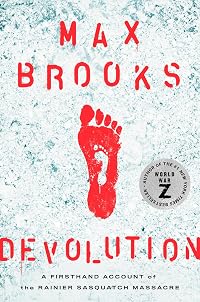
Devolution
by Max Brooks
On This Page
Description
As the ash and chaos from Mount Rainier's eruption swirled and finally settled, the story of the Greenloop massacre has passed unnoticed, unexamined, until now. But the journals of resident Kate Holland, recovered from the town's bloody wreckage, capture a tale too harrowing and too earth-shattering in its implications, to be forgotten. Because if what Kate Holland saw in those days is real, then we must accept the impossible. We must accept that the creature known as Bigfoot walks among us, show more and that it is a beast of terrible strength and ferocity. show lessTags
Recommendations






Member Recommendations
Member Reviews
Devolution: A Firsthand Account of the Rainier Sasquatch Massacre by Max Brooks is set in the deep Pacific Northwest forests near Mount Rainier in Washington State. The story is set in a small, isolated community developed specifically for technologically-dependent people. They are suddenly cut off from the rest of the world by a volcanic eruption. Then in addition to lacking outdoor survival skills and resources, they find themselves being attacked by a group of Bigfoot. While usually any writing about the legendary Sasquatch emphasizes that they are shy, solitary creatures, in this book they are like a tribe of chimpanzee, following a female leader and working together as a cohesive unit.
The story is dark and violent so words like show more “fun” and “enjoy” seem rather inappropriate but this stylish, dark, and captivating tale certainly pleased me. This isn’t a slow build up to excitement, the imaginative story quickly became disturbing and frightening. I live in the Pacific Northwest and do not for a moment believe in the Sasquatch but as a scary monster story, Devolution is very well done.
The author doesn’t bother with questions like “how did they get here?” or “where did they originate?” he simply jumps into this story of super-predators driven by hunger, stalking and hunting a group of lessor beings. As horror stories go, this one is a good one. show less
The story is dark and violent so words like show more “fun” and “enjoy” seem rather inappropriate but this stylish, dark, and captivating tale certainly pleased me. This isn’t a slow build up to excitement, the imaginative story quickly became disturbing and frightening. I live in the Pacific Northwest and do not for a moment believe in the Sasquatch but as a scary monster story, Devolution is very well done.
The author doesn’t bother with questions like “how did they get here?” or “where did they originate?” he simply jumps into this story of super-predators driven by hunger, stalking and hunting a group of lessor beings. As horror stories go, this one is a good one. show less
Devolution' was an extraordinary reading experience: I found it to be compelling and totally immersive. Each page made me want more.
This caught me by surprise as I'd half-expected the documentary style of storytelling to become a little tiresome. I was impressed by Max Brook's ability to weave together a journal giving a first-hand real-time account of the Greenloop massacre with interviews with a Park Ranger and reviews of relevant research in a way that didn't kill the pace of the story or come across like some 'ghost hunter' faux-documentary reality TV cliché. The way he presents these two storytelling streams actually increases the tension. The research adds credibility to the increasingly desperate narrative in the journal. show more Nesting the very tense, edge-of-the-seat journal narrative in an investigative journalism 'How Did This Disaster Happen?' framework, added a sort of fatalistic air that you only get from hindsight. A regretful, head-shaking tone that is part empathy (What a terrible thing to happen) and part incredulity (How could they have been so unprepared) and part worry (Could this happen again? To us this time?). The framework adds to the plausibility and the significance of the story in the journal. It establishes the participants as victims of an extraordinary set of circumstances and then uses those circumstances to reveal weaknesses that we all share and strengths that we hope we might have.
I loved the characterisation of the West Coast tech industry that has so convinced itself that any problem can be solved by the creative use of technology and a commitment to positive thinking, that It has blinded itself to the vulnerability of the digital world and the opportunities for abuse that it offers.. I know from my own experience in Palo Alto that software engineers often struggle to imagine the criminal and military applications of their work (e.g. Blockchain/cryptocurrency an enabler of a global criminal economy or those cute Boston Dynamic dog robots as a way of automating ground warfare to increase kill rates and lower casualties.). Max Brooks did a great job in setting up Greenloop as a showcase for the dream lifestyle of the digital faithful, giving a small, rich group all the convinces of the city while letting them be at one with nature. and then showing how quickly that tech-enabled lifestyle fails when the tech goes down.
The inclusion in this West Coast Tech Eden of Mostar, a survivor of the siege of Mostar and the atrocities committed by both sides against the civilian population who now uses 3D printing to make glass into art, was inspired. She is both a credible character and the embodiment of an atrocity survivor mindset that sees the world in a way that people who have never known hardship resist accepting as real. She helps to make visible a very human reaction to adversity: denial bolstered by intellectual self-deception that serves either to hold fear at arm's length or to mask moral cowardice.
I loved watching the the change in power dynamics once the idea of a community of households united by a desire to for an in-harmony with nature existence with all the conveniences of the digital age is replaced by a collaboration based on the need to work together to survive.
At its heart, 'Devolution' is a horror story, not an essay on technology fallacies and the vulnerabilities they bring. It's about fear and violence and death and rage. The journey towards the final blood-soaked conflict is made compelling because we see it through the eyes of a woman who, at the beginning of the story is struggling to cope with her anxiety and her failing marriage, is energised and transformed by an immediate and urgent purpose and is finally consumed by violent, insatiable rage.
I was totally absorbed in 'Devolution'. It was a story filled with horror but it was also a reminder of reality. that I found sobering and fascinating.
Now, I have to read Max Brooks' earlier book: 'World War Z'. show less
This caught me by surprise as I'd half-expected the documentary style of storytelling to become a little tiresome. I was impressed by Max Brook's ability to weave together a journal giving a first-hand real-time account of the Greenloop massacre with interviews with a Park Ranger and reviews of relevant research in a way that didn't kill the pace of the story or come across like some 'ghost hunter' faux-documentary reality TV cliché. The way he presents these two storytelling streams actually increases the tension. The research adds credibility to the increasingly desperate narrative in the journal. show more Nesting the very tense, edge-of-the-seat journal narrative in an investigative journalism 'How Did This Disaster Happen?' framework, added a sort of fatalistic air that you only get from hindsight. A regretful, head-shaking tone that is part empathy (What a terrible thing to happen) and part incredulity (How could they have been so unprepared) and part worry (Could this happen again? To us this time?). The framework adds to the plausibility and the significance of the story in the journal. It establishes the participants as victims of an extraordinary set of circumstances and then uses those circumstances to reveal weaknesses that we all share and strengths that we hope we might have.
I loved the characterisation of the West Coast tech industry that has so convinced itself that any problem can be solved by the creative use of technology and a commitment to positive thinking, that It has blinded itself to the vulnerability of the digital world and the opportunities for abuse that it offers.. I know from my own experience in Palo Alto that software engineers often struggle to imagine the criminal and military applications of their work (e.g. Blockchain/cryptocurrency an enabler of a global criminal economy or those cute Boston Dynamic dog robots as a way of automating ground warfare to increase kill rates and lower casualties.). Max Brooks did a great job in setting up Greenloop as a showcase for the dream lifestyle of the digital faithful, giving a small, rich group all the convinces of the city while letting them be at one with nature. and then showing how quickly that tech-enabled lifestyle fails when the tech goes down.
The inclusion in this West Coast Tech Eden of Mostar, a survivor of the siege of Mostar and the atrocities committed by both sides against the civilian population who now uses 3D printing to make glass into art, was inspired. She is both a credible character and the embodiment of an atrocity survivor mindset that sees the world in a way that people who have never known hardship resist accepting as real. She helps to make visible a very human reaction to adversity: denial bolstered by intellectual self-deception that serves either to hold fear at arm's length or to mask moral cowardice.
I loved watching the the change in power dynamics once the idea of a community of households united by a desire to for an in-harmony with nature existence with all the conveniences of the digital age is replaced by a collaboration based on the need to work together to survive.
At its heart, 'Devolution' is a horror story, not an essay on technology fallacies and the vulnerabilities they bring. It's about fear and violence and death and rage. The journey towards the final blood-soaked conflict is made compelling because we see it through the eyes of a woman who, at the beginning of the story is struggling to cope with her anxiety and her failing marriage, is energised and transformed by an immediate and urgent purpose and is finally consumed by violent, insatiable rage.
I was totally absorbed in 'Devolution'. It was a story filled with horror but it was also a reminder of reality. that I found sobering and fascinating.
Now, I have to read Max Brooks' earlier book: 'World War Z'. show less
"It’s great to live free of the other sheep until you hear the wolves howl."
(Full disclosure: I received a free e-ARC for review through NetGalley.)
JOURNAL ENTRY #9 - OCTOBER 8
Does she suspect what I’m trying to dismiss? The smell, the howls, the large “boulder” I’d seen on the road. Now this. I’m sure I’m just trying to come up with an explanation for something that doesn’t make any sense. That’s me. A place for everything and everything in its place. I’m just grasping on to what I’ve heard. And I haven’t heard much. I’m not into that stuff. I’m the practical one. I’ve never been interested in things that aren’t real.
###
To me, Greenloop was the Titanic, right down to the design flaws and the lack of show more lifeboats. They were extremely isolated, miles from the one public road which was miles from the nearest town. And, of course, that was the idea. With modern logistics and telecommunications, the world must have still felt very small. But then Rainier cut those connections, and the world suddenly got very big.
###
Though it's much smaller in scope than World War Z, it wouldn't be inaccurate to describe Max Brooks's Devolution as World War Z with Sasquatch (Sasquatches?) instead of aliens - and, oh yeah, a lava-spewing volcano setting the backdrop.
Like the former, Devolution is told through a variety of eyewitness accounts: primarily the journal of Kate Holland, one of the few (assumed) survivors of the titular "Rainier Sasquatch Massacre," but also a mix of private and public interviews - including with Kate's brother Frank, who was supposed to be living in Greenlop in her place - as well as government documents and, weirdly, one deathbed flashback (Hannah!). All are compiled into a book, published roughly thirteen months after THE INCIDENT.
Kate and her husband Dan - a failing/flailing tech bro with an ego as fragile as an eggshell - have been in Greenloop but a week when Mount Rainier erupts. Designed and implement by billionaire (one would assume) Tony Durant, Greenlop is a small, "high-end, high-tech eco-community" located in the Pacific Northwest wilderness. Consisting of just six households, all situated in a ring around a common meeting house, Greenloop is the very definition of exclusive. Everything in the homes is "smart," from the solar panels, biogas generators that turn poop into power, and battery units to store it all, down to the helipad for when an electric car ride into town just won't do.
Though they have tried their best to isolate themselves from the hustle and bustle of city life, Greenloop's residents are still very much dependent on the outside world for their continued existence. Tony brags that "every citizen of Greenloop generates between two and four service jobs for their fellow Americans" - which would seem to contradict the community's sustainability, no? But I digress. A mix of white-collar professionals - CPAs, psychologists, philosophy professors, and computer programmers - the residents all rely on high-speed, fiber optic internet: to telecommute, communicate with their loved ones, and order groceries. While the houses do generate their own power, food is another matter: aside from the odd fruit tree or herb-growing window box, most of their provisions are ordered online and air-dropped by drones.
So when the nearby, long-dormant Mount Rainier finally erupts, Greenloop's selling point becomes its downfall. Lahars overtake the one road out of Greenloop, and the cell phones and internet go soon after, thus severing Greenloop's contact with the outside world. But their situation quickly goes from bad to worse, since the humans are not the only ones facing a harsh winter coupled with a food shortage. The eruption, it seems, has sent all the nonhumans fleeing down the mountain, right into Greenloop's path: including some belonging to a species never seen before. Creatures of myth and legend and not a few cheesy B movies.
Spoiler alert: these guys are no Harry Henderson. More like the murderous chimps Jane Goodall observed hunting in the Gombe rain forests.
Devolution is totally bonkers, in the best way possible. There's so much going on here, much of it (intentionally or not) entirely too plausible and close to home in the time of COVID-19. There's the obvious: being trapped and isolated in your house all winter, nary a fresh tomato or bottle of Kahlua to be borrowed, begged, or stolen. But Brooks goes a little further, concocting this "perfect storm" of factors that conspire to devastate Greenloop - including a slash in government funding that wiped out the early warning system and stymied rescue efforts, as well as food riots in Seattle and a sniper on the I-90 that bumped survivors down on the priority list. Greenloop's residents are adrift, lost, forgotten:
"Someone just had to go for help. There simply wasn’t any other choice. Why? Why are we always looking for someone else to save us instead of trying to save ourselves?"
Watching 45 fight with state governors over PPE gear and ventilators really drives the feelings of isolation and desolation home. Part of me feels like this book couldn't have been released at a more horrifyingly serendipitous time. And that's what good horror does, right? Taps into the fear that's already lurking beneath the surface.
Then there's the misplaced idealism and general white upper class privilege of Greenloop. Maybe it's eco-friendly, in some ways (is trucking in fresh fruits and veggies for eleven people really environmentally friendly? really? why no victory gardens, Tony?), but very few people can actually live like this; it isn't practical, or affordable. Yet they are totes the change they want to see in the world (eyeroll).
There's also the cult of personality surrounding Tony, the mansplaining and hepeating which, coupled with the man's utter uselessness in an emergency situation, makes this feel like a thinly veiled stab at Elon Musk. Again, I am so here for it! (BPAP machines are not ventilators, my dude. Why are you even.)
While I think we're supposed to care about how the siege affects Kate and Dan's relationship, I was much more interested in Mostar. In sharp contrast to her softer and more coddled counterparts, Mostar is badass: a survivor with zero fucks to give. A survivor of the Croat–Bosniak War and May 1993 shelling of Mostar, Bosnia-Herzegovina, the young artist assumed the city's name as a way of making sense of a tragedy.
"GROSS: … And so you’ve taken on the name of your city as a form of public remembrance.
"MOSTAR: Well, I know to some it sounds like … what did Jerry Seinfeld call “Sting”? “A prance-about-stage name”? [Chuckles.] But the inspiration came from Elie Wiesel, when he said, “For the dead and the living, we must bear witness.” That is what my life, this new life I’ve been given, is about. That is why I became an artist. […]
"GROSS: And you feel that discussing tragic events in their barest form runs the risk of repelling people?
"MOSTAR: Not always, but far too often. We can’t just mourn the deaths, we also have to celebrate the lives. We need Anne Frank’s diary, but we also need her smile on the cover. That is why I decided to become an artist, when I had that inspiring moment."
When the Sasquatch start invading Greenloop, Mostar doesn't employ any of the mental acrobatics that seem so popular with her neighbors. From jump street, she's hiding out in her garage, using her artistic talents to fashion weapons: spears, javelins, spikes, flamethrowers. But that's not all: she rallies "Katie" to start a garden in her garage, teaches them how to trap and skin animals, and gives Dan the kick in the ass he needs. This diminutive, gray-haired grandmotherly artiste proves to be Greenloop's (would-be) saving grace.
Mostar simply doesn't have the (white, Western, upper-class) luxury of ignoring the problem, of refusing to see and name the danger in the world.
"Yugoslavia, another country I’d read about in school. A war in the ’90s? I would have been about those kids’ age. I didn’t exactly follow current events back then. The ’90s were O.J. and Britney.
"Even at Penn, I only took intro to poli-sci and all I remember is the term 'ethnic cleansing.' And Professor Tongun, from Sudan, 'Like a tree in the forest, America doesn’t hear foreign suffering.'
"Shelling. Snipers. Siege fries. Mostar."
It's a thing of wonder, and also unimaginable despair.
That said, the story's not without a few hitches; for example, while Brooks generally does a good job explaining why Greenloop is so ill prepared for anything more serious than a paper cut, am I really to believe that there's not a single hammer to be found? Like, I'm hardly what you'd call a skilled do-it-yourselfer, but even I own somewhere around six hammers, if only for picture-hanging purposes.
Bobbi and Vincent the vegans really ticked me off too. Even though we later learn that they're vegan for dietary reasons (to beat Vincent's cancer, now in remission), they get all bent out of shape when Mostar injures a mountain lion that was mere seconds away from devouring a child. And of course everyone freaks out when Mostar suggests establishing a defensive perimeter around the village to scare off the Sasquatch. Say what now? I've been vegetarian/vegan for more than half my 41 years - for ethical/animal rights reasons - and, while I'd never delight in killing or injuring a sentient creature, you do what you gotta for survival.
Of course, this all could have been part of the group's mental health strategy of "deny, deny, deny." What wasn't was Kate's classification of the Boothes as 'the good kind of vegans' - that is, vegans who don't make her feel bad or uncomfortable or conflicted about her own choices, just through their very existence.
"They also weren’t judgy about those of us who aren’t vegan. Does that sound judgy from me? You know what I’m talking about: all the vegans in Venice, especially the new ones. The way they’d look at Dan’s leather shoes or my silk blouse or how one of them called a fish tank a prison. Seriously, we were at someone’s house for a party and this guy totally went off on them about their koi pond. “How’d you like it if you were imprisoned in a tiny air bubble at the bottom of the ocean!” The Boothes weren’t like that. They were so nice."
Not that Kate needs any help in this regard (emphasis mine):
"I can’t see death. You know that. I’ve told you about that time in New York when I couldn’t walk through Chinatown with all the ducks hanging in the windows. I told you about how I can’t even eat at any of those restaurants with the lobsters in the tank because it feels like death row. I told you about when Dan and I went out to Catalina for Valentine’s Day and I got seasick down below because our spot on deck had this dead fly crusted to the railing with one of its wings flapping in the wind. I know it’s hypocritical. I eat fish and chicken. I wear leather and silk. I enjoy all the benefits of killing without ever having to do it myself. I know all this but I just can’t. I can’t see death."
Projecting much, Kate? (Kudos to Brooks if he created this juxtaposition on purpose, though I doubt that most readers will pick up what he's putting down.)
Devolution works on so many levels: social critique, stealth learning through entertainment, cultural mirror - and, yes, visceral horror. I could practically taste the stench of the Sasquatch when Kate describes their musk. This is good stuff, and at the very least took my mind off the real-life horror show transpiring outside my door, if only for a few hours.
http://www.easyvegan.info/2020/06/16/devolution-by-max-brooks/ show less
(Full disclosure: I received a free e-ARC for review through NetGalley.)
JOURNAL ENTRY #9 - OCTOBER 8
Does she suspect what I’m trying to dismiss? The smell, the howls, the large “boulder” I’d seen on the road. Now this. I’m sure I’m just trying to come up with an explanation for something that doesn’t make any sense. That’s me. A place for everything and everything in its place. I’m just grasping on to what I’ve heard. And I haven’t heard much. I’m not into that stuff. I’m the practical one. I’ve never been interested in things that aren’t real.
###
To me, Greenloop was the Titanic, right down to the design flaws and the lack of show more lifeboats. They were extremely isolated, miles from the one public road which was miles from the nearest town. And, of course, that was the idea. With modern logistics and telecommunications, the world must have still felt very small. But then Rainier cut those connections, and the world suddenly got very big.
###
Though it's much smaller in scope than World War Z, it wouldn't be inaccurate to describe Max Brooks's Devolution as World War Z with Sasquatch (Sasquatches?) instead of aliens - and, oh yeah, a lava-spewing volcano setting the backdrop.
Like the former, Devolution is told through a variety of eyewitness accounts: primarily the journal of Kate Holland, one of the few (assumed) survivors of the titular "Rainier Sasquatch Massacre," but also a mix of private and public interviews - including with Kate's brother Frank, who was supposed to be living in Greenlop in her place - as well as government documents and, weirdly, one deathbed flashback (Hannah!). All are compiled into a book, published roughly thirteen months after THE INCIDENT.
Kate and her husband Dan - a failing/flailing tech bro with an ego as fragile as an eggshell - have been in Greenloop but a week when Mount Rainier erupts. Designed and implement by billionaire (one would assume) Tony Durant, Greenlop is a small, "high-end, high-tech eco-community" located in the Pacific Northwest wilderness. Consisting of just six households, all situated in a ring around a common meeting house, Greenloop is the very definition of exclusive. Everything in the homes is "smart," from the solar panels, biogas generators that turn poop into power, and battery units to store it all, down to the helipad for when an electric car ride into town just won't do.
Though they have tried their best to isolate themselves from the hustle and bustle of city life, Greenloop's residents are still very much dependent on the outside world for their continued existence. Tony brags that "every citizen of Greenloop generates between two and four service jobs for their fellow Americans" - which would seem to contradict the community's sustainability, no? But I digress. A mix of white-collar professionals - CPAs, psychologists, philosophy professors, and computer programmers - the residents all rely on high-speed, fiber optic internet: to telecommute, communicate with their loved ones, and order groceries. While the houses do generate their own power, food is another matter: aside from the odd fruit tree or herb-growing window box, most of their provisions are ordered online and air-dropped by drones.
So when the nearby, long-dormant Mount Rainier finally erupts, Greenloop's selling point becomes its downfall. Lahars overtake the one road out of Greenloop, and the cell phones and internet go soon after, thus severing Greenloop's contact with the outside world. But their situation quickly goes from bad to worse, since the humans are not the only ones facing a harsh winter coupled with a food shortage. The eruption, it seems, has sent all the nonhumans fleeing down the mountain, right into Greenloop's path: including some belonging to a species never seen before. Creatures of myth and legend and not a few cheesy B movies.
Spoiler alert: these guys are no Harry Henderson. More like the murderous chimps Jane Goodall observed hunting in the Gombe rain forests.
Devolution is totally bonkers, in the best way possible. There's so much going on here, much of it (intentionally or not) entirely too plausible and close to home in the time of COVID-19. There's the obvious: being trapped and isolated in your house all winter, nary a fresh tomato or bottle of Kahlua to be borrowed, begged, or stolen. But Brooks goes a little further, concocting this "perfect storm" of factors that conspire to devastate Greenloop - including a slash in government funding that wiped out the early warning system and stymied rescue efforts, as well as food riots in Seattle and a sniper on the I-90 that bumped survivors down on the priority list. Greenloop's residents are adrift, lost, forgotten:
"Someone just had to go for help. There simply wasn’t any other choice. Why? Why are we always looking for someone else to save us instead of trying to save ourselves?"
Watching 45 fight with state governors over PPE gear and ventilators really drives the feelings of isolation and desolation home. Part of me feels like this book couldn't have been released at a more horrifyingly serendipitous time. And that's what good horror does, right? Taps into the fear that's already lurking beneath the surface.
Then there's the misplaced idealism and general white upper class privilege of Greenloop. Maybe it's eco-friendly, in some ways (is trucking in fresh fruits and veggies for eleven people really environmentally friendly? really? why no victory gardens, Tony?), but very few people can actually live like this; it isn't practical, or affordable. Yet they are totes the change they want to see in the world (eyeroll).
There's also the cult of personality surrounding Tony, the mansplaining and hepeating which, coupled with the man's utter uselessness in an emergency situation, makes this feel like a thinly veiled stab at Elon Musk. Again, I am so here for it! (BPAP machines are not ventilators, my dude. Why are you even.)
While I think we're supposed to care about how the siege affects Kate and Dan's relationship, I was much more interested in Mostar. In sharp contrast to her softer and more coddled counterparts, Mostar is badass: a survivor with zero fucks to give. A survivor of the Croat–Bosniak War and May 1993 shelling of Mostar, Bosnia-Herzegovina, the young artist assumed the city's name as a way of making sense of a tragedy.
"GROSS: … And so you’ve taken on the name of your city as a form of public remembrance.
"MOSTAR: Well, I know to some it sounds like … what did Jerry Seinfeld call “Sting”? “A prance-about-stage name”? [Chuckles.] But the inspiration came from Elie Wiesel, when he said, “For the dead and the living, we must bear witness.” That is what my life, this new life I’ve been given, is about. That is why I became an artist. […]
"GROSS: And you feel that discussing tragic events in their barest form runs the risk of repelling people?
"MOSTAR: Not always, but far too often. We can’t just mourn the deaths, we also have to celebrate the lives. We need Anne Frank’s diary, but we also need her smile on the cover. That is why I decided to become an artist, when I had that inspiring moment."
When the Sasquatch start invading Greenloop, Mostar doesn't employ any of the mental acrobatics that seem so popular with her neighbors. From jump street, she's hiding out in her garage, using her artistic talents to fashion weapons: spears, javelins, spikes, flamethrowers. But that's not all: she rallies "Katie" to start a garden in her garage, teaches them how to trap and skin animals, and gives Dan the kick in the ass he needs. This diminutive, gray-haired grandmotherly artiste proves to be Greenloop's (would-be) saving grace.
Mostar simply doesn't have the (white, Western, upper-class) luxury of ignoring the problem, of refusing to see and name the danger in the world.
"Yugoslavia, another country I’d read about in school. A war in the ’90s? I would have been about those kids’ age. I didn’t exactly follow current events back then. The ’90s were O.J. and Britney.
"Even at Penn, I only took intro to poli-sci and all I remember is the term 'ethnic cleansing.' And Professor Tongun, from Sudan, 'Like a tree in the forest, America doesn’t hear foreign suffering.'
"Shelling. Snipers. Siege fries. Mostar."
It's a thing of wonder, and also unimaginable despair.
That said, the story's not without a few hitches; for example, while Brooks generally does a good job explaining why Greenloop is so ill prepared for anything more serious than a paper cut, am I really to believe that there's not a single hammer to be found? Like, I'm hardly what you'd call a skilled do-it-yourselfer, but even I own somewhere around six hammers, if only for picture-hanging purposes.
Bobbi and Vincent the vegans really ticked me off too. Even though we later learn that they're vegan for dietary reasons (to beat Vincent's cancer, now in remission), they get all bent out of shape when Mostar injures a mountain lion that was mere seconds away from devouring a child. And of course everyone freaks out when Mostar suggests establishing a defensive perimeter around the village to scare off the Sasquatch. Say what now? I've been vegetarian/vegan for more than half my 41 years - for ethical/animal rights reasons - and, while I'd never delight in killing or injuring a sentient creature, you do what you gotta for survival.
Of course, this all could have been part of the group's mental health strategy of "deny, deny, deny." What wasn't was Kate's classification of the Boothes as 'the good kind of vegans' - that is, vegans who don't make her feel bad or uncomfortable or conflicted about her own choices, just through their very existence.
"They also weren’t judgy about those of us who aren’t vegan. Does that sound judgy from me? You know what I’m talking about: all the vegans in Venice, especially the new ones. The way they’d look at Dan’s leather shoes or my silk blouse or how one of them called a fish tank a prison. Seriously, we were at someone’s house for a party and this guy totally went off on them about their koi pond. “How’d you like it if you were imprisoned in a tiny air bubble at the bottom of the ocean!” The Boothes weren’t like that. They were so nice."
Not that Kate needs any help in this regard (emphasis mine):
"I can’t see death. You know that. I’ve told you about that time in New York when I couldn’t walk through Chinatown with all the ducks hanging in the windows. I told you about how I can’t even eat at any of those restaurants with the lobsters in the tank because it feels like death row. I told you about when Dan and I went out to Catalina for Valentine’s Day and I got seasick down below because our spot on deck had this dead fly crusted to the railing with one of its wings flapping in the wind. I know it’s hypocritical. I eat fish and chicken. I wear leather and silk. I enjoy all the benefits of killing without ever having to do it myself. I know all this but I just can’t. I can’t see death."
Projecting much, Kate? (Kudos to Brooks if he created this juxtaposition on purpose, though I doubt that most readers will pick up what he's putting down.)
Devolution works on so many levels: social critique, stealth learning through entertainment, cultural mirror - and, yes, visceral horror. I could practically taste the stench of the Sasquatch when Kate describes their musk. This is good stuff, and at the very least took my mind off the real-life horror show transpiring outside my door, if only for a few hours.
http://www.easyvegan.info/2020/06/16/devolution-by-max-brooks/ show less
Devolution is a passable page-turning horror story from a writer who has shown he can do much better. Max Brooks, writer of the entertaining World War Z, returns to novel-writing after more than a decade of producing films, comic books and cash-ins (and, bizarrely, lecturing the US military at West Point, for no other reason I can see than that he must be very well-connected). However, the result, Devolution, is a disappointment.
Its premise is interesting: Bigfoot myths are hardly in vogue, so Brooks' decision to centre a horror story around them – a volcano erupts, driving a desperate group of Sasquatches into the path of a sort of vegan eco-village – is rather fresh. In my view, Bigfoot has always been one of the more implausible show more fixations from the aliens/ghosts/conspiracy/etc pop-culture pick-'n'-mix, but Brooks makes it work well enough, rooting his monsters in chimpanzee and other ape psychology and physiology. "Public skepticism dissuades qualified experts from searching for physical evidence, and lack of physical evidence only fuels public skepticism" is a good maxim (pg. 126) and, if Bigfoot mythology remains a nonsense (you think a breeding population of gigantic bipedal apes, or even their remains, could remain completely undiscovered in north America – even if there weren't people looking?), then the reader is at least comfortably on board for the story.
The problem is not in the Bigfoot myth but in Brooks' writing. Quite frankly, this is wretched storytelling. It reads like a movie treatment – or, more charitably, like a lesser Michael Crichton piece – and it was no surprise when I read on the Acknowledgments page that this was how it started. I've always thought that movies can cover up plot holes and absurdities much more easily than novels, simply because they control the pace (just think of that scene in the first Indiana Jones film, where Indy jumps on a submerging U-boat and it then travels across the ocean; in the film, we don't think of how he managed to hold on for the entire journey, how he didn't catch hypothermia, and so on, because the John Williams music is playing and then it's the next scene, whereas if that was a book you'd be reading it at your own pace and have plenty of time to think of how stupid it is). Devolution is a great example of this, because while the flaws could be quite acceptable in a horror B-movie, in print they are glaring.
The characters are clichéd and superficially written, even the protagonist. The book has a long, long build-up (and it's a short book) in which we follow these vapid, quinoa-quaffing, progressive techie types as they go about their lives – and it drags. If the intent was to relish the thought of them getting eaten, then bad news: the Sasquatches don't show up until about halfway through; if the intent was to make the characters more believable for when we later have to root for them, it fails. The characters remain plain throughout; they follow cookie-cutter character arcs to completion, diluting tension in a book that is already struggling to achieve it.
But characterisation is sometimes a crap-shoot, even for good writers; books, particularly thrillers, can still do OK without it. No, what sinks Devolution is its laziness, its sketchiness. The Bigfoot mythology is not seeded naturally into the story; instead, there are info-dumps from made-up 'sources' throughout the novel, interrupting a limited 'found journal' approach which forms the bulk of the narrative. The eruption of Mt. Rainier, which triggers the events of the story, is described in a few lines; there is nothing of awe, terror or fright about such a seismic event. To fight the Sasquatches, one of the characters just happens to know how to make spears, which she apparently learned in Bosnia. Two characters are inexplicably not mentioned for the bulk of the narrative (about two weeks in the story's time) until the moment they are needed, presumably because the writer didn't know what to do with them. And, most brazenly, Brooks mentions a serial-killer shooter (the 'I-90 sniper') who is preying on the main highway connecting the eco-community to Seattle. This is clearly done as a nip-and-tuck to explain why the community is not immediately rescued or reconnected, but you can't even say it is Brooks writing himself out of a potential plot hole, because he doesn't write it. There are only three cursory mentions of the sniper in the whole book.
Ultimately, for a book about a supposedly natural phenomenon (Bigfoot), triggered by another natural phenomenon (the volcano), that forces its beleaguered protagonists to revert to their natural, primitive selves in order to survive, Devolution is aggressively and regressively artificial. The plot is forced into contortions, and it doesn't help that Brooks also drops a heavy authorial hand into the story, failing to resist digs at Trump and the InfoWars host Alex Jones, or an indulgence of the 'Russia hacked the election' conspiracy theory. There are nods to the Rohingya minority and to 'body shaming', an odd, scatter-brained diversion into Israeli defence policy towards the end, and a prepper-like attack on readers who choose classic novels and philosophy over 'practical texts' (pp213-5). The main male character is a 'fragile prince' (pg. 42) who can only work well under female direction, while the women, of course, are crafting spears and building forts and taking charge. The mild-mannered female protagonist becomes a bloodthirsty badass who goes toe to toe with the Sasquatches (who, of course, also have a female alpha), and while this can work (see Ripley versus the 'bitch' xenomorph in Aliens), here it feels forced. In the small band of characters, the white male CEO immediately goes to pieces and the Muslim woman has to step up. There is a lesbian couple also, and while this might seem par the course for a hippy commune, Brooks is also at pains to point out that Frank McCray, who stands outside the 'found journal' narrative and consequently frames it, is also in a gay marriage. Far from giving the book a topical verisimilitude, as was the case in World War Z, all of the above makes Devolution feel painfully woke and try-hard.
This, of course, would be fine if done well (though its prevalence in media is getting a bit tedious); I mention it only because it is not done well and, when allied to the sketchy storytelling, it can only come across as pandering. This is, as I said, an artificial book, when we know Brooks can do better. It's always sad when a writer fails to build on success (creatively, if not financially); it's even harder when they regress. Has Brooks regressed? He has one foot in 2020, trying to play to certain crowds, and one foot still in 2006, back when he last wrote a truly blockbuster story. Despite its clichés and its sketchiness, Devolution is a fun read, but it's hard not to conclude that Brooks' writing has devolved. show less
Its premise is interesting: Bigfoot myths are hardly in vogue, so Brooks' decision to centre a horror story around them – a volcano erupts, driving a desperate group of Sasquatches into the path of a sort of vegan eco-village – is rather fresh. In my view, Bigfoot has always been one of the more implausible show more fixations from the aliens/ghosts/conspiracy/etc pop-culture pick-'n'-mix, but Brooks makes it work well enough, rooting his monsters in chimpanzee and other ape psychology and physiology. "Public skepticism dissuades qualified experts from searching for physical evidence, and lack of physical evidence only fuels public skepticism" is a good maxim (pg. 126) and, if Bigfoot mythology remains a nonsense (you think a breeding population of gigantic bipedal apes, or even their remains, could remain completely undiscovered in north America – even if there weren't people looking?), then the reader is at least comfortably on board for the story.
The problem is not in the Bigfoot myth but in Brooks' writing. Quite frankly, this is wretched storytelling. It reads like a movie treatment – or, more charitably, like a lesser Michael Crichton piece – and it was no surprise when I read on the Acknowledgments page that this was how it started. I've always thought that movies can cover up plot holes and absurdities much more easily than novels, simply because they control the pace (just think of that scene in the first Indiana Jones film, where Indy jumps on a submerging U-boat and it then travels across the ocean; in the film, we don't think of how he managed to hold on for the entire journey, how he didn't catch hypothermia, and so on, because the John Williams music is playing and then it's the next scene, whereas if that was a book you'd be reading it at your own pace and have plenty of time to think of how stupid it is). Devolution is a great example of this, because while the flaws could be quite acceptable in a horror B-movie, in print they are glaring.
The characters are clichéd and superficially written, even the protagonist. The book has a long, long build-up (and it's a short book) in which we follow these vapid, quinoa-quaffing, progressive techie types as they go about their lives – and it drags. If the intent was to relish the thought of them getting eaten, then bad news: the Sasquatches don't show up until about halfway through; if the intent was to make the characters more believable for when we later have to root for them, it fails. The characters remain plain throughout; they follow cookie-cutter character arcs to completion, diluting tension in a book that is already struggling to achieve it.
But characterisation is sometimes a crap-shoot, even for good writers; books, particularly thrillers, can still do OK without it. No, what sinks Devolution is its laziness, its sketchiness. The Bigfoot mythology is not seeded naturally into the story; instead, there are info-dumps from made-up 'sources' throughout the novel, interrupting a limited 'found journal' approach which forms the bulk of the narrative. The eruption of Mt. Rainier, which triggers the events of the story, is described in a few lines; there is nothing of awe, terror or fright about such a seismic event. To fight the Sasquatches, one of the characters just happens to know how to make spears, which she apparently learned in Bosnia. Two characters are inexplicably not mentioned for the bulk of the narrative (about two weeks in the story's time) until the moment they are needed, presumably because the writer didn't know what to do with them. And, most brazenly, Brooks mentions a serial-killer shooter (the 'I-90 sniper') who is preying on the main highway connecting the eco-community to Seattle. This is clearly done as a nip-and-tuck to explain why the community is not immediately rescued or reconnected, but you can't even say it is Brooks writing himself out of a potential plot hole, because he doesn't write it. There are only three cursory mentions of the sniper in the whole book.
Ultimately, for a book about a supposedly natural phenomenon (Bigfoot), triggered by another natural phenomenon (the volcano), that forces its beleaguered protagonists to revert to their natural, primitive selves in order to survive, Devolution is aggressively and regressively artificial. The plot is forced into contortions, and it doesn't help that Brooks also drops a heavy authorial hand into the story, failing to resist digs at Trump and the InfoWars host Alex Jones, or an indulgence of the 'Russia hacked the election' conspiracy theory. There are nods to the Rohingya minority and to 'body shaming', an odd, scatter-brained diversion into Israeli defence policy towards the end, and a prepper-like attack on readers who choose classic novels and philosophy over 'practical texts' (pp213-5). The main male character is a 'fragile prince' (pg. 42) who can only work well under female direction, while the women, of course, are crafting spears and building forts and taking charge. The mild-mannered female protagonist becomes a bloodthirsty badass who goes toe to toe with the Sasquatches (who, of course, also have a female alpha), and while this can work (see Ripley versus the 'bitch' xenomorph in Aliens), here it feels forced. In the small band of characters, the white male CEO immediately goes to pieces and the Muslim woman has to step up. There is a lesbian couple also, and while this might seem par the course for a hippy commune, Brooks is also at pains to point out that Frank McCray, who stands outside the 'found journal' narrative and consequently frames it, is also in a gay marriage. Far from giving the book a topical verisimilitude, as was the case in World War Z, all of the above makes Devolution feel painfully woke and try-hard.
This, of course, would be fine if done well (though its prevalence in media is getting a bit tedious); I mention it only because it is not done well and, when allied to the sketchy storytelling, it can only come across as pandering. This is, as I said, an artificial book, when we know Brooks can do better. It's always sad when a writer fails to build on success (creatively, if not financially); it's even harder when they regress. Has Brooks regressed? He has one foot in 2020, trying to play to certain crowds, and one foot still in 2006, back when he last wrote a truly blockbuster story. Despite its clichés and its sketchiness, Devolution is a fun read, but it's hard not to conclude that Brooks' writing has devolved. show less
If you don't like gore or horror, this is not the book for you. However, if you don't mind a little graphic violence, this is a supremely engaging book which is written on multiple levels. At its simplest, it is the tale of a group of middle class people who move to the woods into an eco community. A natural disaster leaves them to fight for their lives against, as the title tells you, sasquatch. There are other levels, however, that will leave you thinking long after you finish the book. What is the relationship between man and nature? Have we created a fantasy world where nature is pure and wonderful? How much would it take to make you abandon your beliefs and lifestyle choices? Is there a real difference between man and beast? I show more could go on and on, but suffice it to say, I loved this book. show less
Oh boy, does Max Brooks know how to write a horror novel! Not only does this have an actually creepy setting and unsettling monster, but it also throws out a whole lot of commentary on modern life. It’s well-paced, in that I spent a lot of time riveted to the page and needing to know what happened next. And. And and and I think this is the first time I’ve seen clinical anxiety used in a positive light?
I’m having a hard time saying more than that, actually, because this is just a quick, concise read, and such a horrific-in-a-good-way experience that to talk about anything is to spoil the book. But I will say that Brooks is great at character, balancing expectations and character depth, and the relationships between the residents of show more Greenloop, and their actions, are absolutely believable. It’s a hugely diverse group, which is nice to see, but the stand-out for me was Kate, the narrator. The way he writes her anxiety into the story is just … wow. Refreshing. Inspiring, even.
Honestly, Brooks is just kind of good across the board. There’s no real part of this book that falls flat, not the set-up in the world outside Greenloop, not the interviews and things “added” to the story, not the descriptions of the forest and the way he writes the Bigfeet as both sympathetic and terrifying. Everything’s there for a reason and there are some nice unexpected moments. It’s a really tight story, and like a lot of good horror, it’s ultimately hopeful and empowering. I really liked seeing Greenloop knit together under pressure.
But I’m also serious about this being a horror movie as much as it’s a horror novel. It has a reasonable predictable pacing, to the point where a lull in the action was less of a breathing moment and more a signal that things were going to escalate, and there were some revelations and developments that were pretty telegraphed or designed to elicit a specific emotional response. This doesn’t make this a bad book by any means, just one that wasn’t as exciting for me as it could’ve been.
This still gets two thumbs up, though, especially if you’re looking for a mix of “thought-provoking” and “summer chills”. Brooks does a good slow build and a good jump-scare. I appreciated having a horror “villain” that was off-norm, and I liked being challenged, even attacked, by the themes of the novel. I may have to pick up World War Z at some point now, because I never did get around to that one.
8/10
Contains: blood, gore, and violence; realistic but probably not triggering anxiety; one scene containing anorexia-like physical traits; scenes and plot points that are eerily reminiscent of certain current events as I write this show less
I’m having a hard time saying more than that, actually, because this is just a quick, concise read, and such a horrific-in-a-good-way experience that to talk about anything is to spoil the book. But I will say that Brooks is great at character, balancing expectations and character depth, and the relationships between the residents of show more Greenloop, and their actions, are absolutely believable. It’s a hugely diverse group, which is nice to see, but the stand-out for me was Kate, the narrator. The way he writes her anxiety into the story is just … wow. Refreshing. Inspiring, even.
Honestly, Brooks is just kind of good across the board. There’s no real part of this book that falls flat, not the set-up in the world outside Greenloop, not the interviews and things “added” to the story, not the descriptions of the forest and the way he writes the Bigfeet as both sympathetic and terrifying. Everything’s there for a reason and there are some nice unexpected moments. It’s a really tight story, and like a lot of good horror, it’s ultimately hopeful and empowering. I really liked seeing Greenloop knit together under pressure.
But I’m also serious about this being a horror movie as much as it’s a horror novel. It has a reasonable predictable pacing, to the point where a lull in the action was less of a breathing moment and more a signal that things were going to escalate, and there were some revelations and developments that were pretty telegraphed or designed to elicit a specific emotional response. This doesn’t make this a bad book by any means, just one that wasn’t as exciting for me as it could’ve been.
This still gets two thumbs up, though, especially if you’re looking for a mix of “thought-provoking” and “summer chills”. Brooks does a good slow build and a good jump-scare. I appreciated having a horror “villain” that was off-norm, and I liked being challenged, even attacked, by the themes of the novel. I may have to pick up World War Z at some point now, because I never did get around to that one.
8/10
Contains: blood, gore, and violence; realistic but probably not triggering anxiety; one scene containing anorexia-like physical traits; scenes and plot points that are eerily reminiscent of certain current events as I write this show less
A group of naive tech optimists live in a small remote eco-village in Washington state, and are completely unprepared when Mt. Rainier erupts and cuts them off from the physical world and the internet. That would have been disastrous enough, but then the villagers are attacked by a tribe of sasquatches.
The book is primarily in the form of journal entries by one of the village residents, supplemented with transcripts from interviews of various experts from the park service, emergency services, etc.
It's an entertaining and engaging read. Brooks is an excellent writer: the book is just a teeny bit campy, with some nods to Bigfoot in popular culture. It's very much a typical disaster horror story, yet somehow manages to never feel trite. show more The characters are interesting and well-developed, with just enough backstory to make them compelling without detracting from the pacing of the book. Everything is surprisingly plausible, even the sasquatches.
The audiobook is read by a full cast, which includes Nathon Fillion and Terry Gross, which made for a really entertaining listen. show less
The book is primarily in the form of journal entries by one of the village residents, supplemented with transcripts from interviews of various experts from the park service, emergency services, etc.
It's an entertaining and engaging read. Brooks is an excellent writer: the book is just a teeny bit campy, with some nods to Bigfoot in popular culture. It's very much a typical disaster horror story, yet somehow manages to never feel trite. show more The characters are interesting and well-developed, with just enough backstory to make them compelling without detracting from the pacing of the book. Everything is surprisingly plausible, even the sasquatches.
The audiobook is read by a full cast, which includes Nathon Fillion and Terry Gross, which made for a really entertaining listen. show less
Members
- Recently Added By
Published Reviews
"Devolution" is an ambitious mishmash of individually interesting pieces. Not quite sharp enough for compelling satire, a little too sneering for effective horror, it will find plenty of readers among devotees of Brooks, but will be a miss for most general readers.
added by Lemeritus
Civil society is always fragile. When it collapses under violent threat, its citizens inevitably reveal their truest selves.... The transformation of Greenloop and its members—especially Kate and her slacker husband, Dan—from self-doubting basket cases into formidable warriors transcends the notion of “evolution.” It’s terrifying. Brooks is not only dealing with the end of humanity; show more he’s also showing us our further course toward a new, ineluctable, absolute brutality. show less
added by Lemeritus
Piecing together the journal with interviews, transcripts, newspaper clippings, and historical documents, Brooks crafts a terrifying tale that reads like a “true” crime novel. Set in the very near future, with stellar worldbuilding, a claustrophobic atmosphere, an inclusive and fascinating cast of characters, and plenty of bloody action, this inventive story will keep readers’ heart show more rates high. show less
added by Lemeritus
Lists

Best Horror Books
281 works; 85 members

Mythical Monsters of the World
199 works; 79 members

Top Five Books of 2021
604 works; 181 members

It's the end of the world as we know it!
90 works; 23 members

LGBTQ+ Speculative Fiction
821 works; 51 members

Indigenous Peoples: Nonfiction & Fiction
50 works; 1 member

2022 Challenge
24 works; 1 member

Top Five Books of 2024
795 works; 264 members

Kate & Cheyanne's Horror Extravaganza
144 works; 6 members

Horror: Creature Features
70 works; 9 members

Books Read in 2021
5,361 works; 114 members

GoodReads Horror Choice Awards
160 works; 4 members

Female Protagonist
1,056 works; 57 members

Books Set in Washington State
8 works; 3 members
Fiction Published in 2020
32 works; 1 member

Books Read in 2020
4,379 works; 124 members

Epistolary Books
105 works; 25 members

Favorite Science Fiction
456 works; 218 members
Author Information

61+ Works 29,972 Members
Max Brooks was born in New York City on May 22, 1972. He received a bachelor's degree in history from Pitzer College. From 2001 to 2003, he was a member of the writing team at Saturday Night Live and won an Emmy for his work. He is the author of The Zombie Survival Guide, World War Z: An Oral History of the Zombie War, and The Zombie Survival show more Guide: Recorded Attacks. World War Z was made into a movie starring Brad Pitt. He is also a television and voice-over actor. He has appeared on Roseanne, To Be or Not to Be, Pacific Blue, and 7th Heaven. His voice-over work includes Batman Beyond, Buzz Lightyear of Star Command, and Justice League. (Bowker Author Biography) show less
Awards and Honors
Awards
Distinctions
The Guardian Book of the Day (2020-06-24)
Common Knowledge
- Canonical title
- Devolution
- Original publication date
- 2020
- People/Characters
- Kate Holland; Dan Holland; Mostar; Yvette Durant; Tony Durant; Bobbi Boothe (show all 13); Alex Reinhardt; Vincent Boothe; Carmen Perkins; Effie Forster; Palomino; Frank McCray, Jr.; Josephine Schell
- Important places
- Mount Rainier, Washington, USA; Greenloop, Washington, USA (fictional)
- Epigraph
- What an ugly beast the ape, and how like us.
—Marcus Tullius Cicero - Dedication
- To Henry Michael Brooks: May you conquer all your fears.
- First words
- Bigfoot destroys town.
- Quotations
- It’s great to live free of the other sheep until you hear the wolves howl.
You can’t blame the people in Greenloop for having their cupboards bare. The whole country rests on a system that sacrifices resilience for comfort.
“Need. That’s what makes a village. That’s what we are now, and what holds us together is need. I won’t help you if you don’t help me. That is the social contract.”
If we’d had a rash of sightings way back in, say, the ’40s and ’50s, when we were still a cohesive nation with shared beliefs, maybe there would have been enough traction to force the scientific community to act. And if... (show all) they had, if they’d proven these creatures are as real as the gorilla or chimpanzee, icons like Dian Fossey or Jane Goodall might have built their careers studying the great apes of North America. The problem was that sightings peaked in the late ’60s, early ’70s, which was, coincidently, the dawn of public mistrust. We’re talking Vietnam, Watergate, “do your own thing” counterculture. Now, I’m not saying any of that was bad, especially in a democracy. You need a healthy degree of critical thinking. You need to question authority. But Bigfoot came along just as everyone started questioning everything, including academia. This was a time when university profs were getting hit from both sides; the right with their creationist agenda, and the left who’d suddenly realized the connection between science and war. The upshot was that already cautious PhDs got even more skittish about their grants and tenure.
"Believing the unbelievable.” She shook her head. “Like being warned that the country you’ve grown up in is about to collapse, that the friends and neighbors you’ve known your whole life are going to try to kill youâ€... (show all)¦”
Adversity introduces us to ourselves. - Last words
- (Click to show. Warning: May contain spoilers.)The wind howls in the distance. At least I think it's the wind. You hear that?
- Original language
- English US
- Canonical DDC/MDS
- 813.6
- Canonical LCC
- PS3602.R6445
Classifications
Statistics
- Members
- 1,655
- Popularity
- 13,554
- Reviews
- 80
- Rating
- (3.90)
- Languages
- 7 — Dutch, English, French, German, Italian, Polish, Spanish
- Media
- Paper, Audiobook, Ebook
- ISBNs
- 25
- ASINs
- 9