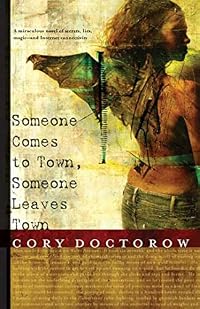
Someone Comes to Town, Someone Leaves Town
by Cory Doctorow
On This Page
Description
Alan is a middle-aged entrepreneur in contemporary Toronto who has devoted himself to fixing up a house in a bohemian neighborhood. This naturally brings him in contact with the house full of students and layabouts next door, including a young woman who, in a moment of stress, reveals to him that she has wings-wings, moreover, that grow back after each attempt to cut them off. Alan understands. He himself has a secret or two. His father is a mountain, his mother is a washing machine, and show more among his brothers are a set of Russian nesting dolls. Now two of the three nesting dolls, Edward and Frederick, are on his doorstep-well on their way to starvation because their innermost member, George, has vanished. It appears that yet another brother, Davey, whom Alan and his other siblings killed years ago, may have returned ... bent on revenge. Under such circumstances it seems only reasonable for Alan to involve himself with a visionary scheme to blanket Toronto with free wireless Internet connectivity, a conspiracy spearheaded by a brilliant technopunk who builds miracles of hardware from parts scavenged from the city's dumpsters. But Alan's past won't leave him alone-and Davey is only one of the powers gunning for him and all his friends. show lessTags
Recommendations





Member Reviews
Alan, a retired man with a bizarre family, gets caught up in a scheme to blanket Toronto with free wireless internet.
I wasn't too sure what to expect, going in. I'd heard that Doctorow's work was very, very strange, and this is true. I've been trying to think of a more politically correct way to say it, but I've failed: this is some weird-ass sh*t. But it's good weird-ass sh*t; it's weird-ass sh*t with a lot of heart. Argus and his family are inhuman in body, but they're very human in soul.
(Their names also change by the minute. It's the first letter that's important here, not the stuff that comes after it. Alan becomes Art becomes Avi becomes Allen, and so on and so forth).
But - and there's always a but, isn't there? - oddly enough, I show more didn't get quite so much out of the human elements, (which were all bizarrely fantastical and fantastically bizarre), as the technostuff. Don't get me wrong, Alan and his family are beautifully rendered, and their strange interactions make for some compelling reading, but the science fictiony portions of the novel were the most fun. Art and his friend Kurt are determined to change the face of interpersonal communication, and I loved watching them work it all out. I initially found it a little confusing, (non-scientist, me), but I quickly caught on. I really looked forward to these scenes; they were by far my favourites.
That's not to say that Alan's personal struggles aren't compelling. They certainly are. He tries so, so hard to be normal, but he can never quite manage it. He wakes his young neighbors up at eight in the morning. He covers the walls of his home with bookcases - even the stairwells, the bathroom and the kitchen. He turns his observations of human nature into long, rambling lectures on business and technology and moral responsibility. He's downright weird. And yet, it's difficult not to like him. You want him to succeed; you want him to figure it out, at long last. And you always, always want to learn more about him and his strange, unconventional family.
All in all, this was a very good book. I had a great time with it, and it's given me a lot to mull over. But I find, oddly enough, that I have no desire to read it again. It was a great one-night stand, and I do wish I'd read it in a class so I could discuss some of the themes at greater length, but I don't want to get involved with it on a long-term basis. I feel all right about passing my copy on to someone else.
(A slightly different version of this review originally appeared on my blog, Stella Matutina). show less
I wasn't too sure what to expect, going in. I'd heard that Doctorow's work was very, very strange, and this is true. I've been trying to think of a more politically correct way to say it, but I've failed: this is some weird-ass sh*t. But it's good weird-ass sh*t; it's weird-ass sh*t with a lot of heart. Argus and his family are inhuman in body, but they're very human in soul.
(Their names also change by the minute. It's the first letter that's important here, not the stuff that comes after it. Alan becomes Art becomes Avi becomes Allen, and so on and so forth).
But - and there's always a but, isn't there? - oddly enough, I show more didn't get quite so much out of the human elements, (which were all bizarrely fantastical and fantastically bizarre), as the technostuff. Don't get me wrong, Alan and his family are beautifully rendered, and their strange interactions make for some compelling reading, but the science fictiony portions of the novel were the most fun. Art and his friend Kurt are determined to change the face of interpersonal communication, and I loved watching them work it all out. I initially found it a little confusing, (non-scientist, me), but I quickly caught on. I really looked forward to these scenes; they were by far my favourites.
That's not to say that Alan's personal struggles aren't compelling. They certainly are. He tries so, so hard to be normal, but he can never quite manage it. He wakes his young neighbors up at eight in the morning. He covers the walls of his home with bookcases - even the stairwells, the bathroom and the kitchen. He turns his observations of human nature into long, rambling lectures on business and technology and moral responsibility. He's downright weird. And yet, it's difficult not to like him. You want him to succeed; you want him to figure it out, at long last. And you always, always want to learn more about him and his strange, unconventional family.
All in all, this was a very good book. I had a great time with it, and it's given me a lot to mull over. But I find, oddly enough, that I have no desire to read it again. It was a great one-night stand, and I do wish I'd read it in a class so I could discuss some of the themes at greater length, but I don't want to get involved with it on a long-term basis. I feel all right about passing my copy on to someone else.
(A slightly different version of this review originally appeared on my blog, Stella Matutina). show less
76 points/100 (4 stars/5)
Genres: urban fantasy, magical (sur)realism
Alan has bought a house and fixed it up for himself to live in. Adam introduces himself to his neighbors. Then one of those neighbors announces she has wings, but that's okay with Allen. His father is a mountain, his mother is a washing machine...and his brothers are different, too. Then two of Arthur's brothers show up saying that a third is missing. They believe a fourth brother, who they teamed up to kill themselves years ago, killed the third.
Alan is my spirit animal.
I had an insanely fun time reading this. It starts off weird and then...it just keeps going. I don't typically read super weird stuff. Yet, when I read the line "his father is a mountain; his mother is show more a washing machine" in the blurb, I knew I had to read this. I'm so, so, SO glad I did.
Because Aaron is my spirit animal.
Andy is weird. He isn't human. He doesn't respond as a normal human would respond. He is unreasonably cheerful for no good reason. Andrew does the weirdest stuff, thinking it is normal, like just inviting himself into other people's houses. You can tell he isn't human, he is just too weird to be human. No one is that cheerful and positive. Yet, Adrian fakes being human really well.
Alan’s father was a mountain, and his mother was a washing machine—he kept a roof over their heads and she kept their clothes clean. His brothers were: a dead man, a trio of nesting dolls, a fortune-teller, and an island.
This little paragraph in one of the first few pages of the book tells you all you need to know about Austin's family and how he grew up. Just how does a washing machine and a mountain raise a cadre of boys? They don't. Who does? Alex. How did he get raised? Well, he had to raise himself.
The thing is, if we look past the surreal, this is perhaps the best I've ever seen a dysfunctional family life being described in urban fantasy. Like so many main characters that I have read before now, when they were growing up the family doesn't function. The difference is, Asher has to raise himself and 6 brothers, one of whom is even more dysfunctional than the family is.
Doug was the one he’d help murder. All the brothers had helped with the murder, even Charlie (Clem, Carlos, Cory), the island, who’d opened a great fissure down his main fault line and closed it up over Doug’s corpse, ensuring that their parents would be none the wiser.
Yes, you read that right. Everyone teamed up to kill one of the brothers and hide it from their parents. This is a book of revenge. In urban fantasy, typically we're on the side. We're trying to get revenge against someone for some wrong. Instead, we're trying to stop someone from getting revenge on you. It is an amazing turn of events.
Yet it isn't without merit. Damien is an unholy terror. He cried for an entire year straight when he was born. Nothing could soothe him. When he grew up, he was constantly hurting people, calling them names. Dallas would say horrible things, threatening to kill everyone. Got kicked out of kindergarten within 15 minutes of his first day. He was broken from the start, and no one could fix him.
Again, once you look past the weirdness of this book, this happens to people. Sometimes, children are born broken. It takes a skilled person to guide them into being a person who doesn't kill, who doesn't torture. Yet, remember: Amir is raising all of his brothers. He is a child himself. Here is where this bends away from reality, because all of his brothers kill Darrell when he gets to be too much for him, and they get away with it for years. And then he comes back for his revenge. Again, in urban fantasy we've seen characters who are broken before, but this is the best, most realistic version I've actually seen of this before.
As the eldest, Alan was the first to recognize the early signs of her pregnancy. The laundry loads of diapers and play clothes he fed into her belly unbalanced more often, and her spin cycle became almost lackadaisical, so the garments had to hang on the line for days before they stiffened and dried completely.
...
The details of her conception were always mysterious to Alan.
To you and me, both, Abraham. The entire scene where the washing machine gives birth is magical. Absolutely magical. His musings on how she got pregnant in the first place just.. perfect. The worldbuilding in this book is as best as I could possibly have hoped for when I knew I had to read this book. There are so many excerpts I wish I could show because it just was perfect to read. I don't want to inundate you with them and spoil the magic of the book. Also, I didn't highlight them all properly.
“Who said anything about money? How much do you think UUNet and PSI charge each other to exchange traffic with one another? Who benefits when UUNet and PSI cross-connect? Is UUNet the beneficiary of PSI’s traffic, or vice versa? Internet access only costs money at the edge—and with a mesh-net, there is no edge anymore. It’s penetration at the center, just like the Devo song.”
Unfortunately, there is that. Weirdly, this book is sort of about creating a homebrew internet service piggybacking off a proper internet service by creating boxes that somehow share the internet? Wooosh, as that all goes over my head. I almost nodded off a few times reading these parts. A strangely large portion of this book is spent on this, and I still am not quite sure why. We actually keep going back to it, which ends up confusing me quite a bit.
It confuses me because the narration kind of breaks down at the end (and if you want to make the joke "Better call the Maytag repairman", you've already been beaten to the punch). The entire book we're popping between scenes in the past and present. This is especially confusing because there aren't actually any chapters in this book... Anyway. In the first half of the book, this was pretty well done, moving back and forth between Alvin's childhood and the present. Halfway through the book, however, I had a really difficult time keeping up. It got increasingly more confusing about where we were in the story, because it started being told out of order. I had to backup a few times to figure out if I just missed something, or if something was skipped.
The most confusing part was the story Anthony was writing. At the start of the book, Antonio said he was going to write a book. It takes him a really long time to get to this book. Yet, when he does get to it, it is threaded within the story. I..don't really understand what happened there. I'm not used to reading stuff with meaning to it, and I just cannot decipher what Doctorow means by that story or by threading it through at the end.
Sidenote: This has been the easiest time I have remembered who was who after having to set the book aside for extended time in ages (I had to sleep). This is hilarious because most of the characters never had a name they stuck to. I found it amusing to see all the names that were used throughout this book for the same person.
You've seen the ones for Allan, the oldest. The second oldest, the fortune teller: Brian, Brandon, Billy, Ben. The island isn't mentioned as much, and one of the quotes above has some for him. Then there is the Deadman: Darien, Daniel, Dylan. My favourites are the nesting dolls. Most of the time they're called in trio, because one cannot exist without the other. Edward-Francis-Gregory, Eric-Fred-George, Ethan-Fabio-Grayson. Even once they were called E-F-G. I loved this naming scheme.
Sidenote #2: Who uses "mons" in a sex scene??
I enjoyed the hell out of this read, and I really do recommend it. This was so delightfully bizarre.
Check this out if:
* you're looking for something truly weird
* a dysfunctional family dynamic that is strangely realistic sounds interesting
* you want to see how a character in a book can become someone's spirit animal
Don't bother if:
* randomness isn't for you
* a story where the timeline jumps repeatedly makes you less interested in the overall story
* technobabble for 13 year old technology (where a 32 MB zip drive is considered anything more than useless) makes you fall asleep
Read more reviews like this at Keikii Eats Books show less
Genres: urban fantasy, magical (sur)realism
Alan has bought a house and fixed it up for himself to live in. Adam introduces himself to his neighbors. Then one of those neighbors announces she has wings, but that's okay with Allen. His father is a mountain, his mother is a washing machine...and his brothers are different, too. Then two of Arthur's brothers show up saying that a third is missing. They believe a fourth brother, who they teamed up to kill themselves years ago, killed the third.
Alan is my spirit animal.
I had an insanely fun time reading this. It starts off weird and then...it just keeps going. I don't typically read super weird stuff. Yet, when I read the line "his father is a mountain; his mother is show more a washing machine" in the blurb, I knew I had to read this. I'm so, so, SO glad I did.
Because Aaron is my spirit animal.
Andy is weird. He isn't human. He doesn't respond as a normal human would respond. He is unreasonably cheerful for no good reason. Andrew does the weirdest stuff, thinking it is normal, like just inviting himself into other people's houses. You can tell he isn't human, he is just too weird to be human. No one is that cheerful and positive. Yet, Adrian fakes being human really well.
Alan’s father was a mountain, and his mother was a washing machine—he kept a roof over their heads and she kept their clothes clean. His brothers were: a dead man, a trio of nesting dolls, a fortune-teller, and an island.
This little paragraph in one of the first few pages of the book tells you all you need to know about Austin's family and how he grew up. Just how does a washing machine and a mountain raise a cadre of boys? They don't. Who does? Alex. How did he get raised? Well, he had to raise himself.
The thing is, if we look past the surreal, this is perhaps the best I've ever seen a dysfunctional family life being described in urban fantasy. Like so many main characters that I have read before now, when they were growing up the family doesn't function. The difference is, Asher has to raise himself and 6 brothers, one of whom is even more dysfunctional than the family is.
Doug was the one he’d help murder. All the brothers had helped with the murder, even Charlie (Clem, Carlos, Cory), the island, who’d opened a great fissure down his main fault line and closed it up over Doug’s corpse, ensuring that their parents would be none the wiser.
Yes, you read that right. Everyone teamed up to kill one of the brothers and hide it from their parents. This is a book of revenge. In urban fantasy, typically we're on the side. We're trying to get revenge against someone for some wrong. Instead, we're trying to stop someone from getting revenge on you. It is an amazing turn of events.
Yet it isn't without merit. Damien is an unholy terror. He cried for an entire year straight when he was born. Nothing could soothe him. When he grew up, he was constantly hurting people, calling them names. Dallas would say horrible things, threatening to kill everyone. Got kicked out of kindergarten within 15 minutes of his first day. He was broken from the start, and no one could fix him.
Again, once you look past the weirdness of this book, this happens to people. Sometimes, children are born broken. It takes a skilled person to guide them into being a person who doesn't kill, who doesn't torture. Yet, remember: Amir is raising all of his brothers. He is a child himself. Here is where this bends away from reality, because all of his brothers kill Darrell when he gets to be too much for him, and they get away with it for years. And then he comes back for his revenge. Again, in urban fantasy we've seen characters who are broken before, but this is the best, most realistic version I've actually seen of this before.
As the eldest, Alan was the first to recognize the early signs of her pregnancy. The laundry loads of diapers and play clothes he fed into her belly unbalanced more often, and her spin cycle became almost lackadaisical, so the garments had to hang on the line for days before they stiffened and dried completely.
...
The details of her conception were always mysterious to Alan.
To you and me, both, Abraham. The entire scene where the washing machine gives birth is magical. Absolutely magical. His musings on how she got pregnant in the first place just.. perfect. The worldbuilding in this book is as best as I could possibly have hoped for when I knew I had to read this book. There are so many excerpts I wish I could show because it just was perfect to read. I don't want to inundate you with them and spoil the magic of the book. Also, I didn't highlight them all properly.
“Who said anything about money? How much do you think UUNet and PSI charge each other to exchange traffic with one another? Who benefits when UUNet and PSI cross-connect? Is UUNet the beneficiary of PSI’s traffic, or vice versa? Internet access only costs money at the edge—and with a mesh-net, there is no edge anymore. It’s penetration at the center, just like the Devo song.”
Unfortunately, there is that. Weirdly, this book is sort of about creating a homebrew internet service piggybacking off a proper internet service by creating boxes that somehow share the internet? Wooosh, as that all goes over my head. I almost nodded off a few times reading these parts. A strangely large portion of this book is spent on this, and I still am not quite sure why. We actually keep going back to it, which ends up confusing me quite a bit.
It confuses me because the narration kind of breaks down at the end (and if you want to make the joke "Better call the Maytag repairman", you've already been beaten to the punch). The entire book we're popping between scenes in the past and present. This is especially confusing because there aren't actually any chapters in this book... Anyway. In the first half of the book, this was pretty well done, moving back and forth between Alvin's childhood and the present. Halfway through the book, however, I had a really difficult time keeping up. It got increasingly more confusing about where we were in the story, because it started being told out of order. I had to backup a few times to figure out if I just missed something, or if something was skipped.
The most confusing part was the story Anthony was writing. At the start of the book, Antonio said he was going to write a book. It takes him a really long time to get to this book. Yet, when he does get to it, it is threaded within the story. I..don't really understand what happened there. I'm not used to reading stuff with meaning to it, and I just cannot decipher what Doctorow means by that story or by threading it through at the end.
Sidenote: This has been the easiest time I have remembered who was who after having to set the book aside for extended time in ages (I had to sleep). This is hilarious because most of the characters never had a name they stuck to. I found it amusing to see all the names that were used throughout this book for the same person.
You've seen the ones for Allan, the oldest. The second oldest, the fortune teller: Brian, Brandon, Billy, Ben. The island isn't mentioned as much, and one of the quotes above has some for him. Then there is the Deadman: Darien, Daniel, Dylan. My favourites are the nesting dolls. Most of the time they're called in trio, because one cannot exist without the other. Edward-Francis-Gregory, Eric-Fred-George, Ethan-Fabio-Grayson. Even once they were called E-F-G. I loved this naming scheme.
Sidenote #2: Who uses "mons" in a sex scene??
I enjoyed the hell out of this read, and I really do recommend it. This was so delightfully bizarre.
Check this out if:
* you're looking for something truly weird
* a dysfunctional family dynamic that is strangely realistic sounds interesting
* you want to see how a character in a book can become someone's spirit animal
Don't bother if:
* randomness isn't for you
* a story where the timeline jumps repeatedly makes you less interested in the overall story
* technobabble for 13 year old technology (where a 32 MB zip drive is considered anything more than useless) makes you fall asleep
Read more reviews like this at Keikii Eats Books show less
I loved this book for 2 reasons.
1) It was a ridiculous and fun story. Easy to read, and never a dull moment. The character of Alan/Arthur/Antoine/etc is quirky (as expected being the son of a Mountain and a Washing Machine) and the development of his family dynamic through the story is really compelling.
2) As it was originally released in 2005 and deals with contemporary technology (somewhat bleeding edge at the time) it is really interesting to see, 7 years later, how drastically different the technological landscape is today. In 2005, it was rare for a laptop to have a built-in wifi card. Hell, it was rare for people to have a laptop. The Blackberry was the closest thing to what we now consider a smartphone and it was hardly that. show more PDAs & Palm Pilots were still a big deal. A plan to blanket Toronto in free Wifi was revolutionary. It feels almost archaic reading about this world again and remembering back to 2005 and how things were then.
As with any [a:Cory Doctorow|12581|Cory Doctorow|http://photo.goodreads.com/authors/1212526024p2/12581.jpg] book, his personal politics bleed through a little bit, but he has some really good points on freedom of speech and free access to information that never get in the way of the story. (If anything, they add to it and make you think about how these ideas could apply today in the age of smartphones and apps).
Finally, if I've convinced you to read this book (and you should), Cory is not one to make a claim and not back it up with his own material. By which I mean, you can download it for free (completely legally) from his website, in PDF, txt, html or any e-book reader format you want. A wild book appears! show less
1) It was a ridiculous and fun story. Easy to read, and never a dull moment. The character of Alan/Arthur/Antoine/etc is quirky (as expected being the son of a Mountain and a Washing Machine) and the development of his family dynamic through the story is really compelling.
2) As it was originally released in 2005 and deals with contemporary technology (somewhat bleeding edge at the time) it is really interesting to see, 7 years later, how drastically different the technological landscape is today. In 2005, it was rare for a laptop to have a built-in wifi card. Hell, it was rare for people to have a laptop. The Blackberry was the closest thing to what we now consider a smartphone and it was hardly that. show more PDAs & Palm Pilots were still a big deal. A plan to blanket Toronto in free Wifi was revolutionary. It feels almost archaic reading about this world again and remembering back to 2005 and how things were then.
As with any [a:Cory Doctorow|12581|Cory Doctorow|http://photo.goodreads.com/authors/1212526024p2/12581.jpg] book, his personal politics bleed through a little bit, but he has some really good points on freedom of speech and free access to information that never get in the way of the story. (If anything, they add to it and make you think about how these ideas could apply today in the age of smartphones and apps).
Finally, if I've convinced you to read this book (and you should), Cory is not one to make a claim and not back it up with his own material. By which I mean, you can download it for free (completely legally) from his website, in PDF, txt, html or any e-book reader format you want. A wild book appears! show less
This is only the second work of Doctorow’s for me (the other having been the very funny short story “I, Rowboat”). It strikes me as a book that would evoke strong opinions, pro and con. Put me squarely in the pro column.
It is an ambitious book, not quite like anything I’ve ever read before. Doctorow demonstrates a facility for juxtaposing the fantastic with the everyday in a way vaguely reminiscent of one my all-time favorites, Cordwainer Smith. The protagonist Alan is an original character on several levels (not the least of which is his unusual family tree). This is not a book that I would consider Cyberpunk, more Urban Fantasy with healthy doses of Lovecraft.
Someone Comes to Town, Someone Leaves Town is clearly a book about show more identify, a book about how we are all the same and how we are each different. And perhaps about how you are defined by the company that your keep. It is at times quite funny, at times quite scary, and often absurd. In the end it delivers a powerful and affirming message, something along the lines of “be true to our commonality and be true to our differences and avoid those who aren’t either.”
There are things about the book that didn’t entirely work for me. The changing names thing was more annoying than effective (although in retrospect it clearly fit squarely into the identity theme of the book). Alan’s brothers (except for Davey) never felt fully fleshed out as distinct characters, which made the climax somewhat less effective than it could have been. The short, choppy narrative segments at times left you confused about which of the various storylines you were dropping in on.
Overall, a book where the pluses far outweigh the minuses. I will definitely plan to read more from Cory Doctorow. show less
It is an ambitious book, not quite like anything I’ve ever read before. Doctorow demonstrates a facility for juxtaposing the fantastic with the everyday in a way vaguely reminiscent of one my all-time favorites, Cordwainer Smith. The protagonist Alan is an original character on several levels (not the least of which is his unusual family tree). This is not a book that I would consider Cyberpunk, more Urban Fantasy with healthy doses of Lovecraft.
Someone Comes to Town, Someone Leaves Town is clearly a book about show more identify, a book about how we are all the same and how we are each different. And perhaps about how you are defined by the company that your keep. It is at times quite funny, at times quite scary, and often absurd. In the end it delivers a powerful and affirming message, something along the lines of “be true to our commonality and be true to our differences and avoid those who aren’t either.”
There are things about the book that didn’t entirely work for me. The changing names thing was more annoying than effective (although in retrospect it clearly fit squarely into the identity theme of the book). Alan’s brothers (except for Davey) never felt fully fleshed out as distinct characters, which made the climax somewhat less effective than it could have been. The short, choppy narrative segments at times left you confused about which of the various storylines you were dropping in on.
Overall, a book where the pluses far outweigh the minuses. I will definitely plan to read more from Cory Doctorow. show less
Even after my disappointment with Eastern Standard Tribe, this still looked really interesting, and this time I wasn't disappointed.
Alan (Andy, Adrian) is the son of a mountain and a washing machine, and he has seven brothers. Alan (Alex, Andreas) is the oldest, and also the one who can pass for human the most easily and comfortably. In fact, only gradually do we learn that there's anything unusual about him at all, except for his parentage and his casual attitude about what name he gives people—as long as it starts with "A". Billy (Bob, Ben) can see the future, Carlo is an island, Doug (Danny,) was a perfectly human-appearing monster until his brothers killed him (which hasn't slowed down his career much), and Ed, Fred, and George show more are nesting dolls. Alan got his early-childhood care and education from the golems provided by his father, the mountain, and then discovered school and the library. After a childhood attempting to raise his brothers (except for Carlo) with decent educations and the ability to blend in to human society, and after a truly horrific experience ending in the death of Doug, Alan takes off on his own. When we meet him, he's a middle-aged, semi-retired entrepreneur living in Toronto, renovating the house he just bought and getting acquainted with the college-age neighbors next door.
His illusions of normality are about to take a nasty hit.
On the one hand, he's getting sucked into a new project, making free wireless internet access available to the neighborhood, the city, and eventually the world. On the other hand, his brothers, Ed, Fred, and George come to visit, with the news that Doug, whom they thought was safely dead, is back and coming after them. And on the third hand, the kids next door aren't as normal as they look, either. As his brothers start dying and Doug starts collecting allies, Alan clings to his version of normality and pitches free wireless internet access to Bell Canada and tiny city merchants and anarchist bookstore operators, and tries to convince the girl next door that wings aren't a handicap. (Silly Alan; Mimi wants to be normal, too!)
All of this could be a recipe for a disaster of a book, and occasionally it does seem to almost spin out of Doctorow's control—but not quite. Somehow it all gels. These characters are fleshed out and interesting, and the story, alternating in time between Alan's strange childhood and his not-quite-normal middle age, is fully developed and absorbing. I'm never going to be Cory Doctorow's biggest fan, but I recommend this one to anyone who enjoys quirky fantasy. show less
Alan (Andy, Adrian) is the son of a mountain and a washing machine, and he has seven brothers. Alan (Alex, Andreas) is the oldest, and also the one who can pass for human the most easily and comfortably. In fact, only gradually do we learn that there's anything unusual about him at all, except for his parentage and his casual attitude about what name he gives people—as long as it starts with "A". Billy (Bob, Ben) can see the future, Carlo is an island, Doug (Danny,) was a perfectly human-appearing monster until his brothers killed him (which hasn't slowed down his career much), and Ed, Fred, and George show more are nesting dolls. Alan got his early-childhood care and education from the golems provided by his father, the mountain, and then discovered school and the library. After a childhood attempting to raise his brothers (except for Carlo) with decent educations and the ability to blend in to human society, and after a truly horrific experience ending in the death of Doug, Alan takes off on his own. When we meet him, he's a middle-aged, semi-retired entrepreneur living in Toronto, renovating the house he just bought and getting acquainted with the college-age neighbors next door.
His illusions of normality are about to take a nasty hit.
On the one hand, he's getting sucked into a new project, making free wireless internet access available to the neighborhood, the city, and eventually the world. On the other hand, his brothers, Ed, Fred, and George come to visit, with the news that Doug, whom they thought was safely dead, is back and coming after them. And on the third hand, the kids next door aren't as normal as they look, either. As his brothers start dying and Doug starts collecting allies, Alan clings to his version of normality and pitches free wireless internet access to Bell Canada and tiny city merchants and anarchist bookstore operators, and tries to convince the girl next door that wings aren't a handicap. (Silly Alan; Mimi wants to be normal, too!)
All of this could be a recipe for a disaster of a book, and occasionally it does seem to almost spin out of Doctorow's control—but not quite. Somehow it all gels. These characters are fleshed out and interesting, and the story, alternating in time between Alan's strange childhood and his not-quite-normal middle age, is fully developed and absorbing. I'm never going to be Cory Doctorow's biggest fan, but I recommend this one to anyone who enjoys quirky fantasy. show less
I thought this book was only good. I hated the first 40 or 50 pages which is something I can't just ignore. Those first pages seemed very male oriented and I felt like I couldn't relate to the story or characters at all, but once I got passed those first pages I became more engaged in the story, especially once the character of Kurt was introduced. Kurt was definitely my favorite character and he made the story actually enjoyable to me. I was okay with the other characters. They didn't really turn me away from the story but they weren't my favorite characters, though I did really like Kurt and Lyman. I found myself getting lost quite a bit in this story. there was a lot of jumping around and weird interspersed stories and I couldn't show more always follow where everyone was and what they were doing. It also took me a bit to get used to the name changing thing throughout this book. I think for me this was still an interesting read and I would probably pick up other books more similar to this in the future even if this particular book wasn't my favorite. I think for anyone thinking about reading this give it a try, but don't be ashamed about putting it aside or not completing the book if this style just isn't your thing, because I know for the first 40-50 pages I was seriously considering not finishing this book, which is not something I typically do. show less
One of the more original fantasy/scifi books I've read, "Someone" is boldly and unapologetically off the beaten path. Alan and his brothers are a strange breed, born of a mountain and a washing machine. Three of the brothers fit inside of each other like nesting dolls, one is prophetic, one an island, and one a sadistic killer. In addition, they have the unsettling narrative quality of constantly changing names, albeit staying with the same consonant (Alan changes to Adam/August/Austin etc.) These circumstances may seem gimmicky, but they somehow interweave to emphasize the other-worldly nature of the family. If the exploration of Alan's lineage isn't intriguing enough, Doctorow adds fratricide, a girl with wings, and Alan's harrowing show more race to protect his family from his destroyer brother. A side plot about creating internet access points feels unrelated, but eventually feels like another of Alan's efforts to reach his goal of blending with humanity. A twist ending creates a burning need to reexamine the book from another perspective. An experimental, yet ultimately satisfying read. show less
Members
- Recently Added By
Lists

Books Read in 2009
464 works; 11 members

Books Read in 2025
4,090 works; 97 members
Author Information

119+ Works 25,825 Members
Writer and activist Cory Doctorow was born in Toronto, Canada on July 17, 1971. In 1999 he co-founded a free software company called Opencola and served as Canadian Regional Director of the Science Fiction and Fantasy Writers of America. For four years he worked as European Affairs Coordinator for the Electronic Frontier Foundation and in 2007 won show more its Pioneer Award. His first novel, Down and Out in the Magic Kingdom, won a Locus Award for Best First Novel. His short story collection A Place So Foreign and Eight More won a Sunburst Award, and his bestselling novel Little Brother received the 2009 Prometheus Award, a Sunburst Award, and the John W. Campbell Memorial Award. Doctorow also writes nonfiction books and articles, and he co-edits the blog Boing Boing. (Bowker Author Biography) show less
Some Editions
Awards and Honors
Awards
Distinctions
Notable Lists
Work Relationships
Is contained in
Common Knowledge
- Canonical title
- Someone Comes to Town, Someone Leaves Town
- Original title
- Someone Comes to Town, Someone Leaves Town
- Original publication date
- 2005-07-01
- People/Characters
- Alan; Mimi; Kurt; mountain (Alan's father); washing machine (Alan's mother); Krishna (show all 17); Link; Natalie; Leyman; Marci; Waldo (the anarchist); Doug (Alan's undead brother); Charlie (Alan's island brother); Billy (Alan's psychic brother); Edward (Alan's outer nesting doll brother); Frederick (Alan's middle nesting doll brother); Gregory (Alan's inner nesting doll brother)
- Important places
- Toronto, Ontario, Canada; Occupied Japan; Kapuskasing, Ontario, Canada; Kensington Market (Toronto, Ontario, Canada); the mountain (Kapuskasing, Ontario, Canada)
- First words
- Alan sanded the house on Wales Avenue.
- Last words
- (Click to show. Warning: May contain spoilers.)She bit his lip and he bit hers and they kissed again, and then he was asleep, and at peace.
- Publisher's editor
- Nielsen Hayden, Patrick
- Blurbers
- Wolfe, Gene; Di Filippo, Paul; Broderick, Damien; Wagner, Thomas M.; Miller, Faren; Kleffel, Rick
- Canonical DDC/MDS
- 813.6
- Canonical LCC
- PS3604.O27
Classifications
Statistics
- Members
- 1,302
- Popularity
- 18,503
- Reviews
- 59
- Rating
- (3.53)
- Languages
- English, Italian
- Media
- Paper, Audiobook, Ebook
- ISBNs
- 15
- ASINs
- 7