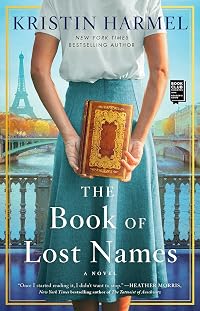
The Book of Lost Names
by Kristin Harmel
On This Page
Description
"Eva Traube Abrams, a semi-retired librarian in Florida, is shelving books one morning when her eyes lock on a photograph in a magazine lying open nearby. She freezes; it's an image of a book she hasn't seen in sixty-five years--a book she recognizes as The Book of Lost Names. The accompanying article discusses the looting of libraries by the Nazis across Europe during World War II--an experience Eva remembers well--and the search to reunite people with the texts taken from them so long ago. show more The book in the photograph, an eighteenth-century religious text thought to have been taken from France in the waning days of the war, is one of the most fascinating cases. Now housed in Berlin's Zentral- und Landesbibliothek library, it appears to contain some sort of code, but researchers don't know where it came from--or what the code means. Only Eva holds the answer--but will she have the strength to revisit old memories and help reunite those lost during the war? As a graduate student in 1942, Eva was forced to flee Paris after the arrest of her father, a Polish Jew. Finding refuge in a small mountain town in the Free Zone, she begins forging identity documents for Jewish children fleeing to neutral Switzerland. But erasing people comes with a price, and along with a mysterious, handsome forger named Rømy, Eva decides she must find a way to preserve the real names of the children who are too young to remember who they really are. The records they keep in The Book of Lost Names will become even more vital when the resistance cell they work for is betrayed and Rømy disappears."--Amazon. show lessTags
Recommendations



Member Reviews
Opening in 2005, this historical novel looks back at the life of 85-year-old Eva Traube Abrams, now living in Florida. At her local library, Eva saw a New York Times report about a Berlin man named Otto Kuhn, who was trying to reunite owners with newly recovered books stolen by the Nazis. He was posing with a picture of one of the books - Epitres et Evangiles. Eva recognized it right away, because 60 years ago, it used to be hers.
The book had served as a repository for crucial information Eva encoded inside. She thought it had been lost forever. Now, she seized on the chance to retrieve what she thought was lost forever, and flew to Berlin that night.
The story then jumps back to Paris in July of 1942. Eva, a 23-year-old college student, show more was living in Paris with her parents, Jewish immigrants from Poland.
Germans had occupied Paris since 1940. (The French government moved to Vichy, France where it tried to operate in exile. Vichy, France was officially independent, but in deference to the Nazis, it adopted a policy of collaboration.) In July, 1942, over 13,000 Jews were rounded up in Paris by the French police acting on orders of the Nazis. They were sent to concentration camps. [For those familiar with Holocaust history, this was the famous “Vélodrome d'Hiver roundup,” the largest French deportation of Jews during the Holocaust, which primarily targeted foreign and immigrant Jews.]
Eva’s father was one of those picked up. (She and her mother were serendipitously staying at a neighbors that night.)
Eva and her mother managed to escape to Aurignon, a small town in Vichy, France. Madame Barbier, the woman who rented them a room in Aurignon, could see that the documents Eva and her mother had were forgeries, albeit good ones. Fortunately, she was part of a local resistance group led by Père Clement, a young Catholic priest. Madame Barbier alerted the priest that Eva could be useful to them with a little training, and he in turn asked for Eva's help.
Most of the rest of the book details Eva’s work creating fake documents for the resistance in Aurignon. She worked alongside Rémy Duchamp, a brave member of the French Resistance, who helped Eva perfect the craft. Harmel based this part of the novel on the real-life story of people in the town of Le Chambon-sur-Lignon, whose residents helped thousands of Jews and other hunted refugees elude the Nazis. They not only hid them in and around the village, but helped make authentic-looking identification documents for them to escape across the border to neutral Switzerland, and sometimes even escorted them to safety themselves.
The character of Père Clement was no doubt inspired by Protestant Pastor André Trocmé in Le Chambon, and the activities of Eva and her fellow-forger Remy Duchamp and later Genevieve, echoed those of actual resistance members, in particular Adolfo Kaminsky and Oscar Rosowsky, both forgers who helped rescue thousands of Jews.
[Kaminsky joined the French Resistance at age 17. The remarkable story of his life is told in a book by his daughter Sarah Kaminsky, A Forger’s Life. The book's episode of Eva frantically producing children's documents overnight was inspired by a Kaminsky anecdote. He recalled that some 300 children needed papers immediately. Thus, 900 documents had to be created. Kaminsky remembered: “The math was simple. In one hour, I make 30 fake documents. If I slept for one hour, 30 people would die.” Kaminsky persevered. The papers were forged and the children avoided deportation.
Oscar Rosowsky worked in Le Chambon, setting up a forgery workshop, and came up with some of the methods Eva and Remy used in the book to copy official seals and duplicate them. His story is told by Peter Grose in The Greatest Escape: How One French Community Saved Thousands of Lives from the Nazis.]
Eva wanted to preserve the real names of the children for whom she made fake documents, and Remy taught her how to encrypt them inside an obscure religious book, Epitres et Evangiles. But after the Nazis came and raided the church, the book was thought to be lost, until its discovery in Berlin 60 years later.
Discussion: There are outstanding, inspirational stories from the dark time of the Holocaust, and the author’s incorporation of some of them into this book is admirable. But her retelling pales against the real life stories for several reasons. Most importantly, it is difficult to like the main character, Eva. She is incredibly naive and ill-informed for 23, and too focused on herself to see what is going on around her, such as: Nazi takeover of Paris. Her mother is even worse. She embodies the worst stereotypes of Jewish mothers, obsessed above all else that Eva should find “a nice Jewish boy” to marry, and then turns absolutely evil after their forced exile. In an absurd turn, she blames Eva for all of it: the Nazi’s taking her husband, their having to leave, giving up their apartment, and their new situation in Aurignon. (Mother: “You let them take him! You knew they were coming and you just stood there and did nothing.”) Then, when Eva starts to work for the resistance movement, the mother blames her for deserting the Jewish faith by working with a priest (who is, needless to say, working to save Jews). She resents the time Eva spends helping: “You are in your own world, Eva, and there’s no room for me in it.” (It is unclear what that would involve besides sitting with her mother in the boarding house all day, bemoaning their fate.). Even more absurdly, Eva actually accepted her mother’s characterization of everything, blaming herself as well! What kind of warped narcissism allowed her to agree with her mother that, for example, it was she, not the Nazis, who caused everything that happened? Further, as her love for (non-Jewish) Remy developed, she obsessed that it was a “betrayal” of her parents. Silly, egotistical, immature: thank goodness she had a talent that could be used to save desperate people, or she would be totally unsympathetic.
Evaluation: Many people today are not aware of all of the non-military efforts made by ordinary citizens in Europe to oppose the genocidal agenda of the Nazis and to resist them in any way, no matter small. These efforts included documenting Nazi war crimes and keeping those documents hidden to use later for evidence; hiding people in their homes at great personal risk; and forging papers for those who could find a safe country which would take them (the latter not always easy). Therefore I appreciated the attention the book gave to some of these acts of defiance, but I think readers could find more satisfying stories about the brave civilian resistance movements in Europe than this one. They range from non-fiction memoirs, like The Art of Resistance: My Four Years in the French Underground by Justus Rosenberg to well-crafted fiction, like A Thread of Grace by Mary Doria Russell. show less
The book had served as a repository for crucial information Eva encoded inside. She thought it had been lost forever. Now, she seized on the chance to retrieve what she thought was lost forever, and flew to Berlin that night.
The story then jumps back to Paris in July of 1942. Eva, a 23-year-old college student, show more was living in Paris with her parents, Jewish immigrants from Poland.
Germans had occupied Paris since 1940. (The French government moved to Vichy, France where it tried to operate in exile. Vichy, France was officially independent, but in deference to the Nazis, it adopted a policy of collaboration.) In July, 1942, over 13,000 Jews were rounded up in Paris by the French police acting on orders of the Nazis. They were sent to concentration camps. [For those familiar with Holocaust history, this was the famous “Vélodrome d'Hiver roundup,” the largest French deportation of Jews during the Holocaust, which primarily targeted foreign and immigrant Jews.]
Eva’s father was one of those picked up. (She and her mother were serendipitously staying at a neighbors that night.)
Eva and her mother managed to escape to Aurignon, a small town in Vichy, France. Madame Barbier, the woman who rented them a room in Aurignon, could see that the documents Eva and her mother had were forgeries, albeit good ones. Fortunately, she was part of a local resistance group led by Père Clement, a young Catholic priest. Madame Barbier alerted the priest that Eva could be useful to them with a little training, and he in turn asked for Eva's help.
Most of the rest of the book details Eva’s work creating fake documents for the resistance in Aurignon. She worked alongside Rémy Duchamp, a brave member of the French Resistance, who helped Eva perfect the craft. Harmel based this part of the novel on the real-life story of people in the town of Le Chambon-sur-Lignon, whose residents helped thousands of Jews and other hunted refugees elude the Nazis. They not only hid them in and around the village, but helped make authentic-looking identification documents for them to escape across the border to neutral Switzerland, and sometimes even escorted them to safety themselves.
The character of Père Clement was no doubt inspired by Protestant Pastor André Trocmé in Le Chambon, and the activities of Eva and her fellow-forger Remy Duchamp and later Genevieve, echoed those of actual resistance members, in particular Adolfo Kaminsky and Oscar Rosowsky, both forgers who helped rescue thousands of Jews.
[Kaminsky joined the French Resistance at age 17. The remarkable story of his life is told in a book by his daughter Sarah Kaminsky, A Forger’s Life. The book's episode of Eva frantically producing children's documents overnight was inspired by a Kaminsky anecdote. He recalled that some 300 children needed papers immediately. Thus, 900 documents had to be created. Kaminsky remembered: “The math was simple. In one hour, I make 30 fake documents. If I slept for one hour, 30 people would die.” Kaminsky persevered. The papers were forged and the children avoided deportation.
Oscar Rosowsky worked in Le Chambon, setting up a forgery workshop, and came up with some of the methods Eva and Remy used in the book to copy official seals and duplicate them. His story is told by Peter Grose in The Greatest Escape: How One French Community Saved Thousands of Lives from the Nazis.]
Eva wanted to preserve the real names of the children for whom she made fake documents, and Remy taught her how to encrypt them inside an obscure religious book, Epitres et Evangiles. But after the Nazis came and raided the church, the book was thought to be lost, until its discovery in Berlin 60 years later.
Discussion: There are outstanding, inspirational stories from the dark time of the Holocaust, and the author’s incorporation of some of them into this book is admirable. But her retelling pales against the real life stories for several reasons. Most importantly, it is difficult to like the main character, Eva. She is incredibly naive and ill-informed for 23, and too focused on herself to see what is going on around her, such as: Nazi takeover of Paris. Her mother is even worse. She embodies the worst stereotypes of Jewish mothers, obsessed above all else that Eva should find “a nice Jewish boy” to marry, and then turns absolutely evil after their forced exile. In an absurd turn, she blames Eva for all of it: the Nazi’s taking her husband, their having to leave, giving up their apartment, and their new situation in Aurignon. (Mother: “You let them take him! You knew they were coming and you just stood there and did nothing.”) Then, when Eva starts to work for the resistance movement, the mother blames her for deserting the Jewish faith by working with a priest (who is, needless to say, working to save Jews). She resents the time Eva spends helping: “You are in your own world, Eva, and there’s no room for me in it.” (It is unclear what that would involve besides sitting with her mother in the boarding house all day, bemoaning their fate.). Even more absurdly, Eva actually accepted her mother’s characterization of everything, blaming herself as well! What kind of warped narcissism allowed her to agree with her mother that, for example, it was she, not the Nazis, who caused everything that happened? Further, as her love for (non-Jewish) Remy developed, she obsessed that it was a “betrayal” of her parents. Silly, egotistical, immature: thank goodness she had a talent that could be used to save desperate people, or she would be totally unsympathetic.
Evaluation: Many people today are not aware of all of the non-military efforts made by ordinary citizens in Europe to oppose the genocidal agenda of the Nazis and to resist them in any way, no matter small. These efforts included documenting Nazi war crimes and keeping those documents hidden to use later for evidence; hiding people in their homes at great personal risk; and forging papers for those who could find a safe country which would take them (the latter not always easy). Therefore I appreciated the attention the book gave to some of these acts of defiance, but I think readers could find more satisfying stories about the brave civilian resistance movements in Europe than this one. They range from non-fiction memoirs, like The Art of Resistance: My Four Years in the French Underground by Justus Rosenberg to well-crafted fiction, like A Thread of Grace by Mary Doria Russell. show less
The story opens in 2005, when a book that had been looted by Nazis is found. Eva, a women in her eighties working at a library, recognizes it as the Book of Lost Names and, though she thought her past was far behind her, she decides to go back and get it. Then we're brought back to 1942, where young Eva Traube is living in Paris with her Polish Jewish parents, and her father is arrested in a roundup. Her art skills come in handy as she crafts new identity cards for her and her mother to travel to a small town in the Free Zone and hopefully to freedom in Switzerland. But then she meets Pere Clement and Remy, resistance workers who could use her skill in forgeries.
This is what I think of as historical fiction lite. It is researched, but show more it wears this lightly and isn't the focus of the story. The focus is, instead, on the characters' relationships, with the time frame more of a back drop than center stage. And while this sort of World War 2 fiction is very popular with my library patrons (and the book world in general, judging by the number of titles being turned out regularly), at this point in my reading life I'm looking for something with a little more meat to it. So when all Eva and her mother can talk about is that Eva's leaving behind their Jewish heritage but the only Jewish holiday that comes up is Hanukkah (twice), coincidences abound (I can't explain more without major spoilers), several characters' choices and motivations don't get explored, and I figure out a major plot twist early on, I'm left feeling like something's missing. show less
This is what I think of as historical fiction lite. It is researched, but show more it wears this lightly and isn't the focus of the story. The focus is, instead, on the characters' relationships, with the time frame more of a back drop than center stage. And while this sort of World War 2 fiction is very popular with my library patrons (and the book world in general, judging by the number of titles being turned out regularly), at this point in my reading life I'm looking for something with a little more meat to it. So when all Eva and her mother can talk about is that Eva's leaving behind their Jewish heritage but the only Jewish holiday that comes up is Hanukkah (twice), coincidences abound (I can't explain more without major spoilers), several characters' choices and motivations don't get explored, and I figure out a major plot twist early on, I'm left feeling like something's missing. show less
Special!
I must admit that the plight of Eva Traube unfolded before my mind's eye in startling detail, even if it was smudged in tones of grey with the occasional flashes of color.
Escaping Paris in 1942, a sliver ahead of the rounding up of Jewish Parisians by the Nazis, Eva makes her way to Aurignon, in the Free Zone.
By a set of twisted circumstances she ends up forging papers along with a fellow forgerer and Resistance member Rémy, for Jewish children being funnelled through to Swizerland. A local priest, Père Clément, is embedded in the program. Eva and Père's discussions about God and guilt and their efforts are touching parts of the story.
Eva is determined that as new identies are being forged for the children a list of their show more names should be kept. Using a mathematical code sequence, the Fibonacci sequence, she and Remy record the childrens'real identities in a religious text.
Spurred on by her mother's despairing voice that the Nazis were "erasing us, and we are helping them." It becomes "very important to [her] that they are not forgotten.”
Years later in 2005, now an elderly woman, widowed Eva Traube Abrams sees that particular tome, she referred to as The Book of Lost Names being discussed in an article about the looted books of Europe.
Now in the care of Berlin’s Zentral- und Landesbibliothek library, it's seen to contain mysterious markings. After sixty-five years Eva sights the book that had meant so much to her. Her decision whether to go Berlin or not to see for herself after all these years has her re-examining her buried memories from that time. As readers we join with her, swinging between those frenetic, fearful times and the present.
Lightly held, with just the right amount of emotion and understandings this is a fascinating look at dark times in World War II, and French history, particularly honing in on the dangerous work done by forgerers, capturing the uncertainty and dedication for many.
A Gallery Books ARC via NetGalley show less
I must admit that the plight of Eva Traube unfolded before my mind's eye in startling detail, even if it was smudged in tones of grey with the occasional flashes of color.
Escaping Paris in 1942, a sliver ahead of the rounding up of Jewish Parisians by the Nazis, Eva makes her way to Aurignon, in the Free Zone.
By a set of twisted circumstances she ends up forging papers along with a fellow forgerer and Resistance member Rémy, for Jewish children being funnelled through to Swizerland. A local priest, Père Clément, is embedded in the program. Eva and Père's discussions about God and guilt and their efforts are touching parts of the story.
Eva is determined that as new identies are being forged for the children a list of their show more names should be kept. Using a mathematical code sequence, the Fibonacci sequence, she and Remy record the childrens'real identities in a religious text.
Spurred on by her mother's despairing voice that the Nazis were "erasing us, and we are helping them." It becomes "very important to [her] that they are not forgotten.”
Years later in 2005, now an elderly woman, widowed Eva Traube Abrams sees that particular tome, she referred to as The Book of Lost Names being discussed in an article about the looted books of Europe.
Now in the care of Berlin’s Zentral- und Landesbibliothek library, it's seen to contain mysterious markings. After sixty-five years Eva sights the book that had meant so much to her. Her decision whether to go Berlin or not to see for herself after all these years has her re-examining her buried memories from that time. As readers we join with her, swinging between those frenetic, fearful times and the present.
Lightly held, with just the right amount of emotion and understandings this is a fascinating look at dark times in World War II, and French history, particularly honing in on the dangerous work done by forgerers, capturing the uncertainty and dedication for many.
A Gallery Books ARC via NetGalley show less
A beautifully written story of the forgers who worked secretly during WWII to produce papers for children to escape the Germans. In this book, Eva, a Jew, relocates from Paris to Aurignon, with her mother after her father is taken by the Germans. She is recruited by a Catholic priest to help forge paperwork for innocent families. Hesitant at first, she agrees to help. Along with a Catholic man, Remy, they work to provide papers. Eva and Remy encode the real names of the children along with their fake names in a book owned by the church. When they fall in love, Eva's mother disapproves. Remy leaves Eva behind to help the children escape. Later, Eva is told Remy is dead.
Now 60 years after the war, Eva reads an article saying the book has show more been found. She heads to Germany to reclaim the book. She wonders if Remy ever received the message she left for him in the book. She is surprised at what she finds.
Harmel writes beautifully about the unsung heroes of WWII. show less
Now 60 years after the war, Eva reads an article saying the book has show more been found. She heads to Germany to reclaim the book. She wonders if Remy ever received the message she left for him in the book. She is surprised at what she finds.
Harmel writes beautifully about the unsung heroes of WWII. show less
When meticulous research combines thoughtful creativity and beautiful descriptive writing, the resulting historical fiction novel is a gift to readers. The gift that Kristin Harmel has crafted captures the courage of individuals who thought they were ordinary. Still, we recognize it as extraordinary as they protected and saved as many individuals as they possibly could and with disregard for their potential peril.
The story tells the experience of Eva Traube, a young woman with a love of books, a love of English literature, and a graduate student as WWII begins. At age 86, Eva is a widow working in a library, and her grown son has no clue about her personal story during the war. The story transitions seamlessly between the present-day show more and the past, sharing her story and her part as a forger preparing documents for those fleeing to Switzerland. Eva begins the task as a means to help herself and her mother with high hopes that saving her father, who has already been arrested, might still be possible.
The novel is as heart-wrenching as it is heartwarming to read of the innocence of children that understand life beyond their years, to read of the sacrifices made for sharing food, the skills of an artist becoming a forger, the humanity of so many from priest to farmer to store owner, for all who kept things as usual for the children as possible by giving them school lessons while in hiding, for the courage of the maquisards, and for those who offered hope to one another and kept each other's spirits positive.
It is a mesmerizing story that, once read, will never be forgotten. show less
The story tells the experience of Eva Traube, a young woman with a love of books, a love of English literature, and a graduate student as WWII begins. At age 86, Eva is a widow working in a library, and her grown son has no clue about her personal story during the war. The story transitions seamlessly between the present-day show more and the past, sharing her story and her part as a forger preparing documents for those fleeing to Switzerland. Eva begins the task as a means to help herself and her mother with high hopes that saving her father, who has already been arrested, might still be possible.
The novel is as heart-wrenching as it is heartwarming to read of the innocence of children that understand life beyond their years, to read of the sacrifices made for sharing food, the skills of an artist becoming a forger, the humanity of so many from priest to farmer to store owner, for all who kept things as usual for the children as possible by giving them school lessons while in hiding, for the courage of the maquisards, and for those who offered hope to one another and kept each other's spirits positive.
It is a mesmerizing story that, once read, will never be forgotten. show less
What a great read this turned out to be! The last quarter was nail-biting and I was on tenterhooks as the danger intensified in the little town of Aurignon. From the start, I was captivated by Eva's story as she and others, such as Père Clément, Rémy, Geneviève, Madame Barbier, Madame Travere, Madame Noirot and Erich risked their lives to save Jews from the tightening clutches of the Nazis. Their courage, tenaciousness, resourcefulness and compassion were shining lights in an otherwise dark, terrifying world.
Throughout the novel the only character I didn't like was Eva's mother. There were times I wanted to slap her for the cruel words she flung at the daughter and for not understanding the danger she, and the people around her, show more were facing. I could understand her grief but not her inability to face reality or accept her daughter's drive to help others.
Based on fact, I found the forging of fake identity documents fascinating. Eva's determination to record the hundreds of children whose names were changed, so their pasts would be preserved, was incredibly moving. So many children, so much heartache! Yet, so many saved thanks to the bravery of others. I also loved that Eva was a librarian and passionate about books. I, too, am a librarian and share her passion, and have witnessed the magic that occurs when the right book is placed into the right hands at the right time.
"The Book of Lost Names" is a novel I would highly recommend to lovers of romantic, historical fiction. By the end, I was in tears and I will definitely be looking for other books by this author. show less
Throughout the novel the only character I didn't like was Eva's mother. There were times I wanted to slap her for the cruel words she flung at the daughter and for not understanding the danger she, and the people around her, show more were facing. I could understand her grief but not her inability to face reality or accept her daughter's drive to help others.
Based on fact, I found the forging of fake identity documents fascinating. Eva's determination to record the hundreds of children whose names were changed, so their pasts would be preserved, was incredibly moving. So many children, so much heartache! Yet, so many saved thanks to the bravery of others. I also loved that Eva was a librarian and passionate about books. I, too, am a librarian and share her passion, and have witnessed the magic that occurs when the right book is placed into the right hands at the right time.
"The Book of Lost Names" is a novel I would highly recommend to lovers of romantic, historical fiction. By the end, I was in tears and I will definitely be looking for other books by this author. show less
One time, a woman commented that authors should stop writing about World War II, implying it was an overused setting that has been thoroughly explored by fiction and non-fiction writers. While we do have lots of World War II fiction out there, I am grateful for these books because with each story, I learn something new. In the case of The Book of Lost Names, I learned about forgers--people who forged documents for Jewish refugees, resistance fighters, and others trying to get away from the Nazis.
What's extraordinary about World War II is that common, ordinary people did extraordinary things every day, not only to survive, but to help others survive too. That's the case for this story's main character, Eva. A young Jewish woman who fled show more Paris with her mother to Vichy France, Eva uses her artistic skills to forge stamps and documents to help Jewish children escape to Switzerland. She meets a cast of other brave people, from the local priest to the local bookseller, who all play a role in the shuttling of Jewish children to neutral Switzerland.
An important theme in The Book of Lost Names is how to protect your identity when it's dangerous to do so. It made me think about how many people who lived during World War II lost so much, including their own identity, just to survive. It's remarkable to think about.
This is a fast-paced book with a love story sprinkled in, and if you are looking to learn more about World War II, be sure to add The Book of Lost Names to your to-read list. show less
What's extraordinary about World War II is that common, ordinary people did extraordinary things every day, not only to survive, but to help others survive too. That's the case for this story's main character, Eva. A young Jewish woman who fled show more Paris with her mother to Vichy France, Eva uses her artistic skills to forge stamps and documents to help Jewish children escape to Switzerland. She meets a cast of other brave people, from the local priest to the local bookseller, who all play a role in the shuttling of Jewish children to neutral Switzerland.
An important theme in The Book of Lost Names is how to protect your identity when it's dangerous to do so. It made me think about how many people who lived during World War II lost so much, including their own identity, just to survive. It's remarkable to think about.
This is a fast-paced book with a love story sprinkled in, and if you are looking to learn more about World War II, be sure to add The Book of Lost Names to your to-read list. show less
Members
- Recently Added By
Lists

Top Five Books of 2022
736 works; 272 members

Maybe This Year? Books to Look Forward To
412 works; 9 members

Holocaust
100 works; 13 members

Books to Read
95 works; 2 members

THE WAR ROOM
813 works; 24 members

Books Read in 2025
4,128 works; 98 members
Author Information

24+ Works 8,798 Members
All Editions
Awards and Honors
Awards
Distinctions
Work Relationships
Is contained in
Common Knowledge
- Canonical title
- The Book of Lost Names
- Original title
- The Book of Lost Names
- Original publication date
- 2020
- People/Characters
- Eva Traube Abrams (Eva Moreau); Rémy Duchamp; Otto Kühn; Ben Abrams; Faiga (Mamusia | Yelena Moreau); Leo (Tatuś) Traube (Tatuś | ) (show all 16); Père Clément; Madame Barbier; Joseph Pelletier (Gé | rard Faucon); Geneviève Marchand; Madame Travere; Madame Noirot; Erich; Madame Trintignant; Père Bouyssonie; Louis Abrams
- Important places
- Winter Park, Florida, USA; Berlin, Germany; Paris, France; Aurignon, France; Drancy internment camp; Switzerland (show all 7); Vichy, France
- Dedication
- To my Swan Valley sisters---Wendy, Allison, Alyson, Emily, and Linda---who understand, as only writers and readers truly can, that books shape destiny.
And to librarians and booksellers everywhere, who ensure that the books with the power to change lives find their way into the hands of the people who need them most. - First words
- It's Saturday morning, and I'm midway through my shift at the Winter Park Public Library when I see it.
- Quotations
- Life turns on the decisions we make, the single moments that transform everything.
"I used to think that memories were less painful when you held them close. I think perhaps that isn't true, though. Now I think pain loses its power when we share it."
My point is that every parent wants what is best for his or her child. But we are all guilty of seeing things through the lens of our own lives. We forget sometimes that it is your life to live.
We're defined by who we are in our hearts, who we choose to be on this earth. - Last words
- (Click to show. Warning: May contain spoilers.)"I love you, too, Eva. And if the offer is still open, my answer is yes." And then he closes the final inches between us, and his lips are on mine, and I'm twenty-five again, my whole life ahead of me rather than behind, all the chapters still unwritten.
- Blurbers
- McMorris, Kristina; Davis, Fiona
Classifications
Statistics
- Members
- 2,814
- Popularity
- 6,479
- Reviews
- 105
- Rating
- (4.08)
- Languages
- 11 — Danish, Dutch, English, Finnish, French, German, Italian, Portuguese, Russian, Spanish, Swedish
- Media
- Paper, Audiobook, Ebook
- ISBNs
- 33
- ASINs
- 8