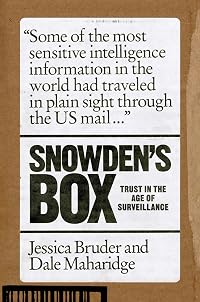
Snowden's Box: Trust in the Age of Surveillance
by Jessica Bruder, Dale Maharidge
On This Page
Description
"In the summer of 2013, the world was riveted by Edward Snowden's leak of millions of classified documents detailing the US government's massive and secret electronic surveillance program, in which the NSA had infiltrated tech companies, communication systems, emails and phones to spy on, among others, its own citizens. But this digital-age story had an analog side--Snowden mailed printed-out documents to the journalists Jessica Bruder and Dale Maharidge, who hid them in barrels, in an show more outhouse, and in a tree. Thus began an education in surveillance and counter-surveillance for these two experienced reporters, who were nonetheless completely ignorant about the lack of privacy they-and all of us-now have"-- show lessTags
Recommendations

























Member Recommendations
Member Reviews
This book does have a couple of instances of swearing.
It feels so wrong, yet so right to read this book.
If you think you've read and watched everything else related to Ed Snowden, then you're missing an important piece. The box. Which this book tells all about.
“the focus of our book was the human relationships that shepherded Snowden’s box — rather than the material inside”
How much of this story is actually true? That I don't know, but as the book mentions,
“systems are only as reliable as the people who operate them.
“When it all boils down to it,” he concluded, “it is all about personal trust.””
Stories are a great way to hook someone in, and it's interesting the approach that this book took.
““Thanks for making me show more laugh so hard,” Laura wrote to both of us the next day. It was the last time I’d laugh for a while.”
It's fascinating how the book is structured, telling the main story first, then adding details, then talking about US history and the future.
If you aren't interested in US history, or the US in general, then I feel you can finish the book once the author's dive into that. I felt they expanded too far away from “the box”, and they had to fill the book to be a certain number of pages.
“Society evolves when people can test boundaries and experiment with ways of living outside the mainstream. In a climate of total surveillance, such innovations would halt. The culture would stagnate and conformity would reign.”
“It also reflected what I consider to be one of the great lessons of adulthood: that most of the institutions and endeavors we regard as ironclad — from parenting to politics — are actually held together with chewing gum and duct tape. Nothing truly works, at least not for long, or not in the way it’s supposed to.” show less
It feels so wrong, yet so right to read this book.
If you think you've read and watched everything else related to Ed Snowden, then you're missing an important piece. The box. Which this book tells all about.
“the focus of our book was the human relationships that shepherded Snowden’s box — rather than the material inside”
How much of this story is actually true? That I don't know, but as the book mentions,
“systems are only as reliable as the people who operate them.
“When it all boils down to it,” he concluded, “it is all about personal trust.””
Stories are a great way to hook someone in, and it's interesting the approach that this book took.
““Thanks for making me show more laugh so hard,” Laura wrote to both of us the next day. It was the last time I’d laugh for a while.”
It's fascinating how the book is structured, telling the main story first, then adding details, then talking about US history and the future.
If you aren't interested in US history, or the US in general, then I feel you can finish the book once the author's dive into that. I felt they expanded too far away from “the box”, and they had to fill the book to be a certain number of pages.
“Society evolves when people can test boundaries and experiment with ways of living outside the mainstream. In a climate of total surveillance, such innovations would halt. The culture would stagnate and conformity would reign.”
“It also reflected what I consider to be one of the great lessons of adulthood: that most of the institutions and endeavors we regard as ironclad — from parenting to politics — are actually held together with chewing gum and duct tape. Nothing truly works, at least not for long, or not in the way it’s supposed to.” show less
Ratings
Members
- Recently Added By
Author Information

3 Works 1,597 Members
Jessica Bruder is an award-winning journalist whose work focuses on subcultures and the dark corners of the economy. She has written for Harper's Magazine, the New York Times, and the Washington Post. Bruder teaches at the Columbia School of Journalism.

13+ Works 695 Members
Dale Maharidge has been teaching at the Graduate School of Journalism at Columbia University since 2001. Before that he was a visiting professor at Stanford University for ten years and spent fifteen years as a newspaperman. He won the Pulitzer Prize for nonfiction in 1990 for his book And Their Children After Them.

Dale Maharidge is a LibraryThing Author, an author who lists their personal library on LibraryThing.
Classifications
- Genres
- Politics and Government, Nonfiction, Technology, General Nonfiction, History
- DDC/MDS
- 327.12730092 — Society, government, & culture Political science International Relations: Spies Foreign policy and specific topics in international relations Espionage and subversion North America United States
- LCC
- JF1525 .W45 .B78 — Political Science Political institutions and public administration Political institutions and public administration Public administration
- BISAC
Statistics
- Members
- 56
- Popularity
- 548,932
- Reviews
- 1
- Rating
- (4.00)
- Languages
- English
- Media
- Paper, Audiobook, Ebook
- ISBNs
- 5
- ASINs
- 3