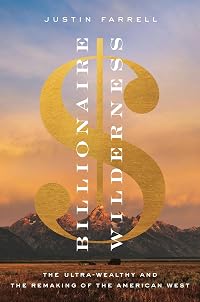
Billionaire Wilderness: The Ultra-Wealthy and the Remaking of the American West (Princeton Studies in Cultural Sociology)
by Justin Farrell
Princeton Studies in Cultural Sociology
On This Page
Description
This audiobook narrated by John Chancer takes you to Teton County, Wyoming, where the ultra-wealthy romanticize rural poverty and leverage the natural world to ascend even higher on the socioeconomic ladder Billionaire Wilderness takes you inside the exclusive world of the ultra-wealthy, showing how today's richest people are using the natural environment to solve the existential dilemmas they face. Justin Farrell spent five years in Teton County, Wyoming, the richest county in the United show more States, and a community where income inequality is the worst in the nation. He conducted hundreds of in-depth interviews, gaining unprecedented access to tech CEOs, Wall Street financiers, oil magnates, and other prominent figures in business and politics. He also talked with the rural poor who live among the ultra-wealthy and often work for them. The result is a penetrating account of the far-reaching consequences of the massive accrual of wealth, and an eye-opening and sometimes troubling portrait of a changing American West where romanticizing rural poverty and conserving nature can be lucrative-socially as well as financially. Weaving unforgettable storytelling with thought-provoking analysis, Billionaire Wilderness reveals how the ultra-wealthy are buying up the land and leveraging one of the most pristine ecosystems in the world to climb even higher on the socioeconomic ladder. The affluent of Teton County are people burdened by stigmas, guilt, and status anxiety-and they appropriate nature and rural people to create more virtuous and deserving versions of themselves. Incisive and compelling, Billionaire Wilderness reveals the hidden connections between wealth concentration and the environment, two of the most pressing and contentious issues of our time. show lessTags
Recommendations







Member Reviews
I usually go through life feeling very wealthy. I also generally think that I live in a beautiful place. It was hard to hold onto either of those feelings reading this book about billionaires in Wyoming.
This is a sociological study undertaken by a Yale professor in Teton County, Wyoming, the most economically disparate county in the nation. He speaks with the rich - the very, very rich - and, through interpreters via a social services organization, the poor as well.
It's repetitive, and he uses his favorite quotes and figures of speech over & over. "Razor-thin margins," "buzz-kill", etc. For a sociological report, it's a very good read; but you can tell he's not a professional author, which in a way is a good thing.
Here are the show more takeaways:
- Ultra-wealthy people use nature to increase their wealth (conservation i.e. NIMBYism) and prestige (the county is home to over a hundred non-profits).
They procure easements, protect their property from nearby development, and get brownie points among each other for starting foundations.
- Ultra-wealthy persons want very much for us all to think of them as "just folks." They dress down, and think of themselves as being chummy with the non-wealthy people in the community. I kept thinking of Stephen Colbert putting his arm around some unfortunate token, pointing at him with a big grin on his face. "Look, here's my Poor friend!"
- Through communing with nature, right outside their multi-million dollar homes, and hobnobbing with the lowly plebes, rich people attempt to achieve personal self-transformation.
- Their philanthropy is geared towards conservation and the arts. Helping out the poor of the community is kind of a "buzz kill" and doesn't get many of their dollars.
And then, doing all the grunt work to keep their kids fed, cars maintained, ski lifts operating, etc. is, surprise surprise, an underclass of Mexican immigrants. These guys really don't have much to say, good or bad, about their rich overlords - except that they are decidedly NOT pals. It's fine that they're wealthy. They probably worked hard and deserved it. Those of the working class are just trying to get by and it's all fine.
That is my impression by & large of how the interviews with the poor went down, though he does dig up people who express anger and wish to work for more systemic change.
Meanwhile, back in my modest, definitely sub-million-dollar home, living my middle class life in the overcrowded east, I achieve a certain humble self-transformation of my own... show less
This is a sociological study undertaken by a Yale professor in Teton County, Wyoming, the most economically disparate county in the nation. He speaks with the rich - the very, very rich - and, through interpreters via a social services organization, the poor as well.
It's repetitive, and he uses his favorite quotes and figures of speech over & over. "Razor-thin margins," "buzz-kill", etc. For a sociological report, it's a very good read; but you can tell he's not a professional author, which in a way is a good thing.
Here are the show more takeaways:
- Ultra-wealthy people use nature to increase their wealth (conservation i.e. NIMBYism) and prestige (the county is home to over a hundred non-profits).
They procure easements, protect their property from nearby development, and get brownie points among each other for starting foundations.
- Ultra-wealthy persons want very much for us all to think of them as "just folks." They dress down, and think of themselves as being chummy with the non-wealthy people in the community. I kept thinking of Stephen Colbert putting his arm around some unfortunate token, pointing at him with a big grin on his face. "Look, here's my Poor friend!"
- Through communing with nature, right outside their multi-million dollar homes, and hobnobbing with the lowly plebes, rich people attempt to achieve personal self-transformation.
- Their philanthropy is geared towards conservation and the arts. Helping out the poor of the community is kind of a "buzz kill" and doesn't get many of their dollars.
And then, doing all the grunt work to keep their kids fed, cars maintained, ski lifts operating, etc. is, surprise surprise, an underclass of Mexican immigrants. These guys really don't have much to say, good or bad, about their rich overlords - except that they are decidedly NOT pals. It's fine that they're wealthy. They probably worked hard and deserved it. Those of the working class are just trying to get by and it's all fine.
That is my impression by & large of how the interviews with the poor went down, though he does dig up people who express anger and wish to work for more systemic change.
Meanwhile, back in my modest, definitely sub-million-dollar home, living my middle class life in the overcrowded east, I achieve a certain humble self-transformation of my own... show less
I really wanted to rate this higher… content was good and super informative, nothing negative to say about that. The book itself- flow was not as smooth for me, felt almost textbook-y. Maybe my recent exodus from higher Ed has my perception skewed. Overall, important - yet terribly sad - information to know about how philanthropy is essentially a scam, how wealth is negatively impacting our ecosystem and environment, and how poverty in rural communities is perpetuated by greed. I would love to take this dudes class- whenever I return to being a student :)
Ratings
Members
- Recently Added By
Lists

University Presses
155 works; 1 member
Author Information

2 Works 125 Members
Some Editions
Series

Classifications
- Genres
- Economics, Sociology, Nonfiction, General Nonfiction, Science & Nature, History
- DDC/MDS
- 333.720978 — Society, government, & culture Economics Economics of land and energy Conservation, Alternative Energy Sources Conservation & protection Biography And History North America Western U.S.
- LCC
- HC107 .A17 .F37 — Social sciences Economic history and conditions Economic history and conditions By region or country
- BISAC
Statistics
- Members
- 113
- Popularity
- 287,944
- Reviews
- 2
- Rating
- (3.38)
- Languages
- English
- Media
- Paper, Audiobook, Ebook
- ISBNs
- 5
- ASINs
- 2