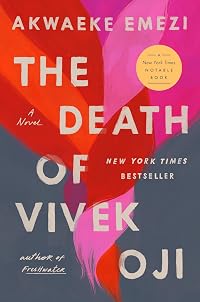
The Death of Vivek Oji
by Akwaeke Emezi
On This Page
Description
"A tender, potent, and compulsively readable novel of a Nigerian-Indian family and the deeply held secret that tests their traditions and bonds"--Tags
Recommendations
















Member Reviews
From the beginning, we know that a young person, Vivek Oji, has died. It then unfolds to tell the story of Vivek’s life, narrated by a number of voices of the people who interacted with Vivek – parents, aunt, uncle, cousin, friends, relationship partners, even strangers who view Vivek from a distance. It is a powerful story of identity.
It is set in Nigeria, a place that, like many other places around the world, is not particularly accepting of those who do not fit an “expected” identity. It is about a relationship that violates socially accepted boundaries. I found it heartbreaking that Vivek could not trust some of the people who were supposed to provide protection. At Vivek’s request, a close circle of friends agrees to show more keep secret some key aspects of their personality. These secrets, which propel the storyline, are eventually revealed.
It is a little more explicit and brutal than I typically can handle, but also inspires great empathy. I was initially wondering why Vivek’s voice is included, and eventually figured out that there is a spiritual reason. Just when I thought it had ended, there were two additional chapters that contain a surprise. I liked this even more than Freshwater. show less
It is set in Nigeria, a place that, like many other places around the world, is not particularly accepting of those who do not fit an “expected” identity. It is about a relationship that violates socially accepted boundaries. I found it heartbreaking that Vivek could not trust some of the people who were supposed to provide protection. At Vivek’s request, a close circle of friends agrees to show more keep secret some key aspects of their personality. These secrets, which propel the storyline, are eventually revealed.
It is a little more explicit and brutal than I typically can handle, but also inspires great empathy. I was initially wondering why Vivek’s voice is included, and eventually figured out that there is a spiritual reason. Just when I thought it had ended, there were two additional chapters that contain a surprise. I liked this even more than Freshwater. show less
Pet was my introduction to Akwaeke Emezi, and I fell in love with their creativity. Here, their prose has matured in leaps and bounds (which makes sense in a way, since Pet was YA), and they’ve included themes that I’ve found very challenging. Even if it wasn’t a book I particularly enjoyed, I found it a rewarding read.
Content warnings:
- rape & sexual assault
- incest (first cousins, also includes sex scenes)
- domestic abuse
- homophobia
- sexism & misogyny
Representation:
- most characters are Nigerian, and several are biracial
- Vivek is Nigerian and Indian, as well as gay and gender fluid
- Osita is a closeted gay/bi man
- other secondary characters are sapphic
Vivek Oji was born the day his grandmother died, and he carries the same show more starfish-shaped scar on his foot that she did, a possible sign of reincarnation. He grows up experiencing strange mysterious blackouts and periods of dissociation, but the only one who knows about it is his cousin, Osita.
Even as he gets older, more reclusive, more strange to his parents, and befriends the daughters of the “Nigerwives”, the foreign-born women who, like his own mother, married Nigerian men, he and Osita have the closest bond. But when their relationship deepens and transforms, and Vivek decides not to hide who is anymore outside of the home, his life is cut short.
The book is told in multiple PoVs, through the eyes of Vivek’s loved ones. It uses Vivek’s point of view maybe once or twice, when the emotional impact is highest. Even then, it’s maybe a few sentences. He’s meant to be a kind of enigmatic figure, his ambiguousness manifested through his illness that is neither named nor ever explained, the possible reincarnation, and his “odd” behavior that’s described by each PoV character.
Although I understand the reason for his mysteriousness (that he’s possibly the reincarnation of his grandmother), I don’t necessarily like the fact that part of it has to include an illness. But there could be cultural factors here that I’m not aware of, so that will be all I’ll say on it.
I’ll get to the incest in a bit, but one thing that did really bother me was the treatment of Elizabeth. Something happened to her when she was younger that was largely Vivek’s fault Vivek literally watched her and Osita have sex, without her consent, and then came into the room. . Vivek is considered blameless because he has those blackouts, but he still chose to spy on them! Then, much later, when they’re all older and Elizabeth is dating a woman (and it’s hinted at that she became a lesbian due to trauma, which is a mood), Vivek makes a dismissive comment about how Elizabeth should just be better or less traumatized from that childhood event. It’s weird how the book makes a sort of sinless being of Vivek, when we the readers can see, or at least I hope everyone is seeing, that he’s actually quite flawed.
But that might be the point. Even though everyone in the book seems to see him as a sort of angelic, larger-than-life creature, we can see him as a complete person--a completed picture through the eyes of everyone who loved him.
Everyone in this book is flawed, actually, and I love that. Osita in particular has flaws by the bucketful, and even though I didn’t really like him, I very much appreciated him as a character. He was written very well.
However, the wonderfully crafted characters hit a little bump when Vivek’s friends shows his parents pictures of him as he truly was, Vivek and Nnemndi, a gender fluid person.That night, Vivek’s mother denies it completely. She says things like, “he was sick”, “that’s not my son”, etc., but then the next day she has this passionate speech to her husband about trans rights. She then chips part of Vivek’s gravestone off with the hoe (is that even possible?), to include the name Nnemndi on his grave.
Okay, now before I end this thing, I’ll touch upon the incest. It’s a major part of this book. I’m not sure why, other than I remember seeing someone say that the author wanted you to be uncomfortable with it while you were reading and to almost examine that feeling a little bit. Well, they succeeded. I was definitely uncomfortable. I’m not sure, though, why incest is more normalized in the text than same-sex attraction. I know in other cultures that romance between first cousins isn’t considered incest, but I don’t think that’s the case with Igbo people (also side note, but WHAT was the deal with the leads having anal sex using spit as lube ??).
Despite my criticisms, this is a very good book. It just wasn’t an enjoyable one for me. However, I was so ecstatic to read a nonlinear plot! I was just talking to a friend about how much I needed that. show less
Content warnings:
- rape & sexual assault
- incest (first cousins, also includes sex scenes)
- domestic abuse
- homophobia
- sexism & misogyny
Representation:
- most characters are Nigerian, and several are biracial
- Vivek is Nigerian and Indian, as well as gay and gender fluid
- Osita is a closeted gay/bi man
- other secondary characters are sapphic
Vivek Oji was born the day his grandmother died, and he carries the same show more starfish-shaped scar on his foot that she did, a possible sign of reincarnation. He grows up experiencing strange mysterious blackouts and periods of dissociation, but the only one who knows about it is his cousin, Osita.
Even as he gets older, more reclusive, more strange to his parents, and befriends the daughters of the “Nigerwives”, the foreign-born women who, like his own mother, married Nigerian men, he and Osita have the closest bond. But when their relationship deepens and transforms, and Vivek decides not to hide who is anymore outside of the home, his life is cut short.
The book is told in multiple PoVs, through the eyes of Vivek’s loved ones. It uses Vivek’s point of view maybe once or twice, when the emotional impact is highest. Even then, it’s maybe a few sentences. He’s meant to be a kind of enigmatic figure, his ambiguousness manifested through his illness that is neither named nor ever explained, the possible reincarnation, and his “odd” behavior that’s described by each PoV character.
Although I understand the reason for his mysteriousness (that he’s possibly the reincarnation of his grandmother), I don’t necessarily like the fact that part of it has to include an illness. But there could be cultural factors here that I’m not aware of, so that will be all I’ll say on it.
I’ll get to the incest in a bit, but one thing that did really bother me was the treatment of Elizabeth. Something happened to her when she was younger that was largely Vivek’s fault
But that might be the point. Even though everyone in the book seems to see him as a sort of angelic, larger-than-life creature, we can see him as a complete person--a completed picture through the eyes of everyone who loved him.
Everyone in this book is flawed, actually, and I love that. Osita in particular has flaws by the bucketful, and even though I didn’t really like him, I very much appreciated him as a character. He was written very well.
However, the wonderfully crafted characters hit a little bump when Vivek’s friends shows his parents pictures of him as he truly was, Vivek and Nnemndi, a gender fluid person.
Okay, now before I end this thing, I’ll touch upon the incest. It’s a major part of this book. I’m not sure why, other than I remember seeing someone say that the author wanted you to be uncomfortable with it while you were reading and to almost examine that feeling a little bit. Well, they succeeded. I was definitely uncomfortable. I’m not sure, though, why incest is more normalized in the text than same-sex attraction. I know in other cultures that romance between first cousins isn’t considered incest, but I don’t think that’s the case with Igbo people (also side note, but WHAT was the deal with the leads having anal sex using spit as lube ??).
Despite my criticisms, this is a very good book. It just wasn’t an enjoyable one for me. However, I was so ecstatic to read a nonlinear plot! I was just talking to a friend about how much I needed that. show less
The book’s tragic premise is given from the beginning (as well as in the book’s title); the reader is aware from the first sentence that the protagonist meets a tragic fate, and so it isn’t really a spoiler to say this, and the story works in temporal circles, shifting back and forth in time, and through the other characters in the story (who knew and loved Vivek) to piece together the events that led to the death of Vivek.
Despite the familiar tragedy that marks almost all queer stories I’ve read, I truly appreciated the focus on community depicted in this novel. The world was and remains a cruel place for queer individuals, suffering being inevitable for a majority, and all of which should be portrayed in literature as works show more centering queer individuals and lives completely devoid of that suffering would be false, even when created as a reaction against this state of affairs. That being said, community, which is a source of sustenance, is rarely ever depicted in the queer stories I’ve read, which, I think, creates a different kind of falseness in these narratives. It is true that there are individuals who are so secluded and so isolated that they are eventually destroyed, since the goal of queer violence in its different levels and forms, from governments creating and enforcing punitive legislations to societal disowning and ostracization, is death (physical and social death) and erasure. Yet, the miraculous marvel that is community still exists, and the complexity of the dynamics within these communities is hardly ever present, and so it was refreshing to encounter it here. This was a good book: humorous, important, at times too sentimental for my taste, but a good book. show less
Despite the familiar tragedy that marks almost all queer stories I’ve read, I truly appreciated the focus on community depicted in this novel. The world was and remains a cruel place for queer individuals, suffering being inevitable for a majority, and all of which should be portrayed in literature as works show more centering queer individuals and lives completely devoid of that suffering would be false, even when created as a reaction against this state of affairs. That being said, community, which is a source of sustenance, is rarely ever depicted in the queer stories I’ve read, which, I think, creates a different kind of falseness in these narratives. It is true that there are individuals who are so secluded and so isolated that they are eventually destroyed, since the goal of queer violence in its different levels and forms, from governments creating and enforcing punitive legislations to societal disowning and ostracization, is death (physical and social death) and erasure. Yet, the miraculous marvel that is community still exists, and the complexity of the dynamics within these communities is hardly ever present, and so it was refreshing to encounter it here. This was a good book: humorous, important, at times too sentimental for my taste, but a good book. show less
"They burned down the market on the day Vivek Oji died"
It's no surprise that this is a heavy, sad story to read. But it's also brilliantly structured, filled with complex characters, and written in a style that breezes along.
Much of the book is concerned with Vivek's life growing up in Nigeria, but told predominantly through the eyes of characters around him (his parents, his cousin, his friends, etc). This puts the emphasis on how other people view his "strange" behavior, and that's kind of the point. How well do we really know someone, even someone so close? How well can we empathize with someone so "different" than us.
The structure is brilliant because we know that he's going to die the entire time, giving a layer of depth and show more emotion to all the scenes preceding this monumental event. Since it's a story centered around grief and loss, the moments of joy and life sprinkled throughout help show us characters in a different light and also highlight the sadness of Vivek's death. The story also jumps around in time, juxtaposing scenes post-death with events leading up to it. There's a lot of moving in time, a lot of moving pieces, and a lot of characters. And yet it all flows so well and I never felt lost, which speaks to the power of the story and the storyteller.
There's also a murder mystery element to the story, as Vivek's body is found naked and wrapped in a cloth on his parent's doorstep. This mystery deepens as we get closer to the end of the book, ultimately revealing itself in the final earth-shattering pages.
I'm speaking vaguely here. Yes, the death isn't a spoiler (it's in the title and the first line). But the shocking reasons behind it, as well as the complexities of the relationships and character dynamics in the book, should absolutely be experienced in the moment as you're reading. There's no way I could discuss it as well as the author writes it...so go read it! show less
It's no surprise that this is a heavy, sad story to read. But it's also brilliantly structured, filled with complex characters, and written in a style that breezes along.
Much of the book is concerned with Vivek's life growing up in Nigeria, but told predominantly through the eyes of characters around him (his parents, his cousin, his friends, etc). This puts the emphasis on how other people view his "strange" behavior, and that's kind of the point. How well do we really know someone, even someone so close? How well can we empathize with someone so "different" than us.
The structure is brilliant because we know that he's going to die the entire time, giving a layer of depth and show more emotion to all the scenes preceding this monumental event. Since it's a story centered around grief and loss, the moments of joy and life sprinkled throughout help show us characters in a different light and also highlight the sadness of Vivek's death. The story also jumps around in time, juxtaposing scenes post-death with events leading up to it. There's a lot of moving in time, a lot of moving pieces, and a lot of characters. And yet it all flows so well and I never felt lost, which speaks to the power of the story and the storyteller.
There's also a murder mystery element to the story, as Vivek's body is found naked and wrapped in a cloth on his parent's doorstep. This mystery deepens as we get closer to the end of the book, ultimately revealing itself in the final earth-shattering pages.
I'm speaking vaguely here. Yes, the death isn't a spoiler (it's in the title and the first line). But the shocking reasons behind it, as well as the complexities of the relationships and character dynamics in the book, should absolutely be experienced in the moment as you're reading. There's no way I could discuss it as well as the author writes it...so go read it! show less
Heartbreaking story of a young man, Vivek, who is exploring his sexuality. Vivek dies, and his mother tries to search for the truth of what happened to her beloved son. The novel gives the back story of Vivek's parents, his aunt, uncle, and cousin, and several of their friends. It gives hints of Vivek and his feelings and his love.
While we know that Vivek dies because of the title, it is the how he died which is so heartbreaking.
Beautifully written, with grief evident throughout.
While we know that Vivek dies because of the title, it is the how he died which is so heartbreaking.
Beautifully written, with grief evident throughout.
For various reasons I didn't get round to reading this book before its recent paperback publication, and I had very high expectations after Emezi's striking debut [b:Freshwater|38622676|Freshwater|Akwaeke Emezi|https://i.gr-assets.com/images/S/compressed.photo.goodreads.com/books/1540612309l/38622676._SY75_.jpg|56785192], which were mostly fulfilled. For me, this book was more of a slow burner, but by the end I found it very moving. Emezi acknowledges the influence of Marquez's [b:Chronicle of a Death Foretold|23878|Chronicle of a Death Foretold|Gabriel García Márquez|https://i.gr-assets.com/images/S/compressed.photo.goodreads.com/books/1553959324l/23878._SY75_.jpg|59137], and as in that book we know about the death of the central show more character from the start, but this book is much more personal - an exploration of the harsh realities of growing up in a homophobic and transphobic society like Nigeria. Another very impressive novel. show less
Members
- Recently Added By
Published Reviews
"... achingly beautiful probe into the challenges of living fully as a nonbinary human being, is an illuminating read."
added by jagraham684
Lists

Books Read in 2021
5,361 works; 114 members

Trans Lit
36 works; 1 member
Author Information

13+ Works 6,534 Members
Some Editions
Awards and Honors
Awards
Distinctions
Common Knowledge
- Canonical title
- The Death of Vivek Oji
- Original publication date
- 2020-08-04
- People/Characters
- Vivek; Osita
- Important places
- Nigeria
- Dedication
- To Franca, my first and best storytelling friend.
Don't ever forget Kurt's last name.
I love you lots.
Live free. - First words
- They burned down the market on the day Vivek Oji died.
- Last words
- (Click to show. Warning: May contain spoilers.)Somewhere, you see, in the river of time, I am already alive.
- Publisher's editor
- Morgan, Cal
- Blurbers
- Laymon, Kiese; Danticat, Edwidge
- Canonical DDC/MDS
- 823.92
- Canonical LCC
- PR9387.9.E42
Classifications
Statistics
- Members
- 1,381
- Popularity
- 17,205
- Reviews
- 48
- Rating
- (4.08)
- Languages
- 9 — Danish, English, Finnish, French, German, Polish, Portuguese, Spanish, Swedish
- Media
- Paper, Audiobook, Ebook
- ISBNs
- 27
- ASINs
- 5