On This Page
Description
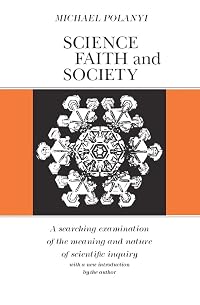
In its concern with science as an essentially human enterprise, Science, Faith and Society makes an original and challenging contribution to the philosophy of science. On its appearance in 1946 the book quickly became the focus of controversy.Polanyi aims to show that science must be understood as a community of inquirers held together by a common faith; science, he argues, is not the use of "scientific method" but rather consists in a discipline imposed by scientists on themselves in the show more interests of discovering an objective, impersonal truth. That such truth exists and can be found is part of the scientists' faith. Polanyi maintains that both authoritarianism and scepticism, attacking this faith, are attacking science itself. show lessTags
Recommendations








































Member Reviews
In this book, philosopher of science and eminent chemist Michael Polanyi warns, scientific inquiry cannot exist without a society and a culture that supports it. That is, science’s light can be extinguished if society decides to stamp it out. The freedom to learn about nature requires not only economic supports but also cultural supports. Writing just after the conclusion of World War II, he argues that scientific progress in Europe needs the foundation of a democratic society. He’s pessimistic about the ability of communist science because it lacks freedom, and despite Sputnik, history proved him correct on that point.
Interestingly, in a sort of postmodern way 30-40 years before postmodern thought, he describes the foundations of show more science as residing in communities. Science does not progress based on one authority figure but instead from personal knowledge dispersed through dialogue with one’s colleagues. Science’s communal foundations are made clear.
Since community and society play a central role in scientific inquiry, we must also consider the transcendent ideals of religious faith. Polanyi sees theism as compatible with scientific inquiry, which he defines as the determined pursuit of truth. Nonetheless, he eschews religious fundamentalism on the one hand and totalitarian nationalism on the other. He observes that some humans pursue power instead of truth – a fact I realize again and again when I read the newspapers. Although he acknowledges that some historical periods involve shedding prior dogmas, he does not view this nature as central to science’s identity. Rather, the dogged but free pursuit of truth remains.
He does not investigate the economic aspects of science, a realm I’m all too aware of in 21st century America. The pursuit of truth relies on economic funding to accomplish a community’s good, and 75 years after Polanyi described science as “personal knowledge,” team science requires coordinating individuals across many disciplines. His ideals from prior decades can seem slightly out of place in this environment. Nonetheless, I found the book encouraging and thought-provoking. His brilliant insights extend science beyond mere pragmatism. It also underscores the necessity for science to continue to advocate for societies across the globe to be based on liberty for all. show less
Interestingly, in a sort of postmodern way 30-40 years before postmodern thought, he describes the foundations of show more science as residing in communities. Science does not progress based on one authority figure but instead from personal knowledge dispersed through dialogue with one’s colleagues. Science’s communal foundations are made clear.
Since community and society play a central role in scientific inquiry, we must also consider the transcendent ideals of religious faith. Polanyi sees theism as compatible with scientific inquiry, which he defines as the determined pursuit of truth. Nonetheless, he eschews religious fundamentalism on the one hand and totalitarian nationalism on the other. He observes that some humans pursue power instead of truth – a fact I realize again and again when I read the newspapers. Although he acknowledges that some historical periods involve shedding prior dogmas, he does not view this nature as central to science’s identity. Rather, the dogged but free pursuit of truth remains.
He does not investigate the economic aspects of science, a realm I’m all too aware of in 21st century America. The pursuit of truth relies on economic funding to accomplish a community’s good, and 75 years after Polanyi described science as “personal knowledge,” team science requires coordinating individuals across many disciplines. His ideals from prior decades can seem slightly out of place in this environment. Nonetheless, I found the book encouraging and thought-provoking. His brilliant insights extend science beyond mere pragmatism. It also underscores the necessity for science to continue to advocate for societies across the globe to be based on liberty for all. show less
A treatise on the nature of scientific inquiry, arguing that scientists take as an article of faith that truth exists and can be discovered by scientific methods.There is also some material on science and its relation to society, and to different types of government. Dry stuff, but useful for certain college classes.
Ratings
Members
- Recently Added By
Author Information

27+ Works 2,187 Members
Series

Classifications
Statistics
- Members
- 208
- Popularity
- 155,287
- Reviews
- 2
- Rating
- (3.45)
- Languages
- English, Italian
- Media
- Paper, Ebook
- ISBNs
- 6
- ASINs
- 5