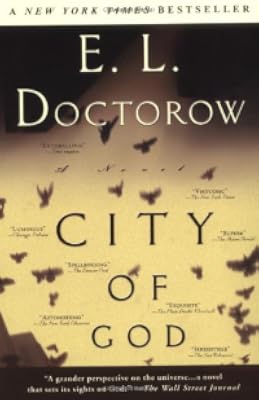
City of God
by E. L. Doctorow
On This Page
Description
NEW YORK TIMES BESTSELLERWith brilliant and audacious strokes, E. L. Doctorow creates a breathtaking collage of memories, events, visions, and provocative thought, all centered on an idea of the modern reality of God. At the heart of this stylistically daring tour de force is a detective story about a cross that vanishes from a rundown Episcopal church in lower Manhattan only to reappear on the roof of an Upper West Side synagogue. Intrigued by the mystery—and by the maverick rector show more and the young rabbi investigating the strange act of desecration—is a well-known novelist, whose capacious brain is a virtual repository for the ideas and disasters of the age.
Daringly poised at the junction of the sacred and the profane, filled with the sights and sounds of New York, and encompassing a large cast of vividly drawn characters including theologians, scientists, Holocaust survivors, and war veterans, City of God is a monumental work of spiritual reflection, philosophy, and history by America’s preeminent novelist and chronicler of our time.
Praise for City of God
“A grander perspective on the universe . . . a novel that sets its sights on God.”—The Wall Street Journal
“Dazzling . . . The true miracle of City of God is the way its disparate parts fuse into a consistently enthralling and suspenseful whole.”—Time
“Blooms with humor, and a humanity that carries triumphant as intelligent a novel as one might hope to find these days.”—Los Angeles Times
“Radiates [with] panoramic ambition and spiritual incandescence.”—Chicago Tribune
“One of the greatest American novels of the past fifty years . . . Reading City of God restores one’s faith in literature.”—The Houston Chronicle. show less
Tags
Recommendations













Member Reviews
St. Augustine receives retribution. Set in the Babel of NYC, a yearning soon-to-be-ex priest (who could only be Episcopal) can disassociate from his belief but not his need for it. This self-referential novel may be too ambitious but definitely is looking at the stars. Ruminating on our cosmology, and whether that is just another story we tell ourselves, and our history (whose story is always changing) the characters attempt to find their belief structure as the 20C comes to a pre-Apocalyptic end. Resembling a sacred text, the novel includes stories, songs, historical references, traditions and questions without definitive answers: the reader, as with all humanity, is responsible for imposing meaning, for finding signs and wonders, show more ourselves.
Pros: some lyrical passages, great lines, an imaginative premise and a whirlwind tour of the 20C, does a good job of incorporating current cosmic knowledge as it reverberates against age old questions — if God did not exist would we have to invent him, how do we keep re-inventing a deity to better serve present needs, what is the true nature of good vs evil?
Cons: one suspects NYC is the center of the universe for Doctorow, there is no inclusion of an Islamic character (I don’t think it makes sense to talk about Christianity and Judaism without Islam, at least in a supporting role), and while the novel has its moments and can be deeply appreciated on an abstract, intellectual level, there ends up being no real resonance, no emotional connection. Disclosure: I am not Jewish, do not love NYC, and am not old enough to remember the 60s, all of which may help its enjoyment. In some ways it tries to be a contemporary version of Dostoevsky’s ‘Diary of a Writer’. There is such a thin line between a work being deeply personal and being self-indulgent, and I wouldn’t profess to know what that line is myself, but I was left thinking the book could have been better than it was: perhaps a wildly inspired author needs a wildly inspired editor.
Ultimately, the novel is a reflection of sacred text: the reader will take what resonates with them and leave the rest behind. show less
Pros: some lyrical passages, great lines, an imaginative premise and a whirlwind tour of the 20C, does a good job of incorporating current cosmic knowledge as it reverberates against age old questions — if God did not exist would we have to invent him, how do we keep re-inventing a deity to better serve present needs, what is the true nature of good vs evil?
Cons: one suspects NYC is the center of the universe for Doctorow, there is no inclusion of an Islamic character (I don’t think it makes sense to talk about Christianity and Judaism without Islam, at least in a supporting role), and while the novel has its moments and can be deeply appreciated on an abstract, intellectual level, there ends up being no real resonance, no emotional connection. Disclosure: I am not Jewish, do not love NYC, and am not old enough to remember the 60s, all of which may help its enjoyment. In some ways it tries to be a contemporary version of Dostoevsky’s ‘Diary of a Writer’. There is such a thin line between a work being deeply personal and being self-indulgent, and I wouldn’t profess to know what that line is myself, but I was left thinking the book could have been better than it was: perhaps a wildly inspired author needs a wildly inspired editor.
Ultimately, the novel is a reflection of sacred text: the reader will take what resonates with them and leave the rest behind. show less
E.L. Doctorow's City of God is about -- well, everything. There's the obvious Augustinian reference in the title. There are treatises on the Big Bang and the effects of popular culture. There's a moving lament for the end of democratic media and art and the rise of corporate Hollywood. There's a Holocaust diary. There's a study of the turmoil evoked by the Vietnam War. There's even a mystery of a stolen cross (although E.L. Doctorow never reveals the solution). Throughout Doctorow intertwines his thoughts on fate and the nature of God and religion.
With so many disparate elements, City of God shouldn't hold together; yet, somehow it does. I guess it's a testament to Doctorow's genius that he accomplishes what should be the impossible and show more creates out of a patchwork of ideas a riveting novel. show less
With so many disparate elements, City of God shouldn't hold together; yet, somehow it does. I guess it's a testament to Doctorow's genius that he accomplishes what should be the impossible and show more creates out of a patchwork of ideas a riveting novel. show less
An amazingly sweeping novel, which somehow transcends all the post-modern clichés we encounter in it. A Episcopal priest with views somewhat too radical for church authorities meets two equally radical Jewish rabbis after vandalism and theft from his church. In a kaleidoscopic presentation which brings in the Creation, Wittgenstein (as characters), the holocaust, Viet Nam, the First World War, (amazingly, without ever seeming to over-reach) the plot explores issues of the place of faith in the late 20th century. A masterpiece, only slightly diminished by the happy rom-com style ending in which the right people end up married, and the even more conventional post-apocalyptic postscript.
Imagine Miles Davis, Janis Joplin and Peter Tchaikovsky getting together at Carnegie Hall for one big symphonic music jam.
Now imagine that syncopated, bluesy, baton-waving overture translated from musical notes to printed words on a page.
That’s City of God, the newest novel from E.L. Doctorow (Ragtime, Billy Bathgate).
It’s been six years since Doctorow published his last novel, The Waterworks. Six long years for fans like me. The wait has been well worth it.
City of God is at once typically Doctorow; yet, at the same time, it is unlike anything else I’ve read. Postmodern in style, it shimmers with thought and energy that fairly explodes off the page with symphonic crescendos. It's told in so many different voices that sometimes it show more can be difficult to navigate the wildly varying passages. My advice? Just hang on and enjoy the ride.
To give you some indication of how explosive Doctorow’s book is, the novel comes out of the starting gate with a meditation on the Big Bang theory. It goes uphill from there.
Let’s get one thing straight from the start: book jacket blurbs and marketing campaigns have pigeon-holed this novel in the “mysteryâÂ? category. Far from it. The only mystery in these pages centers around the deep questions of a soul in crisis, of a tiny human speck investigating a distant God.
Oh sure, thereâÂÂs a bit of detective work at the start of City of God. A large brass cross is stolen from St. TimothyâÂÂs, an Episcopal church in lower Manhattan, and somehow winds up on the roof of the Synagogue for Evolutionary Judaism on the Upper West Side. But that crime of desecration is just one small part of the book. ItâÂÂs a springboard for Doctorow to launch into a variety of other larger, heavier themes; and, just like a fat man bouncing off the end of a diving board (then miraculously doing a graceful swan dive), Doctorow somehow pulls it all off. Meanwhile, the diving board is still reverberating with a resonant thwacka-thwacka sound.
So, you ask, what is City of God about? Very simply, itâÂÂs about everything. Life, death, and all that jazz in between.
In these pages, youâÂÂll find a love triangle between an Episcopalian priest at the end of his faith, a female rabbi at the forefront of radical faith and a novelist who seems to have faith only in his words. ThereâÂÂs theological exegesis, movie plots, pop songs, poetry slams and numbered lists. There are smoky jazz clubs, Nazi death camps and World War I trenches. IâÂÂm only scratching the surface here, you understand.
DoctorowâÂÂs novel concentrates on thought, not plot. Nothing is linear, itâÂÂs all a fragmented hodgepodge of delirious language that eventually takes on a remarkable energy of its own.
Picture David Foster Wallace involved in a car crash with Don DeLillo, each of them on the way to their publishers with unbound manuscripts. And then, after the fenders are bent and the radiators are still hissing, imagine those two writers frantically scooping up their hopelessly shuffled and mixed pages. Those of you who have read Infinite Jest and UnderworldâÂÂtwo sprawling, layered novels by each of those gentlemenâÂÂwill start to guess at the scope IâÂÂm hinting at here. The mind boggles.
And thatâÂÂs one problem with City of God. There were times I got so boggled that I bogged down. Doctorow has long been known for being a writer with a lot on his mind. Here, thereâÂÂs so much that spills onto the page that it can be overwhelming. Some passages reminded me of those textbooks I had to plow through in the Religious Studies class I labored through back in college. If youâÂÂre the kind of person who can breeze through Tillich, Barth, Niebuhr or St. Augustine (obviously referenced by the bookâÂÂs title), then this should be light reading. Me? I waded through those deep waters with a blurred brain.
But when I emerged, dripping wet, oh what wonders awaited me! For every thick-worded exposition on divinity, Doctorow came surging back with a more accessible passage that thrilled me to the core.
I realize IâÂÂve come to the end of this review without giving any examples of the novelâÂÂs symphonic prose. What a crime! Words, after all, are DoctorowâÂÂs forte. Here, then, are just a few of my favorite passagesâ¦
The planet earth is blessed with water, great slops of it, swaying tonnage of saline ocean and sea, clear blue lakes and fish tremblant rivers, streams, brooks, rills, and pulsing springs, mountain runoffs, rains, mists, fogs, and hurricanes. At our birth billions of years ago, an amorphous heap of buzzingly radiant star spinoff, we melted inward to a core of iron and nickel, molten at its edges, and formed on top of this a hot rock mantle, and mineral crust. We began immediately to cool, thus creating enormous clouds of vapor, which rained down into the great craters and basins of rock until the seas were filled. The rock dissolved into soil, granulated into seabed, and the seabed granulates salinated and produced the first bubbling nitrogenized, oxygenized possibilities of blind, dumb life.
* * * * *
Lord, there is something so exhausted about the NY waterfront, as if the smell of the sea were oil, as if boats were buses, as if all heaven were a garage hung with girlie calendars, the months to come already leafed and fingered in black grease.
* * * * *
Or this vividly violent excerpt from the novelistâÂÂs âÂÂbiographyâÂ? of his father, a soldier in combat during World War I, rendered in free verse:
He stumbled over a young soldier lying
with the muzzle of his own rifle in his mouth
and his head resting in an amalgam
of brain and mud.
My father stopped and hunkered down and,
for the first time since coming to France,
felt close enough to someone to mourn him.
This boy had been unable to endure
the hours and hours of cannonade
that my father had barely heard
as he took upon himself the urgencies of battle.
But now it opened up on him, as if he were this fellowâÂÂs heir,
The terrible din, mechanical yet voiced as human,
a thunderous chest-beating boast of colossal,
spittingly cruel, brutish, and vindictive fury
which he imagined as the primordial conversation,
when a tank loomed above him, the muddied treads
rampaging in air,
and in a great grinding spankling roar
spanned the trench and brought a rain of oil
in the darkness upon him.
ItâÂÂs rousing word-music like that which brings me to my feet in an ovation. Bravo, Mr. Doctorow, bravo! show less
Now imagine that syncopated, bluesy, baton-waving overture translated from musical notes to printed words on a page.
That’s City of God, the newest novel from E.L. Doctorow (Ragtime, Billy Bathgate).
It’s been six years since Doctorow published his last novel, The Waterworks. Six long years for fans like me. The wait has been well worth it.
City of God is at once typically Doctorow; yet, at the same time, it is unlike anything else I’ve read. Postmodern in style, it shimmers with thought and energy that fairly explodes off the page with symphonic crescendos. It's told in so many different voices that sometimes it show more can be difficult to navigate the wildly varying passages. My advice? Just hang on and enjoy the ride.
To give you some indication of how explosive Doctorow’s book is, the novel comes out of the starting gate with a meditation on the Big Bang theory. It goes uphill from there.
Let’s get one thing straight from the start: book jacket blurbs and marketing campaigns have pigeon-holed this novel in the “mysteryâÂ? category. Far from it. The only mystery in these pages centers around the deep questions of a soul in crisis, of a tiny human speck investigating a distant God.
Oh sure, thereâÂÂs a bit of detective work at the start of City of God. A large brass cross is stolen from St. TimothyâÂÂs, an Episcopal church in lower Manhattan, and somehow winds up on the roof of the Synagogue for Evolutionary Judaism on the Upper West Side. But that crime of desecration is just one small part of the book. ItâÂÂs a springboard for Doctorow to launch into a variety of other larger, heavier themes; and, just like a fat man bouncing off the end of a diving board (then miraculously doing a graceful swan dive), Doctorow somehow pulls it all off. Meanwhile, the diving board is still reverberating with a resonant thwacka-thwacka sound.
So, you ask, what is City of God about? Very simply, itâÂÂs about everything. Life, death, and all that jazz in between.
In these pages, youâÂÂll find a love triangle between an Episcopalian priest at the end of his faith, a female rabbi at the forefront of radical faith and a novelist who seems to have faith only in his words. ThereâÂÂs theological exegesis, movie plots, pop songs, poetry slams and numbered lists. There are smoky jazz clubs, Nazi death camps and World War I trenches. IâÂÂm only scratching the surface here, you understand.
DoctorowâÂÂs novel concentrates on thought, not plot. Nothing is linear, itâÂÂs all a fragmented hodgepodge of delirious language that eventually takes on a remarkable energy of its own.
Picture David Foster Wallace involved in a car crash with Don DeLillo, each of them on the way to their publishers with unbound manuscripts. And then, after the fenders are bent and the radiators are still hissing, imagine those two writers frantically scooping up their hopelessly shuffled and mixed pages. Those of you who have read Infinite Jest and UnderworldâÂÂtwo sprawling, layered novels by each of those gentlemenâÂÂwill start to guess at the scope IâÂÂm hinting at here. The mind boggles.
And thatâÂÂs one problem with City of God. There were times I got so boggled that I bogged down. Doctorow has long been known for being a writer with a lot on his mind. Here, thereâÂÂs so much that spills onto the page that it can be overwhelming. Some passages reminded me of those textbooks I had to plow through in the Religious Studies class I labored through back in college. If youâÂÂre the kind of person who can breeze through Tillich, Barth, Niebuhr or St. Augustine (obviously referenced by the bookâÂÂs title), then this should be light reading. Me? I waded through those deep waters with a blurred brain.
But when I emerged, dripping wet, oh what wonders awaited me! For every thick-worded exposition on divinity, Doctorow came surging back with a more accessible passage that thrilled me to the core.
I realize IâÂÂve come to the end of this review without giving any examples of the novelâÂÂs symphonic prose. What a crime! Words, after all, are DoctorowâÂÂs forte. Here, then, are just a few of my favorite passagesâ¦
The planet earth is blessed with water, great slops of it, swaying tonnage of saline ocean and sea, clear blue lakes and fish tremblant rivers, streams, brooks, rills, and pulsing springs, mountain runoffs, rains, mists, fogs, and hurricanes. At our birth billions of years ago, an amorphous heap of buzzingly radiant star spinoff, we melted inward to a core of iron and nickel, molten at its edges, and formed on top of this a hot rock mantle, and mineral crust. We began immediately to cool, thus creating enormous clouds of vapor, which rained down into the great craters and basins of rock until the seas were filled. The rock dissolved into soil, granulated into seabed, and the seabed granulates salinated and produced the first bubbling nitrogenized, oxygenized possibilities of blind, dumb life.
* * * * *
Lord, there is something so exhausted about the NY waterfront, as if the smell of the sea were oil, as if boats were buses, as if all heaven were a garage hung with girlie calendars, the months to come already leafed and fingered in black grease.
* * * * *
Or this vividly violent excerpt from the novelistâÂÂs âÂÂbiographyâÂ? of his father, a soldier in combat during World War I, rendered in free verse:
He stumbled over a young soldier lying
with the muzzle of his own rifle in his mouth
and his head resting in an amalgam
of brain and mud.
My father stopped and hunkered down and,
for the first time since coming to France,
felt close enough to someone to mourn him.
This boy had been unable to endure
the hours and hours of cannonade
that my father had barely heard
as he took upon himself the urgencies of battle.
But now it opened up on him, as if he were this fellowâÂÂs heir,
The terrible din, mechanical yet voiced as human,
a thunderous chest-beating boast of colossal,
spittingly cruel, brutish, and vindictive fury
which he imagined as the primordial conversation,
when a tank loomed above him, the muddied treads
rampaging in air,
and in a great grinding spankling roar
spanned the trench and brought a rain of oil
in the darkness upon him.
ItâÂÂs rousing word-music like that which brings me to my feet in an ovation. Bravo, Mr. Doctorow, bravo! show less
This is one of those books that i feel inadequate to the task. It seems that lots of people praise this book and find it to be an extraordinary literary piece but i simply do not see it. I read 120 pages in and had little idea of what i was supposed to be taking away from it.
I have experienced this before. I recall being younger -pre-teen and teen- and reading books that i did not grok. I read them again later with new eyes and found them to be full of meaning. Is this what is happening here? Am i just too stunted or stuck or underdeveloped to understand?
Whether i am or not, whether i come back to this book in years to come and find some profound significance to it then, i cannot say. What i know is that right now i do not get it and do show more not care and cannot follow it. It seems a nearly random set of pieces that drift back and forth across time and space and philosophical realms leading me to shake my head, pinch my nose, and utter an exasperated huff.
Doctorow’s prose is still nice to read and some of the musings about the nature of god and the universe mixed with memoirs from a Jewish ghetto during WWII really are poetic and beautiful. I just can’t make heads nor tails of what the hell is happening. Where is the larger context? I vaguely understand that a rabbi and priest are working together to figure out the whys and wherefores of a large cross stolen from the catholic church coming to reside on the roof of a synagogue. Then there is a man having an affair… that’s about all i can glean.
So, maybe when i’ve gained another 20 years of life experience or buckle down to teach myself how to read literary novels like this, i will find Deep Meaning in these pages. Until then, i am moving on to other books that i hope to enjoy. show less
I have experienced this before. I recall being younger -pre-teen and teen- and reading books that i did not grok. I read them again later with new eyes and found them to be full of meaning. Is this what is happening here? Am i just too stunted or stuck or underdeveloped to understand?
Whether i am or not, whether i come back to this book in years to come and find some profound significance to it then, i cannot say. What i know is that right now i do not get it and do show more not care and cannot follow it. It seems a nearly random set of pieces that drift back and forth across time and space and philosophical realms leading me to shake my head, pinch my nose, and utter an exasperated huff.
Doctorow’s prose is still nice to read and some of the musings about the nature of god and the universe mixed with memoirs from a Jewish ghetto during WWII really are poetic and beautiful. I just can’t make heads nor tails of what the hell is happening. Where is the larger context? I vaguely understand that a rabbi and priest are working together to figure out the whys and wherefores of a large cross stolen from the catholic church coming to reside on the roof of a synagogue. Then there is a man having an affair… that’s about all i can glean.
So, maybe when i’ve gained another 20 years of life experience or buckle down to teach myself how to read literary novels like this, i will find Deep Meaning in these pages. Until then, i am moving on to other books that i hope to enjoy. show less
There are some brilliant parts, but overall the book is too "writerly" for its own good.
Doctorow plays with recursion and and overly meta premise, with a novelist trying to corral an unruly pile of notes and ideas into a single work. It's pretentious and a bit on the nose, as this is exactly what we are reading. There are multiple separate stories only tenuously related to each other, with historical figures ranging from Einstein to Wittgenstein speaking in the first person, to war stories, the holocaust, and a modern day heist/romance. Interspersed are musings about religion, NYC, and the universe, seemingly lifted straight from a late night dorm room discussion, as young adults struggle with Deep Thoughts and coming to grips with show more their place in the world for the first time.
Thus we teeter from profound to profane, from insightful to mundane, resonant to half-baked, astute observations to banal filler. All the literary tricks in the world can't hide the fact that there really isn't enough quality material here to create a cohesive or compelling story, let alone a whole novel. show less
Doctorow plays with recursion and and overly meta premise, with a novelist trying to corral an unruly pile of notes and ideas into a single work. It's pretentious and a bit on the nose, as this is exactly what we are reading. There are multiple separate stories only tenuously related to each other, with historical figures ranging from Einstein to Wittgenstein speaking in the first person, to war stories, the holocaust, and a modern day heist/romance. Interspersed are musings about religion, NYC, and the universe, seemingly lifted straight from a late night dorm room discussion, as young adults struggle with Deep Thoughts and coming to grips with show more their place in the world for the first time.
Thus we teeter from profound to profane, from insightful to mundane, resonant to half-baked, astute observations to banal filler. All the literary tricks in the world can't hide the fact that there really isn't enough quality material here to create a cohesive or compelling story, let alone a whole novel. show less
Apart from the passages on song and the "old standards" (which didn't really work for me), I was enthralled and mesmerized by the breadth and depth of this novel. There is some truly beautiful writing, especially in the story of Sarah Blumenthal's father's experience in the Lithuanian ghettos. But what really grabbed me was Doctorow's ability to seamlessly weave together a number of different narrative threads - Holocaust survival and the search for the perpetrators of war crimes, a crisis of religious faith, and a blossoming relationship - into a magnificent novel that is clearly more than the sum of its parts.
Members
- Recently Added By
Lists

1001 Books You Must Read Before You Die
1,448 works; 1,136 members
Talk Discussions
Past Discussions
Group Read, November 2017: City of God in 1001 Books to read before you die (November 2017)
Author Information

58+ Works 25,218 Members
E. L. (Edgar Lawrence) Doctorow was born on January 6, 1931, in the Bronx, New York. He received an A.B. in philosophy in 1952 from Kenyon College and did graduate work at Columbia University. He served in the U.S. Army Signal Corps from 1953-1955. He began his career as a script reader for CBS Television and Columbia Pictures and as a senior show more editor for the New American Library. He was editor-in-chief for Dial Press from 1964 to 1969, where he also served as vice president and publisher in his last year on staff. It was at this time that he decided to write full time. He wrote novels, short stories, essays, and a play. His debut novel, Welcome to Hard Times, was published in 1960 and was adapted into a film in 1967. His other works include, Loon Lake, The Waterworks, The March, Homer and Langley, and Andrew's Brain. He won the National Book Award for Fiction in 1986 for World's Fair and the National Book Critics Circle Award for fiction in 1976 for Ragtime, which was adapted into a film in 1981 and a Broadway musical in 1998. Billy Bathgate received the PEN/Faulkner Award, the National Book Critics Circle Award, and the William Dean Howells Medal in 1990. The Book of Daniel and Billy Bathgate were also adapted into films. He received the 2013 Medal for Distinguished Contribution to American Letters for his outstanding achievement in fiction writing. He died of complications from lung cancer on July 21, 2015 at the age of 84. (Bowker Author Biography) show less
Awards and Honors
Distinctions
Notable Lists
Work Relationships
Is contained in
Common Knowledge
- Canonical title
- City of God
- Original publication date
- 2000
- People/Characters
- Albert Einstein; Ludwig Wittgenstein
- Important places
- New York, New York, USA; Ulm, Germany; Lithuania
- Important events
- Holocaust; World War II; World War I
- Dedication
- to
Alison
Gabriel
Graylen
Annabel
and
TK - First words
- So the theory has it that the universe expanded exponentially from a point, a singular space/time point, a moment/thing, some original particulate event or quantum substantive happoenstance, to an extent that the word explosi... (show all)on is inadequate though the theory is known as the Big Bang,
- Quotations
- All history has contrived to pour this beer into my glass.
"We are not so flamboyant now, we have culture, real art hangs on the office walls...We know who Wittgenstein was." - Original language
- English
Classifications
Statistics
- Members
- 1,658
- Popularity
- 13,587
- Reviews
- 29
- Rating
- (3.44)
- Languages
- 9 — Dutch, English, French, German, Hungarian, Italian, Polish, Portuguese, Spanish
- Media
- Paper, Audiobook, Ebook
- ISBNs
- 32
- ASINs
- 8