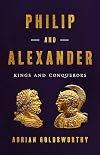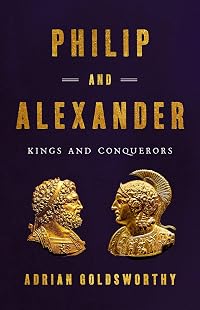
Philip and Alexander: Kings and Conquerors
by Adrian Goldsworthy
On This Page
Description
"Alexander the Great's conquests staggered the world. He led his army across thousands of miles, from northern Greece to modern Pakistan, overthrowing the greatest empires of his time and building a new one in their place. He led from the front and was often wounded. He claimed to be the son of a god, but he was actually the son of Philip II. In Philip and Alexander: Kings and Conquerors, classical historian Adrian Goldsworthy argues that without the work and influence of his father, it is show more very doubtful that Alexander would have achieved so much. Philip II of Macedon is often remembered as an old man, one-eyed and lame from wounds. But he was young and inexperienced when he came to power. Philip inherited a minor kingdom that was on the verge of being dismembered. He succeeded in making Macedonia dominant throughout Greece and preparing Alexander to lead his army into war against Persia. Philip, Goldsworthy shows, created the armies that won Alexander's victories. A bold new interpretation, Philip and Alexander will be the definitive dual biography of two men who together reshaped the ancient world."-- show lessTags
Recommendations







Member Reviews
A very insightful account of the reigns of Philip and Alexander, the two Macedonians who dominated Mediterranean history during the 4th century BC.
This may not be the most comprehensive account of Alexander's campaigns, but by setting Alexander's narrative against the backdrop of what Philip achieved, Goldsworthy convincingly shows the extent of Philip's influence on Alexander, not just through the army which he had set up, but in terms of Alexander's motivations, methods of governance and overall modus operandi. I also felt that Goldsworthy provided a refreshing lens on the well-known episodes of Alexander's life with his consideration of the ancient accounts based on what would be actually be pragmatic and plausible in the show more circumstances.
Goldsworthy really hammers home the point that we are so removed from the subjects here, not only in terms of passage of time and deficiencies of the source material, but also in terms of historical context and relateability. As a result, it is extremely difficult to understand what truly occurred as well as what the intentions were of these great personalities. Everything needs to be considered while maintaining an awareness of the realities of the time period, the potential biases of the sources, and the dangers of applying modern-day viewpoints to ancient personalities.
All in all, a well-researched and nuanced book which shows there are still new perspectives to be brought with respect to one of history's most celebrated commanders. show less
This may not be the most comprehensive account of Alexander's campaigns, but by setting Alexander's narrative against the backdrop of what Philip achieved, Goldsworthy convincingly shows the extent of Philip's influence on Alexander, not just through the army which he had set up, but in terms of Alexander's motivations, methods of governance and overall modus operandi. I also felt that Goldsworthy provided a refreshing lens on the well-known episodes of Alexander's life with his consideration of the ancient accounts based on what would be actually be pragmatic and plausible in the show more circumstances.
Goldsworthy really hammers home the point that we are so removed from the subjects here, not only in terms of passage of time and deficiencies of the source material, but also in terms of historical context and relateability. As a result, it is extremely difficult to understand what truly occurred as well as what the intentions were of these great personalities. Everything needs to be considered while maintaining an awareness of the realities of the time period, the potential biases of the sources, and the dangers of applying modern-day viewpoints to ancient personalities.
All in all, a well-researched and nuanced book which shows there are still new perspectives to be brought with respect to one of history's most celebrated commanders. show less
I picked this book up when I visited the Alexander myth and legend themed exhibition at the British Library. That exhibition was focused on the stories told of Alexander after his passing, from the ancient world to modern-day comics, novels, and television drama. This book is really not interested in any of that, but what's actually in the surviving ancient sources, and it plainly acknowledges where things are unclear. That's very evident in the chapters about Philip, and those were the chapters I probably found more interesting, because I haven't really read that much about him. The chapters on Alexander were on more familiar ground, but I think what this book succeeded doing was give a better idea of the passage of time on various show more campaigns. show less
The author is easily my favorite ancient history historian. His command of each subject, as well as his comprehensive and objective writing style, is second to none. His magisterial biography of Julius Caesar is, in my opinion, his best work and a must read.
This biography also is excellent in many ways. It is thorough, displays a deep understanding of the characters and context, and is refreshingly objective.
However, perhaps the scope of material is simply too vast. Philip or Alexander can easily be the subject of their own biography, hence an attempt to cover both In one work can be problematic. For example, it can be easy to get lost in the detail of either figure’s almost never ending military conquests or intrigues. More than once show more I felt my attention wander due to the volume of information imparted.
Perhaps sometimes less is more. I think that separate biographies would have allowed the author to better demonstrate his fantastic writing skills. Nevertheless, although quite a time commitment, this is a recommended read for those with interest. show less
This biography also is excellent in many ways. It is thorough, displays a deep understanding of the characters and context, and is refreshingly objective.
However, perhaps the scope of material is simply too vast. Philip or Alexander can easily be the subject of their own biography, hence an attempt to cover both In one work can be problematic. For example, it can be easy to get lost in the detail of either figure’s almost never ending military conquests or intrigues. More than once show more I felt my attention wander due to the volume of information imparted.
Perhaps sometimes less is more. I think that separate biographies would have allowed the author to better demonstrate his fantastic writing skills. Nevertheless, although quite a time commitment, this is a recommended read for those with interest. show less
Ratings
Members
- Recently Added By
Lists

THE WAR ROOM
813 works; 24 members

Dual Biographies
38 works; 1 member

Library Non-Fiction
164 works; 1 member

TBR Insta
81 works; 1 member
Author Information

41+ Works 9,322 Members
Adrian Goldsworthy is an award-winning historian of the classical world. He is the author of numerous books about ancient Rome, including Hadrian's Wall, Caesar, How Rome Fell, Pax Romana, and Augustus. Goldsworthy lives in South Wales.
Common Knowledge
- People/Characters
- Philip II of Macedon; Alexander the Great
- Important places
- Macedonia
- Blurbers
- Holland, Tom
Classifications
- Genres
- History, Nonfiction, Biography & Memoir, General Nonfiction
- DDC/MDS
- 938.070922 — History & geography History of ancient world (to ca. 499) Greece to 323 Greece to 323 Macedonian Supremacy (362-323 BC)
- LCC
- DF233.8 .A44 .G65 — History of Europe, Asia, Africa and Oceania Greece History of Greece History By period Macedonian epoch. Age of Philip. 359-336 B.C.
- BISAC
Statistics
- Members
- 320
- Popularity
- 99,633
- Reviews
- 3
- Rating
- (3.86)
- Languages
- 5 — Dutch, English, French, Polish, Spanish
- Media
- Paper, Audiobook, Ebook
- ISBNs
- 16
- ASINs
- 6