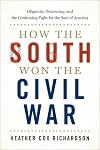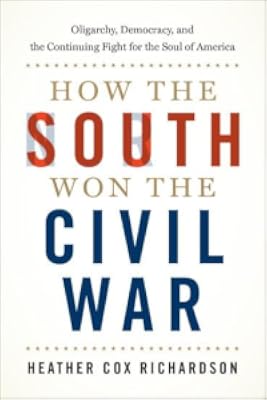
How the South Won the Civil War: Oligarchy, Democracy, and the Continuing Fight for the Soul of America
by Heather Cox Richardson
On This Page
Description
"While in the short term--militarily--the North won the Civil War, in the long term--ideologically--victory went to the South. The continual expansion of the Western frontier allowed a Southern oligarchic ideology to find a new home and take root. Even with the abolition of slavery and the equalizing power of the 13th, 14th, and 15th Amendments, and the ostensible equalizing of economic opportunity afforded by Western expansion, anti-democratic practices were deeply embedded in the country's show more foundations, in which the rhetoric of equality struggled against the power of money. As the settlers from the East pushed into the West, so too did all of its hierarchies, reinforced by the seizure of Mexican lands at the end of the Mexican-American War and violence toward Native Americans. Both the South and the West depended on extractive industries--cotton in the former and mining and oil in the latter--giving rise to the creation of a white business elite"-- show lessTags
Recommendations






Member Reviews
This is a clear-eyed retelling of US history focusing on the many step-by-step legal and economic maneuverings that condemned black and other people people of color to a lower caste. Richardson, a political historian, presents a variety of factors at multiple turning points that created the United States we know today, casting light particularly on the ever-growing chasm between the two political parties. It's a must read for anyone interested in how we got where we are now and how we might create a better future.
Oligarchic ideology based on racism and sexism runs deep in the intellectual history of the United States. As American historian and professor Heather Cox Richardson demonstrates, the battle between oligarchy and democracy did not end with the Civil War—in terms of the battle of ideas, the oligarchic South actually won.
The story begins with the US founders. For all their virtuous qualities, they couldn’t seem to fully transcend the biases of the times, supporting in various degrees the ideas of white supremacy, sexism, slavery, and divinely-inspired class hierarchies and concentrations of wealth and power (perhaps with the exception of Thomas Paine). Despite the rhetoric of equality found in The Declaration of Independence, once show more independence was won, inequality was swiftly built into the Constitution. As Richardson wrote:
“Without irony, Virginian James Madison crafted the Constitution to guarantee that wealthy slaveholders would control the new government. Under the new system, which counted slaves as three-fifths of a person for the purposes of representation, Virginia commanded an astonishing 21 electoral votes, 15.9 percent of the total votes in the Electoral College, the highest percentage of votes controlled by a single state in American history.”
If women and poor white men (without the necessary property qualifications) couldn’t vote, and black people were to remain property, and Indian rights were non-existent, in what sense can we say the country was founded on principles of equality? The idea that “all men are created equal” clearly meant all white men of property.
No wonder Abraham Lincoln had to turn to the Declaration, and to his own conscience, rather than to the Constitution in his fight against slavery. Lincoln’s evolving views and arguments against slavery escaped even the brilliance of the founders, many of which held slaves themselves. As Lincoln wrote:
“You say A. is white, and B. is black. It is color, then; the lighter, having the right to enslave the darker? Take care. By this rule, you are to be slave to the first man you meet, with a fairer skin than your own.
You do not mean color exactly?—You mean the whites are intellectually the superiors of the blacks, and, therefore have the right to enslave them? Take care again. By this rule, you are to be slave to the first man you meet, with an intellect superior to your own.
But, say you, it is a question of interest; and, if you can make it your interest, you have the right to enslave another. Very well. And if he can make it his interest, he has the right to enslave you.”
The irony is that Lincoln was right in that poor and working-class whites throughout history have, in a sense, become slaves to their economic superiors who have an interest in exploiting them for profit in return for low wages and minimal benefits. Lincoln may have prevailed, but the southern ideology was not defeated.
Richardson proceeds to show that, despite the Union victory, oligarchic ideas based on social hierarchies moved west, embodied in the image of the western cowboy as a rugged individualist that asked nothing of the government other than to be left alone. (Except that he asked a lot from the government when he needed help removing Indians or protecting property and the white male vote.)
The West ultimately joined forces with the South, as Richardson details, and the idea of rule by a wealthy majority morphed into the cornerstone of the modern Republican Party, which keeps the old oligarchic ideas alive and well via a repulsive combination of unfettered capitalism, social conservatism, and fundamentalist Christianity, propped up and perpetuated via conservative media outlets.
The real brilliance of Richardson’s book is that it shows how the oligarchy in this country has used the same tactics of persuasion to retain power since the very beginning. The rhetoric of twenty-first-century oligarchs is virtually indistinguishable from the rhetoric of the southern plantation owners of the 1850s.
The strategy is the same: win the poor and working-class white vote by telling them that evil minorities and women are stealing their jobs and wealth so that they never come to see that it is in fact the oligarchy that is rigging the economic system in their favor to siphon worker productivity into ever-higher profits for the wealthy (neatly demonstrated in our continuously rising levels of inequality and middle-class wage stagnation). In summary, people cannot unite economically if they are divided racially.
The strategy never seems to fail, because if poor white people can at least feel superior to minorities, they won’t revolt against the wealthy elite that are in reality the root of the problem. This is the divide-and-conquer strategy the right is well-known for using throughout history. Blame immigrants, the media, the left, the intellectual elite, anyone except the economic elite that push for steeper tax cuts and lower regulation (trickle-up economics).
The game plan simply hasn’t changed in over 150 years because, despite its shameful and exploitive history, the targets of this manipulation are not reading scholarly works in American history. If you ever wondered why leaders like Andrew Jackson and Donald Trump said things like “I love the uneducated,” it’s because they know the uneducated are more likely to fall for the rhetoric that will actually get them to vote against their own interests.
Will democracy survive yet another onslaught of oligarchic subordination? The question is open, but the choice is ours—we know the history and we know the fight. The question is, will we mobilize the vote and fight back, once again, against the same oligarchic ideology that simply refuses to die? show less
The story begins with the US founders. For all their virtuous qualities, they couldn’t seem to fully transcend the biases of the times, supporting in various degrees the ideas of white supremacy, sexism, slavery, and divinely-inspired class hierarchies and concentrations of wealth and power (perhaps with the exception of Thomas Paine). Despite the rhetoric of equality found in The Declaration of Independence, once show more independence was won, inequality was swiftly built into the Constitution. As Richardson wrote:
“Without irony, Virginian James Madison crafted the Constitution to guarantee that wealthy slaveholders would control the new government. Under the new system, which counted slaves as three-fifths of a person for the purposes of representation, Virginia commanded an astonishing 21 electoral votes, 15.9 percent of the total votes in the Electoral College, the highest percentage of votes controlled by a single state in American history.”
If women and poor white men (without the necessary property qualifications) couldn’t vote, and black people were to remain property, and Indian rights were non-existent, in what sense can we say the country was founded on principles of equality? The idea that “all men are created equal” clearly meant all white men of property.
No wonder Abraham Lincoln had to turn to the Declaration, and to his own conscience, rather than to the Constitution in his fight against slavery. Lincoln’s evolving views and arguments against slavery escaped even the brilliance of the founders, many of which held slaves themselves. As Lincoln wrote:
“You say A. is white, and B. is black. It is color, then; the lighter, having the right to enslave the darker? Take care. By this rule, you are to be slave to the first man you meet, with a fairer skin than your own.
You do not mean color exactly?—You mean the whites are intellectually the superiors of the blacks, and, therefore have the right to enslave them? Take care again. By this rule, you are to be slave to the first man you meet, with an intellect superior to your own.
But, say you, it is a question of interest; and, if you can make it your interest, you have the right to enslave another. Very well. And if he can make it his interest, he has the right to enslave you.”
The irony is that Lincoln was right in that poor and working-class whites throughout history have, in a sense, become slaves to their economic superiors who have an interest in exploiting them for profit in return for low wages and minimal benefits. Lincoln may have prevailed, but the southern ideology was not defeated.
Richardson proceeds to show that, despite the Union victory, oligarchic ideas based on social hierarchies moved west, embodied in the image of the western cowboy as a rugged individualist that asked nothing of the government other than to be left alone. (Except that he asked a lot from the government when he needed help removing Indians or protecting property and the white male vote.)
The West ultimately joined forces with the South, as Richardson details, and the idea of rule by a wealthy majority morphed into the cornerstone of the modern Republican Party, which keeps the old oligarchic ideas alive and well via a repulsive combination of unfettered capitalism, social conservatism, and fundamentalist Christianity, propped up and perpetuated via conservative media outlets.
The real brilliance of Richardson’s book is that it shows how the oligarchy in this country has used the same tactics of persuasion to retain power since the very beginning. The rhetoric of twenty-first-century oligarchs is virtually indistinguishable from the rhetoric of the southern plantation owners of the 1850s.
The strategy is the same: win the poor and working-class white vote by telling them that evil minorities and women are stealing their jobs and wealth so that they never come to see that it is in fact the oligarchy that is rigging the economic system in their favor to siphon worker productivity into ever-higher profits for the wealthy (neatly demonstrated in our continuously rising levels of inequality and middle-class wage stagnation). In summary, people cannot unite economically if they are divided racially.
The strategy never seems to fail, because if poor white people can at least feel superior to minorities, they won’t revolt against the wealthy elite that are in reality the root of the problem. This is the divide-and-conquer strategy the right is well-known for using throughout history. Blame immigrants, the media, the left, the intellectual elite, anyone except the economic elite that push for steeper tax cuts and lower regulation (trickle-up economics).
The game plan simply hasn’t changed in over 150 years because, despite its shameful and exploitive history, the targets of this manipulation are not reading scholarly works in American history. If you ever wondered why leaders like Andrew Jackson and Donald Trump said things like “I love the uneducated,” it’s because they know the uneducated are more likely to fall for the rhetoric that will actually get them to vote against their own interests.
Will democracy survive yet another onslaught of oligarchic subordination? The question is open, but the choice is ours—we know the history and we know the fight. The question is, will we mobilize the vote and fight back, once again, against the same oligarchic ideology that simply refuses to die? show less
A fascinating look at the history of our country, seen through the lens of the struggle between democracy and oligarchy. The hook is in her title, suggesting that the southern principles that drove us to civil war never left the country - they just moved to more fertile ground: the new territories of the west. Fundamental to this struggle is the continuous story line used by conservatives, that by supporting all of the people, including those at the bottom rungs of society, freedom is lost for other (white) Americans.
After the Civil War, many white southerners migrated west, and confederate ideology took on a new life. Over time, aided by a media free of equal-time obligations, this west-southern Conservative movement has come to show more dominate American politics.
This book is only 200 pages, but it is not a quick read. It covers all of American history in that short space, and the text is compact with information. If anyone wonders who would follow the likes of Donald Trump, or listen to Rush Limbaugh, this book is the book to read. These people have been a part of the American experiment from the start. show less
After the Civil War, many white southerners migrated west, and confederate ideology took on a new life. Over time, aided by a media free of equal-time obligations, this west-southern Conservative movement has come to show more dominate American politics.
This book is only 200 pages, but it is not a quick read. It covers all of American history in that short space, and the text is compact with information. If anyone wonders who would follow the likes of Donald Trump, or listen to Rush Limbaugh, this book is the book to read. These people have been a part of the American experiment from the start. show less
Whether it’s the pioneer, the yeoman farmer, or the cowboy, America’s iconic hero is believed to be a rugged individualist who was self-made. Heather Cox Richardson calls bulls#@$ on that label. Sure, pioneers, farmers, and cowboys are quintessential Americans. But how self-made were those people? We’re they individuals who made it on their own, or did they rely on some substantial help from outsiders?
According to American legend, the colonialist pioneer, the southern plantation owner, and the western rancher were all self-made warriors whose grit and effort paid off. Richardson contests that belief by pointing out that the colonialists needed substantial protection from the British army (from French and Natives), the southern show more plantation owner needed stolen labor and a police force to protect their “property,” and the rancher needed an extensive series of military forts to steal land from natives and Mexicans. Without massive government intervention projects like railroads, dams, military fort (and later bases), and racist law enforcement (like looking the other way when white settlers stole land and killed immigrants and natives), the economies of these “self-made” men (and they were mostly men) would never have survived.
So, why did the rugged individualist mythology arise? Richardson makes a compelling argument that the demonization of the government was a holdover from the antebellum era when rich slaveowners didn’t want the civil rights of others getting in their way of profit. After the Civil War, that mentality shifted to the West, where whites migrated, built capital, and then promoted the idea that they “deserved” their riches. Demonizing the government which made their wealth possible made sense, since democratic populations might see the hoarding, compare it to the little they received after their hard labor, and use taxes to reclaim their share. show less
According to American legend, the colonialist pioneer, the southern plantation owner, and the western rancher were all self-made warriors whose grit and effort paid off. Richardson contests that belief by pointing out that the colonialists needed substantial protection from the British army (from French and Natives), the southern show more plantation owner needed stolen labor and a police force to protect their “property,” and the rancher needed an extensive series of military forts to steal land from natives and Mexicans. Without massive government intervention projects like railroads, dams, military fort (and later bases), and racist law enforcement (like looking the other way when white settlers stole land and killed immigrants and natives), the economies of these “self-made” men (and they were mostly men) would never have survived.
So, why did the rugged individualist mythology arise? Richardson makes a compelling argument that the demonization of the government was a holdover from the antebellum era when rich slaveowners didn’t want the civil rights of others getting in their way of profit. After the Civil War, that mentality shifted to the West, where whites migrated, built capital, and then promoted the idea that they “deserved” their riches. Demonizing the government which made their wealth possible made sense, since democratic populations might see the hoarding, compare it to the little they received after their hard labor, and use taxes to reclaim their share. show less
The author makes a case that the culture and ideas of the south didn't die with the Civil War, they just moved west, and now have managed to become a dominant theme in the country. She traces the patriarchal, hierarchical, white-centered culture of the antebellum period through the post-war years, then into the boom years of the Golden Age, and beyond, culminating in the Reagan presidency which changed the face of politics. She examines popular culture and how it built the myth of the self-made independent cowboy, even as the government was funding much of the growth of the west and protecting the settlers (and cowboys) from each other and from anything else that attacked. Well written, erudite, and easy for a non-historian to read and show more follow. Talking heads should read this. show less
Don't know much about history, as the song goes. That song written a few years before this book's author (who I'll call HCR) was born. In part, this is because I went to school back when America was great (in the opinion of those who wish to make it great again) and much of the subject matter was taught in a way to emphasize America's greatness. We were also taught that we lived in a democracy, unlike, say, the Soviet Union, but also that we lived in a meritocracy. The obvious differences we saw all around us were attributed to the greater merit of the winners. Hierarchies in school were everywhere, from the academic (I did well) to the social (I did poorly) and were also clearly a part of the world outside of school. I was bullied in show more school and came to believe that the world outside was also run by the bullies though perhaps bullying with their money more often than with naked force.
If we see democracy as the alternative to authoritarianism, how do we deal with the democratic election of a bully? Do we doubt democracy? Or do we say it must not really be democracy if this happens? HCR would choose the latter. For her, the Trump presidency is an aspect of the South winning the Civil War. She historically traces present day voter suppression and movement conservatism to the confederacy. What we now find alarming is only the latest manifestation of many similar power grabs and attempted power grabs by oligarchs, starting with the minority of slave owning Southerners (they were even a minority in the South!) who saw themselves as better (as demonstrated by their success) and thus deserving to rule.
Yes, they lost the shooting war but won the peace because after Lincoln was assassinated, Andrew Johnson, a Southern Democrat succeeded him. Johnson tried to restore the nation to how it had been before the war, minus slavery which was replaced by laws passed in the South to keep the formerly enslaved people subservient.
The Democracy vs. Oligarchy lens through which to view American history is a powerful one and this is a powerful book but it has the drawback of too much good guys (pro Democracy) vs. bad guys (anti-D). There are arguments to be made that as governmental philosophies go, Democracy is bad (though Churchill may be right that all the others are worse). HCR's oligarchs are either greedy or grandiose--that is they are just out for themselves, or else think they're better than the others. Or a combination of the two. Many Trump voters saw themselves as rejecting the elite--the professional class who saw themselves as meritocrats. For them Trump represented true democracy. We can argue that they got the facts wrong or that they are low information voters, but then you might wonder if, perhaps those with low information shouldn't have the vote.
HCR would argue that the undemocratic (historically established to preserve slavery) electoral college put Trump into office and that Democracy as seen in the popular vote would have kept him (and Dubya) out.
At any rate--if we are to "heal" the polarization of this country--not seeing the other side as evil will be necessary. show less
If we see democracy as the alternative to authoritarianism, how do we deal with the democratic election of a bully? Do we doubt democracy? Or do we say it must not really be democracy if this happens? HCR would choose the latter. For her, the Trump presidency is an aspect of the South winning the Civil War. She historically traces present day voter suppression and movement conservatism to the confederacy. What we now find alarming is only the latest manifestation of many similar power grabs and attempted power grabs by oligarchs, starting with the minority of slave owning Southerners (they were even a minority in the South!) who saw themselves as better (as demonstrated by their success) and thus deserving to rule.
Yes, they lost the shooting war but won the peace because after Lincoln was assassinated, Andrew Johnson, a Southern Democrat succeeded him. Johnson tried to restore the nation to how it had been before the war, minus slavery which was replaced by laws passed in the South to keep the formerly enslaved people subservient.
The Democracy vs. Oligarchy lens through which to view American history is a powerful one and this is a powerful book but it has the drawback of too much good guys (pro Democracy) vs. bad guys (anti-D). There are arguments to be made that as governmental philosophies go, Democracy is bad (though Churchill may be right that all the others are worse). HCR's oligarchs are either greedy or grandiose--that is they are just out for themselves, or else think they're better than the others. Or a combination of the two. Many Trump voters saw themselves as rejecting the elite--the professional class who saw themselves as meritocrats. For them Trump represented true democracy. We can argue that they got the facts wrong or that they are low information voters, but then you might wonder if, perhaps those with low information shouldn't have the vote.
HCR would argue that the undemocratic (historically established to preserve slavery) electoral college put Trump into office and that Democracy as seen in the popular vote would have kept him (and Dubya) out.
At any rate--if we are to "heal" the polarization of this country--not seeing the other side as evil will be necessary. show less
Interesting and enlightening review of American history with the emphasis on the original American paradox of being a nation with an ideal of equality for all, while also being a slave holding nation with laws that inhibit the freedoms of a majority of its people and prevent multitudes of citizens from being a part of the "self" governance. To defend the idea that this isn't a paradox, but a right and natural social hierarchy, white male oligarchs have preached a consistent and disturbingly successful message that equality for all really means a loss of liberty.
It is super depressing to trace the current day conservative message that one of government's MAIN responsibilities is to protect property, back to the slave holders reasoning show more for attempting to destroy the United States and start the Civil War. The slave holders argued that the federal government should protect, not take away, their "property", the people they had enslaved, and because it wasn't doing that well enough, they did not want to be a part of the union. Thus it is even more disturbing, when during the current protests, and people are saying that the destruction of property during these protests is just as wrong as the police brutality and murder they are protesting, you see the same message equating black people to property.
Another piece that stuck out to me was about William F Buckley Jr and his arguments that, "American's faith in reasoned debate was a worse superstition than the superstitions the enlightenment had replaced... Rather than try to change people's beliefs through evidence based arguments, ... those opposed to the New Deal should stand firm on an orthodoxy of religion and individualism and refuse to accept any questioning of those two fundamental principals. Rather than making a reasoned argument that fairly presented other positions it (his book) misrepresented the positions of the professors with whom Buckley disagreed, claimed that the wealthy, highly educated Buckley was the member of a persecuted minority, and smeared supporters of the liberal consensus as communists and atheists. "
and
"The minority can override the wishes of the majority if the majority was wrong. "
It is frustrating to see these ideas on steroids through Donald Trump and a certain "news"/entertainment conglomerate that has no shame in using fake images, videos and lies to spread their divisive narrative.
The last bit that stuck with me, was her arguments about the notion of American individualism, how it is used by movement conservatives to preserve oligarchy, and how it is so pervasive in so many of mine and probably most American's favorite stories, books and movies. :( show less
It is super depressing to trace the current day conservative message that one of government's MAIN responsibilities is to protect property, back to the slave holders reasoning show more for attempting to destroy the United States and start the Civil War. The slave holders argued that the federal government should protect, not take away, their "property", the people they had enslaved, and because it wasn't doing that well enough, they did not want to be a part of the union. Thus it is even more disturbing, when during the current protests, and people are saying that the destruction of property during these protests is just as wrong as the police brutality and murder they are protesting, you see the same message equating black people to property.
Another piece that stuck out to me was about William F Buckley Jr and his arguments that, "American's faith in reasoned debate was a worse superstition than the superstitions the enlightenment had replaced... Rather than try to change people's beliefs through evidence based arguments, ... those opposed to the New Deal should stand firm on an orthodoxy of religion and individualism and refuse to accept any questioning of those two fundamental principals. Rather than making a reasoned argument that fairly presented other positions it (his book) misrepresented the positions of the professors with whom Buckley disagreed, claimed that the wealthy, highly educated Buckley was the member of a persecuted minority, and smeared supporters of the liberal consensus as communists and atheists. "
and
"The minority can override the wishes of the majority if the majority was wrong. "
It is frustrating to see these ideas on steroids through Donald Trump and a certain "news"/entertainment conglomerate that has no shame in using fake images, videos and lies to spread their divisive narrative.
The last bit that stuck with me, was her arguments about the notion of American individualism, how it is used by movement conservatives to preserve oligarchy, and how it is so pervasive in so many of mine and probably most American's favorite stories, books and movies. :( show less
Members
- Recently Added By
Lists

Top Five Books of 2020
982 works; 350 members

Must-Read Maine
146 works; 91 members

US White Christian Nationalism
24 works; 1 member

Books That Changed Our Perspective
423 works; 168 members
Author Information

11+ Works 2,179 Members
Heather Cox Richardson is Professor of History at Boston College. The author of West from Appomattox, The Greatest Nation of the Earth, and The Death of Reconstruction, she lives in Massachusetts.
Awards and Honors
Awards
Common Knowledge
- Canonical title
- How the South Won the Civil War: Oligarchy, Democracy, and the Continuing Fight for the Soul of America
- Important places
- USA; American South; American West
- Important events
- American Civil War
- Dedication
- For Buddy Poland
- First words
- (Introduction) The moment in July 1964 when Arizona Senator Barry Goldwater took the stage at the Cow Palace outside San Francisco and beamed at the cheering Republicans who had just nominated him for president is iconic--but... (show all) not for the reasons we remember.
(Chapter 1) The wonder and exciting sense of potential that would eventually create the American paradox was on full display at the Globe Theatre outside London's city gates in summer 1612. - Last words
- (Click to show. Warning: May contain spoilers.)Our country's peculiar history has kept the question open.
- Original language
- English
- Canonical DDC/MDS
- 306.20973
- Canonical LCC
- JK1717
Classifications
- Genres
- History, Nonfiction, General Nonfiction
- DDC/MDS
- 306.20973 — Society, government, & culture Social sciences, sociology & anthropology Social Behavior - Dating, Marriage, Divorce Political institutions Biography And History Political sociology--United States
- LCC
- JK1717 — Political Science Political institutions and public administration (United States) Political institutions and public administration United States Political rights. Practical politics
- BISAC
Statistics
- Members
- 588
- Popularity
- 50,033
- Reviews
- 14
- Rating
- (4.25)
- Languages
- English
- Media
- Paper, Audiobook, Ebook
- ISBNs
- 7
- ASINs
- 2