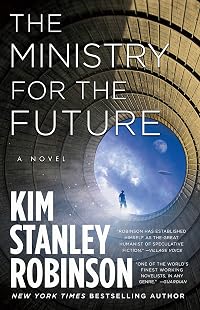
The Ministry for the Future
by Kim Stanley Robinson
On This Page
Description
"From legendary science fiction author Kim Stanley Robinson comes a vision of climate change unlike any ever imagined. Kim Stanley Robinson is one of contemporary science fiction's most acclaimed writers, and with this new novel, he once again turns his eye to themes of climate change, technology, politics, and the human behaviors that drive these forces. But his setting is not a desolate, post-apocalyptic world--rather, he imagines a more hopeful future, one where humanity has managed to show more overcome our challenges and thrive. It is a novel both immediate and impactful, perfect for his many fans and for readers who crave powerful and thought-provoking sci-fi stories"-- show lessTags
Recommendations





























Member Recommendations
Member Reviews
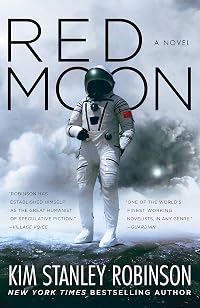
My relationship with KSR's books since the "Mars" Trilogy has been a mixed bag, and even with "Blue Mars" the didacticism of it all was starting to get to me. "Years of Salt and Rice" left me wondering what I had just read, and I just bounced off "2312" and "Red Moon." So, it was with a certain sense of grim determination that I approached this novel, but I figured that if anyone was going to tackle the "Long Emergency" in the depth it deserves it was going to be KSR, and, you know, the man didn't let me down.
Sure, all the issues that people have had with Robinson's writing are still in play, but in giving you a vision of how coping with world climate disaster might play out in a relatively positive way, while at the same time assuming show more the orneriness of events as a constant, this is the current gold standard for near-term science fiction and the most important issue facing human survival; apart from World War III. In that respect, the book might be a little too optimistic! I suspect that what makes this book work in the end is the character of Mary Murphy, a hard-headed international official who approaches her job as being the bearer of bad news and hard solutions with real vim and vigor. show less
Sure, all the issues that people have had with Robinson's writing are still in play, but in giving you a vision of how coping with world climate disaster might play out in a relatively positive way, while at the same time assuming show more the orneriness of events as a constant, this is the current gold standard for near-term science fiction and the most important issue facing human survival; apart from World War III. In that respect, the book might be a little too optimistic! I suspect that what makes this book work in the end is the character of Mary Murphy, a hard-headed international official who approaches her job as being the bearer of bad news and hard solutions with real vim and vigor. show less
i loved this. loosely, an novel of environmental sf, built around the implementation of a set of blueprints for dealing with climate change across the next forty years or so, set into motion here by a deadly heat disaster in India in 2025. it's passionate, it's filled with ideas, and it never loses focus - or hope. Robinson's clear-sighted views on the urgency of climate change, a feature of his long career, are tempered by his humanist outlook and his kind of heartwarming confidence that real change is yet possible even at this point in time. it involves changing the culture, the world economy, the political climate, and the harnessing of applied science, but he makes it feel not only possible but actually doable, instead of yielding show more to the inevitability of a massively dystopian result. show less
I think the UN should immediately set up a Ministry for the Future and make Kim Stanley Robinson head of it. His vision for humankind's way out of the mess of climate disruption that we have caused seems to me like it would work. Something certainly needs to be done as the time for keeping global warming in check is rapidly waning.
The book opens with a disturbing few chapters about a heat wave that occurs in India. Frank May, an American working in a remote area of India, tries to help the people survive the hellish temperatures. As more and more people die he and the survivors head to the lake nearby but it is so hot that really isn't a solution. When some relief workers finally make it to the town about a week after the heat wave show more started Frank is the only person alive and he is just clinging to life. Although he physically gets better he suffers from severe PTSD. When he ends up living in Zurich where the newly established Ministry for the Future is headquartered he becomes convinced that they need to engage in some eco-terrorism. He kidnaps Mary Murphy, the head of the Minstry, and holds her in her apartment while he conveys his thoughts. Eventually, this being Switzerland, police arrive at Mary's door and arrest Frank. But his thoughts have given Mary something to think about and she asks Badim, her second-in-command, what he thinks only to find that there is a secret side of the Ministry overseen by Badim that has engaged in some activities like what Frank was espousing. There are many other arrows in the Ministry's quiver from economic incentives to keep fossil fuels in the ground to supporting research to stop Antarctica's and Greenland's glaciers melting to rewilding areas of the planet not suited to agriculture and so many more initiatives. The first big step though is to keep the fossil fuels in the ground. The idea of paying companies and states who own reserves to not drill or mine them seems revolutionary but Robinson sets the groundwork with economic lessons that even I could understand. Of course, the transition was not smooth and there were persons and entitities violently opposed. Tatiana, one of the top Ministry officials, was killed. Mary had to have round the clock protection herself. But the big story succeeds and, interspersed with the narrative, are little stories about ordinary people's lives being transformed.
One of the things this story shows is how interconnected people and countries are. The fight against climate change also has to be a fight against poverty and racism and oligarchies in order for anything to improve. show less
The book opens with a disturbing few chapters about a heat wave that occurs in India. Frank May, an American working in a remote area of India, tries to help the people survive the hellish temperatures. As more and more people die he and the survivors head to the lake nearby but it is so hot that really isn't a solution. When some relief workers finally make it to the town about a week after the heat wave show more started Frank is the only person alive and he is just clinging to life. Although he physically gets better he suffers from severe PTSD. When he ends up living in Zurich where the newly established Ministry for the Future is headquartered he becomes convinced that they need to engage in some eco-terrorism. He kidnaps Mary Murphy, the head of the Minstry, and holds her in her apartment while he conveys his thoughts. Eventually, this being Switzerland, police arrive at Mary's door and arrest Frank. But his thoughts have given Mary something to think about and she asks Badim, her second-in-command, what he thinks only to find that there is a secret side of the Ministry overseen by Badim that has engaged in some activities like what Frank was espousing. There are many other arrows in the Ministry's quiver from economic incentives to keep fossil fuels in the ground to supporting research to stop Antarctica's and Greenland's glaciers melting to rewilding areas of the planet not suited to agriculture and so many more initiatives. The first big step though is to keep the fossil fuels in the ground. The idea of paying companies and states who own reserves to not drill or mine them seems revolutionary but Robinson sets the groundwork with economic lessons that even I could understand. Of course, the transition was not smooth and there were persons and entitities violently opposed. Tatiana, one of the top Ministry officials, was killed. Mary had to have round the clock protection herself. But the big story succeeds and, interspersed with the narrative, are little stories about ordinary people's lives being transformed.
One of the things this story shows is how interconnected people and countries are. The fight against climate change also has to be a fight against poverty and racism and oligarchies in order for anything to improve. show less
I've been thinking a lot recently about the need to construct a narrative of recovery from disaster, in order to have any hope for the future. My thoughts centred upon the pandemic and how normality as we knew it will never return, but perhaps we can move from emergency into rebuilding something different. The first step towards doing the latter is imagining it as a possibility and envisaging one day not being afraid to leave my home. I am thus attempting to avoid despair despite the truly disastrous state of the UK in January 2021. Racked by the new turbo-covid variant, hospitals overwhelmed, more than a hundred thousand dead in the pandemic and another thousand every day, the worst death rate in the world, in lockdown for the third show more time, economically crippled by brexit, ruled by a bunch of useless Tory goons who are responsible for it all. As I find Kim Stanley Robinson's books among the most hopeful I've ever read, 'The Ministry for the Future' seemed like it might help.
At first, it was just the opposite. In order to illustrate the horrors of climate change, the book opens with a truly terrifying account of a heatwave in India that kills twenty million people in a fortnight. I was thus punched in the face by my existential terror of climate change, which has been crowded to the side by my existential terror of the pandemic in recent times. It was not pleasant to be reminded that while covid dominates our lives, climate change continues to inexorably undermine the survival of human civilisation. It therefore took me a while to get through the first fifty pages, despite their undoubted readability. Once I'd reacquainted myself with this existential dread, and with the help of escapism in large doses, I found the rest of the book compulsive. I do not think it's science fiction, or at least doesn't read as such. Although there are characters and a narrative, as well as technological extrapolations, it felt more like [a:Francis Spufford|68301|Francis Spufford|https://images.gr-assets.com/authors/1468846664p2/68301.jpg]'s elision of fiction and non-. Except Spufford recounts history with judicious use of fictionalisation, whereas Stanley Robinson gives readers a detailed recovery narrative of the future. In [b:New York 2140|29570143|New York 2140|Kim Stanley Robinson|https://i.gr-assets.com/images/S/compressed.photo.goodreads.com/books/1471618737l/29570143._SY75_.jpg|49898123] he spoke directly to the reader, and in 'The Ministry for the Future' he does so still more insistently. This book sits you down, takes you by the shoulders, and says earnestly, "Listen to me. We are not doomed by climate change. There is hope for a better world. Do not despair."
The title of the book refers to an agency set up in Zürich under the auspices of the Paris Agreement, with limited budget and no statutory powers, with the purpose of representing the interests of future generations. It is led by Mary Murphy, who uses the UN agency's soft power to influence governments, banks, and businesses. She is a powerful figure, but still essentially a figurehead and co-ordinator. Kim Stanley Robinson is absolutely the last author to intimate that one person can save the world. Her point of view allows the reader to see the many ways to tackle climate change: geoengineering, renewable energy, financial reform, rewilding, transformation of agriculture, transport decarbonisation, and postcapitalist economics. As ever in his novels, Kim Stanley Robinson has a very impressive grasp of the material, beyond any other author I've come across. I discussed this with a friend who is currently reading [b:Blue Mars|77504|Blue Mars (Mars Trilogy, #3)|Kim Stanley Robinson|https://i.gr-assets.com/images/S/compressed.photo.goodreads.com/books/1429497319l/77504._SY75_.jpg|40711]. He has the trick of extrapolating with considered conviction across an incredible range of disciplines in both the hard and social sciences. Presumably he draws upon a network of experts, identifying key concepts and explaining them with great clarity. I have studied and taught carbon emissions mitigation in academia, so do not praise this lightly. I've read plenty of novels with flimsy and unconvincing economics, in particular. Kim Stanley Robinson synthesises and summarises environmental economics with a succinct accuracy that I can't fault. My knowledge of hard science, engineering, and technology is more limited, but I found his extrapolations almost entirely convincing. I remain sceptical of blockchain, as there's so much baseless hype around it. Nonetheless, I am willing to entertain the possibility that it may be useful if set up and managed as public infrastructure rather than for shareholder returns.
While impressively systematic and convincing, the depiction of technological change and geoengineering are not what make 'The Ministry for the Future' memorable. Obviously I appreciated the economics and the reckoning with bankers. What set this apart for me, from Kim Stanley Robinson's other novels as well other climate change fiction, is his depiction of the violent rage against the hyper-rich elite letting the planet burn. Mary shares protagonist duties with Frank May, who barely survives the catastrophic Indian heatwave and suffers from severe PTSD. He is a fascinating character, the exact opposite of all the men in so-called climate change novels that annoyed me with their self involvement (cf [b:Solar|7140754|Solar|Ian McEwan|https://i.gr-assets.com/images/S/compressed.photo.goodreads.com/books/1320510358l/7140754._SY75_.jpg|7404751], [b:The Lamentations of Zeno|25893848|The Lamentations of Zeno|Ilija Trojanow|https://i.gr-assets.com/images/S/compressed.photo.goodreads.com/books/1455505402l/25893848._SY75_.jpg|17780593]). Climate change has taken over his life and over decades the reader watches how this plays out. Unlike much climate change non-fiction (notably [b:The Future We Choose: Surviving the Climate Crisis|52117860|The Future We Choose Surviving the Climate Crisis|Christiana Figueres|https://i.gr-assets.com/images/S/compressed.photo.goodreads.com/books/1577771399l/52117860._SX50_SY75_.jpg|73597978]), Kim Stanley Robinson acknowledges and reckons with probably the main impediments to tackling climate change: oil companies and the super-rich. Moreover, he examines the question, unmentioned in any climate change non-fiction I've read, of whether killing a few super-rich is morally right in order to preserve billions of people alive and unborn. The answer is not simple and this book doesn't pretend that it is. I found the intensity of Frank's anger very easy to sympathise with - I am constantly seething with murderous rage at the destruction wrought by billionaires. The role of violence and sabotage in turning the world away from climate disaster is carefully judged throughout. Violence is shown to not usually be justified, yet can be effective in desperate situations. Although the Children of Kali and their direct violent actions are only an occasional presence in the narrative, their inclusion is important.Likewise, Frank's peaceful death in a hospice was very moving and a significant thing to include. It parallels Mary's later retirement, but mainly felt like a powerful reminder that all lives end. His death is tragic because it is undramatic; not self-sacrifice for the greater good, self-destruction, or violent tragedy. He dies slowly of cancer, as many do. I found this an effective reminder of the scale of a human life, amid discussion of whole populations and vast projects stretching over a hundred years.
I don't think 'The Ministry for the Future' works particularly well as a conventional novel, as it doesn't spend nearly as much time with its characters as [b:New York 2140|29570143|New York 2140|Kim Stanley Robinson|https://i.gr-assets.com/images/S/compressed.photo.goodreads.com/books/1471618737l/29570143._SY75_.jpg|49898123] or the Mars Trilogy. Although I found Mary and Frank interesting characters, their lives were entirely defined by climate change. This is absolutely not a complaint! The book works brilliantly as a manifesto, polemic, and a narrative of possibility. I cannot be the only person who is consumed by fear and despair about the future right now, and needs convincing, analytical, hopeful narratives to counter the blizzard of disasters that pass for current events. Unfortunately, even Kim Stanley Robinson's outstanding writing abilities cannot make much progress against my anxieties in 2021. [b:New York 2140|29570143|New York 2140|Kim Stanley Robinson|https://i.gr-assets.com/images/S/compressed.photo.goodreads.com/books/1471618737l/29570143._SY75_.jpg|49898123] definitely had a stronger positive impact on me back in 2017. Partly, it's the implication that his books are becoming more and more direct in their message because things are getting worse and worse. Will he write another like this but more so in a couple of years, if COP26 languishes? 'The Ministry for the Future' is adamant that there is still time to avoid runaway climate change and save civilisation. I would very much like to believe that, but am really struggling to at the moment. Lockdown life on Plague Island really doesn't lend itself to positivity. Still, I know that such narratives are important. Maybe I need to construct a personal narrative of becoming less anxious first, then I might be able to think about the climate change situation more clearly. show less
At first, it was just the opposite. In order to illustrate the horrors of climate change, the book opens with a truly terrifying account of a heatwave in India that kills twenty million people in a fortnight. I was thus punched in the face by my existential terror of climate change, which has been crowded to the side by my existential terror of the pandemic in recent times. It was not pleasant to be reminded that while covid dominates our lives, climate change continues to inexorably undermine the survival of human civilisation. It therefore took me a while to get through the first fifty pages, despite their undoubted readability. Once I'd reacquainted myself with this existential dread, and with the help of escapism in large doses, I found the rest of the book compulsive. I do not think it's science fiction, or at least doesn't read as such. Although there are characters and a narrative, as well as technological extrapolations, it felt more like [a:Francis Spufford|68301|Francis Spufford|https://images.gr-assets.com/authors/1468846664p2/68301.jpg]'s elision of fiction and non-. Except Spufford recounts history with judicious use of fictionalisation, whereas Stanley Robinson gives readers a detailed recovery narrative of the future. In [b:New York 2140|29570143|New York 2140|Kim Stanley Robinson|https://i.gr-assets.com/images/S/compressed.photo.goodreads.com/books/1471618737l/29570143._SY75_.jpg|49898123] he spoke directly to the reader, and in 'The Ministry for the Future' he does so still more insistently. This book sits you down, takes you by the shoulders, and says earnestly, "Listen to me. We are not doomed by climate change. There is hope for a better world. Do not despair."
The title of the book refers to an agency set up in Zürich under the auspices of the Paris Agreement, with limited budget and no statutory powers, with the purpose of representing the interests of future generations. It is led by Mary Murphy, who uses the UN agency's soft power to influence governments, banks, and businesses. She is a powerful figure, but still essentially a figurehead and co-ordinator. Kim Stanley Robinson is absolutely the last author to intimate that one person can save the world. Her point of view allows the reader to see the many ways to tackle climate change: geoengineering, renewable energy, financial reform, rewilding, transformation of agriculture, transport decarbonisation, and postcapitalist economics. As ever in his novels, Kim Stanley Robinson has a very impressive grasp of the material, beyond any other author I've come across. I discussed this with a friend who is currently reading [b:Blue Mars|77504|Blue Mars (Mars Trilogy, #3)|Kim Stanley Robinson|https://i.gr-assets.com/images/S/compressed.photo.goodreads.com/books/1429497319l/77504._SY75_.jpg|40711]. He has the trick of extrapolating with considered conviction across an incredible range of disciplines in both the hard and social sciences. Presumably he draws upon a network of experts, identifying key concepts and explaining them with great clarity. I have studied and taught carbon emissions mitigation in academia, so do not praise this lightly. I've read plenty of novels with flimsy and unconvincing economics, in particular. Kim Stanley Robinson synthesises and summarises environmental economics with a succinct accuracy that I can't fault. My knowledge of hard science, engineering, and technology is more limited, but I found his extrapolations almost entirely convincing. I remain sceptical of blockchain, as there's so much baseless hype around it. Nonetheless, I am willing to entertain the possibility that it may be useful if set up and managed as public infrastructure rather than for shareholder returns.
While impressively systematic and convincing, the depiction of technological change and geoengineering are not what make 'The Ministry for the Future' memorable. Obviously I appreciated the economics and the reckoning with bankers. What set this apart for me, from Kim Stanley Robinson's other novels as well other climate change fiction, is his depiction of the violent rage against the hyper-rich elite letting the planet burn. Mary shares protagonist duties with Frank May, who barely survives the catastrophic Indian heatwave and suffers from severe PTSD. He is a fascinating character, the exact opposite of all the men in so-called climate change novels that annoyed me with their self involvement (cf [b:Solar|7140754|Solar|Ian McEwan|https://i.gr-assets.com/images/S/compressed.photo.goodreads.com/books/1320510358l/7140754._SY75_.jpg|7404751], [b:The Lamentations of Zeno|25893848|The Lamentations of Zeno|Ilija Trojanow|https://i.gr-assets.com/images/S/compressed.photo.goodreads.com/books/1455505402l/25893848._SY75_.jpg|17780593]). Climate change has taken over his life and over decades the reader watches how this plays out. Unlike much climate change non-fiction (notably [b:The Future We Choose: Surviving the Climate Crisis|52117860|The Future We Choose Surviving the Climate Crisis|Christiana Figueres|https://i.gr-assets.com/images/S/compressed.photo.goodreads.com/books/1577771399l/52117860._SX50_SY75_.jpg|73597978]), Kim Stanley Robinson acknowledges and reckons with probably the main impediments to tackling climate change: oil companies and the super-rich. Moreover, he examines the question, unmentioned in any climate change non-fiction I've read, of whether killing a few super-rich is morally right in order to preserve billions of people alive and unborn. The answer is not simple and this book doesn't pretend that it is. I found the intensity of Frank's anger very easy to sympathise with - I am constantly seething with murderous rage at the destruction wrought by billionaires. The role of violence and sabotage in turning the world away from climate disaster is carefully judged throughout. Violence is shown to not usually be justified, yet can be effective in desperate situations. Although the Children of Kali and their direct violent actions are only an occasional presence in the narrative, their inclusion is important.
I don't think 'The Ministry for the Future' works particularly well as a conventional novel, as it doesn't spend nearly as much time with its characters as [b:New York 2140|29570143|New York 2140|Kim Stanley Robinson|https://i.gr-assets.com/images/S/compressed.photo.goodreads.com/books/1471618737l/29570143._SY75_.jpg|49898123] or the Mars Trilogy. Although I found Mary and Frank interesting characters, their lives were entirely defined by climate change. This is absolutely not a complaint! The book works brilliantly as a manifesto, polemic, and a narrative of possibility. I cannot be the only person who is consumed by fear and despair about the future right now, and needs convincing, analytical, hopeful narratives to counter the blizzard of disasters that pass for current events. Unfortunately, even Kim Stanley Robinson's outstanding writing abilities cannot make much progress against my anxieties in 2021. [b:New York 2140|29570143|New York 2140|Kim Stanley Robinson|https://i.gr-assets.com/images/S/compressed.photo.goodreads.com/books/1471618737l/29570143._SY75_.jpg|49898123] definitely had a stronger positive impact on me back in 2017. Partly, it's the implication that his books are becoming more and more direct in their message because things are getting worse and worse. Will he write another like this but more so in a couple of years, if COP26 languishes? 'The Ministry for the Future' is adamant that there is still time to avoid runaway climate change and save civilisation. I would very much like to believe that, but am really struggling to at the moment. Lockdown life on Plague Island really doesn't lend itself to positivity. Still, I know that such narratives are important. Maybe I need to construct a personal narrative of becoming less anxious first, then I might be able to think about the climate change situation more clearly. show less
The Ministry for the Future by Kim Stanley Robinson should be required reading for everyone. In particular, for those with economic and political power (send a copy to the people of your choice!). (And HE should be the governor of California, indeed President of the U.S., not Schwartzenaggar and Trump!)
“Easier to imagine the end of the world than the end of capitalism …” p25 And that’s the problem.
“Looking into plans to redirect fossil fuel companies to do decarbonization projects. Capabilities strangely appropriate. Extraction and injection both use same tech, just reversed.” p54 IS THAT TRUE? Then what the hell are we waiting for? “People, capital, facilities, capacities, all these can be used to ‘collect and inject’ show more either by way of cooperation or legal coercion. Keeps oil companies in business but doing good things.” p54
“But lawmakers are often lawyers themselves, notoriously bereft of ideas. Can we assume they get their ideas about law from others? … Think tanks. Academics. / Meaning MBA professors. … Economics departments.” p59 Yes. Right there. B students with no humanities knowledge, understanding, with no science knowledge, understanding run/create the world.
“The three richest people in the world possess more financial assets than all the people in the forty-eight poorest countries added together. The wealthiest one percent of the human population owns more than the bottom seventy percent.” p74
“Also, the two billion poorest people on the planet still lack access to basics like toilets, housing, food, health care, education, and so on.” p74
“…we can’t think in anything but economic terms, our ethics must be quantified …” p75
“GDP … consists of a combination of consumption, plus private investments, plus government spending, plus exports-minus-imports. Criticisms of GDP are many, as it includes destructive activities as positive economic numbers, and excludes many kinds of negative externalities … ” p75
And a wonderful conversation on p98-100 culminating in “There are about a hundred people walking this earth, who if you judge from the angle of the future … are mass murderers. If they started to die … Exile, then. Prisons … What if they woke up one day with no assets?”
“Arctic permafrost [contains] as much stored methane as all the Earth’s cattle would create and emit over six centuries, and this giant burp [the melting of the permafrost, already underway] would almost certainly push Earth over an irreversible tipping point into jungle planet mode …” p147
“The whole field and discipline of economics, by which we plan and justify what we do as a society, is simply riddled with absences, contradictions, logical flaws, and most important of all, false axioms and false goals. … Not profit, but biosphere health, should be the function solved for.” p166
” … many of the worst climate impacts will be irreversible. Extinctions and ocean warming can’t be fixed no matter how much money future people have, so economics as practised miss a fundamental aspect of reality.” p173
” … the heat wave, which was now said to have killed twenty million. As many people, in other words, as soldiers had died in World War One, a death toll which had taken four years of intensely purposeful killing; and the heat wave had taken only two weeks.” p227 “And yet still they burned carbon. They drove cars, ate meat, flew in jets, did all the things that had caused the heat wave and would cause the next one.” p228 How is it that so many people are so mentally deficient?
“Meanwhile the fossil fuel companies keep pouring vast sums into buying elections, politicians, media, and public opinion.” p250
“Then all those planes going down in one day [through sabotage]. … It killed the airline industry, more or less. That was ten percent of the carbon burn, gone in a single day.” p254 Desperate times call for desperate measures.
“… those few so rich that they could imagine surviving the crash of civilization, they and their descendants living on into some poorly imagined gated-community post-apocalypse in which servants and food and fuel and games would still be available to them.” p288-9 Poorly imagined, indeed.
“Help get us to the next world system. … Invent post-capitalism!” p317
“… a clear sign that macroeconomics as a field was ideological to the point of astrology … economics were still very skilled at ignoring outside criticisms of their field …” p343
“So until the climate was actually killing them, people had a tendency to deny it could happen.” p349 And yet, see above re the heat wave. So until it killed them themselves? How special do people think they are such that seeing it kill someone else is … irrelevant?
“In the corporate world I’ve read the average wage ratio is like one to five hundred. Actually that was the median; one to 1500 happens pretty often. The top executives in these companies earn in ten minutes what it takes their starting employees all year to earn … To hide the fact that they don’t actually do a thousand times more than their employees. Hiding like that, they won’t be normal. They’ll be bullshitters.” p383
” … would include American stupidity and hubris, and the assumption of being the world’s sole superpower, as one of their outstanding problems …” p483
“Woman as Other—when would that stop, them being as they were the majority of the species by many millions?” p483-4
“Stan back, get away, keep out; maybe try fishing for plastic rather than fish …” p484 show less
“Easier to imagine the end of the world than the end of capitalism …” p25 And that’s the problem.
“Looking into plans to redirect fossil fuel companies to do decarbonization projects. Capabilities strangely appropriate. Extraction and injection both use same tech, just reversed.” p54 IS THAT TRUE? Then what the hell are we waiting for? “People, capital, facilities, capacities, all these can be used to ‘collect and inject’ show more either by way of cooperation or legal coercion. Keeps oil companies in business but doing good things.” p54
“But lawmakers are often lawyers themselves, notoriously bereft of ideas. Can we assume they get their ideas about law from others? … Think tanks. Academics. / Meaning MBA professors. … Economics departments.” p59 Yes. Right there. B students with no humanities knowledge, understanding, with no science knowledge, understanding run/create the world.
“The three richest people in the world possess more financial assets than all the people in the forty-eight poorest countries added together. The wealthiest one percent of the human population owns more than the bottom seventy percent.” p74
“Also, the two billion poorest people on the planet still lack access to basics like toilets, housing, food, health care, education, and so on.” p74
“…we can’t think in anything but economic terms, our ethics must be quantified …” p75
“GDP … consists of a combination of consumption, plus private investments, plus government spending, plus exports-minus-imports. Criticisms of GDP are many, as it includes destructive activities as positive economic numbers, and excludes many kinds of negative externalities … ” p75
And a wonderful conversation on p98-100 culminating in “There are about a hundred people walking this earth, who if you judge from the angle of the future … are mass murderers. If they started to die … Exile, then. Prisons … What if they woke up one day with no assets?”
“Arctic permafrost [contains] as much stored methane as all the Earth’s cattle would create and emit over six centuries, and this giant burp [the melting of the permafrost, already underway] would almost certainly push Earth over an irreversible tipping point into jungle planet mode …” p147
“The whole field and discipline of economics, by which we plan and justify what we do as a society, is simply riddled with absences, contradictions, logical flaws, and most important of all, false axioms and false goals. … Not profit, but biosphere health, should be the function solved for.” p166
” … many of the worst climate impacts will be irreversible. Extinctions and ocean warming can’t be fixed no matter how much money future people have, so economics as practised miss a fundamental aspect of reality.” p173
” … the heat wave, which was now said to have killed twenty million. As many people, in other words, as soldiers had died in World War One, a death toll which had taken four years of intensely purposeful killing; and the heat wave had taken only two weeks.” p227 “And yet still they burned carbon. They drove cars, ate meat, flew in jets, did all the things that had caused the heat wave and would cause the next one.” p228 How is it that so many people are so mentally deficient?
“Meanwhile the fossil fuel companies keep pouring vast sums into buying elections, politicians, media, and public opinion.” p250
“Then all those planes going down in one day [through sabotage]. … It killed the airline industry, more or less. That was ten percent of the carbon burn, gone in a single day.” p254 Desperate times call for desperate measures.
“… those few so rich that they could imagine surviving the crash of civilization, they and their descendants living on into some poorly imagined gated-community post-apocalypse in which servants and food and fuel and games would still be available to them.” p288-9 Poorly imagined, indeed.
“Help get us to the next world system. … Invent post-capitalism!” p317
“… a clear sign that macroeconomics as a field was ideological to the point of astrology … economics were still very skilled at ignoring outside criticisms of their field …” p343
“So until the climate was actually killing them, people had a tendency to deny it could happen.” p349 And yet, see above re the heat wave. So until it killed them themselves? How special do people think they are such that seeing it kill someone else is … irrelevant?
“In the corporate world I’ve read the average wage ratio is like one to five hundred. Actually that was the median; one to 1500 happens pretty often. The top executives in these companies earn in ten minutes what it takes their starting employees all year to earn … To hide the fact that they don’t actually do a thousand times more than their employees. Hiding like that, they won’t be normal. They’ll be bullshitters.” p383
” … would include American stupidity and hubris, and the assumption of being the world’s sole superpower, as one of their outstanding problems …” p483
“Woman as Other—when would that stop, them being as they were the majority of the species by many millions?” p483-4
“Stan back, get away, keep out; maybe try fishing for plastic rather than fish …” p484 show less
The latest novel from science fiction's most prominent utopian is a clear-eyed look at our most dystopian problem, climate change. The book starts off with a bang in 2025, as an extreme heat wave kills twenty million people in northern India - in a single week. We experience the event with Frank May, an aid worker who becomes one of the few to survive temperature and humidity that exceed human endurance. The rest of Frank's life is darkened by post-traumatic symptoms from this horrific experience.
In Zurich, Switzerland the parties to the Paris Climate Accords set up a small agency charged with representing everyone not yet born. The Ministry for the Future is headed by Mary Murphy, the principal viewpoint character. Can her people show more reverse the ever-increasing greenhouse warming?
Mary's and Frank's stories supply through-lines, but this big book about a big subject takes a collage approach, with 106 chapters showing a wide range of viewpoints, usually of unnamed characters, many of whom appear just once. The Earth's people work to slow Antarctic-glacier loss, expand wildlife habitats, preserve fresh water, find homes for refugees, and reduce CO2 production. They are "inventing the parachute after leaping off the cliff," and fighting psychological denial more than physical forces. The readers see only bits of the entire story, maybe not even the most important bits. There are lots of infodumps. The book is also a tour guide to Switzerland, especially Zurich, where Robinson has lived at times.
Robinson employs his usual spare prose, free of obvious flourishes, even when depicting the worst of events. It's up to the reader to feel the awfulness of plain lines like "All the children were dead, all the old people were dead."
Writing at a grim moment, Robinson still dares to hope. Over several decades, the planet's arc bends in a somewhat better direction, the economy redesigned to value life over greed. The change is not driven by a few great men, but by all of us. I teared up at chapter 85, a four-page alphabetical listing of organizations introducing themselves at a meeting, each working on some aspect of saving the planet, the whole having the effect of some swelling chorus of inspiriting music. These groups don't exist now - but they could, right? Robinson is as unlike a 1920s sense-of-wonder, superscience SF writer as he could be, but the book still feels to me like one of those old, optimistic stories: immense difficulties overcome on the way to saving the universe.
One turning point occurs when the world's central bankers become convinced that they could not maintain the stability of their national currencies - their main job - after human extinction. They save the world to save the money. Robinson's idea is so absurd that I believe it, here in 2020. Terrorism also becomes important, though - some of the ultra-rich die in attacks on their airplanes and yachts, and most of them then decide cooperation beats death. Robinson asks whether nonviolence will be enough. Not a pleasant prospect, and one that, here in 2020, we may still hope to avoid.
The book is dense with ideas, programs, and organizations, some of which exist today. Here, an appendix of sources and links is missing and would be welcome. Works for Peter Watts, why not Robinson? A quick search doesn't turn up anything online.
Twenty years from now, we will wonder why we ever thought about anything but climate in the early 21st century. Will Robinson's hope be justified? I write this the weekend before the 2020 US election. show less
In Zurich, Switzerland the parties to the Paris Climate Accords set up a small agency charged with representing everyone not yet born. The Ministry for the Future is headed by Mary Murphy, the principal viewpoint character. Can her people show more reverse the ever-increasing greenhouse warming?
Mary's and Frank's stories supply through-lines, but this big book about a big subject takes a collage approach, with 106 chapters showing a wide range of viewpoints, usually of unnamed characters, many of whom appear just once. The Earth's people work to slow Antarctic-glacier loss, expand wildlife habitats, preserve fresh water, find homes for refugees, and reduce CO2 production. They are "inventing the parachute after leaping off the cliff," and fighting psychological denial more than physical forces. The readers see only bits of the entire story, maybe not even the most important bits. There are lots of infodumps. The book is also a tour guide to Switzerland, especially Zurich, where Robinson has lived at times.
Robinson employs his usual spare prose, free of obvious flourishes, even when depicting the worst of events. It's up to the reader to feel the awfulness of plain lines like "All the children were dead, all the old people were dead."
Writing at a grim moment, Robinson still dares to hope. Over several decades, the planet's arc bends in a somewhat better direction, the economy redesigned to value life over greed. The change is not driven by a few great men, but by all of us. I teared up at chapter 85, a four-page alphabetical listing of organizations introducing themselves at a meeting, each working on some aspect of saving the planet, the whole having the effect of some swelling chorus of inspiriting music. These groups don't exist now - but they could, right? Robinson is as unlike a 1920s sense-of-wonder, superscience SF writer as he could be, but the book still feels to me like one of those old, optimistic stories: immense difficulties overcome on the way to saving the universe.
One turning point occurs when the world's central bankers become convinced that they could not maintain the stability of their national currencies - their main job - after human extinction. They save the world to save the money. Robinson's idea is so absurd that I believe it, here in 2020. Terrorism also becomes important, though - some of the ultra-rich die in attacks on their airplanes and yachts, and most of them then decide cooperation beats death. Robinson asks whether nonviolence will be enough. Not a pleasant prospect, and one that, here in 2020, we may still hope to avoid.
The book is dense with ideas, programs, and organizations, some of which exist today. Here, an appendix of sources and links is missing and would be welcome. Works for Peter Watts, why not Robinson? A quick search doesn't turn up anything online.
Twenty years from now, we will wonder why we ever thought about anything but climate in the early 21st century. Will Robinson's hope be justified? I write this the weekend before the 2020 US election. show less
As always, Robinson's work is both interesting and irritating, because although he has some of the most intriguing ideas about various issues of our time, he has very little talent for characterization and action. Still, it's must read for those who want to hear what he says, which is usually so creative that it's very, very much worth the effort..
Robinson's Mars Trilogy (Red Mars, Green Mars, and Blue Mars) is still his masterpiece, but this is a close second. Here a small international agency, poorly funded and with little power, brainstorms ways to get Earth's population and governments to cooperate so that global climate change is reversed. CO2 levels have reached the upper 400s (we ourselves are in the lower 400s, so this is most show more timely). The book opens a few years into our future as a record heatwave strikes parts of India. With power cut off and no running water, millions die within a couple of days. A westerner who runs a clinic in a city in the area tries his best to care for his patients when the heat hits, first in the clinic and then with all of them joining the city's other residents in submerging themselves in the local river. But the river is no cooler than their body temperatures, and the following morning everyone in the city is dead except the westerner, who had had a few cups of water stored at the clinic which he had drunk himself. Still, he is close to death when he is found, with the river full of dead bodies.
This first chapter colors the rest of the book. The westerner is never the same and tries to find ways to wake up the world or, in the extreme, join a group in India which starts targeted strikes against high producers of CO2. Gas-guzzling planes and private jets are brought down, specific individuals are assassinated, and so on. India itself is shaken out of business-as-usual, a new government is elected, and the country proceeds with massive changes, beginning with filling the atmosphere with a darkening substance they think will reduce heat in India, and eventually the whole planet, for at least a few years. They proceed regardless of international disapproval.
A group works to ground Antarctica's glaciers to slow them down. A new type of currency is invented to reward those who don't use carbon, and world bankers agree to support it. Wide swaths of land, some thousands of miles long, are put aside worldwide to let animals find their own niches after years of interference by humans. New ways of eating (less animal culture) and agriculture are explored. Blimps are re-imagined to take the place of fossil fuel in aircraft. Large ships start adding sail and solar power. The threat of more violence by the climate vigilantes, who prove immune to capture, combined with new technologies and signs of success, encourage these changes around the world.
As I said, there is little characterization, so the ideas themselves become main actors in the book. Chapters alternate between descriptions of human activities and essays on the science and history of the theories Robinson is laying out. Firmly based on science, his ideas are always thought-provoking and usually leave the reader with some hope. Personally, I don't expect us to make it as a species, but I guess it's always possible with creative minds like Robinson's at work. show less
Robinson's Mars Trilogy (Red Mars, Green Mars, and Blue Mars) is still his masterpiece, but this is a close second. Here a small international agency, poorly funded and with little power, brainstorms ways to get Earth's population and governments to cooperate so that global climate change is reversed. CO2 levels have reached the upper 400s (we ourselves are in the lower 400s, so this is most show more timely). The book opens a few years into our future as a record heatwave strikes parts of India. With power cut off and no running water, millions die within a couple of days. A westerner who runs a clinic in a city in the area tries his best to care for his patients when the heat hits, first in the clinic and then with all of them joining the city's other residents in submerging themselves in the local river. But the river is no cooler than their body temperatures, and the following morning everyone in the city is dead except the westerner, who had had a few cups of water stored at the clinic which he had drunk himself. Still, he is close to death when he is found, with the river full of dead bodies.
This first chapter colors the rest of the book. The westerner is never the same and tries to find ways to wake up the world or, in the extreme, join a group in India which starts targeted strikes against high producers of CO2. Gas-guzzling planes and private jets are brought down, specific individuals are assassinated, and so on. India itself is shaken out of business-as-usual, a new government is elected, and the country proceeds with massive changes, beginning with filling the atmosphere with a darkening substance they think will reduce heat in India, and eventually the whole planet, for at least a few years. They proceed regardless of international disapproval.
A group works to ground Antarctica's glaciers to slow them down. A new type of currency is invented to reward those who don't use carbon, and world bankers agree to support it. Wide swaths of land, some thousands of miles long, are put aside worldwide to let animals find their own niches after years of interference by humans. New ways of eating (less animal culture) and agriculture are explored. Blimps are re-imagined to take the place of fossil fuel in aircraft. Large ships start adding sail and solar power. The threat of more violence by the climate vigilantes, who prove immune to capture, combined with new technologies and signs of success, encourage these changes around the world.
As I said, there is little characterization, so the ideas themselves become main actors in the book. Chapters alternate between descriptions of human activities and essays on the science and history of the theories Robinson is laying out. Firmly based on science, his ideas are always thought-provoking and usually leave the reader with some hope. Personally, I don't expect us to make it as a species, but I guess it's always possible with creative minds like Robinson's at work. show less
Members
- Recently Added By
Published Reviews
ThingScore 88
Le ministère du futur, son dernier livre, réunit en une impressionnante somme fiction et essai, économie politique, géo-ingénierie, luttes souterraines et empathie pour des personnages à notre image.
added by ninzilla
Robinson is a writer who believes fiction can make a difference to the world. His latest is a bold docu-fictional extrapolation of how humanity might tackle the climate crisis, blending practical ideas and information with vivid prose – the astonishing opening chapter, in which a heatwave kills millions, will stay with me for a very long time. Robinson knows we can’t be saved by a single show more heroic flourish but by difficult, drawn-out and, above all, collective labour. A crucial book for our time. show less
added by Cynfelyn
Robinson shows that an ambitious systems novel about global heating must in fact be an ambitious systems novel about modern civilisation too, because everything is so interdependent. Luckily, when he opens one of his discursive interludes with the claim “Taxes are interesting”, he makes good on it within two pages. There is no shortage of sardonic humour here, a cosmopolitan range of show more sympathies, and a steely, visionary optimism. show less
added by melmore
Lists

Best Science Fiction Novels
816 works; 430 members

Top Five Books of 2021
604 works; 181 members

Top Five Books of 2020
982 works; 350 members

Powell's 50 Books for 50 Years
50 works; 4 members

Speculative Fiction to Read
706 works; 32 members

Economist Books of the Year 2020
41 works; 5 members

The Five Books That Represent Us
391 works; 148 members

Obama Reads
181 works; 3 members

Books recommended by Barack Obama
295 works; 28 members

Barack Obama's Summer Reading List 2020
17 works; 5 members

Top Five Books of 2023
767 works; 317 members

Recommended Science-Fiction Books
40 works; 3 members

Books Read in 2023
5,547 works; 145 members
The Guardian Books of the Year 2020
126 works; 8 members

Books Read in 2022
5,168 works; 114 members

Books Read in 2021
5,361 works; 114 members

Grist Magazine's Definitive Climate Fiction Reading List
22 works; 2 members

Sarah's Wish List
48 works; 1 member

Books Read in 2020
4,379 works; 124 members
Favorite Science Fiction
456 works; 218 members
Author Information

139+ Works 49,449 Members
Kim Stanley Robinson was born in Orange County, California on March 23, 1952. He received a B. A. and Ph. D. from the University of California at San Diego and an M. A. from Boston University. His first trilogy of books, Orange County, collectively won a Nebula Award and two Hugo Awards. His other works include the Mars trilogy, 2312, and Aurora. show more He has won an Asimov Award, a World Fantasy Award, a Locus Reader's Poll Award, and a John W. Campbell Award. (Bowker Author Biography) show less
Some Editions
Awards and Honors
Awards
Common Knowledge
- Canonical title
- The Ministry for the Future
- Original title
- The Ministry for the Future
- Original publication date
- 2020-10-06
- Important places
- Zurich, Switzerland; India; Antarctica; New York, New York, USA; Pine Island, Florida, USA
- Dedication
- For Fredric Jameson
- First words
- It was getting hotter.
Frank May got off his mat and padded over to look out the window. Umber stucco walls and tiles, the color of the local clay. Square apartment blocks like the one he was in, rooftop patios occupie... (show all)d by residents who had moved up there in the night, it being too hot to sleep inside. Now quite a few of them were standing behind their chest-high walls looking east. -Chapter 1 - Last words
- (Click to show. Warning: May contain spoilers.)Because we never really come to the end.
- Publisher's editor
- Holman, Tim
- Blurbers
- Lethem, Jonathan; Klein, Ezra
- Original language
- English
- Canonical DDC/MDS
- 813.6
- Canonical LCC
- PS3568.O2893 M56
Classifications
Statistics
- Members
- 2,438
- Popularity
- 7,990
- Reviews
- 93
- Rating
- (3.79)
- Languages
- 9 — Dutch, English, French, German, Hungarian, Italian, Slovenian, Spanish, Swedish
- Media
- Paper, Audiobook, Ebook
- ISBNs
- 26
- ASINs
- 13