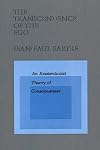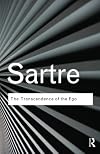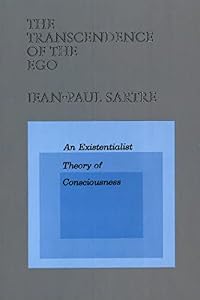
The Transcendence of the Ego: An Existentialist Theory of Consciousness
by Jean-Paul Sartre
On This Page
Description
First published in France in 1936 as a journal article, The Transcendence of the Ego was one of Jean-Paul Sartre's earliest philosophical publications. When it appeared, Sartre was still largely unknown, working as a school teacher in provincial France and struggling to find a publisher for his most famous fictional work, Nausea. The Transcendence of the Ego is the outcome of Sartre's intense engagement with the philosophy of Edmund Husserl, the founder of phenomenology. Here, as in many show more subsequent writings, Sartre embraces Husserl's vision of phenomenology as the proper method for philosophy. But he argues that Husserl's conception of the self as an inner entity, 'behind' conscious experience is mistaken and phenomenologically unfounded. The Transcendence of the Ego offers a brilliant diagnosis of where Husserl went wrong, and a radical alternative account of the self as a product of consciousness, situated in the world. This essay introduces many of the themes central to Sartre's major work, Being and Nothingness: the nature of consciousness, the problem of self-knowledge, other minds, anguish. It demonstrates their presence and importance in Sartre's thinking from the very outset of his career. This fresh translation makes this classic work available again to students of Sartre, phenomenology, existentialism, and twentieth century philosophy. It includes a thorough and illuminating introduction by Sarah Richmond, placing Sartre's essay in its philosophical and historical context. show lessTags
Recommendations
















Member Reviews
Most certainly I should not review this book.
If you respect all that is right in this world, turn away.
I’m about to show I have no idea what I’m talking about…
And yet something about this one compels me to write.
Thinking this might be a small road sign to leave behind.
A missive from a traveling mind…
Right out of the gate I feel like this short work is something that would probably have gone right over my head if I currently wasn’t triangulating with Sartre’s other works and the various introductions to those works. But damn this is a stiff 105 pages! Like telling someone looking for a short fiction read, “Sure, go read Pynchon’s Crying of Lot 49, it’s just over 100 pages… no worries.” Lost many students and show more friends with that one.
In Being and Nothingness Sartre states, “The first procedure of a philosophy ought to be to expel things from consciousness and to reestablish its true connection with the world, to know that consciousness is a positional consciousness of the world. All consciousness is positional in that it transcends itself in order to reach an object, and it exhausts itself in this same positing.”
It seems to me that one of Sartre’s main goals is to strip everything away from bare naked existence to find what is left at the core, and what seems to be left for Sartre is the pre-reflective cogito, or positional consciousness-of a transcendental object, or perhaps also as he states, pure appearance, which to me all speaks of a razor thin transaction of information passing (as appearance) from an object to a subject. The core of being for humans is this “empty” pre-reflective consciousness. Pure information intake. No contents in that core. Pure processing. Which I believe is why he sometimes refers to it as impersonal. Because the you that is processing (i.e., being consciousness-of something) is only an empty processing activity. All the pieces of you that you identify with yourself, your ego for example, lies outside this processing/apprehending. And this pure processing, this ur-existing, comes before any of piece of you, anything that might be considered your essence, comes into being.
To exist is first to be a consciousness-of.
This is why the ego can’t be seen hiding behind the I of consciousness.
The ego is transcendental, outside of consciousness.
But first there must be an “I exist” and that is known by being a consciousness-of even before one can reflect on the fact that they are indeed conscious.
For Sartre, consciousness-of is translucent, unclouded by states and qualities which are part of the reflected-consciousness or ego which is transcendental and outside.
Or something like that...
Sartre argues against theorists like Freud who think we are controlled and affected by the desires of the unconscious. For consciousness to be translucent, there can be no hidden area of desires or states that affect or color its apprehensions.
While I know what Sartre is trying to prove I’m not completely sure I agree with him on this point. It’s hard to see it having to be true that even if we strip the I back to only the consciousness-of that means that it necessarily has to be translucent and unaffected. Biology, information theory and particle physics would lead us to believe that genetics or prior experience as it has remapped neurons might affect the very manner in which consciousness-of is conscious of objects. At the very least Sartre’s assumptions are problematic when viewed in this greater arena.
Or I might not know what I’m talking about at all…
So it goes... show less
If you respect all that is right in this world, turn away.
I’m about to show I have no idea what I’m talking about…
And yet something about this one compels me to write.
Thinking this might be a small road sign to leave behind.
A missive from a traveling mind…
Right out of the gate I feel like this short work is something that would probably have gone right over my head if I currently wasn’t triangulating with Sartre’s other works and the various introductions to those works. But damn this is a stiff 105 pages! Like telling someone looking for a short fiction read, “Sure, go read Pynchon’s Crying of Lot 49, it’s just over 100 pages… no worries.” Lost many students and show more friends with that one.
In Being and Nothingness Sartre states, “The first procedure of a philosophy ought to be to expel things from consciousness and to reestablish its true connection with the world, to know that consciousness is a positional consciousness of the world. All consciousness is positional in that it transcends itself in order to reach an object, and it exhausts itself in this same positing.”
It seems to me that one of Sartre’s main goals is to strip everything away from bare naked existence to find what is left at the core, and what seems to be left for Sartre is the pre-reflective cogito, or positional consciousness-of a transcendental object, or perhaps also as he states, pure appearance, which to me all speaks of a razor thin transaction of information passing (as appearance) from an object to a subject. The core of being for humans is this “empty” pre-reflective consciousness. Pure information intake. No contents in that core. Pure processing. Which I believe is why he sometimes refers to it as impersonal. Because the you that is processing (i.e., being consciousness-of something) is only an empty processing activity. All the pieces of you that you identify with yourself, your ego for example, lies outside this processing/apprehending. And this pure processing, this ur-existing, comes before any of piece of you, anything that might be considered your essence, comes into being.
To exist is first to be a consciousness-of.
This is why the ego can’t be seen hiding behind the I of consciousness.
The ego is transcendental, outside of consciousness.
But first there must be an “I exist” and that is known by being a consciousness-of even before one can reflect on the fact that they are indeed conscious.
For Sartre, consciousness-of is translucent, unclouded by states and qualities which are part of the reflected-consciousness or ego which is transcendental and outside.
Or something like that...
Sartre argues against theorists like Freud who think we are controlled and affected by the desires of the unconscious. For consciousness to be translucent, there can be no hidden area of desires or states that affect or color its apprehensions.
While I know what Sartre is trying to prove I’m not completely sure I agree with him on this point. It’s hard to see it having to be true that even if we strip the I back to only the consciousness-of that means that it necessarily has to be translucent and unaffected. Biology, information theory and particle physics would lead us to believe that genetics or prior experience as it has remapped neurons might affect the very manner in which consciousness-of is conscious of objects. At the very least Sartre’s assumptions are problematic when viewed in this greater arena.
Or I might not know what I’m talking about at all…
So it goes... show less
Ratings
Members
- Recently Added By
Author Information

707+ Works 57,322 Members
Sartre is the dominant figure in post-war French intellectual life. A graduate of the prestigious Ecole Normale Superieure with an agregation in philosophy, Sartre has been a major figure on the literary and philosophical scenes since the late 1930s. Widely known as an atheistic proponent of existentialism, he emphasized the priority of existence show more over preconceived essences and the importance of human freedom. In his first and best novel, Nausea (1938), Sartre contrasted the fluidity of human consciousness with the apparent solidity of external reality and satirized the hypocrisies and pretensions of bourgeois idealism. Sartre's theater is also highly ideological, emphasizing the importance of personal freedom and the commitment of the individual to social and political goals. His first play, The Flies (1943), was produced during the German occupation, despite its underlying message of defiance. One of his most popular plays is the one-act No Exit (1944), in which the traditional theological concept of hell is redefined in existentialist terms. In Red Gloves (Les Mains Sales) (1948), Sartre examines the pragmatic implications of the individual involved in political action through the mechanism of the Communist party and a changing historical situation. His highly readable autobiography, The Words (1964), tells of his childhood in an idealistic bourgeois Protestant family and of his subsequent rejection of his upbringing. Sartre has also made significant contributions to literary criticism in his 10-volume Situations (1947--72) and in works on Baudelaire, Genet, and Flaubert. In 1964 he was awarded the Nobel Prize in Literature and refused it, saying that he always declined official honors. (Bowker Author Biography) show less
Common Knowledge
- Canonical title*
- Het ik is een ding
- Original publication date
- 1937
*Some information comes from Common Knowledge in other languages. Click "Edit" for more information.
Classifications
Statistics
- Members
- 543
- Popularity
- 54,529
- Reviews
- 1
- Rating
- (3.62)
- Languages
- 11 — Danish, Dutch, English, Finnish, French, German, Italian, Polish, Portuguese, Spanish, Swedish
- Media
- Paper, Ebook
- ISBNs
- 24
- ASINs
- 13