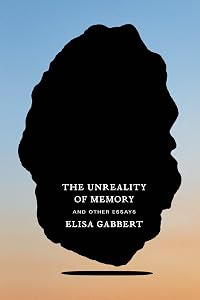
Unreality of Memory
by Elisa Gabbert
On This Page
Description
"Poet and essayist Elisa Gabbert's The Unreality of Memory consists of a series of lyrical and deeply researched meditations on what our culture of catastrophe has done to public discourse and our own inner lives. In these tender and prophetic essays, she focuses in on our daily preoccupation and favorite pastime"--Tags
Recommendations


































Member Reviews
It's hard to say you enjoyed a book when it mostly made you feel a pervasive sense of dread and anxiety but I guess that's just how we all live life now.
I'm a sucker for an essay collection, especially ones which manage to thread into these massive, oblique stories of disaster and doom a sense of the personal. Gabbert reckons with large-scale global phenomena — climate change, geopolitical instability, the seemingly innate animosity between humans — while grounding each essay in her own personal experiences which draw the reader back down to (un)reality.
I'm a sucker for an essay collection, especially ones which manage to thread into these massive, oblique stories of disaster and doom a sense of the personal. Gabbert reckons with large-scale global phenomena — climate change, geopolitical instability, the seemingly innate animosity between humans — while grounding each essay in her own personal experiences which draw the reader back down to (un)reality.
There’s a feeling that you get when you try to think the unthinkable. A nuclear apocalypse. A true planet-wide climate disaster. Earthquakes, tsunamis, meteor strikes . . .
We aren’t equipped to comprehend these kinds of things, as real as they could turn out to be.
And then there are the personal unthinkable. The sudden loss of a partner. Financial disaster. A fatal medical diagnosis.
Those are disasters. And that’s where Gabbert starts her thinking in this book. Although the focus she assigns herself is disaster, there are other kinds of things in the class of the unthinkable. And once you start thinking for yourself, you begin to expand on the general theme of things that are real but so incomprehensible that they seem show more unreal.
Gabbert herself characterizes the category as “seeming unrealness in something I assume to be real.”
The book is a collection of essays, each delving into the theme from a different direction. Ruminations, sometimes with opinions or positions, but more often just the rumination itself. Gabbert is a poet, and she has the sensibilities to make these ruminations poignant and expressive.
I found the essay on “compassion fatigue” especially poignant in the time of covid, the war in Ukraine, and countless attacks on the rights and dignity of different segments of people throughout the world. We are dulled by the repetition, similar even to the way we have become dulled to the repetition of Donald Trump’s moral transgressions — they just stop registering the way that we know they should.
There’s another class of the unthinkable, one not so negative. The origin of the universe. The fate of the universe. Even the kinds of things that happen everyday that we describe as “unbelievable” — a dream job, a dream partner or friendship, a personal success of any sort.
Gabbert doesn’t go technical or philosophical on the overall point, but there is something here. Has evolution equipped us with challenges we now meet in the real world, like climate change, or is our inaction related to this sense of unreality she is writing about? Do autocrats like Putin or Trump tap into and take advantage of that seeming inability to comprehend?
All in all, I’d rather contemplate the origin of the universe, but it’s the challenges we may be ill-equipped to meet that demand our attention. show less
We aren’t equipped to comprehend these kinds of things, as real as they could turn out to be.
And then there are the personal unthinkable. The sudden loss of a partner. Financial disaster. A fatal medical diagnosis.
Those are disasters. And that’s where Gabbert starts her thinking in this book. Although the focus she assigns herself is disaster, there are other kinds of things in the class of the unthinkable. And once you start thinking for yourself, you begin to expand on the general theme of things that are real but so incomprehensible that they seem show more unreal.
Gabbert herself characterizes the category as “seeming unrealness in something I assume to be real.”
The book is a collection of essays, each delving into the theme from a different direction. Ruminations, sometimes with opinions or positions, but more often just the rumination itself. Gabbert is a poet, and she has the sensibilities to make these ruminations poignant and expressive.
I found the essay on “compassion fatigue” especially poignant in the time of covid, the war in Ukraine, and countless attacks on the rights and dignity of different segments of people throughout the world. We are dulled by the repetition, similar even to the way we have become dulled to the repetition of Donald Trump’s moral transgressions — they just stop registering the way that we know they should.
There’s another class of the unthinkable, one not so negative. The origin of the universe. The fate of the universe. Even the kinds of things that happen everyday that we describe as “unbelievable” — a dream job, a dream partner or friendship, a personal success of any sort.
Gabbert doesn’t go technical or philosophical on the overall point, but there is something here. Has evolution equipped us with challenges we now meet in the real world, like climate change, or is our inaction related to this sense of unreality she is writing about? Do autocrats like Putin or Trump tap into and take advantage of that seeming inability to comprehend?
All in all, I’d rather contemplate the origin of the universe, but it’s the challenges we may be ill-equipped to meet that demand our attention. show less
I was impressed with the range and scope of these essays. Most the subjects were downers I suppose, but they were interesting all the same.
My favorite essays were on the subject of disaster culture.
Ratings
Members
- Recently Added By
Lists

Books Read in 2024
4,623 works; 126 members

Borrowed Books 2024 (Books We Have Read BUT do NOT Own)
20 works; 1 member
Author Information
9+ Works 462 Members
Some Editions
Common Knowledge
- Alternate titles
- The Unreality of Memory: Notes on Life in the Pre-Apocalypse (UK) (UK)
Classifications
Statistics
- Members
- 171
- Popularity
- 191,675
- Reviews
- 4
- Rating
- (4.07)
- Languages
- English
- Media
- Paper, Audiobook, Ebook
- ISBNs
- 8
- ASINs
- 1