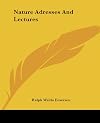
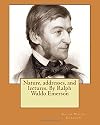
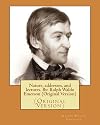
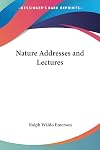
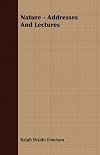
Nature Addresses and Lectures
by Ralph Waldo Emerson 
On This Page
Description
Letters and Social Aims, published in 1875, contains essays originally published early in the 1840s as well as those that were the product of a collaborative effort among Ralph Waldo Emerson, his daughter Ellen Tucker Emerson, his son Edward Waldo Emerson, and his literary executor James Eliot Cabot. The volume takes up the topics of “Poetry and Imagination,” “Social Aims,” “Eloquence,” “Resources,” “The Comic,” “Quotation and Originality,” “Progress of Culture,” show more “Persian Poetry,” “Inspiration,” “Greatness,” and, appropriately for Emerson’s last published book, “Immortality.” The historical introduction demonstrates for the first time the decline in Emerson’s creative powers after 1865; the strain caused by the preparation of a poetry anthology and delivery of lectures at Harvard during this time; the devastating effect of a house fire in 1872; and how the Emerson children and Cabot worked together to enable Emerson to complete the book. The textual introduction traces this collaborative process in detail and also provides new information about the genesis of the volume as a response to a proposed unauthorized British edition of Emerson’s works. Historical Introduction by Ronald A. Bosco Notes and Parallel Passages by Glen M. Johnson Text Established and Textual Introduction and Apparatus by Joel Myerson show lessTags
Recommendations

















Member Reviews
His ideas are interesting, but the early 21st century mind bulks at the tedious presentation. For insomniacs.
Good, "with best wishes for a merry Christmas from Mina, December 1923
Ratings
Members
- Recently Added By
Lists

Literary Works Read in College
316 works; 15 members

Books Cited in Blueprint by Nicholas Christakis
261 works; 1 member
Author Information

797+ Works 21,085 Members
Known primarily as the leader of the philosophical movement transcendentalism, which stresses the ties of humans to nature, Ralph Waldo Emerson, American poet and essayist, was born in Boston in 1803. From a long line of religious leaders, Emerson became the minister of the Second Church (Unitarian) in 1829. He left the church in 1832 because of show more profound differences in interpretation and doubts about church doctrine. He visited England and met with British writers and philosophers. It was during this first excursion abroad that Emerson formulated his ideas for Self-Reliance. He returned to the United States in 1833 and settled in Concord, Massachusetts. He began lecturing in Boston. His first book, Nature (1836), published anonymously, detailed his belief and has come to be regarded as his most significant original work on the essence of his philosophy of transcendentalism. The first volume of Essays (1841) contained some of Emerson's most popular works, including the renowned Self-Reliance. Emerson befriended and influenced a number of American authors including Henry David Thoreau. It was Emerson's practice of keeping a journal that inspired Thoreau to do the same and set the stage for Thoreau's experiences at Walden Pond. Emerson married twice (his first wife Ellen died in 1831 of tuberculosis) and had four children (two boys and two girls) with his second wife, Lydia. His first born, Waldo, died at age six. Emerson died in Concord on April 27, 1882 at the age of 78 due to pneumonia and is buried in Sleepy Hollow Cemetery in Concord, Massachusetts. (Bowker Author Biography) show less
Ralph Waldo Emerson has a Legacy Library. Legacy libraries are the personal libraries of famous readers, entered by LibraryThing members from the Legacy Libraries group.
Classifications
Statistics
- Members
- 87
- Popularity
- 368,523
- Reviews
- 2
- Rating
- (3.75)
- Languages
- English
- Media
- Paper, Ebook
- ISBNs
- 18
- ASINs
- 6