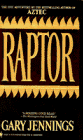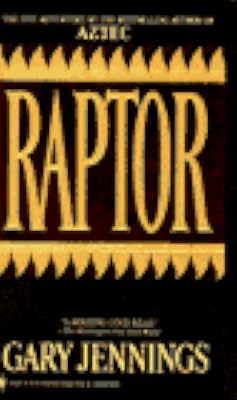
Raptor
by Gary Jennings
On This Page
Description
The Blockbuster epic of the Roman Empire's disintegration. Thorn the Goth is an orphan, brought up in a monastery, transferred to a nunnery, and thrown out into an unforgiving world when the stunning discovery is made that Thorn is a hermaphrodite. For many, this bizarre sexual trait would be a crippling disadvantage. For Thorn, it presents a unique chance to enjoy every pleasure of the flesh, to dissemble, to be all things to all men and to women. As the Roman Empire comes under increasing show more threat from the dark forces that surround it, Thorn eventually finds himself riding at the side of the Goth king, Theodoric. Without ever revealing the strange double life forced on him by a twist of nature, Thorn serves the king as both Field Marshall and Ambassador. Violent battles, erotically charged encounters and a gallery of richly drawn and colourful characters combine in a powerfully written narrative that endows ancient history with drama and immediacy. show lessTags
Recommendations















Member Reviews
One of the most memorable books I’ve ever read. The dichotomy Thorn exacerbates in his nature serves both his overt agenda (to serve Theodoric as his right hand man) and his covert agenda (to be Theodoric’s lover). They are never reconciled into one persona, but as each has an outlet, Thorn feels more at peace. The time period is fascinating as are the characters. I loved Wyrd and his role as father and teacher just when Thorn needed one. A long, brutal, graphic, but rewarding novel.
Read these Runes !!!
On the whole I enjoyed this novel: the [fictitious] memoirs of the hermaphrodite Thorn. I hated in the first Part: "In the Ring of Balsam" the drawn-out, graphic sexual awakening of the intersex hero/heroine, Thorn, in both a monastery and a convent, In fact, anything of a graphic nature from then on I skipped over. [I must be awfully squeamish]. I almost quit reading completely because of Part I, but am glad I persevered after the first 70-80 pages.Thorn had been left at the monastery as a foundling. Since the only clue to his identity was the Runic letter Thorn on his swaddling; that became his name. I enjoyed the basic story of the rest of the novel, set at the time of Theodoric the Great and the Goths, right at show more and after the collapse of the Western Roman Empire, Thrown out from both monastery and convent, Thorn sets out from Burgundy to meet the Ostrogoths and comes upon a woodsman/fur trapper and trader, who had been an officer in the Roman army, Wyrd, who guides him from Burgundy into central Europe. Wyrd was a fascinating character, a father figure to Thorn. For awhile Thorn has a pet eagle and Thorn says somewhere in the novel they are both amoral. All through the novel he compares himself to a raptor. The deaths of both the eagle and of Wyrd were moving. Later, on his journey eastward, Thorn meets Theodoric. Sometimes, depending on what is taking place in the story, Thorn 'becomes' a female, Veleda.
There was a lot of discussion on religions [mainly the three Christian sects in existence at that time], the place of women in society, politics, etc. Thorn/Veleda journeys to Constantinople as Theodoric's emissary, and further journeying will take him to the Black Sea. I liked the descriptions of Constantinople and her customs, the emperor's palace, and Thorn's quarters. After capture by usurper [another Theodoric], Thorn escapes and aftrer his return to King Theodoric he is given the mission to find out the early history of the Goths, which he completes successfully, travelling to the Amber Coast and Skandza. Then Theodoric founds the Kingdom of the Goths; Thorn travels widely on his behalf; and the novel enumerates some of Theodoric's accomplishments: why history has called him "The Great." I felt the novel was researched well, but I question how much historical was incorporated, except the bare bones. I don't know much about hermaphrodites and wonder how well they can even function sexually. I think many of the graphic aspects could have been excised and it wouldn't have hurt the story. I liked the semi-Fraktur typography and that page numbers were in the right and left margins. show less
On the whole I enjoyed this novel: the [fictitious] memoirs of the hermaphrodite Thorn. I hated in the first Part: "In the Ring of Balsam" the drawn-out, graphic sexual awakening of the intersex hero/heroine, Thorn, in both a monastery and a convent, In fact, anything of a graphic nature from then on I skipped over. [I must be awfully squeamish]. I almost quit reading completely because of Part I, but am glad I persevered after the first 70-80 pages.Thorn had been left at the monastery as a foundling. Since the only clue to his identity was the Runic letter Thorn on his swaddling; that became his name. I enjoyed the basic story of the rest of the novel, set at the time of Theodoric the Great and the Goths, right at show more and after the collapse of the Western Roman Empire, Thrown out from both monastery and convent, Thorn sets out from Burgundy to meet the Ostrogoths and comes upon a woodsman/fur trapper and trader, who had been an officer in the Roman army, Wyrd, who guides him from Burgundy into central Europe. Wyrd was a fascinating character, a father figure to Thorn. For awhile Thorn has a pet eagle and Thorn says somewhere in the novel they are both amoral. All through the novel he compares himself to a raptor. The deaths of both the eagle and of Wyrd were moving. Later, on his journey eastward, Thorn meets Theodoric. Sometimes, depending on what is taking place in the story, Thorn 'becomes' a female, Veleda.
There was a lot of discussion on religions [mainly the three Christian sects in existence at that time], the place of women in society, politics, etc. Thorn/Veleda journeys to Constantinople as Theodoric's emissary, and further journeying will take him to the Black Sea. I liked the descriptions of Constantinople and her customs, the emperor's palace, and Thorn's quarters. After capture by usurper [another Theodoric], Thorn escapes and aftrer his return to King Theodoric he is given the mission to find out the early history of the Goths, which he completes successfully, travelling to the Amber Coast and Skandza. Then Theodoric founds the Kingdom of the Goths; Thorn travels widely on his behalf; and the novel enumerates some of Theodoric's accomplishments: why history has called him "The Great." I felt the novel was researched well, but I question how much historical was incorporated, except the bare bones. I don't know much about hermaphrodites and wonder how well they can even function sexually. I think many of the graphic aspects could have been excised and it wouldn't have hurt the story. I liked the semi-Fraktur typography and that page numbers were in the right and left margins. show less
Bought this for my mother, who gave it away it before I realized what a rare find it was. Found another copy at a used bookstore while on vacation. Not quite as good as Aztec and Journeyer, but pretty darn close. The beginning is pretty graphic and brutal, but after that it has all of the hallmarks of a good Jennings tale.
Ich hatte mir etwas historisches in der Art von Bernard Cornwell erhofft, aber der Autor kommt nicht entfernt an Cornwell heran: die Figuren zu holzschnittartig, die Handlung eher im Stile eines Groschenheftes. Nach 150 Seiten wußte ich noch nicht annähernd wohin die Reise überhaupt gehen wird und der Wälzer hat über 800 Seiten - näh danke. Vielleicht irgendwann nochmal, wenn ich sehr verzweifelt bin und sonst nichts zu lesen habe.
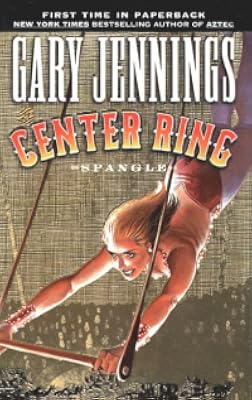
I love AZTEC, SPANGLE and THE JOURNEYER, but as much as I admire Gary Jennings' work in general RAPTOR didn't work as well for me. Even so, it's worth re-reading.
One of the books that has stayed with me over the years. I look forward to reading it again
Members
- Recently Added By
Published Reviews
ThingScore 100
"An impressive, often violent saga that allows readers to experience a richly re-created time and place through the eyes of a hero unlike virtually any other in fact or fiction."
added by bookfitz
Talk Discussions
Past Discussions
Hitorical Fiction/ orphan riased in monestary as a boy but is a girl in Name that Book (July 2016)
Author Information

47+ Works 5,519 Members
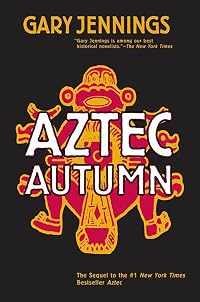
Born in Buena Vista, Va., Gary Jennings worked as an account executive in advertising and as managing editor of Dude and Gent magazines before becoming a full time writer. His early works were written for young adults, but he has since become well known as a writer of extensively researched, epic historical fiction. Jennings immerses himself in show more the culture of the period and locale to gain the background for his novels. Before writing Aztec (1980), Jennings lived in Mexico for 12 years and studied the Nahuatl language. The popularity of this novel resulted in the sequel, Aztec Autumn (1997). To give depth and flavor to his novel, The Journeyer (1984), Jennings followed a route to China, sometimes traveling by camel or elephant, in the manner of Marco Polo. (Bowker Author Biography) show less
Common Knowledge
- Canonical title
- Raptor
- Original title
- Raptor
- Original publication date
- 1992
- People/Characters
- Thorn; Veleda; Theodoric the Great; Dom Clement; Domina Aetherea; Wyrd
- Important places
- Ancient Rome
- Epigraph
- Raptor: (fr. Latin raptere, to ravish)
A bird of prey, as the hawk, characterized by carnivorous appetite, great powers of flight and extreme keenness of vision.
---WEBSTER'S
Mortal,
it was you yourself who cast your lot not with Security but with Fortune. Never rejoice overmuch when she leads you to great victories; never repine when she leads you into sad adversity. Remember, mortal, i... (show all)f Fortune ever should stand still, she is no longer Fortune.
---BOETHIUS, A.D. 524 - Dedication
- For Joyce
Nous revenons toujours
À nos premiers amours
[English Translation:]
We always come back to our first love - First words
- Read these runes! They were inscribed by Thorn the Mannamavi, and at no master's dictation, but in Thorn's own words.
- Last words
- (Click to show. Warning: May contain spoilers.)This manuscript I will put there too, so it will be entombed and invisible and silent forever.
- Original language
- English
Classifications
Statistics
- Members
- 477
- Popularity
- 64,043
- Reviews
- 9
- Rating
- (3.86)
- Languages
- English, German, Italian, Spanish
- Media
- Paper, Ebook
- ISBNs
- 21
- ASINs
- 1