
Nicholas Guild
Author of Assyrian
Series
Works by Nicholas Guild
Tagged
Common Knowledge
Members
Reviews
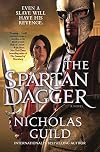
A gripping, easy to read novel set in the 4th century BC for a period of about 20 years against the backdrop of the war of Thebes against Sparta in which Spartan power and grip on its subject people, the helots, began to weaken. Two twin Spartan brothers, members of the krypteia, the secret organization which keeps tight control on helots and to which the most promising future military leaders are admitted, seek out and kill the family of Protos, a helot. Protos kills one brother and takes show more his xuele knife: the "Spartan dagger" of the title. He and the other brother, Eurytus, want to take revenge on each other. Protos has a natural affinity for knife-throwing and escapes Spartans sent after him. He meets an Egyptian "witch" and healer, Nebit, who, throughout his life with her, guides him with her dreams and prophecies. He meets Epaminondas, a Theban general, and together with Pelopidas and their men, set off to destroy Sparta. He conceives the desire to free his people. The Thebans first weaken Sparta at Leuctra, where Epinamondas' unusual oblique formation is used successfully against the Spartan phalanx. Leuctra was given short shrift in this novel; for a detailed fictional description I recommend Hanson's [The End of Sparta]. This battle puts steel into the Thebans' spines and they know they can defeat the Spartans--maybe not right away, but eventually. Much of the novel is either battles or is a cat-and-mouse game between Protos and Eurytus. Sometimes the two are forced by circumstances to be temporary allies. But there is a final duel between the two; Eurytus has lost his left hand earlier.
The character development was outstanding; each of the main characters grew in maturity. For Protos, it was from vengeance to the larger goal of freeing his people and for Eurytus, in spite of his fear, shame, and doubt, although badly injured, fighting in spite of them to restore his honor. I wondered at the mention of Pelopidas with **nothing said** of the Sacred Band. Historically, they were pairs of male lovers under his command. Although Protos seemed too perfect and learned the techniques of war as well as reading and writing too quickly, he did suffer one wound where he lay near death and did take a long time to recover. This was logical. Usually similar novels have a wounded hero recover miraculously within a short span of time.
Highly recommended. show less
The character development was outstanding; each of the main characters grew in maturity. For Protos, it was from vengeance to the larger goal of freeing his people and for Eurytus, in spite of his fear, shame, and doubt, although badly injured, fighting in spite of them to restore his honor. I wondered at the mention of Pelopidas with **nothing said** of the Sacred Band. Historically, they were pairs of male lovers under his command. Although Protos seemed too perfect and learned the techniques of war as well as reading and writing too quickly, he did suffer one wound where he lay near death and did take a long time to recover. This was logical. Usually similar novels have a wounded hero recover miraculously within a short span of time.
Highly recommended. show less

The Assyrian is the first of a two-part series about Tiglath Ashur, the son of Sennacherib, who ruled as king of Assyria from 705–681 BC, Assyria's Golden Age. This hefty book begins with Tiglath's birth to a Greek concubine in Nineveh, where as a child he narrowly escapes from castration (apparently Assyrian kings would thin their herd of sons by castrating a good number of male children). From this moment on, Tiglath becomes a favorite in the eyes of the king. He trains as a soldier and show more leads many military campaigns against various enemies of his father the king. The battle scenes are grisly and vividly written, but pale in comparison against the horrific torture scenes. The overthrown King of Babylon and his immediate family meets a gruesome end in the streets of Nineveh, where their executioners are cheered on by a bloodthirsty crowd. I remember from my high school history class that the Assyrians were a violent and warmongering people, but this novel really brought new meaning to those words.
During the time I spent reading this book, I took numerous breaks to research Assyria. As stated above, King Sennacherib was a real person who was succeeded by his son Esarhaddon after meeting his end in a mysterious assassination. While many of the details of this ancient kingdom have been lost to time, Nicholas Guild rises to the occasion and has written a beautiful book that uses what little we do know about the Assyrians to imagine an incredible adventure story. His attention to historical detail is impressive. For example, the nobles of Assyria studied Sumerian in the same way that educated elite study Latin. During Tiglath's time in school, he learns to read and write Sumerian. The Bronze Age truly comes to life under Guild's pen.
I cannot wait to get my hands on a copy of the sequel, [b:The Blood Star|1539841|The Blood Star|Nicholas Guild|https://images.gr-assets.com/books/1289952740s/1539841.jpg|1532017]! show less
During the time I spent reading this book, I took numerous breaks to research Assyria. As stated above, King Sennacherib was a real person who was succeeded by his son Esarhaddon after meeting his end in a mysterious assassination. While many of the details of this ancient kingdom have been lost to time, Nicholas Guild rises to the occasion and has written a beautiful book that uses what little we do know about the Assyrians to imagine an incredible adventure story. His attention to historical detail is impressive. For example, the nobles of Assyria studied Sumerian in the same way that educated elite study Latin. During Tiglath's time in school, he learns to read and write Sumerian. The Bronze Age truly comes to life under Guild's pen.
I cannot wait to get my hands on a copy of the sequel, [b:The Blood Star|1539841|The Blood Star|Nicholas Guild|https://images.gr-assets.com/books/1289952740s/1539841.jpg|1532017]! show less

A superb piece of historical fiction from a very competent and assured author. The Assyrians werent very popular in the ancient world because of their repuation for extreme brutality and they havent been popular with modern writers either. Guild ventures into unknown territory with a gripping story of the battle between the half-brothers Tiglath and Esarhaddon for the throne of a great Middle Eastern empire. He captures the feel of the civilization superbly, the Assyrians' casual assumption show more of their own superiority and their equally casual brutality is palpable. The one letdown is the cliched romance, it feels tacked- on and we are not even sure the Assyrians (or any other ancient civilization for that matter) understood the concept of love as we do anyway. But it doesnt detract from a wonderful story. This is a must-read, and I think that, like me. having read it you will feel like reading over and over. show less

The Blood Star begins exactly where its predecessor, The Assyrian ends (this is probably obvious, but if you have not read the first book in the series, you must read it first!). I ordered a copy of this book the day I finished The Assyrian as I was eager to continue reading about Tiglath Ashur, our hero. I was not disappointed. With an antiquated writing style, Nicholas Guild thrusts his reader back into the ancient world - it is the Golden Age of Assyria, but we do not return to Assyria show more until the end of the book. We follow Tiglath from the land where the Tigris and the Euphrates meet, around the Arabian peninsula, to the rich Phoenician cities and to a crumbling Egypt (how incredible to think that at this time, Egypt was already an ancient civilization with its glory days far in the past). We are taken to Greece and to Sicily, which is rugged and undeveloped, and finally back to Assyria, where the series comes to a thundering conclusion that does not disappoint.
Together, The Assyrian and The Blood Star are masterpieces of historical fiction. I will definitely be looking for more of Guild's work. show less
Together, The Assyrian and The Blood Star are masterpieces of historical fiction. I will definitely be looking for more of Guild's work. show less
Awards

You May Also Like


Statistics
- Works
- 22
- Members
- 552
- Popularity
- #45,211
- Rating
- 3.7
- Reviews
- 15
- ISBNs
- 102
- Languages
- 4