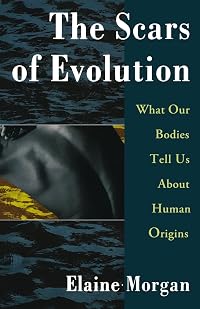
The Scars of Evolution
by Elaine Morgan
On This Page
Description
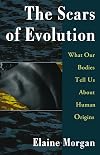
In this lively and controversial book Elaine Morgan presents a challenging interpretation to the question of human evolution. With brilliant logic she argues that our hominid ancestors began to evolve in response to an aquatic environment. Millions of years ago something happened that caused our ancestors to walk on two legs, to lose their fur, to develop larger brains and learn how to speak. Elaine Morgan discovers what this event was by studying the many incongruous flaws in the show more physiological make-up of humans. The human body is liable to suffer from obesity, lower back pain and acne. In support of her aquatic ape hypothesis she points out the flaws in our physiological make-up: the difficulties of erect bipedalism, our hairlessness and fat-layers, our preference for face to face sex and the way we breathe. Are these flaws a record of the history of the species, the 'scars' of evolution that are clues to earlier stages of evolution? Morgan establishes the origins of the evolutionary path that separated humans from other animals and questions the theories currently accepted by science. Did our ancestors adapt to an aquatic environment that subsequently dried out? Elaine Morgan has made the Aquatic Ape Hypothesis a plausible alternative to conventional theories of evolution and in The Scars of Evolution she brings a real understanding of who humans are and where they came from. show lessTags
Recommendations






















Member Reviews
The Aquatic ape hypothesis is this idea according to which we would have evolved not from apes having conquered the land, but an aquatic environment - or, at least, semi-aquatic. A few decades ago the idea had a few ears among the general public. It was then defended vigorously by Elaine Morgan, author of a few scientific books despite not being a scientific herself (she had a degree in English).
Well... It certainly did echo among the general public, but what about the scientific community? Bluntly: they never took it seriously. Out of disdain? Nope. Out of a lack of evidence.
No evidence? Oh dear! Elaine Morgan, therefore, put it then into her stubborn head to line up some in this book, insisting that many of our anatomical features show more have more in common with aquatic mammal than anything else.
Now, I get that similarities can be striking; but similarities are just that: close enough... But no. Her own interpretations to explain various features of our anatomy can be seductive in themselves; yet others have proved as seductive as hers, and, with one crucial and key difference: these other interpretations are actually backed by evidences. Evidence are indeed by the plenty when it comes to establish our lineage with 'land' apes; there is still none linking us to any aquatic specie if they ever existed. It's all here very simplistic, and, as with everything way too simple to be true, it all come down in her narrow logic to only one and only cause (that's a red flag in itself!): an aquatic environment. Would that qualify as reductionism?
No need to debate. Her final attitude says it all: she doesn't end the book by challenging and counter-arguing her opponents on each of their claims, but, on the contrary, digs herself in by portraying herself as a victim of the scientific community - that she accuses of being arrogant and scornful. Well... Beware of people locked up in echo chambers.
Here's a nice read to know why some would believe in such a fancy idea. Apart from that, here's yet another 'just so' story, leading nowhere, and so not worth much in terms of scientific credibility. show less
Well... It certainly did echo among the general public, but what about the scientific community? Bluntly: they never took it seriously. Out of disdain? Nope. Out of a lack of evidence.
No evidence? Oh dear! Elaine Morgan, therefore, put it then into her stubborn head to line up some in this book, insisting that many of our anatomical features show more have more in common with aquatic mammal than anything else.
Now, I get that similarities can be striking; but similarities are just that: close enough... But no. Her own interpretations to explain various features of our anatomy can be seductive in themselves; yet others have proved as seductive as hers, and, with one crucial and key difference: these other interpretations are actually backed by evidences. Evidence are indeed by the plenty when it comes to establish our lineage with 'land' apes; there is still none linking us to any aquatic specie if they ever existed. It's all here very simplistic, and, as with everything way too simple to be true, it all come down in her narrow logic to only one and only cause (that's a red flag in itself!): an aquatic environment. Would that qualify as reductionism?
No need to debate. Her final attitude says it all: she doesn't end the book by challenging and counter-arguing her opponents on each of their claims, but, on the contrary, digs herself in by portraying herself as a victim of the scientific community - that she accuses of being arrogant and scornful. Well... Beware of people locked up in echo chambers.
Here's a nice read to know why some would believe in such a fancy idea. Apart from that, here's yet another 'just so' story, leading nowhere, and so not worth much in terms of scientific credibility. show less
If I were to judge this book solely on the writing and the interesting substance, it would get many more stars. Alas, I cannot do that, for this is a non-fiction book and must also be judged on its merits as non-fiction. The author, not a scientist, proposes a hypothesis that sounds fascinating and believable from the evidence she presents. Unfortunately, much of her evidence is simply not factual. The author misrepresents, miscontextualizes, and in some places just plain makes up facts to fit her preferred thesis, known in the scientific world as the Aquatic Ape Hypothesis. She accuses other scientists of ignoring her important new approach, which can be, but is not always, a mark of pseudoscience. In this case, the anthropologists and show more evolutionists both agree that she is simply wrong. Read it for curiosity, because I think it's fascinating - and important - to know about the ways in which people get science wrong. But keep your mind open to the fact that scientists may actually know the science, and fact check the book thoroughly. Don't be so open minded your brains fall out. show less
The third and last of the books by this author in my collection. Before reading it, I had a look at the debunking site discovered on the internet which pours cold water on the aquatic ape theory, as it is known, which originated with a scientist called Alistair Hardy, mentioned in this volume. The site is able to debunk the AAT, as it refers to it, but not always so successful in providing alternative more convincing explanations.
The book shows no sign of the quirky style of the author's first and most famous ('The Descent of Woman') but instead is written in a very 'straight', bordering on academic style, perhaps chosen because she wanted to be taken seriously. The author develops some information from a previous work, regarding show more isolation of a particular area of Africa cut off by water ingress for millions of years which would have led to adaptations by species trapped there. This, she argues, led to various humanoid characteristics developing which led eventually to our own species which inherited them.
The author had abandoned her speculations about large brains and an aquatic origin by the time she wrote this, probably because evidence from the 'Lucy' skeleton revealed that bipedalism (walking on two legs) predated the development of a large brain or tool use by millions of years. But her speculations about loss of hair, development of particular types of fat deposit, retention of child features (neoteny) and other factors pertaining to humans and humanoid ancestors are interesting. As she says, attributing these to a move to the savannah doesn't convince when primates such as baboons did not develop them. So I remain open minded about this book until more compelling evidence is presented from the other viewpoint. Hence a middle of the road 3 star rating. show less
The book shows no sign of the quirky style of the author's first and most famous ('The Descent of Woman') but instead is written in a very 'straight', bordering on academic style, perhaps chosen because she wanted to be taken seriously. The author develops some information from a previous work, regarding show more isolation of a particular area of Africa cut off by water ingress for millions of years which would have led to adaptations by species trapped there. This, she argues, led to various humanoid characteristics developing which led eventually to our own species which inherited them.
The author had abandoned her speculations about large brains and an aquatic origin by the time she wrote this, probably because evidence from the 'Lucy' skeleton revealed that bipedalism (walking on two legs) predated the development of a large brain or tool use by millions of years. But her speculations about loss of hair, development of particular types of fat deposit, retention of child features (neoteny) and other factors pertaining to humans and humanoid ancestors are interesting. As she says, attributing these to a move to the savannah doesn't convince when primates such as baboons did not develop them. So I remain open minded about this book until more compelling evidence is presented from the other viewpoint. Hence a middle of the road 3 star rating. show less
Brilliant and bloody interesting. Nicely written, lots of science and differentiation between what is fact, speculation and just accepted conjecture.
Morgan argues, among other things, that the vagina (and the monthly menstural cycle) are designed to prevent sperm from reaching the egg. Sperm, in her view, are foreign invaders, and only the strongest get in.
Ratings
Members
- Recently Added By
Lists

Geotrauma
30 works; 1 member
Author Information

25+ Works 1,139 Members
Series
Belongs to Publisher Series
Common Knowledge
- Canonical title
- The Scars of Evolution
- Original title
- The Scars of Evolution
Classifications
- Genres
- Anthropology, Science & Nature, Nonfiction, General Nonfiction
- DDC/MDS
- 573.2 — Natural sciences & mathematics Biology Specific physiological systems in animals, regional histology and physiology in animals Origin of man
- LCC
- GN281.4 .M68 — Geography, Anthropology and Recreation Anthropology Anthropology Physical anthropology. Somatology Human evolution
- BISAC
Statistics
- Members
- 145
- Popularity
- 225,683
- Reviews
- 5
- Rating
- (3.73)
- Languages
- 5 — Danish, English, Finnish, Japanese, Polish
- Media
- Paper, Ebook
- ISBNs
- 6
- ASINs
- 2