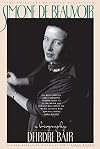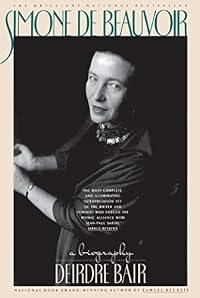
Simone de Beauvoir: A Biography
by Deirdre Bair
On This Page
Description
Explores every facet of Beauvoir's life and thought.Tags
Recommendations






























Member Reviews
This is an excellent biography of a remarkable person. One might have questioned the need for a biography for one who was, in Bair’s words, so “publicly introspective,” given her four-volume memoir and her transparently autobiographical novels. Yet Bair demonstrates time and again how valuable it was to have personal access to Beauvoir in the last years of her life, as well as to her relatives and many of the “Sartristes.” I found this particularly so whenever she questioned Beauvoir about the frequently-uttered criticism that, apart from her refusal to bear children or do housework, her subservience to the needs of the man she’d bound herself to was that of a traditional “helpmate,” despite her scorn of the institution show more of marriage. It also speaks for Beauvoir that she permitted this examination, even if she sometimes refused to say more than evasive answers such as “one must have been there at the time.” In the end, I felt that while she did organize her life around the needs of Sartre, she was his intellectual equal, a valuable sparring partner in his work.
In addition to being an intellectual giant, Sartre was what one person in the book called a Peter Pan—a boy who didn’t want to grow up; less charitably, he could be called an egotistical monster (a reminder that great philosophy isn’t always produced by admirable people). Catering to him must not have been easy.
While Bair enables readers to form their own opinion of these two central figures, when it came to her depiction of the role of two persons whose closeness to Sartre toward the end of his life destabilized his relationship with Beauvoir and marginalized her, I found myself disliking them as much as Beauvoir did.
To recount Beauvoir’s life, given the volume of her and Satre’s written output, their frequent travels, and the comings and goings of associates, disciples, and lovers (including the great romantic love of her life, Nelson Algren) presented an organizational challenge. I think Bair mastered it for the most part, but not completely. At times, I didn’t feel that, as a reader, I needed to be told something for the second or third time.
These are quibbles. In the introduction, Bair reflects on why writing biography was one of her “preferred forms of critical inquiry . . . : How did X’s life and work illuminate our cultural and intellectual history; how did X influence the way we think about ourselves and interpret our society; and finally, what can we learn from X’s life and work that will be of use to us once we have read his/her biography?“ Measured by this self-imposed standard, I’d say Bair succeeded. show less
In addition to being an intellectual giant, Sartre was what one person in the book called a Peter Pan—a boy who didn’t want to grow up; less charitably, he could be called an egotistical monster (a reminder that great philosophy isn’t always produced by admirable people). Catering to him must not have been easy.
While Bair enables readers to form their own opinion of these two central figures, when it came to her depiction of the role of two persons whose closeness to Sartre toward the end of his life destabilized his relationship with Beauvoir and marginalized her, I found myself disliking them as much as Beauvoir did.
To recount Beauvoir’s life, given the volume of her and Satre’s written output, their frequent travels, and the comings and goings of associates, disciples, and lovers (including the great romantic love of her life, Nelson Algren) presented an organizational challenge. I think Bair mastered it for the most part, but not completely. At times, I didn’t feel that, as a reader, I needed to be told something for the second or third time.
These are quibbles. In the introduction, Bair reflects on why writing biography was one of her “preferred forms of critical inquiry . . . : How did X’s life and work illuminate our cultural and intellectual history; how did X influence the way we think about ourselves and interpret our society; and finally, what can we learn from X’s life and work that will be of use to us once we have read his/her biography?“ Measured by this self-imposed standard, I’d say Bair succeeded. show less
beauvoir herself is less interesting than i thought. she is very peculiar! i had no idea that she drank so much and died of cirrhosis. her relationship with sartre was very strange and hard to understand. in fact most of her relationships were very peculiar but she was so loyal and kept them up. is sartre still highly regarded?
the book buyer's advisory 1991
the book buyer's advisory 1991
One of the best biographies I ever read. It is very thoroughly researched and well written story of an exceptional life.
Tough but ultimately gratifying biography.
Heel erg dikke biografie, die naast een levensbeschrijving van De Beauvoir en Sartre ook een tijdsbeeld schetst van het Frankrijk sinds WO 1.
Jun 27, 2008Dutch
Ratings
Members
- Recently Added By
Author Information

10 Works 1,752 Members
Deirdre Bair received the National Book Award for Samuel Beckett: A Biography. She has been a literary journalist and university professor of comparative literature. Her biographies of Anais Nin and Simone de Beauvoir were also prize finalists, and she was awarded fellowships from (among others) the Guggenheim and Rockefeller Foundations and the show more Bunting Institute of Radcliffe College. She divides her time between New York and Connecticut show less
Awards and Honors
Awards
Distinctions
Common Knowledge
- Original publication date
- 1990
- People/Characters
- Simone de Beauvoir; Jean-Paul Sartre
- Important places
- France; Montparnasse, Paris, France
- First words
- (Intro)
The first time I thought of Simone de Beauvoir as someone other than the woman who wrote The Second Sex was in 1974.
(Chap 1)
Her earliest memories were so closely linked to the color black that, throughout her life, whenever something of her childhood came to mind unbidden she often had the sensation of being smothered in blackness. - Last words
- (Click to show. Warning: May contain spoilers.)She may have been a mass of contradictions, but she was still, in the most profoundly respectful sense of the phrase, "the mother of us all."
- Original language
- English
Classifications
- Genres
- Biography & Memoir, Literature Studies and Criticism
- DDC/MDS
- 848.91409 — Literature & rhetoric French Literature French miscellaneous writings 1900- 1900-1999 1945-1999 Individual authors
- LCC
- PQ2603 .E362 .Z59 — Language and Literature French, Italian, Spanish and Portuguese literatures French literature Modern literature 1900-1960
- BISAC
Statistics
- Members
- 449
- Popularity
- 67,850
- Reviews
- 5
- Rating
- (3.85)
- Languages
- 6 — Danish, Dutch, English, French, German, Swedish
- Media
- Paper
- ISBNs
- 15
- UPCs
- 2