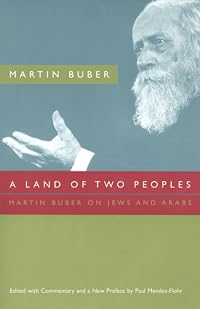
A Land of Two Peoples: Martin Buber on Jews and Arabs
by Martin Buber
On This Page
Description
"Theologian, philosopher, and political radical Martin Buber (1878-1965) was actively committed to a fundamental economic and political reconstruction of society as well as the pursuit of international peace. This new edition of A Land of Two Peoples collects some of Buber's voluminous writings on Arab-Jewish relations in Palestine. The private and open letters, addresses, and essays in this volume unite Buber's religious and philosophical teachings with his politics, which he felt were show more essential to a life of public dialogue and service to God. A committed Zionist, Buber steadfastly articulated the moral necessity for reconciliation and accommodation between the Arabs and Jews. The writings collected here are unified in Buber's call for binationalism as a solution to the conflict in the Middle East. From the Balfour Declaration of November 1917 to his death in 1965, he campaigned passionately for a "one state solution." This timely reprint, which includes new forewords by Paul Mendes-Flohr and Raef Zreik, offers context and depth to current affairs in Israel and Palestine"-- show lessTags
Recommendations








































Member Reviews
The first time I read Martin Buber, I gave up after a few pages. The second time, too. But something kept pulling me back—his reputation, his connection to Judaism, and the rumor that he’d opposed the very zionist project he helped enable. So I picked up A Land of Two Peoples and tried again.
This book gave me whiplash; one moment Buber was my hero and I was in complete agreement with him, and then suddenly he'd say something super arrogant or racist and I'd want to fight him. Martin Buber was, like all of us, a complex human being with complex thoughts and feelings; he was obviously very principled and a deep humanist, but also couldn't rid himself of his belief in nationalism and the superiority of the Jewish race. But he has been show more called a moral voice for Jews for many generations and, while he's not a hero by any means, he did have some really good stuff to say.
I have sympathy for those who seek safety. I have even more sympathy to the Jews in the 19th and 20th century who desired a homeland after thousands of years of pogroms and horrible mistreatment everywhere they went. I lost a great percentage of my family in the holocaust and after, when they tried to return home only to find out they no longer had one, many of them wanted to go to Palestine. I'm glad my grandparents didn't succeed, but I could have easily been a Sabra. Unfortunately, none of this excuses what came next.
Buber was the voice for all the Jews who had a problem with wiping out an entire people, with stealing land, with committing atrocities in the name of their own safety; but he was still a bit of a supremacist. Not once in this 305 page book does he refer to Palestinians as anything but Arabs, minimizing their unique culture. There were so many times throughout these essays that Buber refers to the ignorance of the Arabs; the biggest one perhaps is his claim that the soil loves Jews more than Arabs and that Jews had done more for the land in 50 years than Arabs had in 1200. At times he sounds exactly like the European colonizers (the ones we needed to escape from) and the way they talked about the native population on Turtle Island. The closest I came to putting this book down was when I read, “[Israel] is the one people which was sent on the road of its history by commandment of the Divine Power.” Barf. That line, like many others, reminded me that for all Buber’s moral courage, he never stopped seeing Jews as uniquely chosen—a belief that shaped both his ethics and his blind spots.
We're all full of contradictions, but when they come from a great thinking like Buber and when they involve the humanity of people, they can be a little harder to take. Buber claims to have solid ethics—repeatedly insisting the ends are the means, that killing people to achieve safety does not work—while also sticking to his guns that Jews have a legitimate claim to Palestinian land. In one essay he'll say something like “Independence of one's own must not be gained at the expense of another's independence,” but then follow that up a few essays later with “The best of us had no hope of remaining guiltless and unsullied for our future generations, for we knew we were reducing the space for future generations of the Arabs.” Pick a side Martin. The mental gymnastics one has to perform to recognize injustice, but lack the ability to remove oneself from the ideology that fuels it, must be exhausting. I can't think of a world in which I would call myself a zionist, yet Buber refuses to give up that title.
Despite what I've said so far, I did truly enjoy reading this book. His ability to use empathy—to try and place himself in the shoes of the Palestinians—is far too rare in our culture. He has the chutzpah to remind his fellow Jews to imagine “as if we were the residents of Palestine and the others were the immigrants who were coming into the country in increasing numbers, year by year, taking it away from us. How would we react to events?” He was also clear in his belief, throughout the book, that one people's freedom should never come at the expense of another's, even if he was unable to follow these thoughts far enough to renounce zionism.
There were times throughout A Land of Two Peoples where Buber felt like a comrade, like his ideas had been implanted into my head without ever having read them. He talks about how sacrificing Jewish values in order to take something that they feel like they have a right to, is the biggest form of assimilation. I'm constantly imagining a world without assimilation, a world where all cultures could keep their foundational beliefs and customs while getting along and thriving with other cultures. Buber did too. Perhaps the way in which I most related to him was in our mutual belief that the switch from a moral/ethical tradition to a colonial nation-state has done more than any enemy to destroy Judaism from the inside.
Buber also talked about dual power decades before I've seen anyone else, even if he didn't use that term. He insists that, instead of sucking up to Britain and other European nations, they should work together with the people already living there to create something that would make British rule obsolete. He wanted one state where all of the inhabitants are treated equally and have an fair share in steering the ship. Eventually he moved on from this to talk about a Near East Federation that would be similar to the United States. These are suggestions that appear naive (something I've been called a lot in my day) but points toward solidarity instead of domination.
He also recognized that, to put it too simply, hurt people hurt people. That perhaps thousands of years of attempted extermination, culminating in the holocaust, has created a situation where “after an action of extermination of this kind, the poor human soul is inclined to see extermination lurking everywhere.” This was obvious even in the 1940s, but is even more glaring today. The paranoia of zionists is disgusting and see through, and it baffles me why the world can't see this.
Obviously I have some mixed feelings about this book and its writer. His essays and speeches are full of contradictions, many of them painful, but he tried. Perhaps more than anyone else at the time. While he couldn't free himself from arrogance and racism, he created a path for this generations anti-zionists to follow. show less
This book gave me whiplash; one moment Buber was my hero and I was in complete agreement with him, and then suddenly he'd say something super arrogant or racist and I'd want to fight him. Martin Buber was, like all of us, a complex human being with complex thoughts and feelings; he was obviously very principled and a deep humanist, but also couldn't rid himself of his belief in nationalism and the superiority of the Jewish race. But he has been show more called a moral voice for Jews for many generations and, while he's not a hero by any means, he did have some really good stuff to say.
I have sympathy for those who seek safety. I have even more sympathy to the Jews in the 19th and 20th century who desired a homeland after thousands of years of pogroms and horrible mistreatment everywhere they went. I lost a great percentage of my family in the holocaust and after, when they tried to return home only to find out they no longer had one, many of them wanted to go to Palestine. I'm glad my grandparents didn't succeed, but I could have easily been a Sabra. Unfortunately, none of this excuses what came next.
Buber was the voice for all the Jews who had a problem with wiping out an entire people, with stealing land, with committing atrocities in the name of their own safety; but he was still a bit of a supremacist. Not once in this 305 page book does he refer to Palestinians as anything but Arabs, minimizing their unique culture. There were so many times throughout these essays that Buber refers to the ignorance of the Arabs; the biggest one perhaps is his claim that the soil loves Jews more than Arabs and that Jews had done more for the land in 50 years than Arabs had in 1200. At times he sounds exactly like the European colonizers (the ones we needed to escape from) and the way they talked about the native population on Turtle Island. The closest I came to putting this book down was when I read, “[Israel] is the one people which was sent on the road of its history by commandment of the Divine Power.” Barf. That line, like many others, reminded me that for all Buber’s moral courage, he never stopped seeing Jews as uniquely chosen—a belief that shaped both his ethics and his blind spots.
We're all full of contradictions, but when they come from a great thinking like Buber and when they involve the humanity of people, they can be a little harder to take. Buber claims to have solid ethics—repeatedly insisting the ends are the means, that killing people to achieve safety does not work—while also sticking to his guns that Jews have a legitimate claim to Palestinian land. In one essay he'll say something like “Independence of one's own must not be gained at the expense of another's independence,” but then follow that up a few essays later with “The best of us had no hope of remaining guiltless and unsullied for our future generations, for we knew we were reducing the space for future generations of the Arabs.” Pick a side Martin. The mental gymnastics one has to perform to recognize injustice, but lack the ability to remove oneself from the ideology that fuels it, must be exhausting. I can't think of a world in which I would call myself a zionist, yet Buber refuses to give up that title.
Despite what I've said so far, I did truly enjoy reading this book. His ability to use empathy—to try and place himself in the shoes of the Palestinians—is far too rare in our culture. He has the chutzpah to remind his fellow Jews to imagine “as if we were the residents of Palestine and the others were the immigrants who were coming into the country in increasing numbers, year by year, taking it away from us. How would we react to events?” He was also clear in his belief, throughout the book, that one people's freedom should never come at the expense of another's, even if he was unable to follow these thoughts far enough to renounce zionism.
There were times throughout A Land of Two Peoples where Buber felt like a comrade, like his ideas had been implanted into my head without ever having read them. He talks about how sacrificing Jewish values in order to take something that they feel like they have a right to, is the biggest form of assimilation. I'm constantly imagining a world without assimilation, a world where all cultures could keep their foundational beliefs and customs while getting along and thriving with other cultures. Buber did too. Perhaps the way in which I most related to him was in our mutual belief that the switch from a moral/ethical tradition to a colonial nation-state has done more than any enemy to destroy Judaism from the inside.
Buber also talked about dual power decades before I've seen anyone else, even if he didn't use that term. He insists that, instead of sucking up to Britain and other European nations, they should work together with the people already living there to create something that would make British rule obsolete. He wanted one state where all of the inhabitants are treated equally and have an fair share in steering the ship. Eventually he moved on from this to talk about a Near East Federation that would be similar to the United States. These are suggestions that appear naive (something I've been called a lot in my day) but points toward solidarity instead of domination.
He also recognized that, to put it too simply, hurt people hurt people. That perhaps thousands of years of attempted extermination, culminating in the holocaust, has created a situation where “after an action of extermination of this kind, the poor human soul is inclined to see extermination lurking everywhere.” This was obvious even in the 1940s, but is even more glaring today. The paranoia of zionists is disgusting and see through, and it baffles me why the world can't see this.
Obviously I have some mixed feelings about this book and its writer. His essays and speeches are full of contradictions, many of them painful, but he tried. Perhaps more than anyone else at the time. While he couldn't free himself from arrogance and racism, he created a path for this generations anti-zionists to follow. show less
Ratings
Members
- Recently Added By
Author Information

246+ Works 12,966 Members
Martin Buber was born in Vienna, the son of Solomon Buber, a scholar of Midrashic and medieval literature. Martin Buber studied at the universities of Vienna, Leipzig, Zurich, and Berlin, under Wilhelm Dilthey and Georg Simmel. As a young student, he joined the Zionist movement, advocating the renewal of Jewish culture as opposed to Theodor show more Herzl's political Zionism. At age 26 he became interested in Hasidic thought and translated the tales of Nahman of Bratslav. Hasidism had a profound impact on Buber's thought. He credited it as being the inspiration for his theories of spirituality, community, and dialogue. Buber is responsible for bringing Hasidism to the attention of young German intellectuals who previously had scorned it as the product of ignorant eastern European Jewish peasants. Buber also wrote about utopian socialism, education, Zionism, and respect for the Palestinian Arabs, and, with Franz Rosenzweig, he translated the Bible. He was appointed to a professorship at the University of Frankfurt in 1925, but, when the Nazis came to power, he received an appointment at the Hebrew University of Jerusalem. Buber died in 1965. (Bowker Author Biography) show less
Classifications
- Genres
- Nonfiction, History, Religion & Spirituality, General Nonfiction
- DDC/MDS
- 956.94 — History & geography History of Asia Middle East Asia: Turkey, Iraq, Syria, Lebanon, Israel, Jordan The Levant Israel and Palestine
- LCC
- DS119.7 .B75 — History of Europe, Asia, Africa and Oceania Asia History of Asia Israel (Palestine). The Jews
- BISAC
Statistics
- Members
- 57
- Popularity
- 538,195
- Reviews
- 1
- Rating
- (4.50)
- Languages
- English, German, Italian, Spanish
- Media
- Paper
- ISBNs
- 8