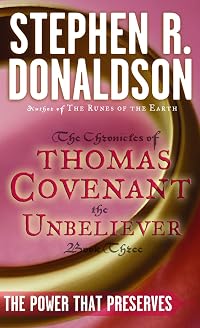
The Power That Preserves
by Stephen R. Donaldson
The Complete Chronicles of Thomas Covenant (3), The First Chronicles of Thomas Covenant, The Unbeliever (3)
On This Page
Description
Twice before Thomas Covenant had been summoned to the strange otherworld where magic worked. Twice before he had been forced to join with the Lords of Revelstone in their war against Lord Foul, the ancient enemy of the Land. Now he was back--to a Land ravaged by the armies of Lord Foul. The Lords were besieged and helpless. No place was safe, and Foul's victory seemed certain. Only Covenant could avert it. Desperately and without hope, he set out to confront the might of the Enemy. Along show more with him traveled a Giant, a Bloodguard, and the madwoman he had wronged. And in Foul's Creche, Lord Foul grew in power with each new defeat for the Land. . . . show lessTags
Recommendations









Member Reviews
Leprosy is killing Thomas Covenant. Lord Foul is killing the Land. For three books, Covenant has shifted between these worlds: our Earth where he is a despised outcast, and the Land where the Despiser manipulates his unbelief to bring the Land to the brink of endless corruption. Now that the destiny Covenant has fought so hard to escape is upon him, will he save the Land or damn it forever?
The Covenant books tend to divide readers into camps of love and hate. I fall in the middle, but I throw in with the love camp in a pinch. I do think the books are overwritten; Donaldson himself has admitted he’s a sucker for wordplay, and it shows in the way words tend to pile up for pages and pages.
But once you set aside the purple prose and show more (very) long descriptions, it seems that those who hate these books just hate Thomas Covenant. They find him a thoroughly putrid protagonist, irritating and reprehensible. They loathe the guy, and so they loathe the books.
I know I’m a weirdo, but this is why I found the trilogy refreshingly interesting. Donaldson isn’t afraid to present us with a central character whose affliction has hollowed him out, transforming him into a hard ball of hatred and suspicion and paranoia who must always put himself first if he means to survive.
After all, a leper doesn’t have the luxury of being a hero, not when the slightest injury can mean a gruesome and lingering death; and Covenant is a master of not being a hero.
By the time we reach this final book of the first trilogy, the kindness of the people of the Land has softened Covenant considerably; but to get to this point, his redemptive arc has ripped through a host of mangled bodies. His unwillingness to endanger himself in any way has destroyed lives and imperiled the very Land that offers him redemption.
Covenant is finally forced to face the consequences of his unbelief, bringing up a profound moral question: is it truly possible to expiate sin? If your injustice shatters lives beyond repair, whether by active crime or aloof passivity, what are you supposed to do with that guilt?
Donaldson, as the son of Presbyterian missionaries, clearly isn’t satisfied with the answer he grew up with. For him, there is no “Get Out of Jail Free” card nailed to a cross. Sure, people may choose to forgive you your trespasses, but you still trespassed. You can’t undo the damage you did.
What you can do, though, is summarized in the proverb of Atiaran Trell-mate, herself a tragic victim of Covenant’s unbelief: “It is the duty of the living to make meaningful the sacrifices of the dead.”
If you truly want to expiate your guilt, it will take more than a sincere apology. You owe a debt to the people you’ve hurt, a debt that binds you to give meaning to their suffering. If you preserved yourself at another’s expense, then you’d better make their sacrifice meaningful by fighting for good, even if that means traversing the Spoiled Plains to an apocalyptic showdown with the Gray Slayer himself.
Is this satisfying moral ground? Your mileage may vary, and the mileage of many of Donaldson’s readers does vary. But I appreciate any author who even attempts to wrestle these sorts of answers to the ground.
Too many writers can’t be bothered with the paradoxes of morality, either taking refuge in comfortable heroisms or leaving it up to you, the reader at home, to decide what’s right for you. Donaldson by contrast hands us a moral disaster with no easy answers, tells us what he thinks, and hasn’t the slightest concern about whether or not we feel good about it.
This really grinds a lot of readers' gears, but I like a book that smacks me in the face and says, “What are you gonna do about it?” If you’re that kind of weirdo, then you might like this trilogy as well. show less
The Covenant books tend to divide readers into camps of love and hate. I fall in the middle, but I throw in with the love camp in a pinch. I do think the books are overwritten; Donaldson himself has admitted he’s a sucker for wordplay, and it shows in the way words tend to pile up for pages and pages.
But once you set aside the purple prose and show more (very) long descriptions, it seems that those who hate these books just hate Thomas Covenant. They find him a thoroughly putrid protagonist, irritating and reprehensible. They loathe the guy, and so they loathe the books.
I know I’m a weirdo, but this is why I found the trilogy refreshingly interesting. Donaldson isn’t afraid to present us with a central character whose affliction has hollowed him out, transforming him into a hard ball of hatred and suspicion and paranoia who must always put himself first if he means to survive.
After all, a leper doesn’t have the luxury of being a hero, not when the slightest injury can mean a gruesome and lingering death; and Covenant is a master of not being a hero.
By the time we reach this final book of the first trilogy, the kindness of the people of the Land has softened Covenant considerably; but to get to this point, his redemptive arc has ripped through a host of mangled bodies. His unwillingness to endanger himself in any way has destroyed lives and imperiled the very Land that offers him redemption.
Covenant is finally forced to face the consequences of his unbelief, bringing up a profound moral question: is it truly possible to expiate sin? If your injustice shatters lives beyond repair, whether by active crime or aloof passivity, what are you supposed to do with that guilt?
Donaldson, as the son of Presbyterian missionaries, clearly isn’t satisfied with the answer he grew up with. For him, there is no “Get Out of Jail Free” card nailed to a cross. Sure, people may choose to forgive you your trespasses, but you still trespassed. You can’t undo the damage you did.
What you can do, though, is summarized in the proverb of Atiaran Trell-mate, herself a tragic victim of Covenant’s unbelief: “It is the duty of the living to make meaningful the sacrifices of the dead.”
If you truly want to expiate your guilt, it will take more than a sincere apology. You owe a debt to the people you’ve hurt, a debt that binds you to give meaning to their suffering. If you preserved yourself at another’s expense, then you’d better make their sacrifice meaningful by fighting for good, even if that means traversing the Spoiled Plains to an apocalyptic showdown with the Gray Slayer himself.
Is this satisfying moral ground? Your mileage may vary, and the mileage of many of Donaldson’s readers does vary. But I appreciate any author who even attempts to wrestle these sorts of answers to the ground.
Too many writers can’t be bothered with the paradoxes of morality, either taking refuge in comfortable heroisms or leaving it up to you, the reader at home, to decide what’s right for you. Donaldson by contrast hands us a moral disaster with no easy answers, tells us what he thinks, and hasn’t the slightest concern about whether or not we feel good about it.
This really grinds a lot of readers' gears, but I like a book that smacks me in the face and says, “What are you gonna do about it?” If you’re that kind of weirdo, then you might like this trilogy as well. show less
The awesomeness of this book almost makes up for the tortuousness of the first book, and part of the 2nd book. Donaldson is an expert at writing about suffering. Every character in these books suffers from start to almost finish. A couple get lucky and make it to the end still alive, heavily scarred. I've seen this kind of plot structure in story arcs in comic books. Just completely beat the hell out of the heroes, make it seem like there's absolutely no way the good guys can win, and then they do. Except that Donaldson makes it so painful, that in the end you don't know if they really did win, considering how broken and damaged they are now. And unlike comic books, these heroes don't come back.
I guess, it's kind of original in fantasy show more novels, so I appreciate that, just not sure I want to read more of it. I hated Covenant almost the entire time. When one of his companions was someone who he had wronged and they loved him, I was delighted by thinking that he would suffer for it. Then I realized that he loves suffering and was always looking for a reason to be even more negative, so that ruined it for me.
BUT this still got 4 stars. What I loved, corrupted giants, friendly giants, ancient artifacts of power, huge sieges of ancient strongholds, lots and lots of magic, the deep history of the land, and of course, finally some good news for the good guys. About that good news, a couple people have talked about the "victory chapter". I loved it, but it seems like the key to it was "the oath of peace", which always seemed kind of lame to me. Like, "our whole world is being destroyed and everyone is being killed, but we better be nice and make sure we don't hurt the bad guys too much, unless we absolutely have to." Again, it almost became like a superhero trope, "we don't kill villains". show less
I guess, it's kind of original in fantasy show more novels, so I appreciate that, just not sure I want to read more of it. I hated Covenant almost the entire time. When one of his companions was someone who he had wronged and they loved him, I was delighted by thinking that he would suffer for it. Then I realized that he loves suffering and was always looking for a reason to be even more negative, so that ruined it for me.
BUT this still got 4 stars. What I loved, corrupted giants, friendly giants, ancient artifacts of power, huge sieges of ancient strongholds, lots and lots of magic, the deep history of the land, and of course, finally some good news for the good guys. About that good news, a couple people have talked about the "victory chapter". I loved it, but it seems like the key to it was "the oath of peace", which always seemed kind of lame to me. Like, "our whole world is being destroyed and everyone is being killed, but we better be nice and make sure we don't hurt the bad guys too much, unless we absolutely have to." Again, it almost became like a superhero trope, "we don't kill villains". show less
Mixed feelings abound about this last in the initial trilogy for Thomas Covenant the Unbeliever - some think this was the best of the first three books, others the worst. I suppose I'm somewhere in the middle. I still found it a good book, but feel as though Donaldson's narrative wanes throughout the book, until the last hundred pages or so. It must be hard to sustain a narrative over so many pages and continue to bring something new to the story, and I felt the strain of it through the middle. Nonetheless, I still think that Donaldson's world-building and creativity are above the field, as so many of these adventure McGuffins are so much Tolkein detritus. I won't get into the story, as so many of you already know that Covenant doesn't show more believe but does, as he accidentally succeeds in saving a world he can't place in either his mind or in another dimension of reality.
Recommended!!!!
4 bones!!!! show less
Recommended!!!!
4 bones!!!! show less
Spurred on by having the first two books of his Last Chronicles of Thomas Covenant on my shelf and knowing that the third and final should be out soon, I embarked on re-reading the first two trilogies, or Chronicles. Rather than review them separately, I thought I would treat each Chronicle as a whole, as I cannot concieve of not finishing any of the Chronicles once they grab hold of you. Although many disparage Stephen Donaldson’s writing, I don’t have any problem with it and like that I sometimes have to grab the dictionary to understand a work he has used. In fact, that is one of the joys of reading him as I like to be challenged with vocabulary while I read.
The Land itself is an incredible creation that for me is one of the show more greatest joys of reading his Chronicles and an incredible achievement for Donaldson, on par with the creation of J.R.R. Tolkien’s Middle-earth. The land and its inhabitants are alive with health and sentience; manifested in EarthPower. The people of the land can sense the right and wrong in rock, tree, water, and fire, as well as in themselves. When their earth-sense lets them down or where despite and evil creep into the land, it has some defenses of its own. This earth-sense is something that resonates deep in my soul and in that part of me that treasures our earth. I wish I had a little more EarthSense. He has also peopled The Land with many strange and interesting inhabitants, good and bad: the giants, the Ranyhyn, Forestals, the Bloodguard, Elohim, Sand Gorgons, Merewives, Ravers, Ur-Viles and the like.
Were the books as good as I remember from reading them in my college days 20+ years ago? Suprisingly, yes. Although I still like the genre and read it occasionally, I have moved on from those times when this was my primary source of literary escape. But I found that the books have held up very well in the time since my last read. I would highly recommend them to readers interested in one of the early masters of the genre.
In The Power That Preserves, the first Chronicles come to an amazing climax. Another seven years have passed in the land when Covenant is summoned in their need. Again there is war in The Land and the Lord’s are hard-pressed by Lord Foul’s armies while Covenant tries to go it alone against the Despiser. This is a fitting and well-written end to the trilogy that ties together many of the loose ends from the first two books. In my opinion, it can stand alone. I’m not sure if Donaldson already had plans for the Second Chronicles at the time of this writing or not. show less
The Land itself is an incredible creation that for me is one of the show more greatest joys of reading his Chronicles and an incredible achievement for Donaldson, on par with the creation of J.R.R. Tolkien’s Middle-earth. The land and its inhabitants are alive with health and sentience; manifested in EarthPower. The people of the land can sense the right and wrong in rock, tree, water, and fire, as well as in themselves. When their earth-sense lets them down or where despite and evil creep into the land, it has some defenses of its own. This earth-sense is something that resonates deep in my soul and in that part of me that treasures our earth. I wish I had a little more EarthSense. He has also peopled The Land with many strange and interesting inhabitants, good and bad: the giants, the Ranyhyn, Forestals, the Bloodguard, Elohim, Sand Gorgons, Merewives, Ravers, Ur-Viles and the like.
Were the books as good as I remember from reading them in my college days 20+ years ago? Suprisingly, yes. Although I still like the genre and read it occasionally, I have moved on from those times when this was my primary source of literary escape. But I found that the books have held up very well in the time since my last read. I would highly recommend them to readers interested in one of the early masters of the genre.
In The Power That Preserves, the first Chronicles come to an amazing climax. Another seven years have passed in the land when Covenant is summoned in their need. Again there is war in The Land and the Lord’s are hard-pressed by Lord Foul’s armies while Covenant tries to go it alone against the Despiser. This is a fitting and well-written end to the trilogy that ties together many of the loose ends from the first two books. In my opinion, it can stand alone. I’m not sure if Donaldson already had plans for the Second Chronicles at the time of this writing or not. show less
Covenant returns to The Land one more time in this last book of the first trilogy. This time, the tolkienoid element is partially diluted with a lewisian (C. S., that is) element: Lord Foul has the Staff of Law and has imprisoned the ghost of Covenant's daughter, Elena. Foul's dominion causes the land to face a perpetual winter.
Oh, if only Aslan would come... I mean, Thomas Covenant. Entering the land after witnessing a girl getting bitten by a rattlesnake, he tries to detach himself from the Land, which he's still not fully convinced is not a dream, and returns to the real world to save the girl. However, he soon is poisoned after sucking out the venom, and back to the Land he goes.
Here, he teams up with the last uncorrupted Giant, show more Saltheart Foamfollower, and the two must save the Land, Elena's ghost, and relieve Foul of the Staff of Law.
Donaldson, by far, is the best of the tolkienoid authors. His works lovingly borrow from the fantasy tomes that came before his. Although the major artifact of his fantasy world is a white gold ring, this right of wild magic, is less like the One Ring than other authors' artifacts of power (say, a sword, or a stone that eventually becomes a pommel). If you're anything like me, you'll find his fantasy world to be much less annoying than Brooks' and Eddings'.
I recommend this series to all of you who like epic fantasy, and want something better than McDonalds, but not quite Smith & Wollensky. show less
Oh, if only Aslan would come... I mean, Thomas Covenant. Entering the land after witnessing a girl getting bitten by a rattlesnake, he tries to detach himself from the Land, which he's still not fully convinced is not a dream, and returns to the real world to save the girl. However, he soon is poisoned after sucking out the venom, and back to the Land he goes.
Here, he teams up with the last uncorrupted Giant, show more Saltheart Foamfollower, and the two must save the Land, Elena's ghost, and relieve Foul of the Staff of Law.
Donaldson, by far, is the best of the tolkienoid authors. His works lovingly borrow from the fantasy tomes that came before his. Although the major artifact of his fantasy world is a white gold ring, this right of wild magic, is less like the One Ring than other authors' artifacts of power (say, a sword, or a stone that eventually becomes a pommel). If you're anything like me, you'll find his fantasy world to be much less annoying than Brooks' and Eddings'.
I recommend this series to all of you who like epic fantasy, and want something better than McDonalds, but not quite Smith & Wollensky. show less
The end of the first trilogy.
Thomas can't come to terms with the death of his daughter who never existed. Ignoring the peril of his leprosy his physical condition deteriorates until he can barely keep himself upright. When he stumbles across a girl bitten by a rattlesnake it is all he can do to try and save her. Unfortunetly the Land calls for him but he his able to reject all their increased suffering in order to save her. When he finally succombs to the Land's call he is not in Revelstone where he expected to be, but back at Mithal Stonedown in the depths of Lord Foul's extended winter. His dying state and the breaking of the natural Law in the last book have enabled him to be summoned by lesser powers, Triock and the Giant Saltheart show more Foamfollower. Covenant quickly learns that the end is nigh for the Land, Winter has extended deep into spring and he cannot regain his previous health. With anger at Elena's and the Land's troubles still frothing in his breast he treks across the Land once more to bring Foul's Creche down around his ears. As if Anger was ever an answer for Despite. But Covenant learns this.
Meanwhile we watch the remaining army batter at Revelstone's gates, and the increasingly dire straights the desperate defenders of the land are put to, whilst staving of the despair that is so dangerous to them. As with the previous books these episodes in some way spoil the essential dilemma - is Thomas brave or a coward, does the land exist or not? When the narrative focuses on Lord Mhoram's despair then it is all too easy to believe the Land is real, something that Covenant never admits.
Much much darker than the previous two books, although less violence without the Land's healing abilities Covenant's leprosy intrudes more, as does his feelings about it, the penetrating cold also leaches from the pages. In general it is Covenant's weakness and dependance that is the overriding darkness to the book, especially the many pages he spends getting no further than Roamsedge. His companions are of no greater cheer either, and Ravers are especially depressing.
However it is a worthy ending to the trilogy, loose ends are firmly tied off, there are satisfyingly calmactic final battles, and while Thomas is never going to get a "happy ending" he does manage to come to terms with some issues.
If you've even vaguely enjoyed the first two books, read it! show less
Thomas can't come to terms with the death of his daughter who never existed. Ignoring the peril of his leprosy his physical condition deteriorates until he can barely keep himself upright. When he stumbles across a girl bitten by a rattlesnake it is all he can do to try and save her. Unfortunetly the Land calls for him but he his able to reject all their increased suffering in order to save her. When he finally succombs to the Land's call he is not in Revelstone where he expected to be, but back at Mithal Stonedown in the depths of Lord Foul's extended winter. His dying state and the breaking of the natural Law in the last book have enabled him to be summoned by lesser powers, Triock and the Giant Saltheart show more Foamfollower. Covenant quickly learns that the end is nigh for the Land, Winter has extended deep into spring and he cannot regain his previous health. With anger at Elena's and the Land's troubles still frothing in his breast he treks across the Land once more to bring Foul's Creche down around his ears. As if Anger was ever an answer for Despite. But Covenant learns this.
Meanwhile we watch the remaining army batter at Revelstone's gates, and the increasingly dire straights the desperate defenders of the land are put to, whilst staving of the despair that is so dangerous to them. As with the previous books these episodes in some way spoil the essential dilemma - is Thomas brave or a coward, does the land exist or not? When the narrative focuses on Lord Mhoram's despair then it is all too easy to believe the Land is real, something that Covenant never admits.
Much much darker than the previous two books, although less violence without the Land's healing abilities Covenant's leprosy intrudes more, as does his feelings about it, the penetrating cold also leaches from the pages. In general it is Covenant's weakness and dependance that is the overriding darkness to the book, especially the many pages he spends getting no further than Roamsedge. His companions are of no greater cheer either, and Ravers are especially depressing.
However it is a worthy ending to the trilogy, loose ends are firmly tied off, there are satisfyingly calmactic final battles, and while Thomas is never going to get a "happy ending" he does manage to come to terms with some issues.
If you've even vaguely enjoyed the first two books, read it! show less
After a long period of waiting for something to happen, I finally find myself liking a book in this trilogy. It took until the middle of the book, granted, but then I flew right through it. The pace picked up, the characters gained interest. It was good, but I'm sad that it was so long coming. However, saying that, I must emphasize again that Donaldson's style is a much vaguer, slower-paced style than I prefer to start with, so those who like that type of writing style will have probably liked this book from the beginning.
Donaldson leaves a lot unexplained, right from the beginning. A great deal of the start of the book leaves the reader following Covenant around in a short of delusional stupor, and later the reader will see glimpses show more into certain perspectives that are truly irrelevant to the story - or, if they are relevant, Donaldson did not clearly explain how.
I made a note to myself after about the first hundred pages pending an incident: "Given any sort of logic, we'd never see Triock again, but even though many of Donaldson's side-exploits seem to be pointless and end in people dying, people don't seem to die. But they still seem pointless." A little harsh, perhaps, but it remains true. It's said that "if you don't see the corpse, they are not dead," and that prove true of several characters in the trilogy, so many that it was becoming predictable, and a bit disappointing. I think perhaps that the point was that Covenant's ghosts were coming back to haunt him, but I'm not certain.
Ultimately, I didn't love the trilogy, but nor can I say I hated it. Much of my opinion on the book, I am consciously aware, has to do with my preference in books, and not the shortcomings of the writer. He has many fans, and has them for a reason. show less
Donaldson leaves a lot unexplained, right from the beginning. A great deal of the start of the book leaves the reader following Covenant around in a short of delusional stupor, and later the reader will see glimpses show more into certain perspectives that are truly irrelevant to the story - or, if they are relevant, Donaldson did not clearly explain how.
I made a note to myself after about the first hundred pages pending an incident: "Given any sort of logic, we'd never see Triock again, but even though many of Donaldson's side-exploits seem to be pointless and end in people dying, people don't seem to die. But they still seem pointless." A little harsh, perhaps, but it remains true. It's said that "if you don't see the corpse, they are not dead," and that prove true of several characters in the trilogy, so many that it was becoming predictable, and a bit disappointing. I think perhaps that the point was that Covenant's ghosts were coming back to haunt him, but I'm not certain.
Ultimately, I didn't love the trilogy, but nor can I say I hated it. Much of my opinion on the book, I am consciously aware, has to do with my preference in books, and not the shortcomings of the writer. He has many fans, and has them for a reason. show less
Members
- Recently Added By
Lists

NPRs your picks: top 100 Sci-Fi/Fantasy books
297 works; 80 members

Blue Pyramid 1,276 Best Books of All Time
1,248 works; 32 members
Author Information

93+ Works 54,855 Members
Stephen Donaldson, 1947 - Novelist Stephen Donaldson was born on May 13, 1947 in Cleveland, Ohio to James R. Donaldson, a medical missionary, and Mary Ruth Reeder, a prosthetist. His father was an orthopedic surgeon that worked with lepers in India. He lived in India between the ages of three to sixteen and while listening to one of his father's show more lectures on leprosy, he conceived the legendary Thomas Covenant. Donaldson attended the College of Wooster, Ohio and graduated in 1968. Afterwards, he spent two years being a conscientious objector doing hospital work in Akron and then attended Kent University where he received an M.A. in English. Donaldson's publishing debut was with "Lord Foul's Bane" (1977), which was the first book in the fantasy trilogy entitled The Chronicles of Thomas Covenant, the Unbeliever. It was named best novel of the year by the British Fantasy Society and received the John W. Campbell Award for Best New Writer, in 1979. He followed with the sequel series The Second Chronicles of Thomas Covenant, also set in The Land, starting with "Daughter of Regals," and then the Mordant's Need series with "The Mirror of Her Dreams" and "A Man Rides Through." Donaldson is also the author of the Gap Into series of science fiction adventure that began with "The Real Story" and followed with "Forbidden Knowledge," "A Dark and Hungry God Arises," and "Chaos and Order." In addition to the awards he received for his first novel/series, Donaldson has also received the Balrog Fantasy Award for Best Novel for "The Wounded Land" in 1981 and for "The One Tree" in 1983, the Saturn Award for Best Fantasy Novel for "The One Tree" in 1983, the Balrog Fantasy Award for Best Collection for "Daughter of Regals and Other Tales" in 1985, and the Science Fiction Book Club Award for Best Book of the Year for "The Mirror of Her Dreams" in 1988 and "A Man Rides Through" in 1989. He also received The College of Wooster Distinguished Alumni Award in 1989, the WIN/WIN Popular Fiction Readers Choice Award for Favorite Fantasy Author in 1991, the Atlanta Fantasy Fair Award for Outstanding Achievement in 1992 and the President's Award, The International Association for the Fantastic in the Arts in 1997. (Bowker Author Biography) show less
Some Editions
Series

The Complete Chronicles of Thomas Covenant
10 works (3)

The First Chronicles of Thomas Covenant, The Unbeliever
3 works (3)
Belongs to Publisher Series
Heyne Science Fiction & Fantasy (06/3839)
Work Relationships
Common Knowledge
- Canonical title
- The Power That Preserves
- Original title
- The Power That Preserves
- Alternate titles
- The First Chronicles of Thomas Covenant, the Unbeliever Volume 3: The Power That Preserves
- Original publication date
- 1977
- People/Characters
- Thomas Covenant; Elena; Mhoram; Lord Foul; Satansfist; Triock (show all 11); Lena, daughter of Atiaran; Drool Rockworm; Saltheart Foamfollower; Bannor; the Creator
- Important places
- The Land; Revelstone; Kevin's Watch; Plains of Ra; Ridjeck Thome; Arch of Time
- Important events
- the Illearth War
- Epigraph
- Be true, Unbeliever
- Dedication
- For James R. Donaldson, M.D.,
whose life expressed compassion
and commitment more eloquently
than any words. - First words
- Thomas Covenant was talking in his sleep.
- Last words
- (Click to show. Warning: May contain spoilers.)Despite the stiff pain in his lip, he smiled at the empty room. He felt the smile on his face, and was sure of it.
He smiled because he was alive. - Blurbers
- Simak, Clifford D.; Bradley, Marion Zimmer; Bloch, Robert; Brooks, Terry
- Original language
- English
- Canonical DDC/MDS
- 813.087661
Classifications
- Genres
- Fantasy, Fiction and Literature
- DDC/MDS
- 813.087661 — Literature & rhetoric American literature in English American fiction in English By type Genre fiction Adventure fiction Speculative fiction Fantasy High fantasy
- LCC
- PZ4 .D6768 — Language and Literature Fiction and juvenile belles lettres Fiction and juvenile belles lettres Fiction in English
- BISAC
Statistics
- Members
- 4,756
- Popularity
- 2,995
- Reviews
- 34
- Rating
- (3.86)
- Languages
- 8 — Dutch, English, French, German, Italian, Polish, Spanish, Swedish
- Media
- Paper, Audiobook, Ebook
- ISBNs
- 43
- ASINs
- 39