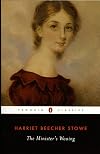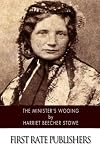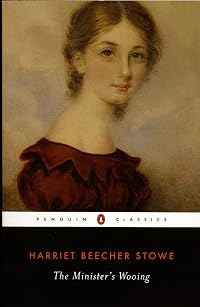
The Minister's Wooing
by Harriet Beecher Stowe
On This Page
Description
From the author of Uncle Tom's Cabin, The Minister's Wooing is a domestic comedy that examines slavery, Protestant theology, and gender differences in early America. First published in 1859, Harriet Beecher Stowe's third novel is set in eighteenth-century Newport, Rhode Island, a community known for its engagement in both religious piety and the slave trade. Mary Scudder lives in a modest farmhouse with her widowed mother and their boarder, Samuel Hopkins, a famous Calvinist theologian who show more preaches against slavery. Mary is in love with the passionate James Marvyn, but Mary is devout and James is a skeptic, and Mary's mother opposes the union. James goes to sea, and when he is reported drowned, Mary is persuaded to become engaged to Dr. Hopkins. With colourful characters, including many based on real figures, and a plot that hinges on romance, The Minister's Wooing combines comedy with regional history to show the convergence of daily life, slavery, and religion in post-Revolutionary New England. show lessTags
Recommendations













Member Reviews
Everyone talks about Uncle Tom. Well, this one was a shorter and simpler story to start with. Stowe has a good grasp of many things and, when she doesn't, manages to convey the importance of old social mores. It definitely made me want to go back to my American roots. I like the importance that she gives women, but Alcott does a better job of conveying something other than the cookie cutter role that they have to play.
Update: A lovely hidden gem. Try it. You might like it.
Update: A lovely hidden gem. Try it. You might like it.
Ratings
Members
- Recently Added By
Lists

Fiction (Mostly) in Selective Bibliography of American Literature 1775-1900
431 works; 3 members

F. B. Perkins' List of 100 Best Fiction
100 works; 5 members
150 Best Novels Selected by Brander Matthews (1883)
150 works; 7 members
Author Information

259+ Works 22,875 Members
Harriet Beecher was born in Litchfield, Connecticut, one of nine children of the distinguished Congregational minister and stern Calvinist, Lyman Beecher. Of her six brothers, five became ministers, one of whom, Henry Ward Beecher, was considered the finest pulpit orator of his day. In 1832 Harriet Beecher went with her family to Cincinnati, Ohio. show more There she taught in her sister's school and began publishing sketches and stories. In 1836 she married the Reverend Calvin E. Stowe, one of her father's assistants at the Lane Theological Seminary and a strong antislavery advocate. They lived in Cincinnati for 18 years, and six of her children were born there. The Stowes moved to Brunswick, Maine, in 1850, when Calvin Stowe became a professor at Bowdoin College. Long active in abolition causes and knowledgeable about the atrocities of slavery both from her reading and her years in Cincinnati, with its close proximity to the South, Stowe was finally impelled to take action with the passage of the Fugitive Slave Act in 1850. By her own account, the idea of Uncle Tom's Cabin (1852) first came to her in a vision while she was sitting in church. Returning home, she sat down and wrote out the scene describing the death of Uncle Tom and was so inspired that she continued to write on scraps of grocer's brown paper after her own supply of writing paper gave out. She then wrote the book's earlier chapters. Serialized first in the National Era (1851--52), an important abolitionist journal with national circulation, Uncle Tom's Cabin was published in book form in March 1852. It was an immediate international bestseller; 10,000 copies were sold in less than a week, 300,000 within a year, and 3 million before the start of the Civil War. Family legend tells of President Abraham Lincoln (see Vol. 3) saying to Stowe when he met her in 1862: "So this is the little lady who made this big war?" Whether he did say it or not, we will never know, since Stowe left no written record of her interview with the president. But he would have been justified in saying it. Certainly, no other single book, apart from the Bible, has ever had any greater social impact on the United States, and for many years its enormous historical interest prevented many from seeing the book's genuine, if not always consistent, literary merit. The fame of the novel has also unfortunately overshadowed the fiction that Stowe wrote about her native New England: The Minister's Wooing (1859), Oldtown Folks (1869), Poganuc People (1878), and The Pearl of Orr's Island (1862), the novel that, according to Sarah Orne Jewett, began the local-color movement in New England. Here Stowe was writing about the world and its people closest and dearest to her, recording their customs, their legends, and their speech. As she said of one of these novels, "It is more to me than a story. It is my resume of the whole spirit and body of New England." (Bowker Author Biography) Harriet Beecher Stowe (1811-1896) remains one of the most influential writers in American history. Following the publication of "Uncle Tom's Cabin" she became an instant celebrity, speaking against slavery in the United States & Europe. (Publisher Provided) show less
Work Relationships
Common Knowledge
- Canonical title
- The Minister's Wooing
- Original publication date
- 1859
- People/Characters
- Aaron Burr; Katy Scudder; James Marvyn; Mary Scudder; Madame de Frontignac
- Epigraph
- "...her pure and eloquent blood / Spoke in her cheeks, and so distinctly wrought / That you might almost say her body thought."
- First words
- Mrs. Katy Scudder had invited Mrs. Brown, and Mrs. Jones, and Deacon Twitchel's wife to take tea with her on the afternoon of June second, A.D. 17--.
Classifications
- Genres
- Fiction and Literature, General Fiction, Historical Fiction
- DDC/MDS
- 813.3 — Literature & rhetoric American literature in English American fiction in English Middle 19th Century 1830-1861
- LCC
- PS2954 .M5 .S76 — Language and Literature American literature American literature Individual authors 19th century
- BISAC
Statistics
- Members
- 242
- Popularity
- 134,277
- Reviews
- 1
- Rating
- (3.77)
- Languages
- English
- Media
- Paper, Ebook
- ISBNs
- 36
- ASINs
- 8