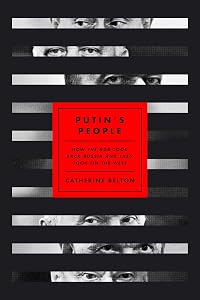
Putin's People: How the KGB Took Back Russia and Then Took On the West
by Catherine Belton
On This Page
Description
A chilling and revelatory expose of the KGB's renaissance, Putin's rise to power, and how Russian black cash is subverting the world. In Putin's People, former Moscow correspondent and investigative journalist Catherine Belton reveals the untold story of how Vladimir Putin and his entourage of KGB men seized power in Russia and built a new league of oligarchs. Through exclusive interviews with key inside players, Belton tells how Putin's people conducted their relentless seizure of private show more companies, took over the economy, siphoned billions, blurred the lines between organized crime and political powers, shut down opponents, and then used their riches and power to extend influence in the West. In a story that ranges from Moscow to London, Switzerland and Trump's America, Putin's People is a gripping and terrifying account of how hopes for the new Russia went astray, with stark consequences for its inhabitants and, increasingly, the world. show lessTags
Recommendations



Member Reviews
The full scale of the corruption of the Putin regime will likely never be known, but if it was even half of what Catherine Belton lays out in Putin's People, it would be frightening. The broad outlines of what Belton covers here—how the weaknesses of the Yeltsin administration allowed for the rise of first the oligarchs and then Putin and his KGB cronies—won't be hugely new to anyone who's got a passing familiarity with recent Russian history.
But Belton—a longtime business journalist—excels at laying out the labyrinthine financial schemes that have siphoned billions out of the Russian economy and turns a sharp light on the men (and it's mostly men) whom such doings have enriched. This involves both a close look at Russia and at show more the Western financiers (mostly in London and New York) and politicians who are fine with making money and aren't too bothered about the source of it. (There's a whole chapter in here on Trump.) Belton also makes a fairly convincing case that Putin's KGB past isn't just important as something formative of his worldview but that it's the key to understanding his whole regime: that Russia is now essentially a state run by a group of siloviki or former KGB officers who are contemporaries of Putin's. These siloviki are both incredibly greedy and utterly hostile to the West. Putin is sketched here not as some charismatic puppetmaster but as a capable, amoral leader of his cadre of supporters.
The number of billionaires who have sued Catherine Belton for defamation as a result of this book may make one wonder just how close to the truth of it all she may have come. show less
But Belton—a longtime business journalist—excels at laying out the labyrinthine financial schemes that have siphoned billions out of the Russian economy and turns a sharp light on the men (and it's mostly men) whom such doings have enriched. This involves both a close look at Russia and at show more the Western financiers (mostly in London and New York) and politicians who are fine with making money and aren't too bothered about the source of it. (There's a whole chapter in here on Trump.) Belton also makes a fairly convincing case that Putin's KGB past isn't just important as something formative of his worldview but that it's the key to understanding his whole regime: that Russia is now essentially a state run by a group of siloviki or former KGB officers who are contemporaries of Putin's. These siloviki are both incredibly greedy and utterly hostile to the West. Putin is sketched here not as some charismatic puppetmaster but as a capable, amoral leader of his cadre of supporters.
The number of billionaires who have sued Catherine Belton for defamation as a result of this book may make one wonder just how close to the truth of it all she may have come. show less
This history reads as prelude to Russia's 2022 war with Ukraine. It tells the story of an ex-KGB agent and his ex-Soviet professionals with a chekist mind-set influencing Russia's development to the dangerous pariah state we now see. Over the years, building on oligarchy constructed in the Yeltsin era, Putin oversees extraction of something like a trillion dollars of wealth into the pockets of a kleptocracy. Looking back to the annexation of Crimea and a series of questionable actions including apparent staged terrorist attacks on its own citizens, the author seems to imply after color revolutions and being in power too long, Putin's hold on Russia may be nearing an end:
At least to me, such cracks don't seem to be emerging as I write. Maybe a sudden catastrophic collapse as happened to the USSR?
Most of the personages in the Putin constellation are not going to stick with me; they all end up in a sock labeled "someone-ov"... Interesting is the details of Russian support for Trump and using him (and other real estate opportunities) for money laundering as well as a political pawn. There is also a fair amount on Roman Abramovich and how he appears to be an example of oligarch-as-pawn. What I mean by that was explained by Mikhail Khodorkovsky in a HARDtalk interview "Making an enemy of Putin" where Stephen Sackur spoke to the exiled Russian businessman 22 April 2022 and pointed out that what we call "oligarchs" are just Putin's agents without actual policy-making roles. show less
...Putin and his security men took the warning signs seriously.show more
Putin would soon be running into another constitutional limit on his hold on power: this time in 2024 – the end of his second consecutive term as president since his return in 2012 – when the constitution dictated he step down. Increasing uncertainty over who would replace him was already deepening infighting among the elite, and Putin’s people understood all too acutely the dangers of any transfer of power. They’d seen the jeopardy the Yeltsin Family faced as it entered the final year of Yeltsin’s rule. And with each year that passed of Putin’s own twenty-year rule, the potential threats he – or any of his security men – could personally face went far beyond anything that had confronted the Yeltsin Family. Any handover, even within the ruling elite, was fraught with peril. There were the apartment bombings, the Dubrovka theatre siege, the handling of the Beslan terror attack, the takedown of Russia’s one-time richest man, and then the subversion of the country’s legal system and economy, and the hundreds of billions of dollars they’d seized command of as they shored up their own power and then projected it abroad. There was no telling where a backlash might lead. The lengths they’d gone to to forge their own fortress of power had dragged Putin and his security men so deeply into a web of compromise and criminality that the only way to secure their position was to find a way to prolong Putin’s rule – or at the very least a way to drag out the transition.
At least to me, such cracks don't seem to be emerging as I write. Maybe a sudden catastrophic collapse as happened to the USSR?
Most of the personages in the Putin constellation are not going to stick with me; they all end up in a sock labeled "someone-ov"... Interesting is the details of Russian support for Trump and using him (and other real estate opportunities) for money laundering as well as a political pawn. There is also a fair amount on Roman Abramovich and how he appears to be an example of oligarch-as-pawn. What I mean by that was explained by Mikhail Khodorkovsky in a HARDtalk interview "Making an enemy of Putin" where Stephen Sackur spoke to the exiled Russian businessman 22 April 2022 and pointed out that what we call "oligarchs" are just Putin's agents without actual policy-making roles. show less
I nearly stopped reading this book during the first few chapters (covering Putin’s time in Dresden), which are full of far-fetched conspiracy theories and scarcely visibly “evidence” trails. It’s a lot of off-hand comments about “visits to Moscow,” and reading deep meaning into the shadows that fall across interviewee’s faces—lots of “it might be that...” and “Putin probably would have....” What was almost the final straw was her absurd suggestion that Dresden’s complete insignificance is what’s so important about his time there. It’s boilerplate conspiracy-theory rhetoric, and if the rest of the book had depended on it much, I would have stopped reading.
Fortunately, once she gets into Putin’s entry into show more the Kremlin and quick rise to the premiership, the rhetoric settles down. The author sticks a little more closely to established facts (though she does allow herself the occasional flight of unsupported fantasy). At this point her real thesis also starts to emerge, and it’s one worth considering: Basically, that KGB types had managed to carve out a lot of power and resources as they watched the Soviet Union fall around them, and that it was their urge to protect these things which really led to Putin’s rise. “Ultimately, when it came, the collapse had been an inside job.” It may not be the entire, precise truth, but there does seem to be a lot of truth in it. I think she downplays Putin’s own will to power, and his tactical political skill, a bit too much. But there are aspects of his presidency that make more sense if you realize that he doesn’t have a free hand to do whatever he wishes, and Belton paints one reasonable picture to explain why that is.
I should note: I was also concerned when I saw the pictures of Trump and the references to him in the blurb. It’s pretty clear that he was never an active agent on Russia’s (or Putin’s) behalf, and any insinuation otherwise would have been just more conspiratorial whackadoodle. Fortunately, she doesn’t tread far into that realm; she sticks pretty firmly to the notion that Trump was an incompetent, unaware dupe (what Russians typically call a “useful idiot”) who, in the course of laundering money and kissing up, did manage to do some things that the Kremlin enjoyed. And, of course, that in their broad efforts to support corruption and disorder in Western democracy, the Kremlin invested some time and effort to promote Trump (who firmly represents both those things).
Overall, it’s a decent read if you have kind of an intermediate-level understanding of Russian national and international politics. It shouldn’t be anyone’s first book on the subject, because you’re going to learn a lot of things that just ain’t so. But if you are able to occasionally shake your head and ignore some obvious nonsense, there is a lot of meat on this book’s bones. show less
Fortunately, once she gets into Putin’s entry into show more the Kremlin and quick rise to the premiership, the rhetoric settles down. The author sticks a little more closely to established facts (though she does allow herself the occasional flight of unsupported fantasy). At this point her real thesis also starts to emerge, and it’s one worth considering: Basically, that KGB types had managed to carve out a lot of power and resources as they watched the Soviet Union fall around them, and that it was their urge to protect these things which really led to Putin’s rise. “Ultimately, when it came, the collapse had been an inside job.” It may not be the entire, precise truth, but there does seem to be a lot of truth in it. I think she downplays Putin’s own will to power, and his tactical political skill, a bit too much. But there are aspects of his presidency that make more sense if you realize that he doesn’t have a free hand to do whatever he wishes, and Belton paints one reasonable picture to explain why that is.
I should note: I was also concerned when I saw the pictures of Trump and the references to him in the blurb. It’s pretty clear that he was never an active agent on Russia’s (or Putin’s) behalf, and any insinuation otherwise would have been just more conspiratorial whackadoodle. Fortunately, she doesn’t tread far into that realm; she sticks pretty firmly to the notion that Trump was an incompetent, unaware dupe (what Russians typically call a “useful idiot”) who, in the course of laundering money and kissing up, did manage to do some things that the Kremlin enjoyed. And, of course, that in their broad efforts to support corruption and disorder in Western democracy, the Kremlin invested some time and effort to promote Trump (who firmly represents both those things).
Overall, it’s a decent read if you have kind of an intermediate-level understanding of Russian national and international politics. It shouldn’t be anyone’s first book on the subject, because you’re going to learn a lot of things that just ain’t so. But if you are able to occasionally shake your head and ignore some obvious nonsense, there is a lot of meat on this book’s bones. show less
This book tells the story of how Russia became a state run by a mafia. After a hesitant start where some forces of opposition still had to be respected, Putin started killing and jailing his enemies and took the country's riches for himself, so that he could distribute them as he pleases. His deliberate and nefarious corruption of Russian state institutions made sure that honest people could not have a successful career either in Russian business or in its judiciary. It is depressing to read how many billions Putin's KGB circle has expropriated. Imagine how Russia could have prospered if this wealth had been broadly shared. The eagerness of English and Swiss firms to provide services for this mafia speaks to their weak moral backbone. show more One can only hope that the present war has revealed the true nature of the Russian regime even to these dimwits.
It must have taken years to assemble all the information presented in this book and the author should be commended not only for the amount of investigative work, but also for her bravery. I did at times hope - especially toward the end of the book - that she would take a step back from the deeds of specific persons and instead provide some general analysis of Russian corruption. But it's not like the overall picture is unclear: a dictatorship rewards loyalty and ruthlessness, and money is money to western bankers. Aside from amassing power and wealth, reversing the disintegration of the Soviet Union and weakening the west are the only things this old KGB agent cares about. As the author writes toward the end of the book, his endgame must be leadership for life - mafia leaders who let go of power can only face punishment or death. show less
It must have taken years to assemble all the information presented in this book and the author should be commended not only for the amount of investigative work, but also for her bravery. I did at times hope - especially toward the end of the book - that she would take a step back from the deeds of specific persons and instead provide some general analysis of Russian corruption. But it's not like the overall picture is unclear: a dictatorship rewards loyalty and ruthlessness, and money is money to western bankers. Aside from amassing power and wealth, reversing the disintegration of the Soviet Union and weakening the west are the only things this old KGB agent cares about. As the author writes toward the end of the book, his endgame must be leadership for life - mafia leaders who let go of power can only face punishment or death. show less
This is a vastly detailed book, so much so that I had to put it aside for a while as there was too much information for me. The first part of the work focusses on Putin's early years in the KGB and the wholesale looting of Russian assets by the KGB and organised crime that came about when Yeltsin's slapdash attempt at liberalisation turned into a free-for-all that saw billions of roubles spirited away into foreign bank accounts and set the stage for Putin and his cronies' rise to power.
The second part reads more like a thriller - showing how Putin's ideological framework of destabilisation of the West was facilitated by the greed and corruption of some Western political and financial institutions - knowingly or not.
It's a terrifying show more but essential read. show less
The second part reads more like a thriller - showing how Putin's ideological framework of destabilisation of the West was facilitated by the greed and corruption of some Western political and financial institutions - knowingly or not.
It's a terrifying show more but essential read. show less
If trump were a reading man, this book would make him green with envy. trump has done everything he could to be just like Putin, but he just doesn't have the brains or, fortunately, the ability to completely destroy the rule of law in his country. Putin is a clever man. He weaseled his way up the KGB and up the Soviet political system without people paying much attention. When he finally got to head leadership in Russia most people thought he was a black horse newcomer. As a deputy mayor of St. Petersburg, he managed to intertwine organized crime and the KGB and so allow selected people to become extremely rich. I don't think he used Don Corleone's actual warning to new personnel acquisitions that he would help them, but someday in the show more future, he would want them to do him a favor, but that was his attitude. His chosen few became heads of business and industry then when he wanted to take their businesses for himself if they refused this little favor they were hit with billions of dollars in back taxes. Taxes and laws were both made retroactive. Surprise. Some billionaires ended up dead, some in jail, some just lost their businesses, then he came for the west financing politicians who could help break apart the European Union and laundering money. He was behind Brexit, he is behind the right-wing hatred of George Soros who has warned people about him, and he's played trump like a fiddle. I can see why trump has such respect for him, he's the godfather trump never will be. According to the NYT Putin's response to her description of his dealings in St. Petersberg, “This all happened,” he smugly acknowledged. “But this is absolutely normal trading operations. How can you explain this to a menopausal woman like that?” So, trump has the attitude of disdainful misogyny, he just doesn't have the ability. show less
Yesterday it snowed.
By the time I managed to work a walk into my daily routine it was dusk. I took my usual route through the park overlooking Lake Ontario.
There were few people in the park. Just a few of us and the whiteness all around.
Walking along the fenced cliff toward the meadow at the eastern boundary of the park virtually the entire vista of Lake Ontario was shrouded by a white mist. I could barely make out the marina at the base of the cliff.
Everything else was hidden.
That feeling, that so much was hidden beneath the surface, reminded me of Catherine Belton’s dogged study of corruption in the Putin regime.
You could only see glimpses of the enormous graft that runs deep in the Russian state. My reading stopped as in shock I show more read that experts estimate the stolen assets leaving Russia since Boris Yeltsin’s revolution at $800 billion, roughly the equivalent of all the other wealth in the country.
This includes the proceeds of share sales in state enterprises, stolen oil and gas royalties, stolen loans from western governments and from lenders in the west.
Belton’s key thesis is that the guardians to the wealth of Russia — and hence the conspirators — derive their authority from connections to Russia’s security services, once called the KGB, now called the FSB, SVR, and other agencies. Vladimir Putin’s top advisors worked in the security organs.
They are informally called the siloviki.
Belton shows us how KGB alumnae like Vladimir Putin stepped into the power void after the demise of the Soviet Union and continued to funnel resources to their covert offshore activities, and most spectacularly to themselves.
“Putin’s People” are the ex-spies and the organized crime figures who frequently coordinated their activities with KGB. Then there are the willing policemen, bureaucrats, and politicians who take their cut right down the line.
In this way everybody is compromised and there’s really nobody to tattle to.
The theft didn’t begin with “Putin’s People.” Yeltsin’s extended “family” also made their killings on the loans-for-shares programs, and assorted thugs made off with proceeds from the “food-for-oil” programs in a hungry St. Petersburg.
As the incursion into Ukraine rages we have to ask ourselves to what purpose has Putin engaged in this war if the leadership has already enriched themselves beyond their wildest dreams. If they have more power than they know what to do with and virtually silenced critics with threats of jail, poisoning, or being pushed out of their apartment windows.
Belton and other critics say Putin is driven to rebuild the glory of the Russian people/Slavic race that was squandered by the czars and ultimately inept communists. On the surface of it, I would ask: “Russia bet against the west in the 20th century and lost. What makes them think the shelling of Ukraine is going to end up any differently?”
Much that Putin’s People have done is supposedly to shore up power in the East even as their methods have remained suspect throughout. When are they really working for themselves, and when for the betterment of their people?
It’s pretty hard to say when they are working for the State, especially when those mega-yachts pull up in Antibes.
Putin’s own wealth some people estimate at $200 billion. Not roubles. US dollars.
The great exodus of money from Russia has undoubtedly dirtied the business and political elites of other countries, and nobody after reading this book could say with a straight face that Donald Trump hasn’t cashed in big time.
A lot of that money went into the Brexit campaign, the 2016 US election, and continuing dirty tricks and alliances with ultra right wing groups around the globe. And it unsurprisingly smells like a lot of the money undermining cooperation between the political parties in US government by the Koch family and their ilk.
On one level I as a businessman can empathize with people who want to cut corners to make a living. In this environment it’s very hard to make a consistent living. That’s probably why three-quarters of the economies on the planet are driven by corruption, including Russia, India, China, part of Italy, many African and other Asian states.
The reliance we in the west place on the sanctity of property, the rule of law, the peaceful transfer of power, well, is not really the rule but the exception. Even in big democracies there is big corruption.
So how much are Putin and his “people” really outliers. Aren’t people like them more the rule than the exception?
I think this is what gives Putin the confidence to invade sovereign countries with impunity, because he sees the West as so easily corrupted by wealth that they will simply avert their eyes. This being why Europe has tied its energy security to Russia. This being why the US barely squeaked when Russia invaded Georgia, the Crimea, and the eastern sectors of Ukraine.
And yet the years of massive corruption clearly showed up in the weakness of the Russian war machine. In this case as in so many before it, the authoritarian regime is creaking under its own inertia.
Even if Putin were toppled by this mess, there are others behind him, many others. It probably would take another civil war to clean out the rot.
If there’s one thing we can all agree on about corruption it is that it sucks the vitality out of the artist, the entrepreneur, and the innovator.
Russians and slavs outside of Russia aren’t stupid.
If Putin bred a culture of openness, and accountability, if innovators weren’t afraid that a gang of goons would steal the fruit of their work, slavs and quite frankly everyone else would be clamoring to get in, not run from their bullets. show less
By the time I managed to work a walk into my daily routine it was dusk. I took my usual route through the park overlooking Lake Ontario.
There were few people in the park. Just a few of us and the whiteness all around.
Walking along the fenced cliff toward the meadow at the eastern boundary of the park virtually the entire vista of Lake Ontario was shrouded by a white mist. I could barely make out the marina at the base of the cliff.
Everything else was hidden.
That feeling, that so much was hidden beneath the surface, reminded me of Catherine Belton’s dogged study of corruption in the Putin regime.
You could only see glimpses of the enormous graft that runs deep in the Russian state. My reading stopped as in shock I show more read that experts estimate the stolen assets leaving Russia since Boris Yeltsin’s revolution at $800 billion, roughly the equivalent of all the other wealth in the country.
This includes the proceeds of share sales in state enterprises, stolen oil and gas royalties, stolen loans from western governments and from lenders in the west.
Belton’s key thesis is that the guardians to the wealth of Russia — and hence the conspirators — derive their authority from connections to Russia’s security services, once called the KGB, now called the FSB, SVR, and other agencies. Vladimir Putin’s top advisors worked in the security organs.
They are informally called the siloviki.
Belton shows us how KGB alumnae like Vladimir Putin stepped into the power void after the demise of the Soviet Union and continued to funnel resources to their covert offshore activities, and most spectacularly to themselves.
“Putin’s People” are the ex-spies and the organized crime figures who frequently coordinated their activities with KGB. Then there are the willing policemen, bureaucrats, and politicians who take their cut right down the line.
In this way everybody is compromised and there’s really nobody to tattle to.
The theft didn’t begin with “Putin’s People.” Yeltsin’s extended “family” also made their killings on the loans-for-shares programs, and assorted thugs made off with proceeds from the “food-for-oil” programs in a hungry St. Petersburg.
As the incursion into Ukraine rages we have to ask ourselves to what purpose has Putin engaged in this war if the leadership has already enriched themselves beyond their wildest dreams. If they have more power than they know what to do with and virtually silenced critics with threats of jail, poisoning, or being pushed out of their apartment windows.
Belton and other critics say Putin is driven to rebuild the glory of the Russian people/Slavic race that was squandered by the czars and ultimately inept communists. On the surface of it, I would ask: “Russia bet against the west in the 20th century and lost. What makes them think the shelling of Ukraine is going to end up any differently?”
Much that Putin’s People have done is supposedly to shore up power in the East even as their methods have remained suspect throughout. When are they really working for themselves, and when for the betterment of their people?
It’s pretty hard to say when they are working for the State, especially when those mega-yachts pull up in Antibes.
Putin’s own wealth some people estimate at $200 billion. Not roubles. US dollars.
The great exodus of money from Russia has undoubtedly dirtied the business and political elites of other countries, and nobody after reading this book could say with a straight face that Donald Trump hasn’t cashed in big time.
A lot of that money went into the Brexit campaign, the 2016 US election, and continuing dirty tricks and alliances with ultra right wing groups around the globe. And it unsurprisingly smells like a lot of the money undermining cooperation between the political parties in US government by the Koch family and their ilk.
On one level I as a businessman can empathize with people who want to cut corners to make a living. In this environment it’s very hard to make a consistent living. That’s probably why three-quarters of the economies on the planet are driven by corruption, including Russia, India, China, part of Italy, many African and other Asian states.
The reliance we in the west place on the sanctity of property, the rule of law, the peaceful transfer of power, well, is not really the rule but the exception. Even in big democracies there is big corruption.
So how much are Putin and his “people” really outliers. Aren’t people like them more the rule than the exception?
I think this is what gives Putin the confidence to invade sovereign countries with impunity, because he sees the West as so easily corrupted by wealth that they will simply avert their eyes. This being why Europe has tied its energy security to Russia. This being why the US barely squeaked when Russia invaded Georgia, the Crimea, and the eastern sectors of Ukraine.
And yet the years of massive corruption clearly showed up in the weakness of the Russian war machine. In this case as in so many before it, the authoritarian regime is creaking under its own inertia.
Even if Putin were toppled by this mess, there are others behind him, many others. It probably would take another civil war to clean out the rot.
If there’s one thing we can all agree on about corruption it is that it sucks the vitality out of the artist, the entrepreneur, and the innovator.
Russians and slavs outside of Russia aren’t stupid.
If Putin bred a culture of openness, and accountability, if innovators weren’t afraid that a gang of goons would steal the fruit of their work, slavs and quite frankly everyone else would be clamoring to get in, not run from their bullets. show less
Members
- Recently Added By
Published Reviews
ThingScore 100
Belton gives a chilling account of Putin’s rise to power and his personal corruption. Previous books have been written on the same theme, [...]. But Belton offers the most detailed and compelling version yet, based on dozens of interviews with oligarchs and Kremlin insiders, as well as former KGB operatives and Swiss and Russian bankers.
added by Nevov
Lists

Economist Books of the Year 2020
41 works; 5 members

Books Read in 2020
4,379 works; 124 members

Books Read in 2021
5,361 works; 114 members

Books Read in 2022
5,168 works; 114 members

Wishlist
99 works; 1 member

Russia / Ukraine
13 works; 1 member
Author Information

4 Works 775 Members
Some Editions
Awards and Honors
Awards
Distinctions
Common Knowledge
- Canonical title*
- Putinin sisäpiirissä : kuinka KGB valtasi Venäjän ja kääntyi länttä vastaan
- Original publication date
- 2020
- People/Characters
- Vladimir Putin; Igor Sechin; Nikolai Patrushev; Viktor Ivanov; Viktor Cherkesov; Sergei Ivanov (show all 28); Dmitry Medvedev; Gennady Timchenko; Yury Kovalchuk; Arkady Rotenberg; Vladimir Yakunin; Valentin Yumashev; Tatyana Dyachenko; Boris Berezovsky; Alexander Voloshin; Roman Abramovich; Sergei Pugachev; Mikhail Khodorkovsky; Ilya Traber; Vladimir Kumarin; Semyon Mogilevich; Sergei Mikhailov; Vyacheslav Ivankov; Yevgeny Dvoskin; Felix Sater; Boris Yeltsin; Tatyana Yumasheva; Donald Trump
- Important places
- Moscow, Russia; Saint Petersburg, Russia; London, England, UK
- Epigraph
- 'Russian organised-crime leaders, their members, their associates, are moving into Western Europe, they are purchasing property, they are establishing bank accounts, they're establishing companies, they're weaving themselves ... (show all)into the fabric of society, and by the time that Europe develops an awareness it's going to be too late.'
Former FBI special agent Bob Levinson
'I want to warn Americans. As a people, you are very naïve about Russia and its intentions. You believe because the Soviet Union no longer exists, Russia is now your friend. It isn't, and I can show you how the SVR is trying... (show all) to destroy the US even today and even more than the KGB did during the Cold War'.
Sergei Tretyakov, former colonel in Russian Foreign Intelligence, the SVR, stationed in New York - Dedication
- To my parents, Marjorie and Derek,
as well as to Richard and to Catherine Birkett. - First words
- It was late in the evening in May 2015, and Sergei Pugachev was flicking through an old family photo album he'd found from thirteen years ago or more.
- Last words
- (Click to show. Warning: May contain spoilers.)Russia's revolution had come full circle. The reformers who declared to the world with such great promise nearly thirty years ago that the country was on a new market path towards global integration were either soon comprised, or had been working with the KGB on Russia's transition all along. Those who believed they were working to introduce a free market had underestimated the enduring power of the security men. 'This is the tragedy of twentieth-century Russia,' said Pugachev. 'The revolution was never complete.' From the beginning, the security men had been laying down roots for revanche. But from the beginning, its seems, they'd been doomed to repeat the mistakes of the past.
- Blurbers
- Bullough, Oliver; Frankopan, Peter
- Original language
- English
*Some information comes from Common Knowledge in other languages. Click "Edit" for more information.
Classifications
- Genres
- History, General Nonfiction, Nonfiction, Politics and Government, Biography & Memoir
- DDC/MDS
- 947.086 — History & geography History of Europe Eastern European Counties and Russia Russian & Slavic History by Period 1855- 1991-
- LCC
- DK510.763 .B463 — History of Europe, Asia, Africa and Oceania Russia. Soviet Union. Former Soviet Republics – Poland History of Russia. Soviet Union. Former Soviet Republics Local history and description Russia (Federation). Russian S.F.S.R.
- BISAC
Statistics
- Members
- 772
- Popularity
- 36,270
- Reviews
- 17
- Rating
- (4.11)
- Languages
- 9 — Dutch, English, Estonian, Finnish, German, Italian, Polish, Spanish, Swedish
- Media
- Paper, Audiobook, Ebook
- ISBNs
- 24
- ASINs
- 8