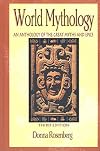
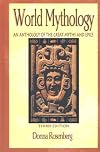
World Mythology: An Anthology of the Great Myths and Epics
by Donna Rosenberg
On This Page
Description
World Mythology is a compilation of over 50 great myths and epics. Your students will gain an appreciation and understanding of ancient and modern cultures through myths and epics from the Middle East, Greece and Rome, the Far East and Pacific islands, the British Isles, Northern Europe, Africa, and the Americas. An introduction and historical background supplement each myth. Questions at the end of each selection prompt analysis and response.Tags
Recommendations

















Member Reviews
Title: "World Mythology" (2nd edition)
Editor: Donna Rosesnberg
Format: Paperback
Number of Pages: 584
ISBN: 978-0844257679
Publisher: McGraw-Hill
Date of Publication: January 11, 1994
4 stars: Mythology for beginners
I had to buy this for my college mythology class. It's a nice enough text, with many stories from many different cultures. Before each culture, we learn a little about the people and how their stories came about, which I thought helped me understand the stories more. My personal favorites were the Egyptian myths and the Greek myths, of which there were many. It also includes classics like 'King Arthur', 'Beowulf', and 'The Illiad'. It was interesting to note the similarities and differences between the cultures and their stories, show more many of which were being created at the same time years ago- but many miles apart.
As for the flaws this book has, there is one major one. While I'm sure the translators translated to the best of their ability, if I had to read "flooded their hearts" one more time, I think I would scream. Okay I get it, they're happy, filled with joy, ecstatic, delighted.... but really? "Flooded"? So maybe that was the literal translation, but couldn't the editors have changed it a few times so that the readers didn't die from the repetition?
Overall I would recommend this book, especially if you're interested in mythology. Just be aware that there are many different interpretations of myths, and the ones that are in this book may not be the most well known. Additionally I'm not sure if they cut out some parts because they knew this would be a school text. If you know the story of Osiris and Isis, you know that there was one piece of his body that a fish ate... that part of the myth isn't in this book-- I guess because they deemed it unappropriate? There is a newer edition out however, which may be better than this one. At the very least, I hope they don't use the word "flooded" so much in that one. show less
Editor: Donna Rosesnberg
Format: Paperback
Number of Pages: 584
ISBN: 978-0844257679
Publisher: McGraw-Hill
Date of Publication: January 11, 1994
4 stars: Mythology for beginners
I had to buy this for my college mythology class. It's a nice enough text, with many stories from many different cultures. Before each culture, we learn a little about the people and how their stories came about, which I thought helped me understand the stories more. My personal favorites were the Egyptian myths and the Greek myths, of which there were many. It also includes classics like 'King Arthur', 'Beowulf', and 'The Illiad'. It was interesting to note the similarities and differences between the cultures and their stories, show more many of which were being created at the same time years ago- but many miles apart.
As for the flaws this book has, there is one major one. While I'm sure the translators translated to the best of their ability, if I had to read "flooded their hearts" one more time, I think I would scream. Okay I get it, they're happy, filled with joy, ecstatic, delighted.... but really? "Flooded"? So maybe that was the literal translation, but couldn't the editors have changed it a few times so that the readers didn't die from the repetition?
Overall I would recommend this book, especially if you're interested in mythology. Just be aware that there are many different interpretations of myths, and the ones that are in this book may not be the most well known. Additionally I'm not sure if they cut out some parts because they knew this would be a school text. If you know the story of Osiris and Isis, you know that there was one piece of his body that a fish ate... that part of the myth isn't in this book-- I guess because they deemed it unappropriate? There is a newer edition out however, which may be better than this one. At the very least, I hope they don't use the word "flooded" so much in that one. show less
Around the world numerous different peoples came up with explains about the natural world and their own cultural heritage, though separated by vast distances create obvious differences there is also many similarities. World Mythology: An Anthology of Great Myths and Epics by Donna Rosenberg brings together the stories of different cultures both well-known and hardly known together for a mass audience.
Rosenberg covers all corners of the world from such the well-known epics of Gilgamesh, The Iliad, Beowulf, King Arthur of the Middle East, Greece, Northern Europe and Britain while also covering from the Segu in African, Bakaridjan Kone, and from the Inuit, Sedna. Rosenberg also covered numerous creation and fertility myths from those same show more cultures or nearby neighboring cultures. Before each piece, Rosenberg would give an introduction and historical background giving the reader better context for what they are about to read.
This collection brings together well-known myths and epics that “Western” audiences know as well as those not known from the “Western” perspective, with a few exceptions like The Ramayana. From the standpoint of getting a large audience introduced to these myths, the book succeeds. However, Rosenberg literally sets off alarm bells to any discerning reader when she says that she will be retelling these myths for the modern world. While I didn’t expect the entirety of The Iliad or Beowulf to be republished in this collection, I expected a fairly authentic telling of these myths and the butchering of them made me appreciate less those myths and epics I hadn’t read before like The Aeneid or The Ramayana or that I hadn’t known of before like the aforementioned Bakaridjan Kone and Sedna because I knew it wasn’t a true representation of the myth. To add further insult were Rosenberg’s introductions and historical background that were wrong on history thus making her explanations of the myth questionable especially when she wants to push forward the Great Goddess theory on every myth that has an important female deity or heroine—I don’t deny that there was important Great Goddess religions but not every myth Rosenberg claims is a patriarchal takeover of a matriarchal religious system.
While World Mythology is an okay introduction to numerous cultural myths from around the globe, but do not get this for the classics nor consider those other myths you’ll read as the definitive versions. show less
Rosenberg covers all corners of the world from such the well-known epics of Gilgamesh, The Iliad, Beowulf, King Arthur of the Middle East, Greece, Northern Europe and Britain while also covering from the Segu in African, Bakaridjan Kone, and from the Inuit, Sedna. Rosenberg also covered numerous creation and fertility myths from those same show more cultures or nearby neighboring cultures. Before each piece, Rosenberg would give an introduction and historical background giving the reader better context for what they are about to read.
This collection brings together well-known myths and epics that “Western” audiences know as well as those not known from the “Western” perspective, with a few exceptions like The Ramayana. From the standpoint of getting a large audience introduced to these myths, the book succeeds. However, Rosenberg literally sets off alarm bells to any discerning reader when she says that she will be retelling these myths for the modern world. While I didn’t expect the entirety of The Iliad or Beowulf to be republished in this collection, I expected a fairly authentic telling of these myths and the butchering of them made me appreciate less those myths and epics I hadn’t read before like The Aeneid or The Ramayana or that I hadn’t known of before like the aforementioned Bakaridjan Kone and Sedna because I knew it wasn’t a true representation of the myth. To add further insult were Rosenberg’s introductions and historical background that were wrong on history thus making her explanations of the myth questionable especially when she wants to push forward the Great Goddess theory on every myth that has an important female deity or heroine—I don’t deny that there was important Great Goddess religions but not every myth Rosenberg claims is a patriarchal takeover of a matriarchal religious system.
While World Mythology is an okay introduction to numerous cultural myths from around the globe, but do not get this for the classics nor consider those other myths you’ll read as the definitive versions. show less
We bought this book to get more information about Greek Mythology following reading the [b:D'Aulaires' Book of Greek Myths|79626|D'Aulaires' Book of Greek Myths|Ingri D'Aulaire|http://photo.goodreads.com/books/1170970293s/79626.jpg|891861] version of Greek Mythology for kids. Over the years we have jumped around and read different myths and epics in this book, but we have mostly focused on the Greeks.
This time, however, we started with the old favorites and have just plowed through without picking and choosing. There are some very entertaining aspects of some of the unfamiliar myths. In one myth, the creator creates demons by farting them out of his rear end. This produced roars of laughter and continues to produce endless jokes in our show more house.
Regardless of origination of the various myths, we are finding a lot of similarities. For example, there are plenty of floods that happen to annihilate entire races that don't meet the expectations of the gods. I don't know if the editor is highlighting them or we are seeing how people are more similar than we think, especially in their story telling.
Some of the myths provoke a lot of discussion. One creation myth from Africa was particularly annoying. There are two major gods in this myth, Olorun (male) and Olokun (female). Olorun is the god of the sky and Olokun is the goddess of the sea. There is no land at this time. One of the lesser gods, Obatala, decides that it would be fun to create the earth. Following the directions of some of the other gods, he pours dirt into the water and land is formed. Essentially, he steals part of the Olokun's kingdom. Nowhere in the story does Obatala consult with Olokun about this action. Later in the story she gets angry and creates a big flood. Still, there is no discussion abnout resolving the issue fairly or appeasement going on. In the end, Olokun relents without any discussion and Obatala is not made to pay for stealing. I don't like the messages this myth sends out, but the discussions we had were interesting.
The abridgment isn't very good in this book, but it isn't terrible either. The editor writes/edits so the language is quite repetitive and leaves out some critical parts of the various stories. The abridgment (and translation of the Kotan Utunnai is particularly repetitive). The editing also has a lot to be desired. There are words that are obviously wrong (warned instead of warmed in the Liu Chun/Bao Chu myth from China). Still, this book is getting us ready for the full versions. show less
This time, however, we started with the old favorites and have just plowed through without picking and choosing. There are some very entertaining aspects of some of the unfamiliar myths. In one myth, the creator creates demons by farting them out of his rear end. This produced roars of laughter and continues to produce endless jokes in our show more house.
Regardless of origination of the various myths, we are finding a lot of similarities. For example, there are plenty of floods that happen to annihilate entire races that don't meet the expectations of the gods. I don't know if the editor is highlighting them or we are seeing how people are more similar than we think, especially in their story telling.
Some of the myths provoke a lot of discussion. One creation myth from Africa was particularly annoying. There are two major gods in this myth, Olorun (male) and Olokun (female). Olorun is the god of the sky and Olokun is the goddess of the sea. There is no land at this time. One of the lesser gods, Obatala, decides that it would be fun to create the earth. Following the directions of some of the other gods, he pours dirt into the water and land is formed. Essentially, he steals part of the Olokun's kingdom. Nowhere in the story does Obatala consult with Olokun about this action. Later in the story she gets angry and creates a big flood. Still, there is no discussion abnout resolving the issue fairly or appeasement going on. In the end, Olokun relents without any discussion and Obatala is not made to pay for stealing. I don't like the messages this myth sends out, but the discussions we had were interesting.
The abridgment isn't very good in this book, but it isn't terrible either. The editor writes/edits so the language is quite repetitive and leaves out some critical parts of the various stories. The abridgment (and translation of the Kotan Utunnai is particularly repetitive). The editing also has a lot to be desired. There are words that are obviously wrong (warned instead of warmed in the Liu Chun/Bao Chu myth from China). Still, this book is getting us ready for the full versions. show less
Ratings
Members
- Recently Added By
Lists

Before Austen Comes Aesop
318 works; 9 members
Author Information
12 Works 1,092 Members
Common Knowledge
- Canonical title
- World Mythology: An Anthology of the Great Myths and Epics
- Original publication date
- 1986 (1st ed.) (1st ed.); 1994 (2nd ed.) (2nd ed.); 1999 (3rd ed.) (3rd ed.)
- People/Characters
- Achilles; Aeneas; Aeolus; Agamemnon
- Dedication
- To Dick, my favorite hero
- First words
- World Mythology presents the major myths from around the world in a manner that preserves their appeal as fine literature. (Preface)
Myths symbolize human experience and embody the spiritual values of a culture. (Introduction)
The myths of Greece have earned universal fame and popularity. - Last words
- (Click to show. Warning: May contain spoilers.)"And his brother will always stand beside him and help him!"
Classifications
- Genre
- Nonfiction
- DDC/MDS
- 291.13 — Religion Other religions [Formerly: General Religious Topics] [formerly: Religious mythology, general classes of religion, interreligious relations and attitudes, social theology. Relocated to 201] Archetypal Mythology
- LCC
- BL311 .R63 — Philosophy, Psychology and Religion Religions. Mythology. Rationalism Religions. Mythology. Rationalism The myth. Comparative mythology
- BISAC
Statistics
- Members
- 891
- Popularity
- 30,062
- Reviews
- 3
- Rating
- (3.91)
- Languages
- English
- Media
- Paper
- ISBNs
- 13
- ASINs
- 7