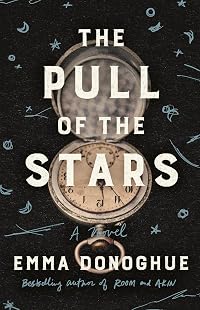
The Pull of the Stars
by Emma Donoghue
On This Page
Description
In an Ireland doubly ravaged by war and disease, Nurse Julia Power works at an understaffed hospital in the city center, where expectant mothers who have fallen sick are quarantined into a separate ward to keep the plague at bay. Into Julia's regimented world step two outsiders, a woman doctor who is a rumored Rebel, and a teenage girl, Bridie, procured by the nuns from their orphanage as an extra set of hands. At first, this Bridie seems unschooled in life, she makes up a bed with only the show more rubber mat and savors the weak tea and barely edible porridge from the hospital kitchen. But in the intensity of this ward, over three brutal days, Julia and the women come together in unexpected ways. show lessTags
Recommendations








Member Recommendations
Member Reviews
But this book . . . this book I loved and read in two days. It is set in a maternity ward in Ireland during the influenza epidemic in the early 1900s. The main character is Julia Power, who is a nurse running the short-staffed ward for pregnant mothers with influenza. She is highly competent, intelligent, and caring without letting her emotions color her work. She lives with her brother, who is suffering with PTSD after fighting in WWI.
Into her well-ordered life enters Bridie Sweeney, sent by a local convent that houses orphaned young women in return for servitude. Bridie and Nurse Power are immediately drawn to each other. They work well together and over a brief couple of days form a strong bond that is just what Julia has been show more lacking in her otherwise full life.
The pacing of this novel is fantastic. Donoghue writes in four long sections that mimic the hectic pace of the maternity ward. One of the reasons I read it so fast is that there is nowhere to stop - just as the nurses/doctors experience the relentless pace of illness and birth, the reader does as well.
It's also an intriguing parallel between the influenza pandemic and the covid pandemic. I was so interested to know that Donoghue wrote this before covid - it seems so clearly like an intentional parallel. The fear of contagion resulting in isolation, the masks and disinfecting, the trauma for hospital workers, the ineffectual government response . . . show less
Into her well-ordered life enters Bridie Sweeney, sent by a local convent that houses orphaned young women in return for servitude. Bridie and Nurse Power are immediately drawn to each other. They work well together and over a brief couple of days form a strong bond that is just what Julia has been show more lacking in her otherwise full life.
The pacing of this novel is fantastic. Donoghue writes in four long sections that mimic the hectic pace of the maternity ward. One of the reasons I read it so fast is that there is nowhere to stop - just as the nurses/doctors experience the relentless pace of illness and birth, the reader does as well.
It's also an intriguing parallel between the influenza pandemic and the covid pandemic. I was so interested to know that Donoghue wrote this before covid - it seems so clearly like an intentional parallel. The fear of contagion resulting in isolation, the masks and disinfecting, the trauma for hospital workers, the ineffectual government response . . . show less
My year of enjoying Irish literature graciously continues with this summer's pandemic novel, [b:The Pull of the Stars|52722079|The Pull of the Stars|Emma Donoghue|https://i.gr-assets.com/images/S/compressed.photo.goodreads.com/books/1591030878l/52722079._SY75_.jpg|76322248].
The year is 1918 and the world is fighting two wars: the Spanish Flu epidemic and WWI. In Dublin, Irish political tensions add to the pressure cooker of fear, violence, and illness. Our protagonist, Julia Power, is maternity ward nurse in Ireland's capital, caring for expectant women fighting off the flu. Along comes a bright young volunteer, Bridie, and Irish rebel Dr. Lynn. The three women save and lose lives over the course of three days.
The book weaves together show more fact and fiction to transport us to last century's plague, which is not so different from the pandemic we are living in now. Donoghue began writing this book in 2018, before any signs of COVID-19 appeared on the horizon, and rushed publication in March 2020 when our very own pandemic arrived one century after the book's. Donoghue somehow had insight into the minutia of plague life before living through one herself, from wearing masks to propaganda signage at the bus station to the low thrum of anxiety and distrust.
While Nurse Power and Bridie are fictional characters based on historical testimonies, Dr. Kathleen Lynn is a true historical figure (1874-1955). A feminist, lesbian, and activist, she was involved with the Irish rebel group Sinn Fein and was passionate about public and women's health. Donoghue referenced [b:Kathleen Lynn: Irishwoman, Patriot, Doctor|5628421|Kathleen Lynn Irishwoman, Patriot, Doctor|Margaret Ó. HÓgartaigh|https://i.gr-assets.com/images/S/compressed.photo.goodreads.com/books/1267769514l/5628421._SY75_.jpg|5799821] to inform her character.
I enjoyed this book and recommend it to anyone who needs a reminder that while right now the world seems to be caving in on itself, many points in history felt hopeless and scary, too. I'm surprised I found hope in reading a novel about a pandemic. Several scenes detailed intense and painful childbirths, so this book is not for the squeamish. Also, I'm grateful that I had previous knowledge of the Irish political/rebel situation thanks to the fabulous book, [b:Say Nothing: A True Story of Murder and Memory in Northern Ireland|40163119|Say Nothing A True Story of Murder and Memory in Northern Ireland|Patrick Radden Keefe|https://i.gr-assets.com/images/S/compressed.photo.goodreads.com/books/1537315266l/40163119._SY75_.jpg|62303430]. Without that knowledge, Dr. Lynn's character would have completely blown over my head. In fact, I would have liked to see more of her character, as she was a complex and loyal woman. show less
The year is 1918 and the world is fighting two wars: the Spanish Flu epidemic and WWI. In Dublin, Irish political tensions add to the pressure cooker of fear, violence, and illness. Our protagonist, Julia Power, is maternity ward nurse in Ireland's capital, caring for expectant women fighting off the flu. Along comes a bright young volunteer, Bridie, and Irish rebel Dr. Lynn. The three women save and lose lives over the course of three days.
The book weaves together show more fact and fiction to transport us to last century's plague, which is not so different from the pandemic we are living in now. Donoghue began writing this book in 2018, before any signs of COVID-19 appeared on the horizon, and rushed publication in March 2020 when our very own pandemic arrived one century after the book's. Donoghue somehow had insight into the minutia of plague life before living through one herself, from wearing masks to propaganda signage at the bus station to the low thrum of anxiety and distrust.
While Nurse Power and Bridie are fictional characters based on historical testimonies, Dr. Kathleen Lynn is a true historical figure (1874-1955). A feminist, lesbian, and activist, she was involved with the Irish rebel group Sinn Fein and was passionate about public and women's health. Donoghue referenced [b:Kathleen Lynn: Irishwoman, Patriot, Doctor|5628421|Kathleen Lynn Irishwoman, Patriot, Doctor|Margaret Ó. HÓgartaigh|https://i.gr-assets.com/images/S/compressed.photo.goodreads.com/books/1267769514l/5628421._SY75_.jpg|5799821] to inform her character.
I enjoyed this book and recommend it to anyone who needs a reminder that while right now the world seems to be caving in on itself, many points in history felt hopeless and scary, too. I'm surprised I found hope in reading a novel about a pandemic. Several scenes detailed intense and painful childbirths, so this book is not for the squeamish. Also, I'm grateful that I had previous knowledge of the Irish political/rebel situation thanks to the fabulous book, [b:Say Nothing: A True Story of Murder and Memory in Northern Ireland|40163119|Say Nothing A True Story of Murder and Memory in Northern Ireland|Patrick Radden Keefe|https://i.gr-assets.com/images/S/compressed.photo.goodreads.com/books/1537315266l/40163119._SY75_.jpg|62303430]. Without that knowledge, Dr. Lynn's character would have completely blown over my head. In fact, I would have liked to see more of her character, as she was a complex and loyal woman. show less
Set in Dublin in 1918, as deadly influenza spreads and the war continues, The Pull of the Stars takes place over a mere two-day timespan (Oct. 31-Nov. 1), as Nurse Julia Power works in a hospital, in a repurposed closet now labeled Maternity/Fever: she has three beds of pregnant patients afflicted with the flu. When she arrives at work just after dawn one morning, she finds that she is in charge - and the only person to aid her is Bridie Sweeney, newly arrived to the hospital, not even a "probie" (probationary nurse).
The story is separated into four sections (Red, Brown, Blue, and Black, for the skin color of patients during progressive stages of the flu). Over two days, Nurse Power manages births and deaths, aided only by Bridie and show more occasional visits by a doctor - including another new arrival to the hospital, Dr. Lynn, who is rumored to be an Irish rebel. (Dr. Lynn is the only character based on a real historical figure, Kathleen Lynn.) As the three work to save the lives of mothers and babes through difficult labors and deliveries, Julia and Bridie get to know each other better. But just as Julia begins to hope and plan a way out of Bridie's current situation - and maybe a future for the two of them - she discovers that Bridie has lied about having had the flu already.
Quotes
As far as I could tell, the whole world was a machine grinding to a halt. (12)
My job wasn't to cure all [her] ills but to bring her safe through this particular calamity...to push her little boat back into the current of what I imagined to be her barely bearable life. (26)
No need for a certificate of birth or death; legally speaking, nothing had happened here. (re: stillbirth, 100)
Every symptom is a word in the language of disease, but sometimes we can't hear them properly. (Dr. Lynn to Nurse Power, 102)
If a lesson's not learnt, blame the student. But if it's not taught right - or not taught at all - blame the teacher. (Nurse Power to Bridie Sweeney, 103)
Were all [Dublin's] lights going to blink out one by one? (149)
Nursing was like being under a spell: you went in very young and came out older than any span of years could make you. (154)
Regret seemed all too likely either way. (to marry or not, 154)
This was how civilization might grind to a halt, one rusted-up cog at a time. (the postal delivery being temporarily suspended, 158)
If the war was over by then, what would have taken its place? (168)
What if...there was nothing I could do to rescue mother and child from each other, from their joint and private hell? (215)
I'd stepped so far away from my old life, I wasn't sure I could ever go back. (258)
documentary: Kathleen Lynn: The Rebel Doctor (2011) show less
The story is separated into four sections (Red, Brown, Blue, and Black, for the skin color of patients during progressive stages of the flu). Over two days, Nurse Power manages births and deaths, aided only by Bridie and show more occasional visits by a doctor - including another new arrival to the hospital, Dr. Lynn, who is rumored to be an Irish rebel. (Dr. Lynn is the only character based on a real historical figure, Kathleen Lynn.) As the three work to save the lives of mothers and babes through difficult labors and deliveries, Julia and Bridie get to know each other better. But just as Julia begins to hope and plan a way out of Bridie's current situation - and maybe a future for the two of them - she discovers that Bridie has lied about having had the flu already.
Quotes
As far as I could tell, the whole world was a machine grinding to a halt. (12)
My job wasn't to cure all [her] ills but to bring her safe through this particular calamity...to push her little boat back into the current of what I imagined to be her barely bearable life. (26)
No need for a certificate of birth or death; legally speaking, nothing had happened here. (re: stillbirth, 100)
Every symptom is a word in the language of disease, but sometimes we can't hear them properly. (Dr. Lynn to Nurse Power, 102)
If a lesson's not learnt, blame the student. But if it's not taught right - or not taught at all - blame the teacher. (Nurse Power to Bridie Sweeney, 103)
Were all [Dublin's] lights going to blink out one by one? (149)
Nursing was like being under a spell: you went in very young and came out older than any span of years could make you. (154)
Regret seemed all too likely either way. (to marry or not, 154)
This was how civilization might grind to a halt, one rusted-up cog at a time. (the postal delivery being temporarily suspended, 158)
If the war was over by then, what would have taken its place? (168)
What if...there was nothing I could do to rescue mother and child from each other, from their joint and private hell? (215)
I'd stepped so far away from my old life, I wasn't sure I could ever go back. (258)
documentary: Kathleen Lynn: The Rebel Doctor (2011) show less
It may seem like insanity to read a book about a pandemic while currently living through a pandemic. And not just any pandemic but THE pandemic, the one to which all experts compare our current COVID pandemic – the Spanish Influenza epidemic. However, in the capable hands of Emma Donoghue, The Pull of the Stars becomes a story so much more than its setting with its universal themes of hope, love, and compassion.
Told through the eyes of one Julia Power, we experience her life as a midwife living in Dublin in 1919 before the end of the Great War but still in the midst of the Spanish Influenza pandemic. We experience three days as the head nurse of an isolated maternity ward for those pregnant women who have the flu. Short of staff and show more room, we see her come into her own as she must make life-or-death decisions while providing comfort and care to her patients.
Julia is a remarkable character, so well-defined that you forget that she is fictional. Her experiences in those three days are insane and yet one gets the impression that they are also completely normal. Her constant level-headedness and, most importantly, the compassion she shows each of her patients are a refreshing reminder of how people should act in times of crisis.
So much of the story could happen today. Through her patients and through her own commute to and from work we see the same poverty, the same loss, the same abuse, the same scorn for anyone who is different. Even eerier, we read posters that talk about keeping your distance from others to stay healthy, we see people wearing masks to protect themselves, and we see the fear that occurs when someone in public sneezes or coughs. Yet, at no time did I feel uncomfortable about reading the novel. If anything, there is a strange comfort one finds in understanding how little things change sometimes, even when it should.
The one thing The Pull of the Stars did do is to reinforce my belief that the Catholic Church is not only hypocritical but also evil in the damage it has done to those they profess to protect. Taking place in the very Catholic Dublin in a Catholic hospital no less, one encounters the policies established by the Church in a myriad of ways. However, it is the impact of those policies and the Catholic belief system on the women in Julia’s care which drive home that hypocrisy.
The Pull of the Stars is a remarkable story for several reasons. For one, Julia Power is a fascinating character. She doesn’t do anything other than act with compassion, but you finish the novel thinking her the wisest of women. For another, the story has a timeless quality to it because the social issues Julia sees occurring within her own little ward occur across time. Lastly, it reinforces today’s messaging about mask wearing, hand washing, and social distancing as the only acceptable ways to maintain your health while the current influenza virus rages around the globe.
Related Posts Plugin for WordPress, Blogger... show less
Told through the eyes of one Julia Power, we experience her life as a midwife living in Dublin in 1919 before the end of the Great War but still in the midst of the Spanish Influenza pandemic. We experience three days as the head nurse of an isolated maternity ward for those pregnant women who have the flu. Short of staff and show more room, we see her come into her own as she must make life-or-death decisions while providing comfort and care to her patients.
Julia is a remarkable character, so well-defined that you forget that she is fictional. Her experiences in those three days are insane and yet one gets the impression that they are also completely normal. Her constant level-headedness and, most importantly, the compassion she shows each of her patients are a refreshing reminder of how people should act in times of crisis.
So much of the story could happen today. Through her patients and through her own commute to and from work we see the same poverty, the same loss, the same abuse, the same scorn for anyone who is different. Even eerier, we read posters that talk about keeping your distance from others to stay healthy, we see people wearing masks to protect themselves, and we see the fear that occurs when someone in public sneezes or coughs. Yet, at no time did I feel uncomfortable about reading the novel. If anything, there is a strange comfort one finds in understanding how little things change sometimes, even when it should.
The one thing The Pull of the Stars did do is to reinforce my belief that the Catholic Church is not only hypocritical but also evil in the damage it has done to those they profess to protect. Taking place in the very Catholic Dublin in a Catholic hospital no less, one encounters the policies established by the Church in a myriad of ways. However, it is the impact of those policies and the Catholic belief system on the women in Julia’s care which drive home that hypocrisy.
The Pull of the Stars is a remarkable story for several reasons. For one, Julia Power is a fascinating character. She doesn’t do anything other than act with compassion, but you finish the novel thinking her the wisest of women. For another, the story has a timeless quality to it because the social issues Julia sees occurring within her own little ward occur across time. Lastly, it reinforces today’s messaging about mask wearing, hand washing, and social distancing as the only acceptable ways to maintain your health while the current influenza virus rages around the globe.
Related Posts Plugin for WordPress, Blogger... show less
Emma Donoghue’s startlingly prescient novel, The Pull of the Stars, is set in a Dublin maternity ward during the 1918 influenza pandemic. Specifically, the action takes place over three days beginning on October 31, the day before the novel’s main character, Nurse Julia Power, will turn thirty. Julia’s hospital—ravaged by the effects of the war as well as the worsening pandemic—is impoverished, understaffed and in a perpetual state of crisis (her “ward” is actually a converted supply room with space for three beds reserved for women sick with the flu who are about to give birth). As the novel begins, Julia arrives for her shift to discover that one of her patients has died in the night, and, as the day progresses, Donoghue show more chillingly evokes the myriad and horrific challenges facing health professionals at a time when a deadly illness of mysterious origin is spreading unchecked through the population via mechanisms that defy understanding. The novel’s dramatic urgency derives from the fact that the virulent respiratory illness makes pregnancy and childbirth even more dangerous than it normally is. Julia’s responsibilities to her patients—to ease their distress and see them safely through a period of physical dependency where any number of things can go wrong—often prove impossible to uphold. Over the course of the three days we see her grapple with as many deaths as births—only rarely do the fortunes of her patients match her hopes for them. As we’ve seen previously in Emma Donoghue’s historical fictions, she does not shy away from depicting the squalid and gory details of her characters’ daily lives. In the Pull of the Stars, childbirth is rendered as a torturous rite of passage, fraught with risk for both mother and child. For Ireland’s typical young mother or working-poor female in 1918, there is little beauty or magic in being pregnant, and none of the romance and glowing promise we find in popular representations. It is, in fact, a dread condition for women who are frequently malnourished and physically depleted from caring for already large families and labouring like slaves from dawn to dusk. More often than anyone would like to admit, it is a death sentence. Julia’s concerns and activities are not limited to the hospital, and her emotional life deepens as the action moves forward. She lives in a flat with her brother Tom, who returned from the war shell-shocked and unable to speak. For Julia, Tom is a source of comfort, but also a source of worry and heartache. In the makeshift Maternity/Fever ward, Julia develops a close and surprising bond with a young volunteer worker, Bridie Sweeney. Nurse Julia does not regard herself as naïve—she is acutely aware that unwholesome living conditions are a prime contributor to the misery her patients endure. Experience has taught her that women’s subservience to men and their forced adherence to rigid religious doctrine exact a huge physical toll. But Bridie’s situation as a boarder at a nearby convent opens Julia's eyes to a whole new world of suffering of which she is ignorant. Julia Power understands that there are limits to her influence. She will never fix the rampant inequities to which she is witness. She knows that she is but a miniscule cog in a massive wheel. But she emerges from her experiences over these three days profoundly altered, newly energized to make a difference, to alleviate suffering, to defy the forces of oppression. Emma Donoghue’s novel is written on an intimate, human scale, but its message is large: that if we can find a way to set aside our differences and accept our shared humanity, it will see us through any crisis. show less
As a nurse working in a busy Dublin hospital during the influenza epidemic, Julia is used to hard work and figuring things out on the fly, but for three days, when too many nurses are out sick, she's the only nurse for a small fever ward for pregnant women and her only help is an untrained, but willing girl from a Catholic orphanage.
Emma Donoghue does such a good job with historical fiction and her novels are always so well-researched. This novel is no exception, digging into what hospitals in Dublin looked like a century ago, the impact the First World War had on the men who were lucky enough to return, the Irish struggle for independence, how Catholic charities treated both unwed mothers and their offspring, and what giving birth show more looked like, among other things. In the end, the history took precedence over the story, with the majority of the book simply following Julia as she tries to care for the women on her ward as best she can. The final section of the book segues abruptly into Julia's personal life and what might have been an integral part of the story was simply tacked on to the end and felt unlikely, largely because so many huge events happened on top of each other.
This novel is worthwhile for a well-written look at a specific time and place, but if you prefer more story and less detail, this one's not for you. I enjoyed it, but I prefer the novels where Donoghue allows her characters to exist fully as people, although I learned a ton about what a horror giving birth was in Ireland a hundred years ago and there's one particularly vile procedure, called a symphysiotomy, that was in use until the 1980s, because although it caused permanent pain and disability to the woman, it preserved her ability to have more children. If your reaction to that is, "oh, that sounds interesting," read this novel, but if you just want great historical fiction, choose Frog Music or Slammerkin instead. show less
Emma Donoghue does such a good job with historical fiction and her novels are always so well-researched. This novel is no exception, digging into what hospitals in Dublin looked like a century ago, the impact the First World War had on the men who were lucky enough to return, the Irish struggle for independence, how Catholic charities treated both unwed mothers and their offspring, and what giving birth show more looked like, among other things. In the end, the history took precedence over the story, with the majority of the book simply following Julia as she tries to care for the women on her ward as best she can. The final section of the book segues abruptly into Julia's personal life and what might have been an integral part of the story was simply tacked on to the end and felt unlikely, largely because so many huge events happened on top of each other.
This novel is worthwhile for a well-written look at a specific time and place, but if you prefer more story and less detail, this one's not for you. I enjoyed it, but I prefer the novels where Donoghue allows her characters to exist fully as people, although I learned a ton about what a horror giving birth was in Ireland a hundred years ago and there's one particularly vile procedure, called a symphysiotomy, that was in use until the 1980s, because although it caused permanent pain and disability to the woman, it preserved her ability to have more children. If your reaction to that is, "oh, that sounds interesting," read this novel, but if you just want great historical fiction, choose Frog Music or Slammerkin instead. show less
I would have found this book an excellent read at any time but given our current circumstances this novel set in a hospital in Dublin in 1918 during the Spanish influenza was one I could not put down. The really interesting feature about this book is that Emma Donoghue had no inkling it would be released during the 21st century's equivalent to the Spanish influenza. She finished it in late 2019 and delivered the last draft to her publisher in March 2020 expecting it would come out in about 8 months; instead when COVID-19 ramped up to a global pandemic Harper Collins worked with Donoghue to release it in four months. I understand that some people living through the pandemic don't want to read anything associated with another one but I'm show more the kind of person that believes we need to learn from previous examples and I welcome this book.
Julia Power works as a midwife and nursing sister in a hospital in one of the poorest areas in Dublin. World War I is still raging in October 1918 but the Spanish influenza is waging war right in Dublin. Nurse Power has been assigned to assist in a small ward dedicated to expectant mothers with influenza. On the morning of October 31 she is told that her supervisor is needed on another ward and she will be on her own. Three patients for one nurse doesn't sound too bad but when there is no-one else helping with chores Nurse Power is run off her feet. Thankfully a volunteer is assigned but Bridie Sweeney is completely untrained. She is very willing though and Julia finds her to be very quick at learning what has to be done. Also available at critical times is Doctor Kathleen Lynn who is a general practitioner but has specialized training in obstetrics and maternity. Unfortunately Dr. Lynn (a real person living in Dublin in 1918) is wanted by the police for anti-British activities. She can only hide from them for so long. Nurse Power isn't even sure she approves of Dr. Lynn's politics but she does appreciate her expertise. The novel encompasses only 3 days but so much happens that they seemed to last forever.
Having never given birth myself there was a lot of new information in this book about complications. I am even more in awe of those women I know who have delivered children and also those people who assist women in childbirth. Nurse Power and Bridie Sweeney may not be based on real people of those names but they are surely based on actual people who help deliver babies and care for the mothers. Donoghue mentions several in her author's note at the end of the book.
I really appreciated how deftly Donoghue wove in details about rampant poverty and the Irish quest for independence from Britain with the central story. This is an historical novel that puts the reader right in that time and place. Highly recommended. show less
Julia Power works as a midwife and nursing sister in a hospital in one of the poorest areas in Dublin. World War I is still raging in October 1918 but the Spanish influenza is waging war right in Dublin. Nurse Power has been assigned to assist in a small ward dedicated to expectant mothers with influenza. On the morning of October 31 she is told that her supervisor is needed on another ward and she will be on her own. Three patients for one nurse doesn't sound too bad but when there is no-one else helping with chores Nurse Power is run off her feet. Thankfully a volunteer is assigned but Bridie Sweeney is completely untrained. She is very willing though and Julia finds her to be very quick at learning what has to be done. Also available at critical times is Doctor Kathleen Lynn who is a general practitioner but has specialized training in obstetrics and maternity. Unfortunately Dr. Lynn (a real person living in Dublin in 1918) is wanted by the police for anti-British activities. She can only hide from them for so long. Nurse Power isn't even sure she approves of Dr. Lynn's politics but she does appreciate her expertise. The novel encompasses only 3 days but so much happens that they seemed to last forever.
Having never given birth myself there was a lot of new information in this book about complications. I am even more in awe of those women I know who have delivered children and also those people who assist women in childbirth. Nurse Power and Bridie Sweeney may not be based on real people of those names but they are surely based on actual people who help deliver babies and care for the mothers. Donoghue mentions several in her author's note at the end of the book.
I really appreciated how deftly Donoghue wove in details about rampant poverty and the Irish quest for independence from Britain with the central story. This is an historical novel that puts the reader right in that time and place. Highly recommended. show less
Members
- Recently Added By
Published Reviews
I found this novel admirable right up to the final chapters, when it veers into a disappointing cliche.
added by amanda4242
Lists

Top Five Books of 2020
982 works; 348 members

Best Feminist Literature
188 works; 26 members
The Guardian Books of the Year 2020
126 works; 8 members

ALA Reading List: Historical Fiction 2021-2026
30 works; 4 members

Sense of place
156 works; 13 members

Top Five Books of 2022
736 works; 272 members

Best medical fiction
26 works; 17 members

Irish writers
87 works; 17 members

Books Read in 2020
4,379 works; 124 members

World Books
51 works; 4 members

Books Read in 2021
5,361 works; 114 members

Viral Outbreaks and Pandemics
82 works; 8 members

COVID in literature
96 works; 9 members

Fiction (Non-Fantasy) by Irish Authors Set in Ireland
87 works; 3 members

2026 Reading List
50 works; 1 member

Queer Fiction (Owned TBR)
142 works; 1 member
Author Information

42+ Works 34,648 Members
Emma Donoghue was born on October 24, 1969 in Dublin, Ireland. She received her BA degree from the University College Dublin and PhD in English from University of Cambridge. Her first novel was Stir. Her next novel was Hood which won the 1997 American Library Association's Gay, Lesbian and Bisexual Book Award for Literature. Her novel Slammerkin show more was a finalist in the 2001 Irish Times Irish Literature Prize for Fiction. The Sealed Letter, published in 2008, is a work of historical fiction. This work was the joint winner of the 2009 Lambda Literary Award for Lesbian Fiction. She continued writing several award winning novels including Room which was shortlisted for the Man Booker Prize in September 2010. Some of her other works include Astray, Three and a Half Deaths, and Frog Music. (Bowker Author Biography) show less
Some Editions
Awards and Honors
Awards
Distinctions
The Guardian Book of the Day (2020-07-17)
Common Knowledge
- Canonical title
- The Pull of the Stars
- Original title
- The Pull of the Stars
- Original publication date
- 2020-07-21
- People/Characters
- Julia Power; Bridie Sweeney; Dr. Kathleen Lynn; Tim Power; Ita Noonan; Delia Garrett (show all 12); Mary O'Rahilly; Honor White; Sister Luke; Groyne; Dr. MacAuliffe; Barnabas White
- Important places
- Dublin, Ireland
- Important events
- Spanish Flu; World War I
- First words
- Still hours of dark to go when I left the house that morning.
- Quotations
- She doesn't love him unless she gives him twelve.
Guilt was the sooty air we breathed these days.
It's like a secret code, Bridie Sweeney said with pleasure. Red to brown to blue to black.
It suddenly struck me as perverse that someone was said to have grown up in a home only if she had no real home.
That's what influenza means, she said. Influenza delle stella--the influence if the stars. Medieval Italians thought the illness proved that the heavens were governing their fates, that people were literally star-crossed.
Nursing was like being under a spell: you went in very young and came out older than any span of years could make you.
I listened in on speculations about the kaiser being on the verge of surrender; the imminence of peace. It occurred to me that in the case of this flu there could be no signing a pact with it; what we waged in hospitals was a... (show all) war of attrition, a battle over each and every body.
This world is a web of lies.
Then here's to the dead already,
And hurrah for the next one who dies.
I gazed up at the sky and let my eyes flicker from one constellation to another to another, jumping between stepping-stones. I thought of the heavenly bodies throwing down their narrow ropes of light to hook us. I'd never bel... (show all)ieved the future was inscribed for each of us the day we were born. If anything was written in the stars, it was we who joined those dots, and our lives were the writing.
Staff who fell sick disappeared like pawns from a chessboard.
As far as I could tell, the whole world was a machine grinding to a halt.
Physicians were as rare as four-leafed clovers.
What a peculiar job nursing was. Strangers to our patients but—by necessity—on the most intimate terms for a while. Then unlikely ever to see them again.
The mortuary was deserted. I'd been down to its white chill before, but I'd never seen it so eerily full of coffins. Six high against all four walls, like firewood stacked ready for the furnace.
(So often we had to mete out indignity on a body in a vain attempt to keep it breathing.)
Red to brown to blue to black. This poor fellow was at the end of that terrible rainbow.
Like the poor, maybe, the war would always be with us.
I'm beginning to know enough to know that I know nothing.
I was old enough to know my own mind, surely, and to be aware of what I was doing. But I seemed to have stumbled into love like a pothole in the night.
She looked pretty in a half-destroyed way.
Bridie looked see-through to me today, as if made of bone and light, wearing her flesh like a dress.
The human race settles on terms with every plague in the end, the doctor told her. Or a stalemate, at the least. We somehow muddle along, sharing the earth with each new form of life. - Last words
- (Click to show. Warning: May contain spoilers.)So I carried him along through streets that looked like the end of the world.
- Original language*
- Engels
*Some information comes from Common Knowledge in other languages. Click "Edit" for more information.
Classifications
Statistics
- Members
- 1,977
- Popularity
- 10,685
- Reviews
- 111
- Rating
- (4.06)
- Languages
- 5 — English, Finnish, French, Polish, Portuguese
- Media
- Paper, Audiobook, Ebook
- ISBNs
- 36
- ASINs
- 9