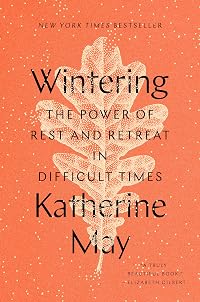
Wintering: The Power of Rest and Retreat in Difficult Times
by Katherine May
On This Page
Description
"An intimate, revelatory book exploring the ways we can care for and repair ourselves when life knocks us down. Sometimes you slip through the cracks: unforeseen circumstances like an abrupt illness, the death of a loved one, a break up, or a job loss can derail a life. These periods of dislocation can be lonely and unexpected. For May, her husband fell ill, her son stopped attending school, and her own medical issues led her to leave a demanding job. Wintering explores how she not only show more endured this painful time, but embraced the singular opportunities it offered. A moving personal narrative shot through with lessons from literature, mythology, and the natural world, May's story offers instruction on the transformative power of rest and retreat. Illumination emerges from many sources: solstice celebrations and dormice hibernation, C.S. Lewis and Sylvia Plath, swimming in icy waters and sailing Arctic seas. Ultimately Wintering invites us to change how we relate to our own fallow times. May models an active acceptance of sadness and finds nourishment in deep retreat, joy in the hushed beauty of winter, and encouragement in understanding life as cyclical, not linear. A secular mystic, May forms a guiding philosophy for transforming the hardships that arise before the ushering in of a new season"-- show lessTags
Recommendations









Member Reviews
I acquired this book because it had good reviews, and because I enjoy personal essays and reflections, especially when they include natural facts and descriptions. Katherine May lives by the seaside in England. She has published essays and journalism. Her wintering began when she quit her job as a writing teacher, and her husband came close to dying from appendicitis. Her second or third grade son could no longer stand being in school, and started home schooling instead. These lead her to depression (she is irritable, has early morning awakening, change in appetite, and fatigue) and to writing about winter, starting in September and arranged in monthly chapters until May. She writes lyrically about the weather, the snow, hibernating, show more organizing her home, baking and teaching her child. She discovers swimming in the sea in winter, with another woman. She worries about money, gives up on a place outside the home for writing, and sleeps a lot. She recalls trips to Trömso, Norway to see the northern lights.
“Seeing them is an uncertain experience, almost an act of faith. You have to get your eye in, and I don’t think I would ever have spotted them at all had I not been told they were there.
There is nothing showy about the northern lights, nothing obvious or demanding. They hide from you at first, and then they whisper to you”
She experiences an ice storm, a common occurrence in Maryland but apparently rare in England. She writes that Eden Phillpotts, an author of A Shadow Passes in 1918, calls in an “ammil”, a corruption of “enamel”. She goes to a voice teacher because she loses her voice, and visits a bee keeper.
She is thinking to attract sympathy for her need for rest and retreat, and the book is certainly beautifully written. However, I note that she is writing the book and collecting quotes for it as she “winters”, and ultimately, the book will pay the bills. As someone who has worked steadily for forty five years as a busy physician, with the longest vacation being 6 weeks, her wintering seems like a tremendous self indulgence. show less
“Seeing them is an uncertain experience, almost an act of faith. You have to get your eye in, and I don’t think I would ever have spotted them at all had I not been told they were there.
There is nothing showy about the northern lights, nothing obvious or demanding. They hide from you at first, and then they whisper to you”
She experiences an ice storm, a common occurrence in Maryland but apparently rare in England. She writes that Eden Phillpotts, an author of A Shadow Passes in 1918, calls in an “ammil”, a corruption of “enamel”. She goes to a voice teacher because she loses her voice, and visits a bee keeper.
She is thinking to attract sympathy for her need for rest and retreat, and the book is certainly beautifully written. However, I note that she is writing the book and collecting quotes for it as she “winters”, and ultimately, the book will pay the bills. As someone who has worked steadily for forty five years as a busy physician, with the longest vacation being 6 weeks, her wintering seems like a tremendous self indulgence. show less
Summary: A memoir exploring the importance of winters in our lives and the importance of the inward turn and care for ourselves in such seasons.
In the autumn of a recent year, in rapid succession, Katherine May’s husband faced a long recovery from a burst appendix. As he recovered, Katherine got sicker with worrisome intestinal symptoms of her own. Meanwhile, her son’s struggles with school became so severe that he refused to attend. With all this, Katherine gave her notice at her teaching job. She realized this was a time of wintering, not only as autumn turned to winter, but a winter of difficulties settled into their lives. Out of this experience, as well as a formative earlier “wintering” experience of depression at show more seventeen, she wrote this book, arguing it is not only our physical world that needs winter but that wintering can be formative in our lives:
“Once we stop wishing it were summer, winter can be a glorious season in which the world takes on a sparse beauty and even the pavements sparkle. It’s a time for reflection and recuperation, for slow replenishments, for putting your house in order” (p. 14).
May’s book was published February of 2020, when many of us were facing the long winter of the COVID pandemic. Her book gave words to the inchoate experience of many trying to understand what had been happening and could happen in their lives during these experiences. The book traverses seven months from September through late March. The struggles leading to this onset of “winter”, the forced rest of her condition, the re-centering of life around home, including cooking to occupy the hands as well as to eat. She realizes the tension she has lived under that may be coming out in her body. She has time for books waiting to have been read. She rediscovers sleep and even the first and second sleeps with an hour or so of wakefulness between, the longer hours of sleep in winter, mimicking the hibernation of other creatures
She also discovers the life of winter. She takes saunas as part of a cruise to Iceland. She delves into the pagan festival of Samhain, at Halloween, this liminal moment between light and darkness, living and dying. With the turn to November, Samhain gives way to Cailleach, the hag deity who freezes the ground until Brighde takes over in spring. In all this she becomes newly aware of life’s cyclical character–the dropping of leaves and the buds already present for the new year. She celebrates Saint Lucy and the lighting of candles in a Swedish church. She rises early to watch the winter solstice sun rise at Stonehenge and considers the earthward religion Christianity replaced and develops both practices religious and secular to mark a pagan counterpart to Christmastide. January takes them to Norway and the northern lights. She considers the significance of wolves in nature and literature, including Lewis’s Narnia Chronicles. She describes the powerful effect of swimming in cold water with friends, even for three minutes. And as spring emerges she draws lessons from observing the merger of two colonies of bees in a hive when the queen of one is dying. She describes the re-emergence of her lost voice and her ability to sing once more under the care of a voice teacher. She speaks of how wrong it is to tie singing to talent:
“The right to sing is an absolute, regardless o how it sounds to the outside world. We sing because we must. We sing because it fills our lungs with nourishing air, and lets our hearts sour with the notes we let out” (p. 228).
May faced the onslaught of winter. Her encouragement is not to evade winter but learn from it. Take time to query our unhappiness. Slow down to take care of oneself with sleep and food and fresh air. Learn from winter in the world about us. Discover the richness in winter.
There is much of beauty in this book. I also found it a striking reflection of a turn from Christian faith while retaining its language of retreat and rest. The author recognizes what Christian spiritual directors have long known of how the liminal space of spiritual winters refine and renew, a knowledge I find many Christians trying to evade. I cannot commend the turn to pagan gods and rituals but the recognition of seasons and the importance of the practices that remind us of the story in which we live is worth reflection. For those who come across this book post-pandemic, it may offer language to reflect upon that winter in our lives. Winter comes to all of us, for many of us multiple times. Will we be spiritual “snowbirds” who flee it or will we lean into its lessons, bundle up, and grow resilient? show less
In the autumn of a recent year, in rapid succession, Katherine May’s husband faced a long recovery from a burst appendix. As he recovered, Katherine got sicker with worrisome intestinal symptoms of her own. Meanwhile, her son’s struggles with school became so severe that he refused to attend. With all this, Katherine gave her notice at her teaching job. She realized this was a time of wintering, not only as autumn turned to winter, but a winter of difficulties settled into their lives. Out of this experience, as well as a formative earlier “wintering” experience of depression at show more seventeen, she wrote this book, arguing it is not only our physical world that needs winter but that wintering can be formative in our lives:
“Once we stop wishing it were summer, winter can be a glorious season in which the world takes on a sparse beauty and even the pavements sparkle. It’s a time for reflection and recuperation, for slow replenishments, for putting your house in order” (p. 14).
May’s book was published February of 2020, when many of us were facing the long winter of the COVID pandemic. Her book gave words to the inchoate experience of many trying to understand what had been happening and could happen in their lives during these experiences. The book traverses seven months from September through late March. The struggles leading to this onset of “winter”, the forced rest of her condition, the re-centering of life around home, including cooking to occupy the hands as well as to eat. She realizes the tension she has lived under that may be coming out in her body. She has time for books waiting to have been read. She rediscovers sleep and even the first and second sleeps with an hour or so of wakefulness between, the longer hours of sleep in winter, mimicking the hibernation of other creatures
She also discovers the life of winter. She takes saunas as part of a cruise to Iceland. She delves into the pagan festival of Samhain, at Halloween, this liminal moment between light and darkness, living and dying. With the turn to November, Samhain gives way to Cailleach, the hag deity who freezes the ground until Brighde takes over in spring. In all this she becomes newly aware of life’s cyclical character–the dropping of leaves and the buds already present for the new year. She celebrates Saint Lucy and the lighting of candles in a Swedish church. She rises early to watch the winter solstice sun rise at Stonehenge and considers the earthward religion Christianity replaced and develops both practices religious and secular to mark a pagan counterpart to Christmastide. January takes them to Norway and the northern lights. She considers the significance of wolves in nature and literature, including Lewis’s Narnia Chronicles. She describes the powerful effect of swimming in cold water with friends, even for three minutes. And as spring emerges she draws lessons from observing the merger of two colonies of bees in a hive when the queen of one is dying. She describes the re-emergence of her lost voice and her ability to sing once more under the care of a voice teacher. She speaks of how wrong it is to tie singing to talent:
“The right to sing is an absolute, regardless o how it sounds to the outside world. We sing because we must. We sing because it fills our lungs with nourishing air, and lets our hearts sour with the notes we let out” (p. 228).
May faced the onslaught of winter. Her encouragement is not to evade winter but learn from it. Take time to query our unhappiness. Slow down to take care of oneself with sleep and food and fresh air. Learn from winter in the world about us. Discover the richness in winter.
There is much of beauty in this book. I also found it a striking reflection of a turn from Christian faith while retaining its language of retreat and rest. The author recognizes what Christian spiritual directors have long known of how the liminal space of spiritual winters refine and renew, a knowledge I find many Christians trying to evade. I cannot commend the turn to pagan gods and rituals but the recognition of seasons and the importance of the practices that remind us of the story in which we live is worth reflection. For those who come across this book post-pandemic, it may offer language to reflect upon that winter in our lives. Winter comes to all of us, for many of us multiple times. Will we be spiritual “snowbirds” who flee it or will we lean into its lessons, bundle up, and grow resilient? show less
I had such high hopes for this book. I wanted to love it. From the moment a client recommended it to me, I thought it sounded right up my alley. And to be fair, had I read it last year, I think I would have rated it much higher. At that time, with the pandemic still reasonably new, I was riding an anxiety and depression roller-coaster. I was deep in my own winter, and it would have been helpful to hear someone else's experiences.
However, I read this book in the late spring of 2021, and while we're still in lockdown, I feel like I'm emerging into my own spring. That could be why I found May's story incredibly self-pitying and downright annoying. I was put off from the first anecdote where she recounted the way her 40th birthday party was show more RUINED by her husband's burst appendix. (I mean, how dare he suffer a medical emergency?! So insensitive.) The fact that she didn't believe he was in any "real" pain until a friend pointed it out to her made me cringe. Things didn't improve from there. Throughout the book, I felt very little empathy for the author's struggles. She came across as whiny and privileged. Very few of the things she talked about held any emotional resonance for me.
I do think a big part of my response to this book is an issue of, "It's not you, it's me." I have no doubt this book landed in many readers' laps just when they needed it the most. I, however, am in a phase of my life where I crave a book about spring and summer, about joy and connection, about bliss and peace and ease and calm. Or at the very least, a relatable book about depression and hardship. This wasn't it. show less
However, I read this book in the late spring of 2021, and while we're still in lockdown, I feel like I'm emerging into my own spring. That could be why I found May's story incredibly self-pitying and downright annoying. I was put off from the first anecdote where she recounted the way her 40th birthday party was show more RUINED by her husband's burst appendix. (I mean, how dare he suffer a medical emergency?! So insensitive.) The fact that she didn't believe he was in any "real" pain until a friend pointed it out to her made me cringe. Things didn't improve from there. Throughout the book, I felt very little empathy for the author's struggles. She came across as whiny and privileged. Very few of the things she talked about held any emotional resonance for me.
I do think a big part of my response to this book is an issue of, "It's not you, it's me." I have no doubt this book landed in many readers' laps just when they needed it the most. I, however, am in a phase of my life where I crave a book about spring and summer, about joy and connection, about bliss and peace and ease and calm. Or at the very least, a relatable book about depression and hardship. This wasn't it. show less
A lyrical, kind, insightful book on taking a step back to re-group. But it's more than that - it shows the path that Katherine May took when she had to stop her own life in the face of illness. The biggest strength is her way of giving validation to those times in our lives when we, too, are faced with the challenges life throws at us, and the rightness of retreating from the world to emerge whole on the other side. Her observations of her native English seaside and towns add a grounding to this slim volume.
She speaks with a friend from Finland, who talks about the steps the Finns have to take each year to prepare for the winter. Because it always comes. She speaks with a Druid and joins a group celebrating the Midwinter sunrise at show more Stonehenge. She discusses dormice, those quintessential English sleepers who spend so much time fattening up before slipping into their annual hibernation.
I found myself taking heart from her examples and the underlying message: winter will always come around again. The challenge is how we prepare for and nurture ourselves during those times. show less
She speaks with a friend from Finland, who talks about the steps the Finns have to take each year to prepare for the winter. Because it always comes. She speaks with a Druid and joins a group celebrating the Midwinter sunrise at show more Stonehenge. She discusses dormice, those quintessential English sleepers who spend so much time fattening up before slipping into their annual hibernation.
I found myself taking heart from her examples and the underlying message: winter will always come around again. The challenge is how we prepare for and nurture ourselves during those times. show less
It looks like I'm going to have to create a little section in my book collection and add Wintering by Katherine May to sit between Patricia Hampl's The Art of the Wasted Day and Jenny Odell's How to Do Nothing. All those books on productivity I've collected over the years, and yet now I need a section on how not to be productive and how to just be, to settle in, and observe the nature around you.
I think I'll call it my Hygge section to borrow the Danish and Norwegian term.
Really, this is the perfect book to read as we head into a hard winter and a second wave of the pandemic. Katherine May has written a wonderful little treatise about how to draw healing power from the winters in our lives. And this certainly is a winter we are in. I show more certainly had a sense of Hygge reading it. Here is just one of several paragraphs I enjoyed, this one on books and reading:
"In the high summer, we want to be outside and active; in winter, we are called inside, and here we attend to all the detritus of the summer months, when we were too busy to take the necessary care. Winter is when I reorganize my bookshelves, and when I read all the books that I acquired in the previous year and failed to actually read; it is also the time when I re-read beloved novels, just for the pleasure of reacquainting myself with old friends. In summer I want big, splashy ideas and trashy novels, devoured in a garden chair, or perched on one of the wave-breaks on the beach. In winter I want concepts to chew over in a pool of lamplight; slow, spiritual reading; a re-enforcement of the soul. Winter is a time for libraries: the muffled quiet of book-stacks and the scent of old pages and dust. In winter, I can spend hours in silent pursuit of a half-understood concept, or a detail of history. Ther is nowhere else to be, after all." -Katherine May, Wintering
Now to convince my book club this is the book they need. Which probably won't be that hard! show less
I think I'll call it my Hygge section to borrow the Danish and Norwegian term.
Really, this is the perfect book to read as we head into a hard winter and a second wave of the pandemic. Katherine May has written a wonderful little treatise about how to draw healing power from the winters in our lives. And this certainly is a winter we are in. I show more certainly had a sense of Hygge reading it. Here is just one of several paragraphs I enjoyed, this one on books and reading:
"In the high summer, we want to be outside and active; in winter, we are called inside, and here we attend to all the detritus of the summer months, when we were too busy to take the necessary care. Winter is when I reorganize my bookshelves, and when I read all the books that I acquired in the previous year and failed to actually read; it is also the time when I re-read beloved novels, just for the pleasure of reacquainting myself with old friends. In summer I want big, splashy ideas and trashy novels, devoured in a garden chair, or perched on one of the wave-breaks on the beach. In winter I want concepts to chew over in a pool of lamplight; slow, spiritual reading; a re-enforcement of the soul. Winter is a time for libraries: the muffled quiet of book-stacks and the scent of old pages and dust. In winter, I can spend hours in silent pursuit of a half-understood concept, or a detail of history. Ther is nowhere else to be, after all." -Katherine May, Wintering
Now to convince my book club this is the book they need. Which probably won't be that hard! show less
[b:Wintering: The Power of Rest and Retreat in Difficult Times|52623750|Wintering The Power of Rest and Retreat in Difficult Times|Katherine May|https://i.gr-assets.com/images/S/compressed.photo.goodreads.com/books/1585165814l/52623750._SY75_.jpg|70486056] is not my usual fare according to its categorization as new age/self-improvement but the writing was skillful and lovely enough to disregard preconceptions. And as a summer person I balked at snow and ice, the frigid settings of Iceland and the Arctic but thoroughly enjoyed meeting the Sami and their reindeer, the adaptable hard-working Finns and the Polar Bear Clubbers. The story of her husband's burst appendix resonated with personal experience (my husband's appendix burst on a show more camping trip) and her exploration of her own illness, pulling her unhappy child our of school and the captivating incident of losing and regaining her voice held my attention. Wolves, bees as one organism, friendly robins and kids books carried me along with the narrator. The best quote: "They say that we should dance like no one is watching. I think that applies to reading, too" which she says of her familiar loose, exploratory reading during nights of insomnia, "a chapter here, a segment there." And best of all, February 1st marks the Gaelic festival of Imbolc or St. Brigid's Day when we dust away our cobwebs to welcome spring hovering just over there. My snowbells are up, the tulips leaves visible. show less
I have no idea who steered me to this book but whoever it was I am sending you a BIG thank you! It reminded me of so many wonderful books I have read such as Sarah Moss's book on Iceland or H is for Hawk by Helen Macdonald. In this book she looks from the lens of her own life to change and the critical part and insight that winter (or possibly depression) gives to making those critical and important changes. She has lots of personal observations such a becoming a mother, the challenge of career that is not working well, the wonder of very cold ocean swimming, the concerns for children when things are not going well for them, the replenishment for us of nature and much more. This book could be re-read many times with different sections show more taking honour. I liked this quiet book! show less
Members
- Recently Added By
Published Reviews
This timely memoir details seven months that the author, suffering from a mysterious illness, spent sequestered at home. For May, who saw life as “linear, a long march from birth to death,” the enforced hiatus comes to feel like nonexistence. Yet it inspires unusual investigations—into hibernating animals, deciduous trees, the cultures of places with long winters, and the ritual pauses show more that once shaped human society. May’s message isn’t about how to be cheery during a personal winter but about how to embrace the “negative presence” of these moments, and to allow the rebirth they naturally engender. “We have seasons when we flourish and seasons when the leaves fall from us,” she writes. “Given time, they grow again.” show less
added by shervinafshar
Lists

Indie Next Picks
196 works; 4 members

Books Read in 2023
5,638 works; 147 members

Psychology: Abuse, Grief, Self-Help
189 works; 1 member

Lending Library
4 works; 1 member

Healing resources for women
588 works; 1 member
Author Information

6+ Works 2,301 Members
Some Editions
Awards and Honors
Distinctions
The Guardian Book of the Day (2020-02-04)
Common Knowledge
- Original publication date
- 2020-11-10
- Epigraph
- Over the land freckled with snow half-thawed
The speculating rooks at their nests cawed
And saw from elm-tops, delicate as flowers of grass,
What we below could not see, Winter pass.
Edward Thomas,... (show all) "Thaw" - Dedication
- For all who have wintered
- First words
- Some winters happen in the sun.
- Quotations
- Everybody winters at one time or another; some winter over and over again.
Wintering is a season in the cold. It is a fallow period in life when you're cut off from the world, feeling rejected, sidelined, blocked from prog... (show all)ress, or cast into the role of an outsider. - Last words
- (Click to show. Warning: May contain spoilers.)We let our voices fill the air.
- Blurbers
- Gilbert, Elizabeth; McInerny, Nora; Jones, Lucy; Hazard, Leah; Maiklem, Laura
- Original language*
- Englisch
*Some information comes from Common Knowledge in other languages. Click "Edit" for more information.
Classifications
Statistics
- Members
- 1,634
- Popularity
- 13,855
- Reviews
- 58
- Rating
- (3.69)
- Languages
- 8 — Dutch, English, German, Italian, Korean, Portuguese, Spanish, Swedish
- Media
- Paper, Audiobook, Ebook
- ISBNs
- 26
- ASINs
- 9